


Hugging Face has introduced @huggingface/kernels, a JavaScript library and Hub-based collection designed to improve local artificial intelligence inference in WebGPU-enabled browsers. Announced on September 1, 2026, the release starts with 207 WebGPU kernels published as individual, versioned repositories. The project targets a low-level problem that is easy to overlook: a browser AI model can be available locally, but still feel slow if the GPU operations underneath it are poorly optimized.
The announcement matters because it gives developers reusable building blocks for browser inference rather than another standalone chatbot demo. Hugging Face says each kernel includes an interface contract, shader templates, correctness tests, benchmark cases, and usage instructions. The initial collection is published under the Apache-2.0 license, according to the companyâs release post.
For businesses exploring generative AI development, this creates a more practical route to private, lightweight features inside web applications. A browser-based assistant, document classifier, image tool, or data-entry helper may be able to process some workloads on a userâs device instead of sending every input to a remote inference API. That does not eliminate cloud AI, but it expands the design choices available to product teams.
What Hugging Face actually released
A kernel is a small GPU operation used by a larger machine-learning model. Common examples include matrix multiplication, normalization, attention-related calculations, convolutions, data conversion, and activation functions. A model runtime breaks inference into these operations and dispatches them to the available hardware.
Hugging Faceâs JavaScript loader connects an application to a kernel repository on the Hub. Developers can request a kernel by repository ID and contract version, then pass typed data and tensor shapes. In the companyâs example, an addition kernel receives two arrays, applies broadcasting, and returns an output whose shape and logical data type are derived from the contract.
The small example is not intended to represent a complete AI workload. Its value is architectural. A published contract tells developers what an operation accepts and returns, while the accompanying tests and benchmarks make the implementation easier to inspect and compare. The shader itself is written using WGSL, the shading language used with WebGPU.
Why WebGPU kernels are difficult to optimize
WebGPU offers a portable way for modern browsers to access compatible GPU compute capabilities, but portability does not guarantee identical performance. The best workgroup size, memory layout, vectorization strategy, data type, or fusion approach can vary by GPU, browser, operating system, input shape, and driver.
Two shaders can produce the same numerical result while taking very different amounts of time. A general-purpose implementation may work adequately across many devices but lose badly on a particular shape. A specialized implementation can be faster, yet it must be tested carefully to avoid incorrect outputs or excessive device-specific assumptions.
The new Hub format treats a kernel as a complete software artifact rather than an isolated shader file. Metadata records identity and provenance. Test files hold correctness cases. Benchmark files describe workloads used for tuning. Parameterized WGSL templates can then generate an implementation for a particular request and device.
This structure could help higher-level runtimes improve independently from model libraries. It also gives developers reference implementations for custom browser AI projects. Hugging Face describes the release as a foundation for its broader WebAI stack, including future connections to higher-level model tooling.
Teams planning a responsive website development project should view the release as an enabling layer, not a complete application framework. Model format, download size, caching, user consent, fallback behavior, and interface design still determine whether local inference feels useful.
Hugging Face Kernels Bring Faster WebGPU Local AI to Browsers - Techno Particles
How much faster are the kernels?
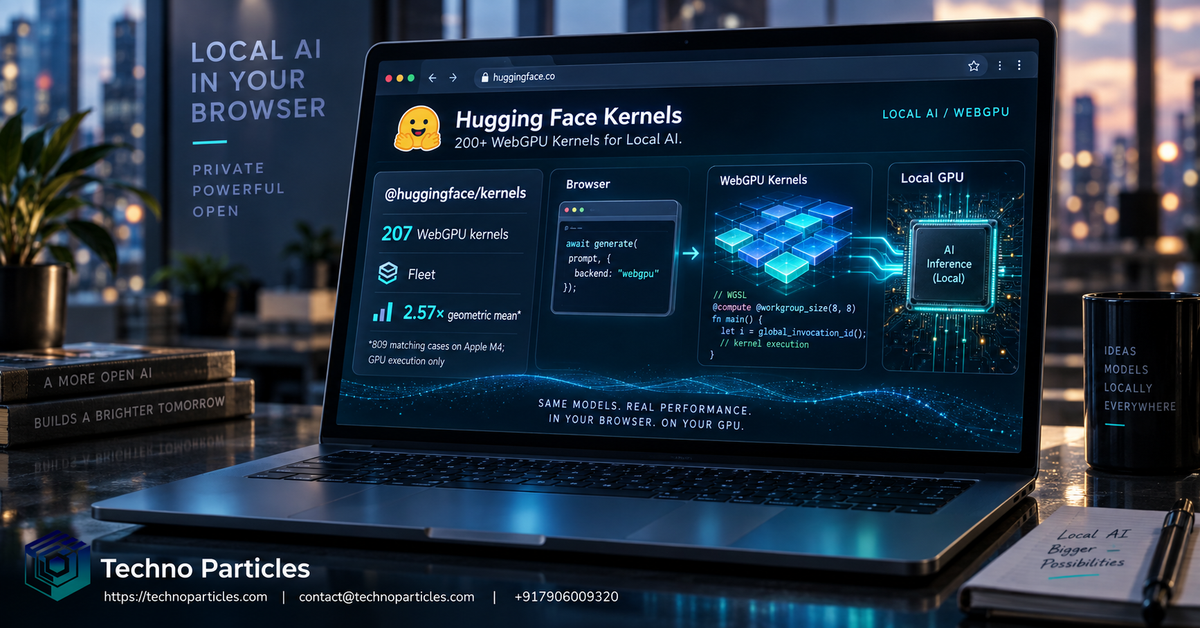
Hugging Face compared its collection with ONNX Runtime WebGPU on an Apple M4 GPU. The company began with 1,756 test cases across the 207 operations and retained 809 cases where both implementations produced matching outputs and reliable timings. In that comparison, Hugging Face reported a 2.57-times speedup by geometric mean and a 1.90-times speedup at the median, with 629 wins, 176 losses, and four ties.
The result is useful evidence, but it needs careful interpretation. The benchmark measured GPU execution for individual operations. It excluded setup work such as downloading kernels, creating sessions, uploading inputs, compiling shaders, and reading outputs back to the application. It therefore should not be treated as a promise that a complete browser application will run 2.57 times faster.
Hugging Face reported especially strong results for some operations. In the published table, Add, MatMul, Softmax, and LayerNormalization all showed lower measured GPU times for the companyâs kernels in the tested cases. The release also describes an unusual Einsum case that was more than 10,000 times faster and a row-wise CumSum case that was 301 times faster. Those are specialized examples, not expected everyday results.
For an end user, total responsiveness includes more than kernel execution. A large model may spend time downloading weights, allocating memory, compiling shaders, tokenizing text, moving data between CPU and GPU, and rendering the interface. A tiny operation may finish so quickly that browser and GPU transfer overhead dominate the result.
The fair conclusion is that optimized kernels can remove serious low-level bottlenecks, while application developers must benchmark the complete pipeline on the hardware they intend to support. Hugging Face itself notes that exact performance changes across GPUs and browsers. The comparison is an encouraging technical signal, not a universal performance guarantee.
Fleet adds real-device testing
Alongside the kernel library, Hugging Face introduced Fleet, a browser-based GPU benchmarking and testing suite. Fleet runs kernels on a participantâs hardware and records performance and correctness evidence. With user consent, contributed runs can help identify incorrect results, slow paths, and better kernel variants across devices that a conventional test laboratory could not cover.
This crowdsourced approach addresses one of WebGPUâs central challenges: the browser API is portable, but the hardware landscape is highly varied. A kernel that behaves well on an Apple M4 may not have the same profile on an integrated Windows GPU, an Android device, or a laptop using a different browser driver. More device evidence can help maintainers choose safer defaults and target optimizations where they matter most.
Fleet also changes how browser AI performance can be discussed. Instead of relying only on a polished demo or one laboratory machine, developers can gather observations from real-world configurations. That is valuable for product decisions, although any benchmark remains dependent on the test workload, browser version, thermal conditions, background applications, and user privacy choices.
What developers can build with it
The immediate audience is JavaScript and WebGPU developers building local inference features. A web application could use optimized operations as part of an ONNX-based pipeline or another browser-compatible runtime. Possible use cases include private text summarization, local search embeddings, image preprocessing, speech-related operations, document classification, and AI-assisted form workflows.
Local execution can reduce recurring server inference costs and may improve privacy for sensitive inputs. It can also support useful functionality during periods of weak connectivity after required models and assets have been cached. However, the approach shifts responsibility toward the browser: developers need clear support detection, model-size expectations, memory safeguards, progress indicators, and a reliable remote or CPU fallback.
Companies building a custom application development solution should begin with a narrow workload. Measure startup time, first-result latency, sustained throughput, memory consumption, and battery impact. Then compare local WebGPU execution with a server API and a CPU path. The best choice may differ between an internal enterprise tool, an e-commerce feature, and a consumer-facing mobile website.
There is also an ecosystem benefit. Because kernels are individually versioned and discoverable on the Hub, improvements can be shared without every team maintaining a private collection of browser shaders. The stable contract is particularly important when a runtime needs to select different implementations for different shapes or devices.
Important limits behind the release
The Hugging Face Kernels release does not mean every browser can run every AI model locally. The package requires a browser with WebGPU support, and availability depends on the browser, operating system, GPU, and driver. A simple JavaScript check such as "gpu" in navigator can indicate whether the API is exposed, but it does not prove that a particular model will fit in memory or perform well.
Model size remains a practical constraint. A browser may download large weight files before inference starts, and a device may have limited graphics memory. Quantization can reduce storage and bandwidth requirements, but it may affect quality, supported operations, or implementation complexity. Developers must also account for caching rules, model licensing, cross-origin configuration, and the possibility that a user clears local storage.
Correctness is another concern. GPU arithmetic, precision choices, shader variants, and driver behavior can create differences that are harmless in one workload but important in another. The releaseâs inclusion of correctness cases is therefore significant, but application teams should still validate outputs for their own models and acceptance criteria.
Security and privacy need equally careful treatment. Local inference can keep user inputs on the device during computation, but a website may still download code, models, analytics tools, or remote content. Teams should explain what leaves the browser, what is stored locally, and when a cloud fallback is activated. Privacy is an architectural property, not an automatic consequence of using WebGPU.
Why the announcement matters for businesses
For startups and Indian SMEs, browser-based AI could make selected features easier to deploy across websites and lightweight applications. A retailer might add local product-image processing. An education platform could experiment with on-device exercises or text assistance. A field-sales tool could offer limited offline classification when connectivity is unreliable. These examples remain product possibilities, not capabilities guaranteed by the release.
The technology is most compelling when the workload is small enough for a user device, sensitive enough to benefit from local processing, and frequent enough that server costs or latency matter. It is less suitable when a model requires substantial memory, centralized data, heavy multi-user orchestration, or strict consistency across every device.
Product teams should involve engineering, UX, security, and SEO planning early. A local feature still needs accessible controls, understandable loading states, mobile testing, and crawlable page content around it. A UI/UX design process can help users understand whether processing is local, remote, or unavailable.
For organizations combining AI with lead workflows, a practical architecture might use local inference for classification or drafting and a secure backend for approved records, analytics, and workflow actions. A CMS implementation or SEO strategy can then expose the feature to customers without making the technology itself the only selling point.
The practical takeaway
Hugging Face Kernels is an important infrastructure release because it focuses attention on the operations beneath browser AI. The 207-kernel starting collection, JavaScript loader, versioned contracts, bundled tests, and Fleet benchmarking suite create a more organized foundation for local inference with WebGPU.
The companyâs benchmark suggests that specialized implementations can outperform a general WebGPU path in meaningful cases.



Leave a comment