

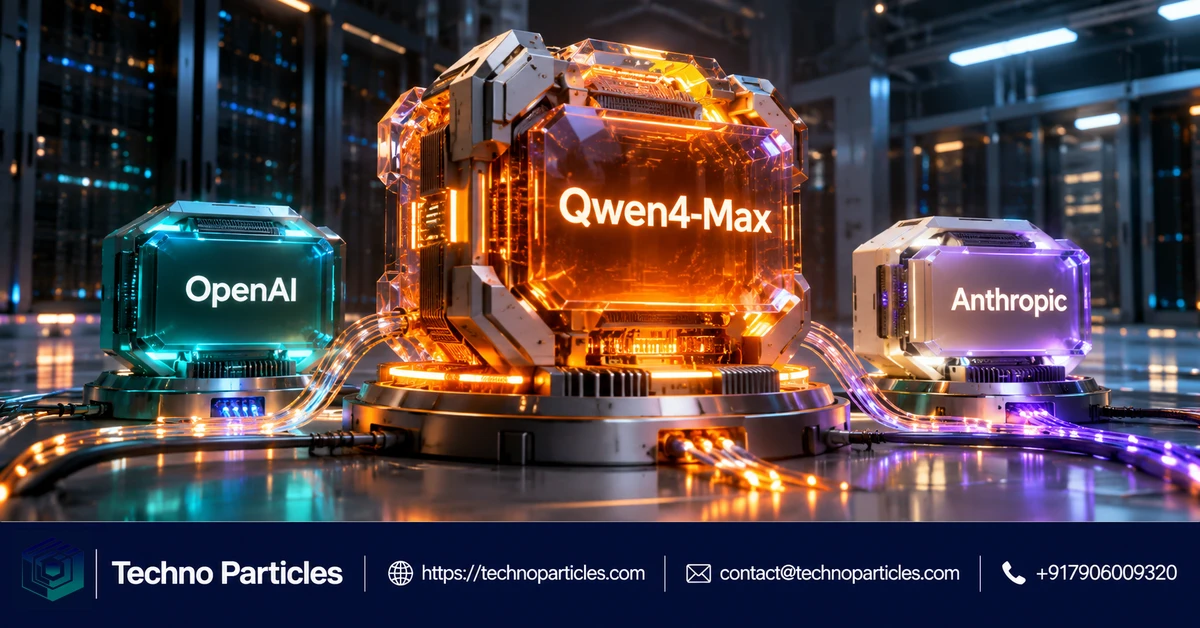
Alibaba’s new flagship AI model vs OpenAI and Anthropic is a comparison shaped as much by access as by specifications. Alibaba Cloud’s Qwen4-Max-Preview enters a field that includes OpenAI’s GPT-6 Astra and Anthropic’s Claude Opus 5.5, with all three vendors describing models suited to demanding reasoning tasks.
For teams considering generative AI development, the immediate question is how a temporary preview fits alongside established API offerings. The figures below summarize each provider’s published specifications; they do not establish which model performs best.
| Model | Published context window | Published access or positioning |
|---|---|---|
| Qwen4-Max-Preview | 1 million tokens | Preview through Alibaba Cloud Token Plan |
| GPT-6 Astra | 1.05 million tokens | OpenAI flagship for complex reasoning and coding |
| Claude Opus 5.5 | 1 million tokens | Available through Claude, its API platform and listed cloud partners |
Alibaba’s new flagship AI model vs OpenAI and Anthropic: what changed
Alibaba Cloud’s Token Plan update, published November 13, 2026, records Qwen4-Max-Preview’s availability from November 11. Its model documentation, updated November 16, calls it the Qwen family’s next-generation flagship multimodal model. This is a preview, not a general-availability release.
Anthropic dates its Claude Opus 5.5 announcement to September 22, 2026, and describes the model as its strongest Opus offering. Meanwhile, OpenAI’s model catalog identifies GPT-6 Astra as its flagship for complex reasoning and coding.
These are the vendors’ own descriptions and specifications. They provide a starting point for comparing products, but flagship labels alone do not demonstrate how the models perform against one another on a particular task.
How the three flagship models differ technically
Alibaba describes Qwen4-Max-Preview as a model that can work with text, images and video. Its documented features include function calling, web search, built-in tools and structured outputs. It also supports interfaces compatible with OpenAI Chat Completions and Responses, as well as Anthropic Messages. That compatibility gives developers options for connecting an application, although it does not by itself establish identical behavior across providers.
Qwen enables thinking by default and offers low, medium and xhigh reasoning settings. Developers can use those settings to vary how much reasoning a request receives. The model’s maximum output is 393,216 tokens, shared between its thinking and final answer: a longer reasoning process therefore leaves less of that output budget for the response shown to the user.
A context window and an output limit serve different purposes. The context window describes how much material a model can process within a request, while the output limit constrains what it generates. A large context window can accommodate substantial source material, but it does not mean the model can return an equally long answer in one response.
OpenAI’s model catalog lists functions, web search, file search and computer use for GPT-6 Astra, with a maximum output of 128K tokens. These tools offer different integration choices: file search supports applications working with stored material, while computer use is relevant to workflows that interact with interfaces.
For teams planning application development, the interface choice affects how requests and tool results move through the product. A compatibility layer can make an existing integration a useful starting point, but developers still need to account for each provider’s supported tools and response behavior when designing the application.
Access, pricing, and preview limits
Qwen4-Max-Preview requires Alibaba Cloud Token Plan access; pay-as-you-go access is not supported. Its preview runs from November 11, 2026, at 10:00 UTC+8 through November 25, 2026, at 24:00 UTC+8, after which the model is scheduled for retirement. Teams considering a deployment should account for that end date when deciding how much integration work to commit.
Alibaba’s Token Plan update says preview credit consumption can be as low as 20% of the standard rate, with an additional 60% discount from 22:00 to 08:00 UTC+8. Those figures describe promotional credit consumption, not a standard currency price per million tokens. A direct cost comparison therefore requires translating the relevant plan and usage pattern into an actual expense.
OpenAI lists GPT-6 Astra at $10 per million input tokens and $50 per million output tokens. Anthropic lists Claude Opus 5.5 at $4 per million input tokens and $20 per million output tokens, plus $0.20 per million tokens for cache reads. Anthropic’s Opus page also lists access through Claude plans, the Claude Platform, Amazon Web Services, Google Cloud and Microsoft Foundry.
The input and output rates are separate: a workload that produces long responses can have a different cost profile from one that mainly sends source material to the model. The listed rates put Opus 5.5 below GPT-6 Astra for both ordinary input and output tokens, but those figures alone do not establish the total cost of an application.
For a team weighing an existing system against a custom build, project consultation can help frame access and operating costs alongside the intended workflow. The choice of access channel also matters operationally because billing and deployment arrangements may differ across providers.
What the available evidence actually proves
The published specifications establish what each provider says its product supports; they do not establish how reliably a model will complete a particular business task. A tool listed in a catalog, for example, describes an available integration rather than the accuracy of every decision an application makes when using it.
Anthropic publishes performance claims for Claude Opus 5.5, but those are vendor-reported results. No independently verified, like-for-like evaluation covering all three models is available in the evidence considered here. That leaves no sound basis for declaring an overall winner.
Benchmark conditions matter because a score reflects more than the model name. Results can change with the instructions given to the model, the tools it can use, its reasoning settings, safeguards and the software that runs the evaluation. Two published scores are not necessarily comparable unless those conditions and the tasks are aligned.
Even a controlled comparison needs an outcome suited to the intended work. For a document assistant, that might mean whether an answer is supported by the supplied material; for a coding workflow, whether the resulting change satisfies the stated requirements. A high score on an unrelated benchmark cannot settle either question on its own.
Reported costs also need context. Alibaba’s Token Plan update describes promotional credit consumption, so a credit figure alone cannot demonstrate that one model is cheaper for a completed task. A meaningful comparison would account for the resources consumed across the same workload and the quality of the resulting output.
Teams exploring generative AI services can use this distinction when assessing a proposed application: ask which statements describe documented product features and which depend on measured performance in the actual workflow. That separation makes vendor evidence useful without treating marketing claims as independent verification.
Which model fits which workload
For a multimodal prototype, Qwen4-Max-Preview is a candidate when the task combines written instructions with images or video. A team building an interface for reviewing visual material could explore that input combination before committing to a broader design. Alibaba also documents compatibility with OpenAI and Anthropic API formats, which can help teams assess how the model would fit an existing application. Its temporary preview status makes a replaceable integration a sensible priority. See the Qwen model documentation for its supported interfaces.
GPT-6 Astra is a candidate for a coding agent or a long-document workflow that needs to combine reasoning with tools. For example, an agent that must inspect stored material and interact with a software interface can be designed around the file-search and computer-use options in OpenAI’s model catalog. The relevant choice is whether those tools fit the application’s actual workflow, rather than whether the catalog contains the longest list.
Claude Opus 5.5 is worth considering when an organization’s deployment path is a decisive requirement. Anthropic lists several cloud platforms alongside its own services, giving teams a starting point for checking whether their preferred environment is supported. A cost-sensitive production team can also weigh its listed rates against the expected mix of input and output, while accounting for the wider application’s operating costs.
These workload choices affect application design as well as model selection. A product that must switch providers needs a clear boundary between its own business logic and provider-specific requests, responses and tool handling. That boundary is especially useful for a prototype whose model access is temporary. Teams planning an integration can use an application development service to consider those interfaces alongside the product’s existing requirements.
The decision rule for choosing among them
For Alibaba’s new flagship AI model vs OpenAI and Anthropic, choose the model whose access route, tool compatibility, output needs and evaluation results match the intended production workload; choose Qwen4-Max-Preview only if its preview status is acceptable. Next, run a controlled pilot on representative, non-sensitive tasks before committing.


Leave a comment
Your email stays private. You can see your comment immediately on this browser. Others see it after approval.