

Apple and OpenEvidence have introduced an iPhone app for a U.S. study into how people use and understand AI-generated health information. Announced by Apple on November 15, 2026, the Apple OpenEvidence AI health study app lets eligible participants ask health questions and receive responses linked to clinical sources.
The project’s central question is how people interact with health AI in everyday life. Apple says the study will examine trust, comprehension, response quality, and engagement, offering a closer look at how participants use conversational answers when considering health information.
| Study feature | What Apple or the App Store says |
|---|---|
| Purpose | Research into people’s use and understanding of health AI |
| Responses | Health answers with links to peer-reviewed clinical sources |
| Personal context | Participants can choose whether to share selected HealthKit data |
| Access and price | Free iPhone app for a U.S. study with eligibility requirements |
What Apple and OpenEvidence announced
In its November 15 announcement, Apple described the Apple Health AI Usage Study as a virtual research project developed with OpenEvidence. Participants can use the app to explore everyday health questions and prepare for conversations with healthcare professionals. The study is intended to help researchers understand how people interpret and engage with the answers they receive.
The study’s research goal
Trust and comprehension are distinct questions: a participant may find an answer persuasive without understanding it fully. Studying both can help researchers investigate how people interpret conversational health information in practice. For readers interested in how such interfaces fit into broader workflows, this overview of generative AI services describes related application areas.
Why the app is not an Apple doctor
The App Store listing describes the app as part of a research study and says it is not intended to diagnose or treat conditions or replace professional medical advice. Its value is informational: it can help users frame questions for a clinician, who can assess their individual circumstances.
How the Apple OpenEvidence AI health study app works
Participants can begin with an everyday health question and receive an explanation with links to peer-reviewed clinical sources. Those links give readers a way to inspect the material behind an answer: a citation can lead to the underlying research, where its subject and findings may provide useful context. Apple’s study announcement describes this combination of conversational answers and clinical references as part of the participant experience.
Questions, citations, and personal context
A participant can also choose whether to share selected HealthKit information. Apple identifies resting heart rate, activity, sleep, and lab results as examples of data that can provide context for a question. The personalization available in an answer depends on the information the participant chooses to share.
For example, someone asking about an exercise routine could use the conversation to understand how an activity measure relates to the question. They could then open a cited source to see what the supporting research actually addresses. The useful distinction is between the app’s explanation and the clinical material linked from it: one interprets information for the reader, while the other supplies evidence to examine.
From an answer to a practical plan
The App Store description also lists personalized exercise and meal plans among the app’s potential uses. A participant interested in a meal plan, for instance, can use the conversational format to explore an everyday question and follow the references attached to the response.
This experience brings together a mobile interface, a conversational response, linked sources, and an optional connection to health data. Each part has a different role: the interface presents the conversation, the links let a reader explore evidence, and selected HealthKit information can supply context. For readers curious about how mobile applications connect interfaces with other systems, the application development service page describes related development work.

Who can join, what it costs, and what remains limited
Apple describes the study as open to eligible people in the United States who are at least 21 years old. It plans to enroll up to 200,000 participants. The app is free, but downloading it and qualifying for the study are separate matters: the App Store’s 18+ age rating does not change the study’s higher minimum age.
Eligibility and device requirements
Participants need an Apple Intelligence-enabled iPhone 15 Pro or later running iOS 26 or later. The App Store lists the app for iPhone and identifies English as its language. Someone considering participation should therefore check both their device compatibility and the study’s age and location rules.
The capacity figure is a study-wide enrollment limit, not a promise that every eligible person will receive a place. Eligibility establishes who can apply under Apple’s stated rules; it does not establish an individual’s enrollment status.
What the free listing does and does not settle
The free price describes the app’s listed cost. It does not establish a per-user question quota, compensation policy, study end date, or availability outside the United States. Readers should check the enrollment materials for any terms that matter to their decision before taking part.
For organizations considering a separate health-related digital project, the project consultation page describes support for defining requirements and scope. The Apple study’s eligibility rules apply to its own participants, rather than to other health applications.
Privacy, HealthKit permissions, and trust decisions
Before joining, read the study consent materials and consider which health information you are comfortable sharing. A question about a symptom can itself reveal sensitive information, even if you choose not to provide any HealthKit measurements. Consent and permissions are therefore separate decisions: one concerns participation in the study, while the other governs access to particular data.
What participants control
Apple’s study announcement says participants can choose whether to share HealthKit metrics and survey responses, and that study data will not be used to train AI models. That is Apple’s statement about model training; it should not be read as a complete description of every way information may be handled during the study.
For example, a person who wants an explanation of a general health topic may decide that the question does not require sharing a personal measurement. Someone seeking context about their own activity may make a different choice. The relevant permission is tied to the information the participant wants the app to use.
What the privacy label shows
The App Store privacy label says a user ID may be collected and linked to the user for analytics and app functionality. It also describes performance data that may be collected without being linked to the user. These are developer-provided disclosures about categories of data and their stated purposes; they are distinct from Apple’s statement about training AI models.
The distinction matters when assessing a conversational tool: an assurance about training does not, by itself, explain data retention or every operational use of information. Apple’s published materials do not specify an individual data-retention schedule. For background on how conversational interfaces can fit into digital workflows, Techno Particles describes related work on its generative AI services page.
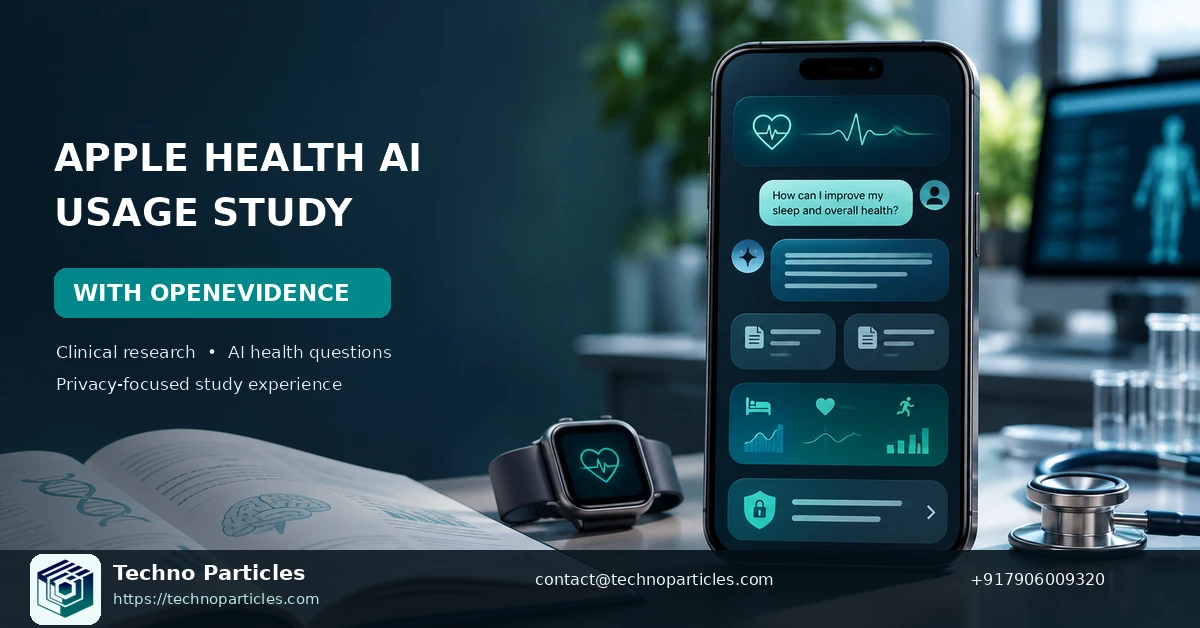
What OpenEvidence adds to Apple’s health-AI experiment
OpenEvidence supplies the medical-AI component behind the study’s conversational answers. In its November 15, 2026 study announcement, Apple says responses draw on established medical sources and include links to peer-reviewed clinical literature. Those links give participants a way to examine some of the material behind an explanation.
Why citations matter
A citation can help a reader distinguish the app’s interpretation from the underlying research. For example, someone asking about a health condition can open a cited paper and consider whether it addresses the same question as the answer. The paper’s subject, population and conclusions provide context that may be lost in a short conversational response.
OpenEvidence describes its broader medical-AI platform and its approach to clinical information in its Trust Center, updated November 7, 2026. Those statements concern the company’s platform generally; they do not establish how well every answer in Apple’s study app performs. For a broader explanation of work involving conversational interfaces and retrieval, the generative AI capabilities page outlines related development services.
What citations cannot prove
A relevant-looking citation does not establish that an answer is complete, current or appropriate for a particular person. A study may address a different population or a narrower question than the one the participant asked, and a linked source alone does not show that the app interpreted it correctly. No independent accuracy benchmark for this Apple study app has been published in the sources discussed here.
The distinction also matters when an answer sounds confident: its wording is not a measure of how directly the cited evidence applies. Readers can use the link to investigate the claim, but the presence of a reference should not be treated as a verdict on the answer’s accuracy.
Who should consider taking part?
Consider joining the Apple OpenEvidence AI health study app only if you meet the eligibility requirements and are comfortable contributing health questions or selected data to research, while using its answers as informational support rather than medical care. As a next step, read the consent materials and confirm your permissions before enrolling through the official App Store listing.



Leave a comment
Your email stays private. You can see your comment immediately on this browser. Others see it after approval.