
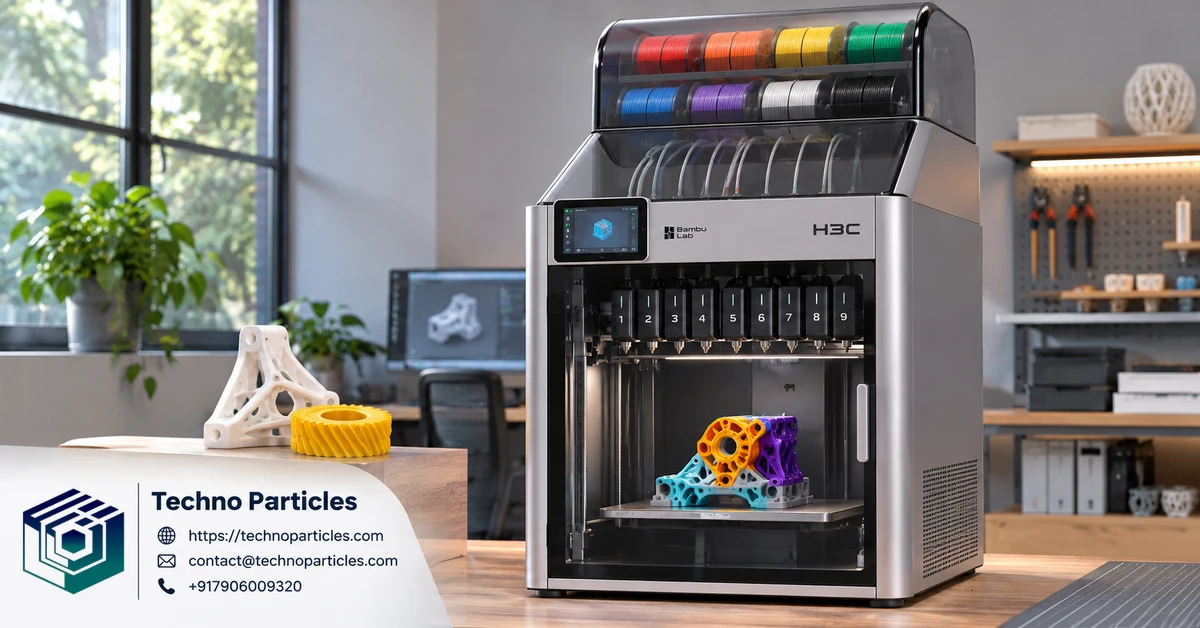
Bambu Lab’s H3C puts nine independently equipped print tools inside one desktop 3D printer, offering a different approach to jobs that combine colors or materials. Announced on November 3, 2026, the H3C AMS Combo carries a US launch price of $2,499 before tax. The company says its tool-changing system can switch materials in under six seconds. Bambu Lab’s launch announcement
| H3C feature | Published detail |
|---|---|
| Print tools | Nine independent Swaptek tools |
| Build volume | 330 × 320 × 325 mm |
| Filament diameters | 1.75 mm and 2.85 mm |
| Integrated material handling | AMS 3H stores, routes and dries filament |
| US launch price | $2,499 before tax for the H3C AMS Combo; shipping included |
What changed with the Bambu Lab H3C?
The H3C is Bambu Lab’s first third-generation desktop 3D printer. Its launch post, published November 3, 2026, presents Swaptek as the central change: instead of relying on one shared print tool for every material, the printer has nine tools, each with its own filament path and heating system. That architecture gives a print job access to several prepared tools as it moves between materials.
In its November 3 Swaptek explainer, Bambu Lab describes automatic tool changes and says a change takes less than six seconds. That timing is a manufacturer claim, not an independent benchmark. For a reader planning a multi-material project, the distinction matters: the published switching time describes one part of a print, rather than the total time needed to produce a finished object.
Bambu Lab’s November 3 release says sales began that day through its official store. Businesses considering how a printer fits an existing production process can use project consultation to define workflow requirements before selecting equipment.
How the nine-tool Swaptek system works
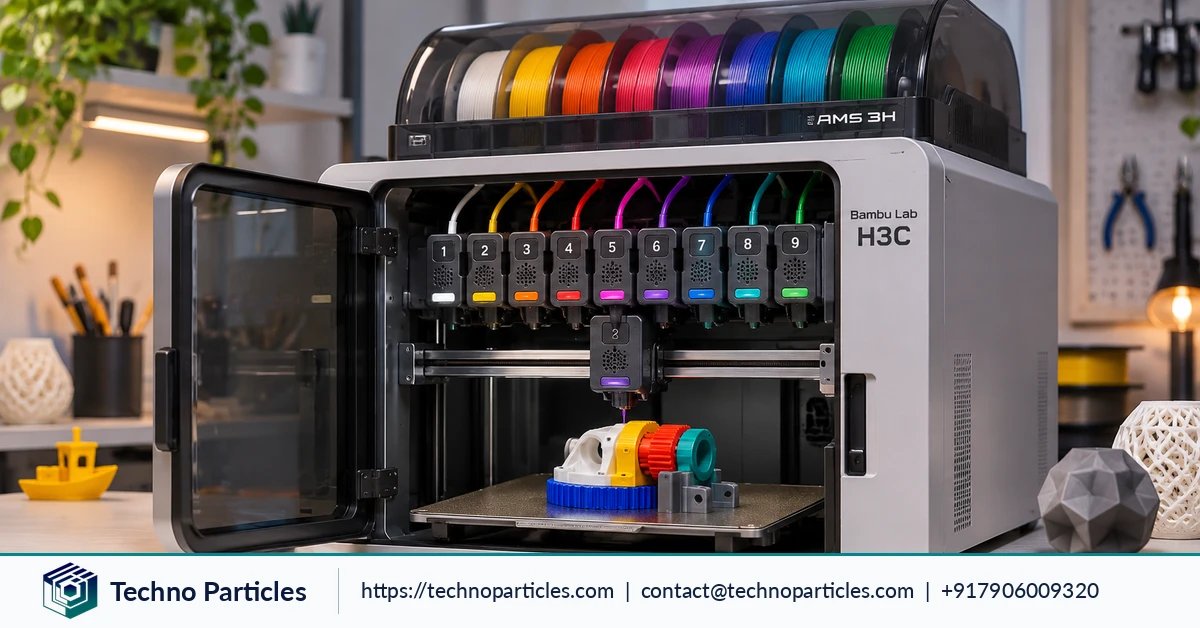
Swaptek organizes the H3C’s tools around a retractable rack. When a job needs a different tool, the printer automatically exchanges the active one for another in the rack. Each tool retains its own filament path and heating system, so the machine can prepare a different material or nozzle for a later stage of the job. Bambu Lab explains the mechanism in its Swaptek system overview.
Swaptek and Active Pre-Heat
Active Pre-Heat prepares a tool before it is needed. This matters when a model alternates between materials: the incoming tool can warm while another is printing, helping reduce the wait at a changeover. The rack also gives the tools a place to sit when they are not in use, making automatic exchanges possible within the same print.
For example, a designer could assign one tool to the main part and another to its support material. The printer can change tools as the sliced job calls for each material, rather than requiring the operator to intervene at every transition. The same approach can be useful when separate tools are configured with different nozzle sizes for different parts of a model.
AMS 3H and material handling
The integrated AMS 3H stores, routes and dries filament. Bambu Lab says its two drying slots reach up to 85°C, while FlexFeed handles both 1.75 mm and 2.85 mm filament, including TPU as soft as 75A. For jobs requiring more material options, an older-generation AMS connected through print tool No. 1 expands the stated maximum to 24 materials in one print. Bambu Lab’s H3C announcement describes the material system and expansion.
For teams documenting how equipment fits a broader digital workflow, the examples on the projects page show the range of software and website work that can sit alongside physical production.
Bambu Lab H3C price, bundles and availability
Bambu Lab’s launch prices for the H3C AMS Combo vary by region. In the United States, the listed price is $2,499 before tax, with shipping included. The launch prices are €2,499 including tax in the European Union and £2,199 including tax in the United Kingdom. Bambu Lab’s November 3, 2026 release says sales began that day through its official store.
The Bambu Lab Japan store listing lists the H3C at ¥449,900. Regional tax, shipping, stock and bundle contents can vary, so the price shown for one market should not be treated as the final cost in another.
What to check in a bundle
The launch price refers to the H3C AMS Combo. Buyers comparing configurations should check the regional listing for the equipment included and the total price at checkout. Accessories such as the Vision Encoder, BirdsEye camera and additional AMS units should be treated as optional unless the selected bundle explicitly includes them.
For a business planning a wider technology budget, Techno Particles’ services page describes its digital development and support offerings. Equipment purchases and digital services are separate costs to account for in that budget.
H3C specifications and supported materials
The H3C’s published build volume is 330 × 320 × 325 mm. That is the space available for a model, while the machine itself measures 493 × 571 × 587 mm and weighs 36.28 kg including the AMS 3H. The distinction matters when planning both the size of a print and the space needed to house the equipment. Bambu Lab’s launch specifications list these dimensions alongside the printer’s temperature and material limits.
Build and temperature limits
Bambu Lab specifies a maximum nozzle temperature of 350°C, a maximum bed temperature of 120°C and active chamber heating up to 65°C. These are separate limits: the nozzle heats material as it is deposited, the bed supports the print, and the chamber controls the environment around it. A suitable setup depends on the requirements of the chosen filament and the object being printed.
The machine’s external dimensions and weight also make placement a practical consideration for a shared workspace. Teams defining equipment requirements can include available space and intended part size in a project requirements consultation, alongside any digital workflows the project needs.
Filament and nozzle support
The published nozzle diameter options are 0.2, 0.4, 0.6 and 0.8 mm. Nozzle diameter affects the scale at which material is deposited: a smaller opening can be useful for fine features, while a larger one can suit broader deposited lines. The choice should reflect the model’s detail and the filament being used.
The listed filament diameters are 1.75 and 2.85 mm. Bambu Lab’s stated compatibility, including flexible TPU, is a manufacturer specification rather than independent validation of every filament and nozzle combination.
Who benefits from the H3C’s tool changer?
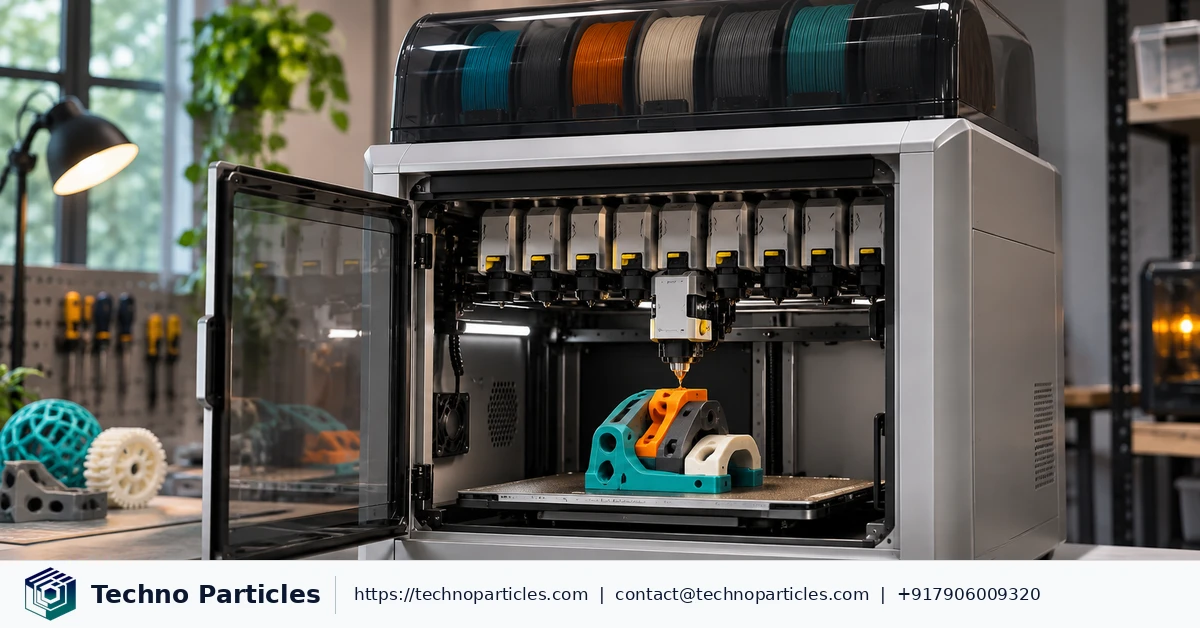
The H3C is most relevant to teams whose jobs routinely combine materials or require different tools within one print. A designer producing a part with a flexible section, for example, could use a dedicated tool for that section and another for the rest of the model. The value depends on how often the workflow calls for those changes, rather than the number of colors a printer can theoretically handle.
Where multiple tools can help
For prototypes that use several colors, ready tools can reduce the need to handle filament between stages. Separate support materials offer another use: they can be chosen for how they interact with the main material. The benefit will vary with the geometry and materials in the job; a model printed entirely in one material has fewer opportunities to use the tool changer.
Flexible components are another potential fit. Bambu Lab identifies TPU support in its Formnext announcement. A team making both rigid housings and flexible elements can consider whether those parts belong in the same production workflow. A UI/UX research and prototyping service can help teams examine how a physical prototype fits the wider user experience.
Performance claims and evidence
Bambu Lab claims TPU flow can reach up to three times the rate it describes for earlier systems. Its launch materials also claim average prints more than 10% faster than its previous flagship, AI failure detection and accuracy under 50 µm with the optional Vision Encoder. These are manufacturer claims, and the figures describe different aspects of operation; they should not be combined into a single speed or quality expectation. The H3C launch announcement describes the stated capabilities.
No independent benchmark or long-term reliability result is established here. A demanding production workflow therefore has an open question: whether the claimed improvements carry through to its particular parts, materials and operating schedule.
Making the H3C buying decision
Choose the Bambu Lab H3C nine-tool 3D printer when frequent multi-material or flexible-filament jobs justify nine ready tools and its US$2,499-class price; otherwise, compare a less expensive printer. Next, check the regional store configuration and total landed cost against the intended workflow.



Leave a comment
Your email stays private. You can see your comment immediately on this browser. Others see it after approval.