

Node.js 26 became a Long-Term Support release on October 28, 2026, giving teams a current runtime foundation for new production APIs. Fastify 5 already supports Node.js 20 and newer, so the framework is compatible with this LTS line. The practical challenge is not simply choosing newer versions: production readiness depends on explicit schemas, controlled lifecycle behavior, testing, logging, and deployment decisions. For teams planning a new backend, application development support can help translate those requirements into an implementation plan.
| Component | Verified position | Production implication |
|---|---|---|
| Node.js 26 | LTS, codename Lithium | A current long-term runtime choice with support scheduled through April 2029 |
| Fastify 5 | Supports Node.js 20+ | Compatible with Node.js 26 and designed around modern route schemas |
| Route contracts | Full JSON Schema objects are required | Define validation and response behavior explicitly instead of relying on v4 shorthand |
| Operations | Built-in Pino logging and stable node:test | Use structured diagnostics and repeatable automated tests from the start |
What Node.js 26 and Fastify 5 change for production API projects
Node.js 26.13.0 entered LTS without functional changes compared with Node.js 26.12.1, so its significance is lifecycle stability rather than a sudden API rewrite. Fastify 5’s migration requirements still matter: routes should use complete JSON Schema definitions for query strings, parameters, request bodies, and responses, while servers should use the options-object form of listen(), such as listen({ port: 3000 }). Response schemas also establish a deliberate serialization boundary, helping prevent unintended fields from leaving the API.
That combination makes the stack a sensible starting point for APIs where runtime support and clearly defined contracts matter. The remaining choices—database, authentication, hosting, and observability platform—are architectural decisions rather than features guaranteed by Node.js or Fastify.
Set up the runtime and server contract
Start by pinning the runtime and framework versions in the project documentation and deployment configuration. Node.js 26 is the current LTS line, but production teams should still record the exact version used in local development, continuous integration, and release environments. That prevents a successful build from depending on an untracked runtime difference.
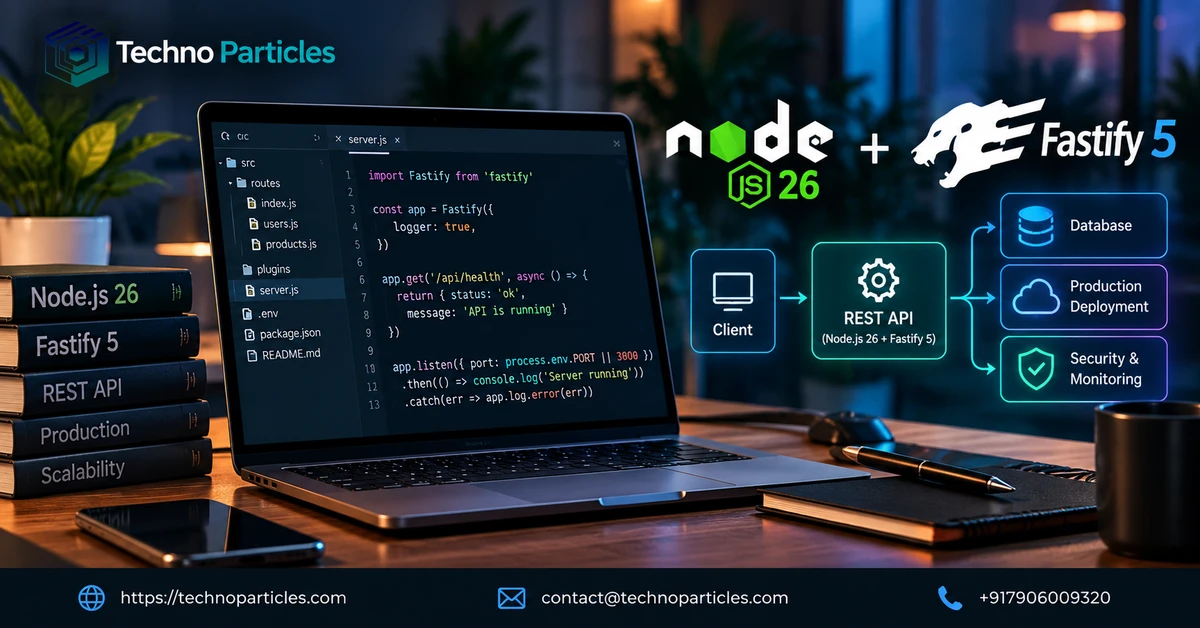
Fastify 5’s server startup API is intentionally explicit. A minimal entry point can create the application and pass an options object to listen():
import Fastify from 'fastify';

const app = Fastify({ logger: true });

app.get('/health', async () => ({ status: 'ok' }));

await app.listen({ port: 3000, host: '127.0.0.1' });
Binding to 127.0.0.1 is appropriate when the process should accept traffic only through the local machine or a reverse proxy. Containerized deployments commonly need 0.0.0.0 so traffic can reach the process through the container network, but that choice should be paired with deliberate firewall, proxy, and exposure controls. The host value is therefore a deployment decision, not a universal setting.
Keep application boundaries explicit
Separate route registration, configuration, business logic, and infrastructure adapters as the API grows. Fastify’s plugin model can help group related routes and dependencies, while lifecycle hooks provide controlled points for request processing and shutdown behavior. Keep secrets and environment-specific values outside route definitions, and validate configuration before the server begins accepting traffic.
For a broader delivery plan, project consultation services can help map these boundaries to the API’s workflows and rollout requirements. The next implementation concern is the route contract itself: every request shape and response shape should be defined with complete JSON Schema objects before adding more endpoints.
Define complete schemas before implementing route logic
Fastify 5 treats JSON Schema as part of the route contract, not optional documentation. Define separate schemas for query strings, route parameters, request bodies, and responses. For example, a user-creation endpoint should specify which fields are required, which types are accepted, and which response fields may be serialized. This makes malformed input fail at the boundary and gives client developers a stable contract to consume.
const createUserSchema = {
  body: {
    type: 'object',
    required: ['email'],
    properties: {
      email: { type: 'string', format: 'email' },
      name: { type: 'string' }
    }
  },
  response: {
    201: {
      type: 'object',
      properties: {
        id: { type: 'string' },
        email: { type: 'string' }
      }
    }
  }
};
The example illustrates the full object form expected by Fastify 5. Avoid carrying over Fastify 4 shorthand definitions during a migration; incomplete schemas can turn a route change into a runtime or validation problem. Fastify uses Ajv v8 for validation and fast-json-stringify for schema-driven serialization, so a response schema can also prevent fields that are not part of the public contract from being emitted.
Keep validation separate from business checks
Initial validation should answer whether the request has the expected shape and basic values. It should not perform database lookups or other asynchronous business operations. Checks such as whether an email is already registered belong in the route or service layer, where failures can be represented with the API’s consistent error format and handled alongside transaction logic.
Because schemas are application code that dynamically evaluate validation and serialization behavior, review them as carefully as executable logic. Test valid requests, malformed bodies, missing parameters, unexpected fields, and error responses. Teams planning a broader web development project should also document these contracts so frontend, mobile, and integration work can proceed against the same expectations.
Test operations before calling the API production-ready
A valid route contract is only the beginning of production readiness. Add tests for successful requests, malformed input, missing authentication context, unexpected failures, and response shapes. Node.js includes the stable node:test runner, which can be invoked with node --test, so the project can keep its basic test workflow close to the runtime rather than introducing an unverified testing dependency.
Test the server through its public HTTP boundary as well as testing individual business functions. Boundary tests can reveal incorrect status codes, serialization leaks, inconsistent error bodies, and lifecycle problems that unit tests may miss. Keep test data isolated from production systems, and make the test command reproducible in local development and continuous integration.
Make logs useful during an incident
Fastify provides Pino-based logging, which gives the application a structured foundation for recording requests, failures, and important lifecycle events. Configure log levels by environment, avoid writing secrets or sensitive request bodies, and include identifiers that let operators connect a request with the work it triggered. Logging should explain what happened without turning every successful request into unmanageable noise.
Graceful shutdown deserves an explicit path. When the process receives a termination signal, stop accepting new work, allow active requests to finish within an agreed boundary, close database or queue clients, and then exit. The exact integrations depend on the infrastructure selected, so this behavior should be tested in the same deployment shape used by the service.
Container networking also belongs in the operational checklist. A process bound to 0.0.0.0 may be reachable through the container network, but exposure should be controlled by the surrounding proxy, firewall, and platform configuration. Document the intended traffic path and verify that health checks, logs, and shutdown behavior work together before release. A structured application development process can help coordinate these concerns across API, frontend, and deployment teams.
Decide whether this runtime combination fits the deployment
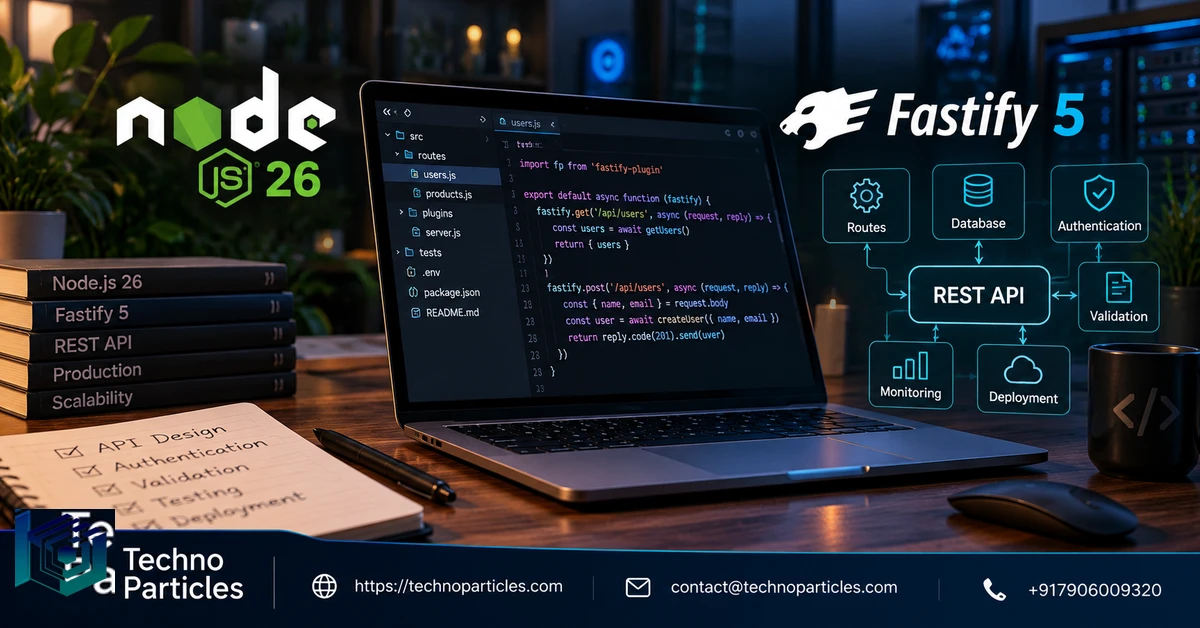
Node.js 26 and Fastify 5 are a practical baseline for a new production REST API when the team wants a current LTS runtime and a framework built around explicit schemas. Node.js 26.13.0 entered Long-Term Support on October 28, 2026, with support scheduled through April 2029. Fastify 5 supports Node.js 20 and newer, so the framework’s documented runtime requirement is satisfied. That compatibility does not, by itself, choose the database, hosting model, authentication mechanism, or observability platform; those decisions remain part of the service design.
For an existing API, treat the upgrade as a compatibility exercise rather than a package-version change. Review the application’s Node.js support range, dependency status, startup command, schema definitions, listening code, and removed Fastify APIs. Routes using Fastify 4 shorthand schemas need full JSON Schema objects, and the server startup should use the options-object form such as listen({ port: 3000 }). Run the complete test suite against the target runtime before changing production traffic, then exercise representative error paths and shutdown behavior in a staging environment.
Separate confirmed framework choices from open architecture decisions
The production shape of a REST API depends on decisions that Node.js 26 and Fastify 5 intentionally do not prescribe. Define where authentication is enforced, how secrets are supplied, which component owns migrations, how rate limits are applied, and which logs or metrics are retained. Keep those boundaries visible in the repository so a future engineer can distinguish framework defaults from application policy.
Container deployments also require an explicit host decision. Binding to 0.0.0.0 can make the service reachable through a container network, but the resulting exposure must be controlled by the platform, proxy, and firewall configuration. Verify the intended traffic path before release. Teams coordinating this work across API and client surfaces may benefit from an API project consultation workflow that records these unresolved choices and their owners.
Choose the API baseline around your operational needs
The most useful conclusion from this Node.js 26 and Fastify 5 review is that framework selection is only the first production decision. The combination gives a current runtime baseline and a clear contract-first development model, but reliability still depends on the boundaries your team defines around the service.
Before implementation, write down the API’s ownership model: which team maintains the routes, who approves schema changes, how backward compatibility is handled, and which consumers must be notified before a contract changes. This prevents a technically valid deployment from becoming an integration problem for web, mobile, or partner clients.
Turn the runtime choice into a release policy
For a new service, standardise the Node.js version, package-manager behavior, environment variables, startup command, test command, and shutdown expectations in the repository. For an existing service, create a migration checklist covering dependencies, route schemas, startup APIs, error handling, and deployment probes. A repeatable policy makes future runtime updates smaller and easier to review.
Keep performance claims evidence-based. Node.js 26 and Fastify 5 may be a sound starting point, but the right capacity plan must come from representative traffic, payload sizes, downstream latency, and failure behavior measured in your own environment. Do not substitute a framework reputation for load testing.
When those decisions are documented, a production REST API with Node.js 26 and Fastify 5 becomes more than a working collection of endpoints: it becomes an operable service with explicit contracts, testable failure modes, and an upgrade path. The next practical step is to build one representative route end to end, validate its inputs and outputs, exercise its failure paths, and use that slice to refine the standards for the rest of the API.



Leave a comment
Your email stays private. You can see your comment immediately on this browser. Others see it after approval.