
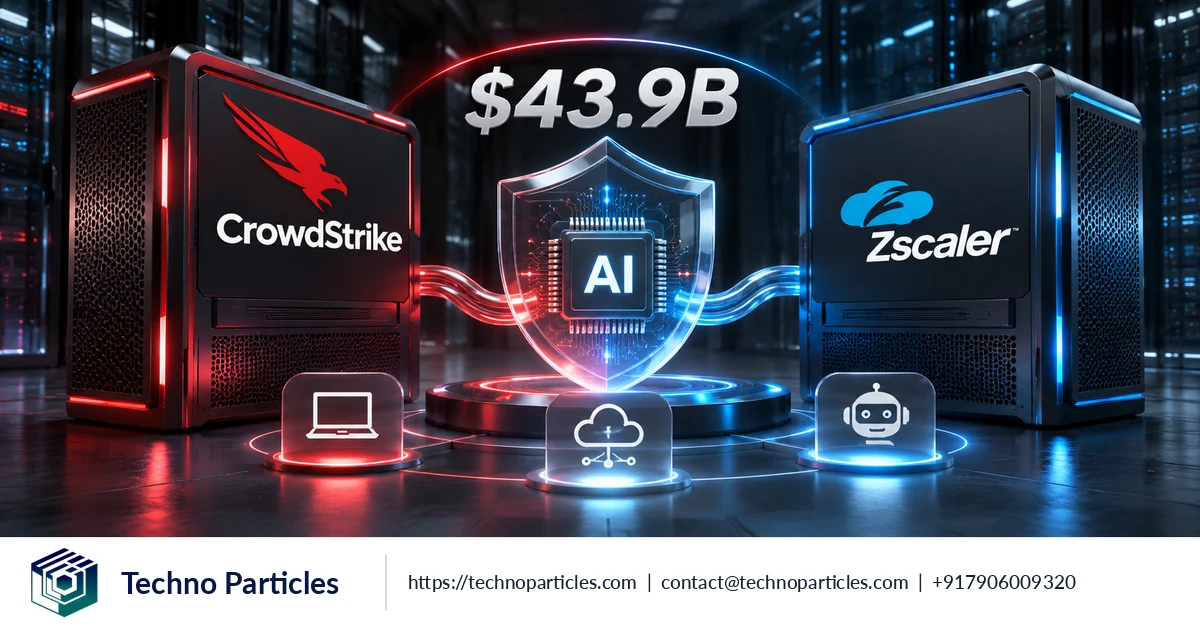
The CrowdStrike Zscaler $43.9B acquisition would bring two security providers together around a shared question: how can organizations protect the devices, cloud workloads and connections used by people and AI agents? The companies announced a definitive all-stock agreement on November 23, 2026, positioning the proposed combination around CrowdStrike’s Falcon platform and Zscaler’s network security capabilities. The deal remains pending. CrowdStrike’s announcement sets out the terms and rationale.
| Deal detail | Announced term |
|---|---|
| Transaction value | Approximately $43.9 billion in an all-stock transaction |
| Exchange ratio | 1.135 CrowdStrike shares for each Zscaler share |
| Implied value | Approximately $260.41 per Zscaler share |
| Expected ownership after closing | 84.1% existing CrowdStrike shareholders; 15.9% existing Zscaler shareholders |
What changed with the CrowdStrike Zscaler $43.9B acquisition?
The November 23 announcement established a signed agreement, not a completed acquisition. CrowdStrike’s SEC-filed earnings announcement, also dated November 23, 2026, confirms the definitive agreement, transaction value and share exchange ratio. The stock consideration means the deal’s stated value is tied to shares rather than a cash payment.
The companies’ stated direction is to combine security information and controls across endpoints, workloads, identities, data and network connections. For an organization assessing that direction, the immediate distinction is between the agreed transaction terms and the architecture the companies intend to build. A project consultation can help document existing workflows and dependencies before a proposed platform change is assessed.
Completion is subject to Zscaler shareholder approval, regulatory approvals and customary closing conditions. Until those conditions are satisfied and the transaction closes, the announced ownership split describes the expected outcome rather than the companies’ current ownership.
Why the deal is framed as AI security
The proposed combination addresses two different points in an AI-enabled workflow. CrowdStrike describes Falcon as protecting endpoints and cloud workloads, while Zscaler’s Zero Trust Exchange is intended to control connections between users, applications and services. In its November 23, 2026 financial announcement, Zscaler presented the agreement as a way to bring cloud, network and endpoint security together for the AI era.
Consider an employee using an AI assistant to work with a cloud application. The device running the assistant and the connection to that application offer different places to apply security controls. Device and workload information can help a security team understand the environment from which activity originates; network controls can help determine which connections are permitted. An autonomous agent makes that distinction relevant even when a person is not manually initiating every connection.
CrowdStrike’s November 23, 2026 announcement describes a plan to converge device and network telemetry. In practical terms, that could give analysts more context when investigating activity across those control points: an event associated with a device could be considered alongside information about its connections.
That context matters when designing an AI workflow as well as when investigating an alert. Teams evaluating generative AI services can map which applications an assistant needs to reach and where its activity runs, then identify the existing controls at each point. This helps make the intended relationship between application access and device security concrete.
The proposed security benefits remain the companies’ architectural rationale, not measured results from a completed integration. The announcement does not establish how a particular organization’s alerts, access policies or investigations would change.

What customers should expect before closing
For current customers, the immediate operating picture remains familiar. Zscaler’s customer and partner guide says the companies will continue to operate independently before closing, and customers do not need to take immediate action because of the announcement.
The guide says existing products and roadmaps, support contacts, service-level agreements, contracts and current-term pricing remain unchanged during that period. It also says current data handling and governance arrangements continue. Those assurances give customers a basis for distinguishing their present service obligations from possible future changes.
For an organization documenting how its security tools support wider operations, an inventory of application dependencies can make subsequent vendor notices easier to assess. Techno Particles describes its application development services as covering integrations and maintenance coordination, which are relevant when recording dependencies between applications and external systems.
What could change after closing
CrowdStrike’s stated plan is to add Zscaler’s Zero Trust Exchange to Falcon and pursue a common platform and data layer. The company also describes Falcon Flex as a way to commercialize the combined portfolio and expects its partner ecosystem to offer Zscaler products. These are proposed changes, not a published set of final product packages or commercial terms.
The potential sales opportunity is part of CrowdStrike’s rationale. It says about 8,000 Zscaler customers do not already use CrowdStrike, while more than 2,000 customers use both companies’ products. CrowdStrike also identifies 16 existing integrations. Those figures are company statements; they do not establish how many customers would adopt a future combined offering.
For a buyer, the distinction is between an integration already identified by the companies and a future platform experience. A shared vendor relationship could eventually affect purchasing and deployment choices, but the announced plan does not specify a combined SKU, post-close pricing or a unified support model.
The approval timeline and unresolved risks
The transaction still requires Zscaler shareholder approval, regulatory approvals and customary closing conditions. Those conditions determine whether the agreement can be completed; an announcement alone does not establish when the companies will be able to combine their operations. CrowdStrike sets out the conditions in its acquisition announcement.
The companies’ official materials describe the expected timing differently. CrowdStrike’s announcement says closing is expected in the second half of its fiscal year 2028. A Zscaler employee FAQ filed with the SEC says the second half of 2027, while Zscaler’s customer and partner guide refers to the fourth quarter of its fiscal year. The documents do not present a consistent expected closing window.
That discrepancy matters for procurement schedules. A team planning a renewal or deployment around a presumed completion date could find that the transaction remains pending when its own decision is due. The safer planning assumption is to use the contract and product documentation currently in force rather than treating any one of those timing descriptions as a confirmed deadline.
Approval and product delivery are also separate milestones. Even if the transaction closes, the announcement does not establish when a particular organization would receive a combined product or how its existing deployment would connect to a future platform. Teams with implementation schedules can account for that uncertainty in their dependency planning; project consultation services describe scope definition and workflow analysis that can support that work.
For customers with multiple stakeholders, the practical distinction is between a transaction milestone and a change that affects their own agreement. A regulatory approval or shareholder vote may advance the deal, but a customer-specific contract notice or product update is the document relevant to an organization’s particular operating arrangements.

Where AI agents change the security boundary
AI agents can connect applications, cloud services and data as part of a workflow, so security teams must consider both the device or workload running an agent and the connections it makes. Zscaler’s November 23, 2026 financial announcement frames the proposed combination around security across cloud, network and endpoint environments.
These control points answer different questions. Endpoint and workload information can help establish the context of activity on a device or in a computing environment. Network controls can govern connections between users, applications and services. Bringing those perspectives together could give an investigation more context than either view provides alone.
That distinction is useful when mapping an agent workflow: an application may initiate a request, while a separate service handles the connection to another system. The responsibilities and integrations involved in building that workflow can be considered during generative AI service planning.
Conclusion: a decision rule for AI security planning
For the CrowdStrike Zscaler $43.9B acquisition: what changes for AI security depends on future closing and product decisions. Keep the current architecture in place unless an official closing notice, contract update or product document changes the facts relevant to your organization.
Assign one owner to monitor official updates from CrowdStrike, Zscaler and the SEC.



Leave a comment
Your email stays private. You can see your comment immediately on this browser. Others see it after approval.