A Practical Guide to Custom Software Development For Small Business
Editorial status: This dry-run draft has no external research bundle. Factual, product, legal, security, pricing, and statistical claims still require review.
Techno Particles is an Agra-based digital solutions partner offering custom, responsive, SEO-aware, secure, and scalable websites. If your team wants to plan or deliver this work, review the Website Development service, explore the Techno Particles project portfolio, and contact Techno Particles for a consultation.
Choosing the right Website Development partner is easier when the decision is based on business outcomes rather than a feature list. The harder decision is whether a provider understands your goals, communicates clearly, delivers a maintainable solution, and supports the work after launch. A growing business usually has limited time and budget, so the right technology partner should reduce uncertainty rather than create extra coordination work.
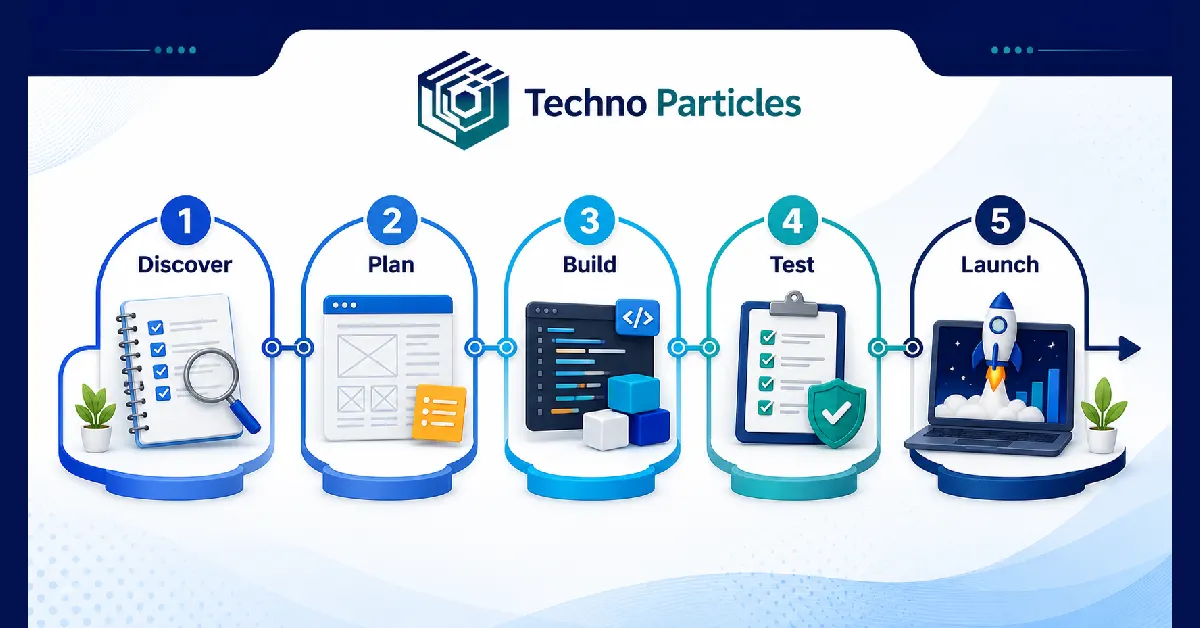
This guide turns custom software development for small business into a practical evaluation. You will define the work the provider should support, create a small test set from real business tasks, inspect the quality of its process and output, and run a controlled pilot. The goal is not to find a universal winner. It is to make a decision that is explainable for your goals, workflow, risk tolerance, and budget.
Start with the decision your team actually needs to make
Before comparing providers, write down the decision in one sentence. For example: “We need a technology partner that can deliver a reliable, maintainable solution while keeping our team in control of requirements and approvals.” That sentence is more useful than a broad request to “improve the business” because it creates boundaries for the evaluation.
Separate three questions that are often mixed together. First, what work should the tool support? Second, what evidence would show that it supports that work safely? Third, what operating cost can the team absorb, including review time, onboarding, policy work, and failures? The tool is only a good fit if the answer is acceptable across all three.
Choose a narrow first use case
Good pilot tasks are common enough to repeat and bounded enough to review. Examples include improving a landing page, prototyping a customer workflow, auditing a mobile app experience, connecting a CRM, planning an e-commerce feature, or automating a repetitive business process. Avoid starting with an undefined “build everything” request. A short brief, clear owner, acceptance criteria, and review checkpoint make it easier to judge the result.
Learn more about the relevant Website Development service and compare it with your business goals.
Need help implementing this? Talk to Techno Particles about Website Development. You can also see our projects or send a project enquiry.
Build an evaluation set from real engineering work
A useful evaluation set contains tasks your team recognizes. Pull a handful of completed issues, recurring maintenance requests, and small enhancements from the same repository. Remove secrets and private customer data, then describe the acceptance criteria without encoding the solution. Keep the original human-authored outcome so the pilot has a comparison point.
Record more than whether the provider delivered a polished demo. For each task, capture whether it understood the users, followed the agreed scope, handled edge cases, documented assumptions, tested important flows, and left a result the business can operate. If the task involves private customer data, use a sanitized brief and define access boundaries before work begins.
| Evaluation area | What to inspect | Evidence to keep |
|---|
| Repository awareness | Does the tool reuse existing helpers and patterns? | File references, duplicate code, and reviewer notes |
| Correctness | Does the implementation satisfy acceptance criteria and edge cases? | Tests, manual checks, and rejected suggestions |
| Security | Does the change avoid unsafe input handling, secrets, and over-broad permissions? | Security review findings and scanner output |
| Reviewability | Can a teammate understand the change without reconstructing the assistant's reasoning? | Diff size, review questions, and rework |
| Workflow fit | Does the tool work in the team's editor, repository, and CI process? | Setup notes, failures, and time spent |
Use the same task with the same acceptance criteria
Do not compare a tool on one task and a teammate on a different task. The comparison does not need to be a laboratory benchmark. It does need to be consistent enough that the team can explain why a result was accepted, rejected, or sent for another pass. Save prompts, relevant context, the resulting diff, test output, and reviewer comments. This record becomes more valuable than a one-time demo because it exposes repeatable strengths and failure modes.
Test context handling before you test autonomy
A Website Development project works with the context it receives, not with an abstract understanding of your business. A provider can propose a plausible solution that misses your users, processes, integrations, or operational constraints. Context quality therefore deserves its own test.
Give the provider a representative business task and ask it to identify the relevant users, inputs, integrations, delivery stages, and acceptance checks before work begins. Compare that plan with your actual operations. A strong result exposes assumptions and dependencies. A weak result sounds confident while skipping a constraint, overpromising an outcome, or ignoring a nearby workflow.
Keep the context selective
More files are not automatically better. Start with the issue, the relevant modules, the nearest tests, and the project's contributor instructions. Add context only when the assistant demonstrates that it needs it. This makes the evaluation easier to reproduce and reduces the chance of exposing unrelated secrets or customer information.
Treat context selection as an explicit part of the evaluation: check whether the assistant uses current, relevant repository information rather than assuming that a larger context is automatically better.
Review comparable work in the Techno Particles project portfolio before finalizing your scope.
For company background and delivery context, visit the Techno Particles about page before comparing providers.
Make correctness and security independent of generation
An assistant may propose a test and implementation that agree with each other while both disagree with the requirement. That is why a green test run is evidence, not a verdict. The person reviewing the change still needs to check behavior, boundaries, error handling, dependencies, and the consequences of a failure.
A generated or outsourced deliverable should be reviewed and tested by the team that owns the business outcome; treat the provider as a delivery partner, not as the sole accountable owner.
Use the normal engineering controls: formatters, linters, unit and integration tests, dependency checks, secret scanning, and a human review appropriate to the risk. For security-sensitive changes, ask for a second review or a separate verification step. Keep the assistant away from production credentials and grant tools only the permissions required for the task.
Treat risk management as an ongoing part of design, development, use, and evaluation rather than as a final publication check.
Turn known AI risks into test cases
For a technology project, practical test cases include unsafe input handling, missing authorization checks, insecure defaults, accidental secret exposure, broken integrations, and dependencies that are not approved by the business.
For an AI feature your team is building, also consider prompt injection, sensitive-information disclosure, improper output handling, excessive agency, and misinformation. These are not reasons to reject every tool; they are reasons to define what the tool may touch and how its output is checked.
Run a small pilot with a review budget
A pilot should have an owner, a fixed task set, a clear time window, and a decision rule written before the first result arrives. Include developers who will use the tool and reviewers who will absorb the changes. Ask participants to record setup friction, accepted suggestions, rejected suggestions, rework, test failures, and questions that the tool could not answer.
Measure against the team's own baseline rather than against a marketing promise. Useful observations include time to a reviewable pull request, review time, rework, queue depth, defect findings, and the share of tasks that required a human to rewrite the result. Do not collapse these into a single score unless the team agrees on how safety and review cost should be weighted. A faster draft that creates a longer review queue is not automatically faster delivery.
Decide what happens after the pilot
If the result is positive, document approved uses, prohibited data, required checks, ownership, and a path for reporting failures. Start with the autonomy level the team can meaningfully review. Increase it only when the review evidence and permission boundaries support that decision. If the result is mixed, keep the useful use cases and narrow the scope. If the result is negative, record the failure mode so the team does not repeat the same experiment with a new brand name.
Common mistakes when evaluating Website Development
- Comparing features instead of outcomes: a long feature list does not prove that the tool fits your repository.
- Using toy prompts only: a clean demo hides context, integration, and review problems.
- Measuring acceptance without review cost: accepted code can still consume more reviewer attention than it saves.
- Letting the assistant write the proof: independently inspect requirements and tests.
- Ignoring data handling: define what code, logs, prompts, and credentials may leave the team's controlled environment.
- Publishing an unsupported claim: use primary sources for changing product and security details, and label uncertainty.
Frequently Asked Questions
How do you choose the right Website Development partner?
There is no defensible universal answer without the team's repository, languages, workflow, data rules, and review capacity. Run the same small set of real tasks through the shortlist and keep the evidence. Choose the tool that improves the work your team can actually review and maintain.
How many tasks should a pilot include?
Use enough tasks to cover the intended use cases and repeat a few patterns. The important properties are consistency and reviewability, not an invented universal sample size. Include at least one task that tests repository context, one that tests edge cases, and one that tests the security controls relevant to your codebase.
Should AI-generated code be marked?
Follow the team's policy and customer commitments for any generated or outsourced deliverable. Retain enough documentation for reviewers to understand what changed, who owns it, and which quality and security checks were completed.
Can a Website Development project succeed without human review?
No. Automated checks can add useful signals, but accountability for the outcome remains with the business and its delivery partner. Human review should match the impact of the project and confirm that the delivered behavior is what users and stakeholders actually need.
Conclusion
A disciplined evaluation of custom software development for small business is a small engineering project. Define the use case, test repository context, preserve the task evidence, validate code independently, and measure the review workflow as well as drafting speed. That process gives Techno Particles readers a decision they can explain and revisit. It also keeps the useful promise of automation in view: remove repetitive work while keeping judgment, security, and responsibility with the people who own the system.
Need help implementing this? Talk to Techno Particles about Website Development. You can also see our projects or send a project enquiry.
Explore all Techno Particles services, projects, about the company, careers, and Sonuai.
Final checklist: seed topic selected; search intent recorded; content gap recorded; search volume and keyword difficulty left blank; source URLs preserved where research was available; claims associated with sources; article reviewed for keyword stuffing; images labeled accurately; publishing remains disabled.




Leave a comment