
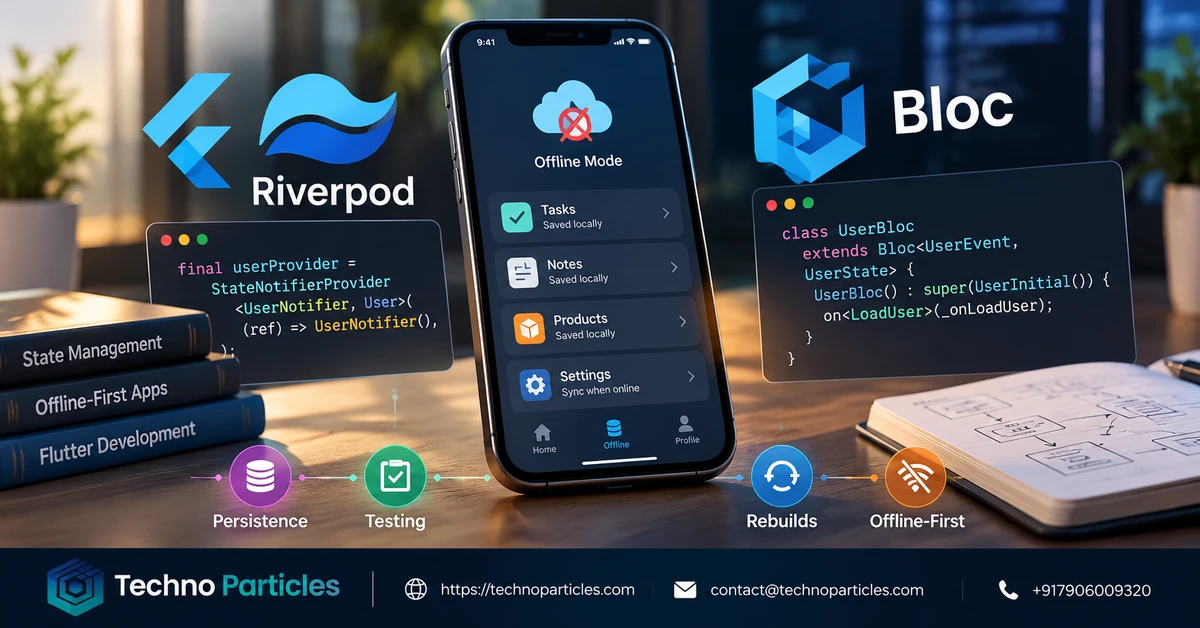
Flutter Riverpod vs Bloc for offline-first apps is not only a state-management choice. Persistence, testing, and rebuilds depend on how the repository, local database, remote API, and synchronization rules fit together. Teams planning application development should decide that boundary first, then choose the state layer.
| Concern | Riverpod | Bloc | Practical meaning |
|---|---|---|---|
| Persistence | Riverpod 3 offers opt-in experimental persistence for Notifier providers. | HydratedCubit can persist and restore state across sessions. | Neither replaces a durable repository and sync design. |
| Testing | ProviderContainer, ProviderScope, overrides, and tester.container(). | test and bloc_test support unit tests for state transitions. | Both support isolated tests, with different workflows. |
| Rebuild control | ref.select narrows updates to selected properties. | buildWhen and BlocSelector narrow selected state changes. | Immutable state and widget boundaries still matter. |
Riverpod’s Riverpod 3 documentation labels offline persistence experimental and warns that its API may change without a major-version bump. Bloc’s HydratedCubit tutorial documents restoration across sessions. Flutter’s offline-first guidance recommends repositories as the single source of truth. The retrieved official pages do not display publication or update dates.
Flutter Riverpod vs Bloc for Offline-First Apps: What the Docs Confirm
Riverpod documents provider-level lifecycle and testing tools. Bloc documents explicit state transitions, selective rebuilds, and repository injection. Neither source establishes a universal speed or usability winner. Teams can map the choice during project consultation, then connect it to software delivery, CMS-backed workflows, or business software where offline behavior affects daily operations.
Persistence Belongs Below State Management
For offline-first Flutter apps, the durable design decision is not whether Riverpod or Bloc owns the data. Flutter’s offline-first architecture guidance places the repository at the center, combining local and remote data sources behind a single source of truth. The state layer should expose that repository’s current status to the interface, while the repository coordinates reads, writes, caching, retries, and synchronization.
Separate the four responsibilities
A practical structure has four boundaries. The local database stores data that must remain useful without a connection. The remote API supplies server-backed records and accepts uploads when connectivity allows. The repository decides which source to read, when to write locally, and how to reconcile changes. Riverpod providers or Blocs then represent loading, available, stale, syncing, success, and failure states for the UI.
This separation matters when designing offline-capable app architecture. A provider or Bloc can survive a screen change, but it should not silently become the only durable store. Flutter’s data-layer guidance assigns caching, retry logic, and synchronization responsibilities to the repository layer, keeping those rules testable and independent from widgets.
Choose a synchronization policy explicitly
The repository may use fallback reads, local-only reads followed by later synchronization, online-only writes, or offline-first writes that queue changes for upload. Those choices affect conflict handling, authentication recovery, retry behavior, and what the user sees after reconnecting. Riverpod’s experimental persistence and Bloc’s HydratedCubit can restore state across sessions, but restoration is not the same as server synchronization. The database schema, conflict policy, and background-work strategy still need their own design.
Testing the Same Offline Flow with Riverpod and Bloc
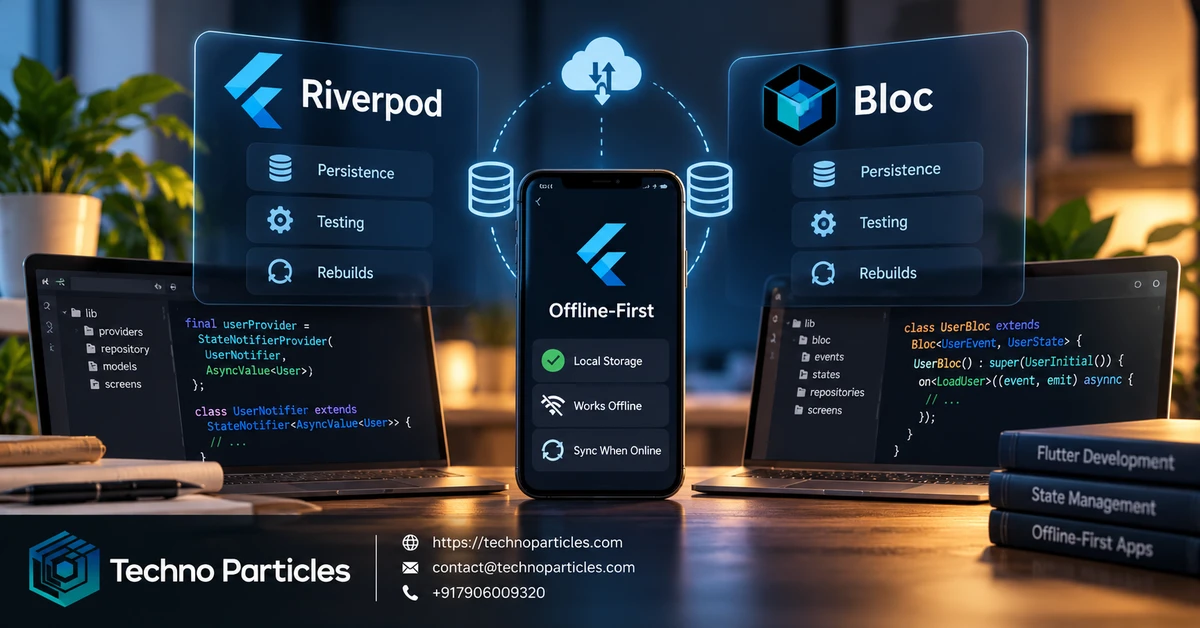
Offline-first tests should verify repository behavior and state exposure separately. A useful scenario starts with cached data, simulates a failed network request, then checks the state shown by the Flutter UI. Teams refining this workflow during a consultation workflow can keep storage, synchronization, and presentation failures distinct.
Riverpod: isolate providers and override dependencies
Riverpod supports isolated tests with ProviderContainer, while widget tests can use ProviderScope. Provider overrides replace repositories, API clients, or databases with test doubles. The testing guide also documents tester.container() for accessing providers from widget tests, plus ProviderContainer.test in Riverpod 3. This structure lets one test inject an offline repository and another inject a repository that reports synchronization failure.
For an offline feature, test the provider’s visible state after each repository result: cached content, stale content, pending synchronization, successful upload, and failure recovery. Keep persistent storage state controlled between tests. Otherwise, data restored from an earlier test can make a provider appear reliable when the test did not create that state.
Bloc: assert explicit state transitions
Bloc’s official testing workflow uses test and bloc_test to describe inputs and expected state sequences. A test can seed a repository with cached records, dispatch an event, and assert transitions such as loading, loaded-from-cache, syncing, and synchronized. This makes event-to-state behavior visible without rendering every widget.
Use repository fakes for network and database behavior, then reserve widget tests for verifying that the correct state produces the correct interface. With either library, dispose providers or Blocs correctly and reset durable test data between cases. Riverpod’s override model and Bloc’s transition-focused assertions offer different test styles; neither removes the need to test the offline boundary itself.
Flutter Riverpod vs Bloc: Rebuild Control
Offline-first screens often show cached data, sync status, and retry actions together. Updating every widget for every state change can make that interface harder to reason about. Riverpod and Bloc both provide tools to narrow rebuilds, but they apply those tools at different points in the state flow.
Riverpod uses selected provider values
Riverpod’s normal ref.watch behavior rebuilds a consumer when a watched object changes. The select method watches only a chosen property, such as a synchronization flag or record count. A widget displaying cached content can therefore avoid rebuilding when an unrelated error field changes. The Riverpod rebuild guidance also requires selected values to behave immutably for comparisons to remain useful.
This approach fits offline-first views that expose several independent repository fields. Keep selection close to the widget that needs it, then measure whether the narrower dependency improves the actual screen. Riverpod documents that select adds some complexity and recommends benchmarking before adopting it broadly.
Bloc filters transitions or state slices
Bloc offers two related controls. buildWhen decides whether a builder should run for a particular state transition. BlocSelector rebuilds only when its selected immutable value changes. For example, a sync-status indicator can select status while a list widget selects the collection of records. The Bloc concepts documentation describes both patterns alongside BlocBuilder.
The practical comparison is state-shape discipline. Riverpod selection filters provider dependencies; Bloc filtering evaluates transitions or selected state values. Neither guarantees fewer useful rebuilds without clear immutable state boundaries. Link this UI review to UI/UX evaluation when deciding which widgets should react to cache updates, sync progress, or failures.
Decision Matrix for Offline-First Flutter Projects
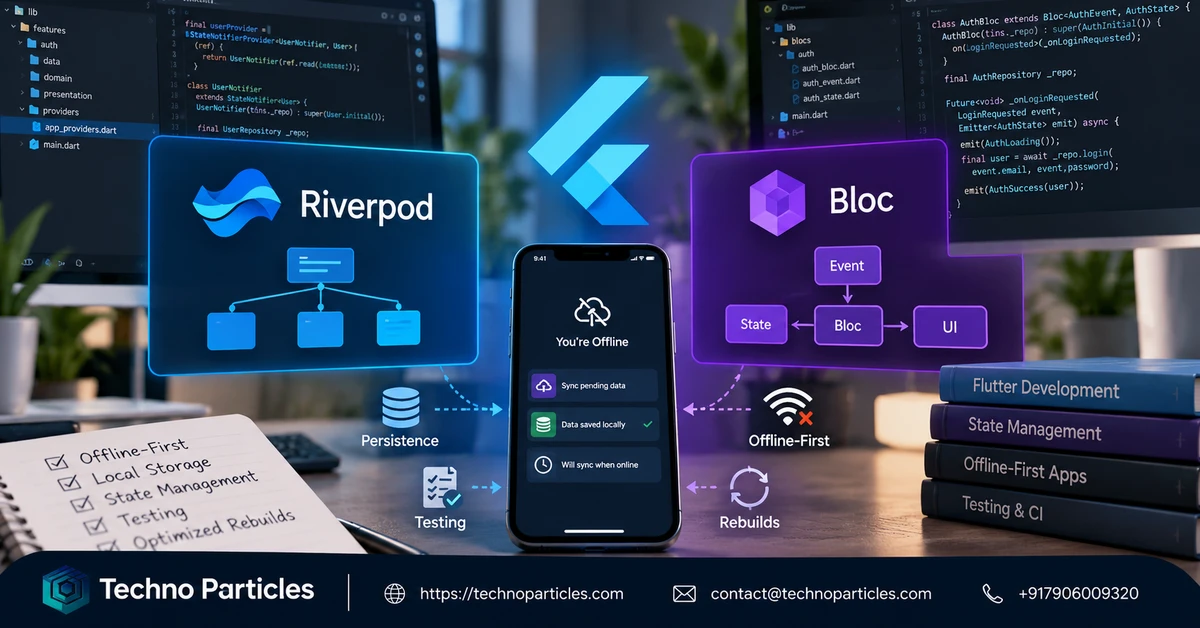
Choose the state library after defining the offline boundary. Flutter’s architecture guidance places repositories between the interface, local data source, and remote API. A software-services overview can help frame that boundary, but the technical decision belongs to the project’s data and testing constraints.
| Project constraint | Riverpod fit | Bloc fit |
|---|---|---|
| Provider-level dependency replacement | Strong fit through ProviderContainer and provider overrides. | Use Bloc and repository injection through its documented provider pattern. |
| Explicit event-to-state testing | Possible through isolated provider tests and controlled overrides. | Strong fit for teams that prefer bloc_test state sequences. |
| Selective UI updates | Use select for a chosen immutable value. | Use buildWhen or BlocSelector. |
| Provider-level persistence | Riverpod 3 documents opt-in experimental persistence for Notifier providers. | Use HydratedCubit or the hydrated_bloc ecosystem for state restoration. |
| Lifecycle and migration risk | Review Riverpod 3 lifecycle changes and experimental API status. | Review existing Bloc conventions, hydrated state, and event contracts. |
Riverpod’s testing guide documents container isolation, overrides, and widget-test access through tester.container(). Its Riverpod 3 notes also document experimental offline persistence and ProviderContainer.test. These features suit teams that want dependency control close to providers, but experimental persistence creates migration risk. See the Riverpod 3 documentation for scope and status.
Bloc’s official concepts and testing documentation support explicit state transitions, buildWhen, BlocSelector, and bloc_test. HydratedCubit restores application state across sessions, but restoration still differs from repository synchronization. Compare the Bloc testing workflow with your team’s preferred test style.
No universal winner exists. Select Riverpod when provider overrides and granular dependency composition matter most. Select Bloc when explicit event-to-state contracts and established transition tests matter most. In both cases, keep durable offline data, conflict handling, and synchronization outside the state library.
Flutter Riverpod vs Bloc for Offline-First Apps: Release Rule
Choose the library that makes your team’s offline contract easiest to enforce across one complete feature. Do not decide from syntax, popularity, or an assumed performance advantage. Start with a real workflow: load cached records, edit one item, lose connectivity, reopen the screen, restore access, and reconcile the result.
Use that feature to test architecture boundaries. Repository methods should define what the screen can read, write, retry, and synchronize. State objects should expose those outcomes clearly enough for the interface and tests to consume. The experiment should include a durable local store, an unavailable API, delayed responses, rejected writes, and a restart between operations.
Riverpod is a practical choice when provider overrides, container isolation, and dependency composition match the team’s testing habits. Bloc is a practical choice when explicit events, state transitions, and established bloc_test workflows make behavior easier to review. Both can support focused rebuilds when state remains immutable and widget boundaries reflect actual UI responsibilities.
Set a release gate before adopting either library across the application. The representative feature must pass repository tests, state-layer tests, widget tests, restart tests, and synchronization failure tests. Developers should also inspect rebuild behavior on the busiest screen, because a technically available selector does not prove that the screen benefits from it.
Then record the decision in project conventions: where persistence lives, which layer owns synchronization, how failures surface, how state is named, and how tests replace dependencies. Revisit the choice only when those constraints change or the pilot exposes a concrete maintenance problem. This gives a Flutter Riverpod vs Bloc decision a durable basis: the library serves the offline design, and the offline design serves the product.



Leave a comment
Your email stays private. You can see your comment immediately on this browser. Others see it after approval.