

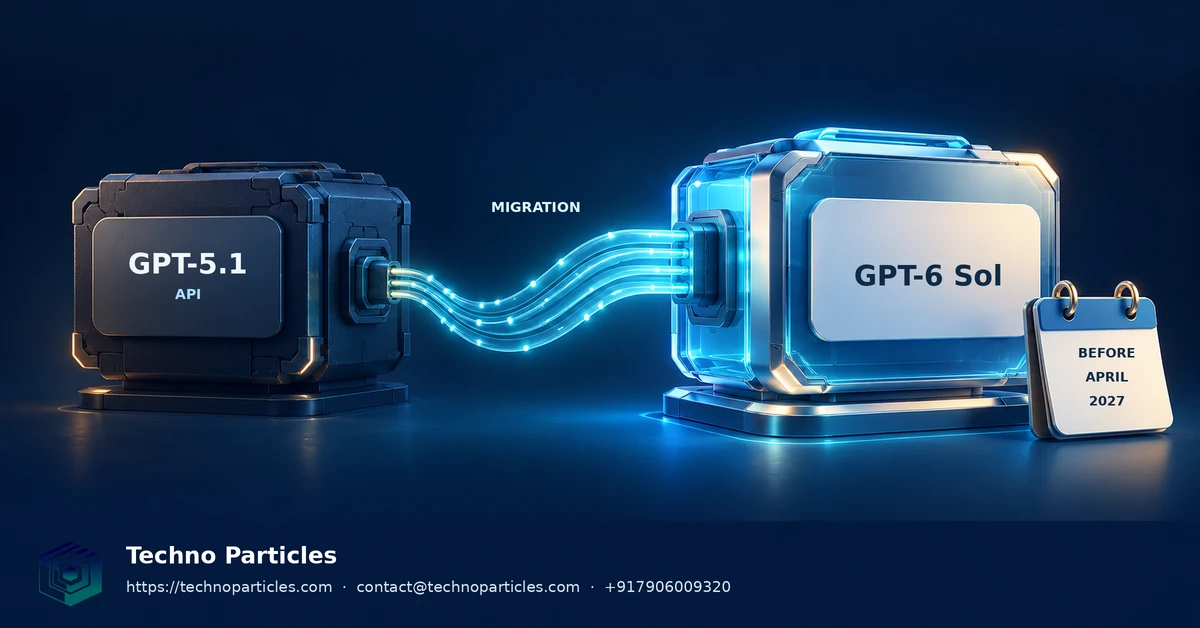
OpenAI has set a firm deadline for developers using GPT-5.1: the model is scheduled for removal from the API on April 1, 2027. The companyâs API Deprecations page, updated October 1, 2026, gives users six monthsâ notice and names gpt-6-sol as the recommended replacement. This makes the GPT-5.1 API deprecation a migration project, not simply a routine model upgrade.
What changes with the GPT-5.1 API deprecation?
Applications that send requests with the hard-coded gpt-5.1 model ID may stop working after the removal date. The affected surface can include chat features, background automations, coding tools, customer-support workflows, and agent systems that depend on specific prompts or function calls. OpenAIâs notice also covers gpt-5.3-codex, while users of gpt-5.4-nano are directed toward gpt-6-luna.
OpenAI describes GPT-6 Sol as a model for complex coding and agentic workflows. Its documentation lists support for the Responses API and function calling, a 1,050,000-token context window, and up to 128,000 output tokens. Standard listed pricing is $2 per million input tokens and $10 per million output tokens, with separate rates for cached, batch, flex, and regional usage. These specifications are documented by OpenAI; performance and cost comparisons in the September 2026 launch announcement remain company-reported evaluations rather than independent benchmarks.
Start with a complete model inventory
Before changing production code, search application repositories, environment variables, configuration files, workflow builders, and monitoring dashboards for gpt-5.1. Record each use case, prompt version, tool schema, latency expectation, token volume, and fallback model. Teams building AI-enabled websites or applications can also review Generative AI development services when planning a controlled migration.
Test prompts, tools, and real workloads
Run representative requests against gpt-6-sol, checking structured outputs, function-call arguments, refusal behavior, long-context handling, response quality, and total cost. Keep the existing model available during comparison, then stage the replacement behind a feature flag or limited rollout before the April 2027 deadline.
Build a measured GPT-6 Sol migration plan
The safest response to the GPT-5.1 API deprecation is a staged migration rather than a last-minute model-ID replacement. Create a test set from real, anonymized requests across every affected workflow. Include short conversations, long documents, structured extraction, code generation, customer-support replies, and tasks that trigger tools. The goal is to identify behavior changes that a basic success-status check would miss.
Compare quality, latency, and spending
Run the same test cases through gpt-5.1 and gpt-6-sol while recording output quality, response time, token usage, tool-call accuracy, and failure or retry rates. OpenAI lists standard GPT-6 Sol pricing at $2 per million input tokens and $10 per million output tokens, but your effective cost will depend on caching, batch or flex processing, regional rates, prompt length, and output limits. Use your own traffic profile to model the financial effect before approving the change.
Pay particular attention to integrations that expect a strict JSON shape or pass function-call arguments directly into business systems. Validate schemas, permissions, retries, timeouts, and human-review controls. A model that handles a prompt well in isolation can still require application changes when it interacts with a CRM, CMS, ERP, or internal database.
Release the replacement behind controls
Keep the model selection configurable through an environment variable or service layer, rather than scattering the ID throughout application code. Deploy gpt-6-sol to a small percentage of traffic, compare monitored outcomes, and retain a documented rollback path while the migration is being evaluated. Teams rebuilding an AI workflow as part of a wider product change can use application development services to review the surrounding architecture, testing, and deployment process.
Finally, assign an owner and calendar the remaining checks well before April 1, 2027. Review prompts, tool definitions, usage dashboards, and incident procedures again after the first production release, because real user inputs may expose cases absent from the initial test set.
GPT-5.1 API Deprecation: Migrate to GPT-6 Sol Before 2027 - Techno Particles
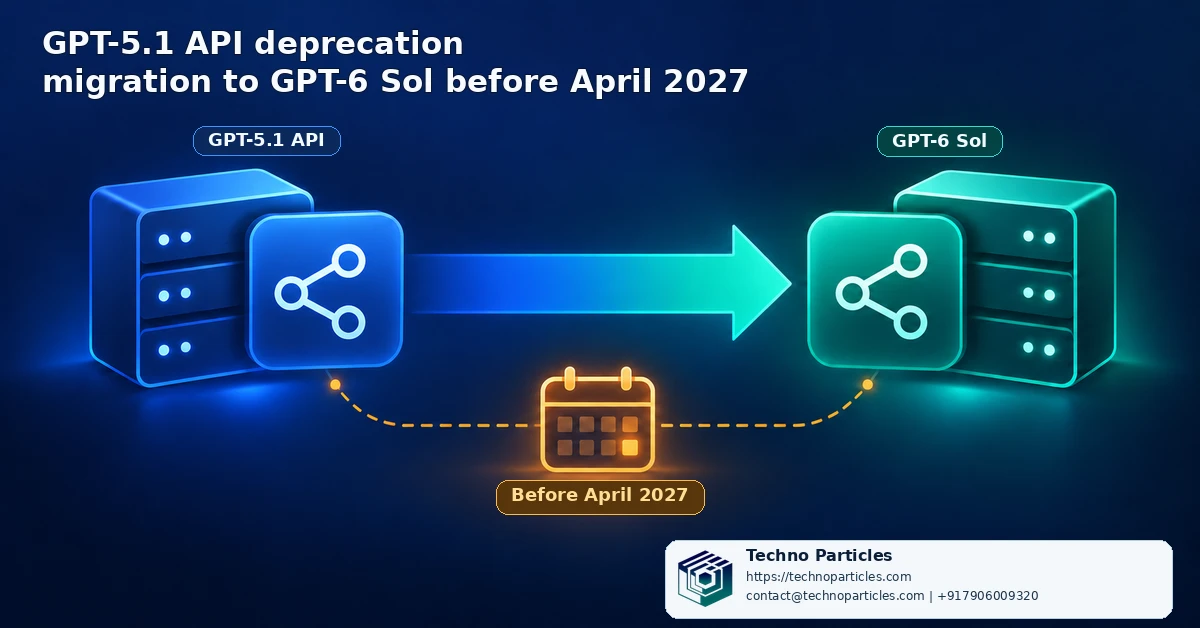
Operational safeguards before the GPT-5.1 API deprecation
A migration is incomplete until the surrounding application is ready for changed model behavior. Review authentication, request construction, streaming, timeout handling, retries, logging, and usage-limit responses in the same test environment. If your service stores model-specific assumptions, move them into a documented configuration layer so future replacements do not require edits across multiple repositories.
Protect data and business workflows
Test GPT-6 Sol with the permissions and safeguards used in production. Function calling can connect model output to applications, so confirm that every tool validates arguments before performing an action. Sensitive workflows should retain approval steps for payments, account changes, customer communications, or database updates. Also check whether logs and evaluation datasets contain personal or confidential information before sharing them with wider development teams.
For customer-facing websites and applications, monitor more than successful API responses. Track escalation rates, incomplete answers, malformed structured output, tool-call failures, latency, and token consumption by workflow. A dashboard that separates migration traffic from legacy traffic will make it easier to identify regressions and calculate the real operating cost of gpt-6-sol.
Give teams time to adapt
Set internal checkpoints before April 1, 2027: inventory completion, evaluation sign-off, staging deployment, limited production traffic, and final retirement of the old model. Share representative prompt changes and known behavior differences with support, product, and engineering teams. If the migration also exposes weaknesses in an AI-enabled product, project consultation services can help structure the evaluation and rollout plan.
Do not wait for the removal date to discover an overlooked scheduled job or low-volume customer workflow. Search archived code, vendor integrations, and separate business-unit accounts, then confirm that alerts identify any remaining requests using gpt-5.1. This creates an auditable path from discovery to replacement and leaves room to fix application-level issues before the deadline.
Document migration ownership and fallback rules
Assign responsibility for each part of the GPT-5.1 API deprecation instead of treating migration as a single engineering ticket. One owner should track model inventory, another should approve evaluation results, and product or operations leads should confirm that changed outputs remain suitable for customers and staff. Record the current prompt version, tool definitions, expected schemas, latency targets, and spending assumptions before testing gpt-6-sol. This baseline makes later comparisons easier to audit.
Check every route that can call the model
Applications often reach an API model through more than a visible chat feature. Review background workers, scheduled reports, admin dashboards, mobile builds, staging environments, serverless functions, and third-party automation platforms. Search configuration files, deployment secrets, infrastructure manifests, and monitoring rules for gpt-5.1. Also inspect fallback logic: an application may silently select the deprecated model after a timeout, quota event, or failed feature-flag lookup.
For each workflow, define an explicit fallback policy before release. A safe fallback might pause an automated action, route the request to human review, or use a separately tested model for a limited function. Avoid silently switching models when the output can update records, send messages, approve transactions, or change customer-facing content. Teams managing several connected systems can use project consultation services to map dependencies and assign rollout responsibilities.
Set a retirement gate
Before removing the old model from configuration, require evidence that critical tests pass, monitoring is active, owners have signed off, and support teams know how to report regressions. Keep migration notes with prompt revisions, evaluation results, cost assumptions, and unresolved limitations. This record will help explain later decisions if user feedback differs from internal test results.
The April 1, 2027 removal date is confirmed, but readiness should be measured by operational evidence rather than the calendar alone. A controlled, documented transition gives teams time to correct prompt, tool, and application issues while GPT-5.1 remains available for comparison.

Validate GPT-6 Sol before the final cutover
Once the inventory and ownership plan are complete, compare the replacement against the workloads that matter most. OpenAI describes gpt-6-sol as a model for complex coding and agentic workflows, with Responses API and function-calling support. Those are confirmed product capabilities in its documentation, but they do not prove that every application will receive better results. Your own evaluation should decide whether the replacement meets the required standard.
Use representative evaluation cases
Build a test set from anonymized production prompts, difficult edge cases, structured-output requests, and tool interactions. Compare factual accuracy, instruction following, schema compliance, refusal behavior, latency, and token usage between gpt-5.1 and gpt-6-sol. For coding workflows, include compilation, test execution, dependency changes, and review quality rather than judging output from a few examples. For customer-facing systems, have domain specialists review answers where an error could affect a purchase, support decision, or business record.
OpenAIâs launch materials include company-reported performance and cost comparisons. Treat those figures as useful context, not as a substitute for application-specific testing. Pricing should also be recalculated using your actual input, output, cached, batch, flex, and regional usage patterns. A larger context window may enable longer workflows, but sending more information can increase spend and expose unnecessary data.
Roll out traffic in controlled stages
After staging tests pass, release the new model behind a feature flag or configurable model setting. Start with internal users or a small percentage of compatible traffic, then compare error rates and business outcomes before expanding. Keep a rollback path while the evidence is collected, but make sure it points to a supported, tested model rather than assuming the deprecated endpoint will remain available after April 1, 2027.
Teams that need help translating evaluation results into a production plan can use project consultation services. The goal is a measured transition with clear acceptance criteria, observable risks, and enough time to resolve failures before the deadline.
Turn the migration into a repeatable operating process
The GPT-5.1 API deprecation is not only a model replacement task. It is an opportunity to make model selection, evaluation, and release controls easier to maintain. Keep the model identifier in a central configuration layer where possible, document why each workflow uses a particular model, and expose the setting to approved operators without scattering hard-coded values across the codebase.
Monitor the replacement after launch
Migration work should continue after production traffic reaches gpt-6-sol. Monitor response quality, tool-call failures, schema errors, latency, token consumption, and user feedback against the baseline collected during testing. Create alerts for unusual changes rather than waiting for support tickets to reveal a regression. If a workflow affects business records or automated decisions, retain appropriate logs and review samples under your privacy and security requirements.
OpenAI documents a 1,050,000-token context window and up to 128,000 output tokens for GPT-6 Sol, alongside Responses API and function-calling support. These capabilities may help complex coding and agentic workflows, but teams should use only the context and output capacity their applications need. Larger requests can increase cost, processing time, and data exposure, so practical limits remain important even when the platform permits more.
Complete the change before the deadline
OpenAIâs October 1, 2026 deprecation notice confirms that gpt-5.1 is scheduled for removal on April 1, 2027, and names gpt-6-sol

Leave a comment