


GPT-6 Luna arrived with an appealing promise: high-volume performance at a very low API cost. OpenAI introduced the model on September 22, 2026, alongside GPT-6 Sol, describing Luna as an efficient option for workloads that need speed, scale, and adjustable reasoning. Its documented capabilities include reasoning effort from none through max, a 1.05-million-token context window, and pricing of $0.10 per million input tokens and $0.50 per million output tokens.
That launch has also created a more difficult question for developers: do GPT-6 Luna benchmark regressions indicate worse results than GPT-5.6 Luna on some tasks? Early community reports point to possible declines on selected coding and reasoning evaluations. However, those observations are based on small samples and should not yet be treated as a definitive verdict on the model.
Why shorter answers are attracting attention
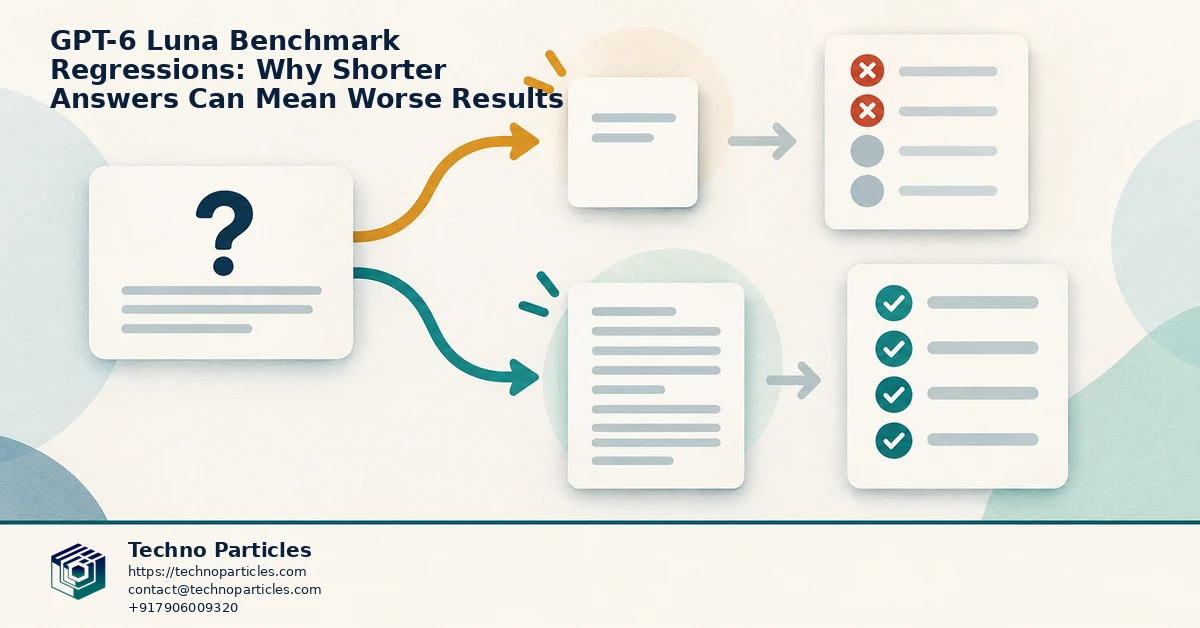
OpenAI says GPT-6 Sol and Luna often produce slightly shorter responses without losing substance. Its verbosity sweeps also report almost no dependence between factuality and answer length. That distinction matters because a concise answer can reflect better prioritisation, lower repetition, or a different reasoning policyânot necessarily weaker reasoning.
Conversely, brevity can hide a regression when a response omits an edge case, skips a necessary implementation detail, or reaches the right-looking conclusion through flawed logic. For a coding assistant, fewer words may simply mean fewer explanations; for an automation workflow, they may mean a missing field or an unhandled failure state.
OpenAI reports that Luna reaches 66.6% on DeepSWE v1.1 at maximum reasoning effort and improves on GPT-5.6 Luna by 5.4 percentage points on AutomationBench at high effort. Those company-reported results do not settle every independent comparison. Teams evaluating the model for generative AI and automation projects should test their own prompts, tools, and success criteria before changing production systems.
How to verify a GPT-6 Luna regression
The first step is to make the comparison reproducible. Keep the prompt, system instructions, attached files, tool definitions, temperature settings, and maximum output limits identical. Record the exact model identifier and reasoning effort, because a no-effort Luna run is not a fair comparison with a max-effort run from another model. Also separate API tests from ChatGPT experiments: OpenAI warns that research or API evaluations may differ from behaviour in the production ChatGPT experience.
Next, score the work rather than the transcript. For coding tasks, run generated patches against the same tests and inspect whether they handle validation, errors, security, and maintainability. For research or business automation, check factual accuracy, required fields, tool-call success, latency, and whether the workflow completes without human repair. A shorter response that produces a correct database update may be more valuable than a detailed response that requires manual cleanup.
Use repeated trials and task-specific evidence
Single prompts can produce misleading results, particularly when a benchmark has a small sample or depends on a narrow set of examples. Build a test set that includes routine cases, ambiguous requests, long-context inputs, and known failure cases. Run each prompt several times when the workflow is sensitive to variation, then compare pass rates and error types instead of relying on one average score.
It is also useful to test reasoning effort as a configurable operating choice. Lower effort may suit classification, extraction, and high-volume routing, while higher effort may be justified for debugging, planning, or complex document analysis. The right configuration depends on the cost of an error and the value of faster output.
For teams building customer portals, internal tools, or AI-assisted operations, this evaluation can be part of a broader project consultation and implementation plan. That process should define acceptance tests before a model is promoted, preserve a baseline from the previous model, and monitor production failures after deployment. Benchmarks can identify signals, but real task outcomes determine whether a regression matters.
GPT-6 Luna Benchmark Regressions: Why Shorter Answers Can Mean Worse Results - Techno Particles
What GPT-6 Luna benchmark regressions may actually reveal
A reported GPT-6 Luna benchmark regression can describe several different problems, and each requires a different response. A model may fail because it misunderstood the task, used a tool incorrectly, exceeded a context limit, omitted a required answer field, or produced code that fails only on an edge case. Treating all of these outcomes as âthe model got worseâ makes the result difficult to act on.
Create an evaluation record for every trial. Store the prompt, model version, reasoning setting, input length, tool activity, output, latency, token use, and final score. This makes it easier to identify whether a shorter answer is genuinely incomplete or simply more direct. It also exposes hidden changes in the test environment, such as a different retrieval document, updated system instruction, or altered parser.
Measure the workflow, not just the answer
For production teams, the most useful metric may sit after the model response. A lead-management workflow should be judged by valid field extraction, duplicate detection, routing accuracy, and successful CRM updates. An employee-management assistant should be tested on policy retrieval, permission handling, and whether payroll or leave data reaches the correct approval stage. In these cases, answer length is only a secondary diagnostic signal.
Use a small set of human-reviewed examples alongside automated checks. Human reviewers can identify subtle omissions, misleading confidence, or poor explanations that a binary grader misses. Automated tests remain valuable for repeatability, especially when checking JSON schemas, API calls, calculations, and generated code. Combining both methods produces stronger evidence than copying a public leaderboard score into a deployment decision.
A staged rollout can then limit the cost of uncertainty. Keep the previous model available as a fallback, route a controlled share of low-risk tasks to Luna, and compare failure rates before expanding usage. Teams planning this kind of evaluation can document the acceptance criteria through project consultation for AI implementation, especially when model output connects to customer records or business operations.
How developers should respond to GPT-6 Luna benchmark regressions
When testing suggests a GPT-6 Luna benchmark regression, the next step is not automatically to revert. First, classify the failed tasks by business risk. A missed formatting preference may be acceptable in a draft-generation workflow, while an incorrect invoice value, unsafe code change, or wrong customer record update requires a stronger safeguard. This risk-based view helps teams decide where Luna can run independently and where it needs review or a fallback model.
Keep the previous model as a comparison point during the transition. Route selected tasks through both versions when the extra cost is justified, then compare structured outcomes rather than stylistic differences. Useful checks include factual consistency, schema validity, tool-call completion, citation accuracy, code-test results, latency, and total token cost. Logging these results makes it possible to distinguish a real quality decline from a preference for longer explanations.
Configure reasoning effort by task
Lunaâs reasoning-effort setting should be treated as part of the application design. A low-effort configuration may be appropriate for classification, summarisation, routing, or routine extraction. More demanding workâsuch as debugging, multi-step planning, long-document analysis, or complex code generationâmay benefit from a higher setting. Teams should test this configuration directly instead of assuming that the modelâs default behaviour represents its best performance.
Prompt design also matters. State the required output fields, validation rules, tool-use boundaries, and escalation conditions explicitly. For structured workflows, validate the response before taking action and send incomplete or contradictory outputs to a review queue. Retrieval systems should record which documents were supplied, since a changed knowledge source can look like a model regression.
Businesses building AI-enabled websites, CRM workflows, or internal applications can formalise these safeguards through custom application development. The implementation should preserve model-version metadata, support controlled fallbacks, and expose enough monitoring data for engineers to investigate failures without relying on answer length alone.

Turning GPT-6 Luna benchmark regressions into better tests
The reported GPT-6 Luna benchmark regressions should therefore become a prompt to improve evaluation design. Start by separating capability tests from preference tests. A grader that rewards detailed explanations may favour a longer response, while a production workflow may prefer a concise answer that contains every required field. Both results can be valid, but they measure different objectives.
Run paired trials with the same prompt, system instructions, retrieved material, tools, model version, and reasoning effort. Repeat important cases enough times to expose inconsistent behaviour, then review failures by category. For coding tasks, execute the generated code and record test outcomes. For research or support tasks, check factual claims against a defined source set. For automation, verify the downstream state rather than judging the prose alone.
What the shorter-answer debate gets wrong
OpenAIâs September 22 guidance says GPT-6 Sol and Luna can produce slightly shorter answers without losing substance, while its verbosity analysis found almost no dependence between factuality and answer length. Those are company-reported findings, not proof that every deployment will behave identically. Early community reports describing regressions on selected coding or reasoning benchmarks are useful signals, but small samples cannot establish a general decline.
The practical question is whether Luna meets the acceptance threshold for a specific job. Teams should define that threshold before comparing models: required facts, valid output structure, tool completion, error tolerance, latency, and cost. This prevents a visible style change from overshadowing a meaningful workflow improvementâor hiding a serious omission.
For organisations integrating models into customer-facing websites or internal systems, a documented evaluation plan can connect these measures to rollout decisions. Generative AI implementation services can help translate model testing into monitored workflows with review queues, fallbacks, and version-aware reporting.
GPT-6 Luna benchmark regressions: a practical decision framework
The debate around GPT-6 Luna benchmark regressions is ultimately a reminder that model selection should follow evidence, not presentation style. A shorter response may be an improvement when it preserves the required facts, structure, and actions. It becomes a regression when omitted reasoning hides an error, a tool call fails, or the output no longer satisfies the workflowâs acceptance criteria.
Before expanding Luna across a product or business process, create a small evaluation set that represents real work. Include routine cases, difficult edge cases, ambiguous requests, long-context inputs, and known failure scenarios. Run the same set against the current model and Luna with matching prompts, tools, context, and reasoning-effort settings. Record both quality and operational measures, including latency, token usage, structured-output validity, escalation frequency, and downstream task success.
When to adopt, adjust, or delay
Adoption makes sense when Luna meets the required quality threshold at an acceptable cost and its shorter outputs do not remove information users need. Adjust the configuration when failures cluster around complex reasoning, long documents, coding, or tool use; a higher reasoning effort, stronger validation, or human review may address the problem. Delay rollout when high-risk errors remain unexplained or when the evaluation set is too small to support confidence.
Keep monitoring after launch because production traffic can differ from laboratory tests. Model updates, changing retrieval content, prompt edits, and new user behaviour can all affect results.



Leave a comment