

NeoMME multimodal multilingual encoder explained means looking beyond another image-and-text AI announcement. H Company has introduced a family of open-weight encoders designed to represent multilingual text and raw images in one shared Transformer. The release includes 260M and 800M parameter versions, plus retrieval-focused checkpoints for visual document search.
H Company described the project in a Hugging Face article published on September 3, 2026. A related technical report by Aurélien Lac and Tony Wu was posted on arXiv on August 31, 2026. The important change is architectural: NeoMME is not a generative chatbot with a vision adapter. It is a bidirectional encoder built from scratch for producing useful representations, or embeddings, from text, images, or both.
That distinction matters for companies building search, classification, recommendation, document processing, or retrieval-augmented generation systems. An encoder does not need to generate a paragraph every time it receives an input. It can instead convert content into vectors that software compares quickly. For Indian businesses handling scanned invoices, catalogues, forms, reports, or multilingual customer material, that can be a more focused approach than running a large vision-language model for every search request.
What NeoMME changes in multimodal AI
Many multimodal systems combine a pretrained vision encoder with a language model. The image tower creates visual features, a projection layer maps them into the language model's space, and a causal decoder processes the combined sequence. This design is powerful for captioning, visual question answering, and conversational tasks, but it also carries components intended for generation.
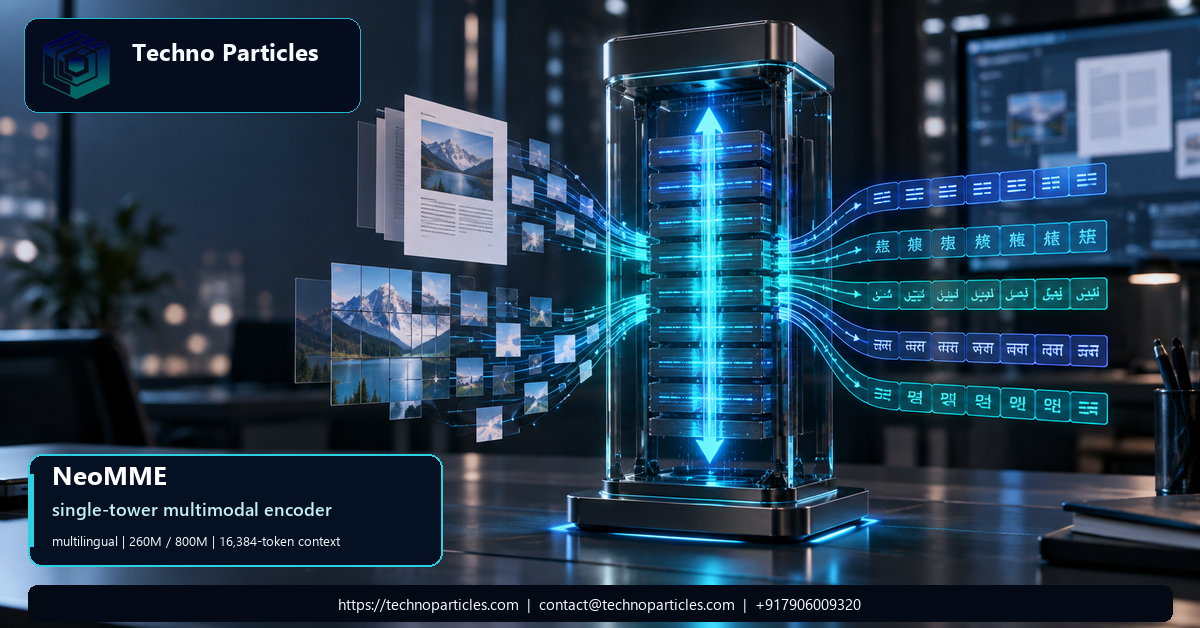
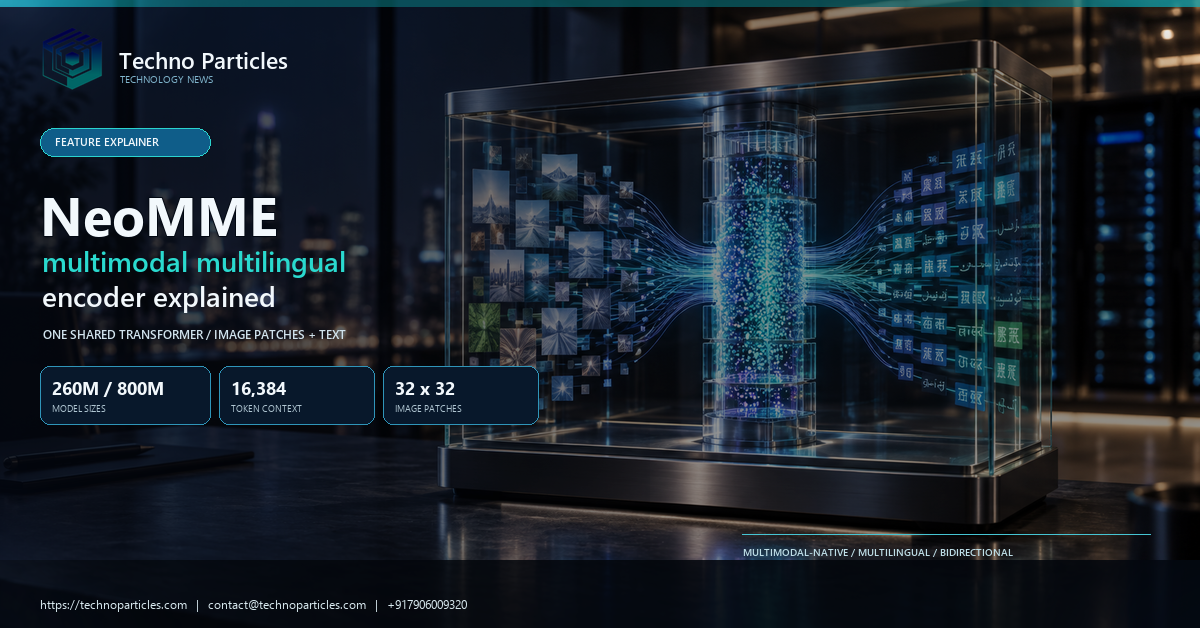
NeoMME takes a single-tower route. Text tokens and image patches enter one bidirectional Transformer encoder. Text uses factorized token embeddings, while images are divided into non-overlapping 32-by-32 patches and projected with a small multilayer perceptron. Both modalities then follow the same computational path.
The models also support dynamic image resolution. Instead of forcing every page into one fixed shape, NeoMME preserves an image's aspect ratio and can allocate more tokens to information-dense pages. That is particularly relevant to visual document retrieval, where a small table, stamp, diagram, or column layout may be lost when a page is aggressively resized.
NeoMME provides a 16,384-token context window. According to the project announcement, that is enough for up to two standard 4K UHD images under the stated processing setup. The architecture also uses grouped-query attention, query-key normalization, gated attention, two-dimensional rotary position embeddings, and squared-ReLU MLPs. These are implementation details, but together they show that the project is aimed at efficient long-context encoding rather than general-purpose conversation.
For a broader view of how such systems can fit into practical digital products, businesses can explore generative AI development services alongside more specialized retrieval architecture.
How NeoMME learns from images and languages
The training method is one of the most interesting parts of the NeoMME multimodal multilingual encoder explained in the new release. The models were trained from scratch with a masked discrete-diffusion text objective. In simple terms, the system receives text with some tokens hidden and learns to reconstruct the missing content.
For multimodal examples, image patches remain visible while portions of the paired text are masked. Light masking allows the model to use surrounding language. Heavy masking reduces that shortcut and encourages it to use visual evidence from the page or image. This gives NeoMME a route to learn relationships between page appearance, layout, text, and meaning without requiring a pixel-reconstruction objective.
The pretraining mixture included multilingual text, code, mathematics, natural images, document pages, captions, and synthetic OCR data. H Company says each model processed about 524 billion packed input tokens, including 290 billion tokens from text-only examples. Those are company-reported training details, not an independent evaluation of data quality or language coverage.
The tokenizer has a 131,000-token vocabulary trained on multilingual text, code, mathematics, and machine-produced image transcripts. The public announcement does not present a complete language-by-language quality table, so businesses should test their own content before assuming equal performance across every language, script, or regional spelling pattern. Multilingual availability is an important design goal, but it is not the same as universal fluency.
Why retrieval is the first major use case
NeoMME-Retriever is a fine-tuned version of the backbone for visual document retrieval. It produces both dense embeddings and late-interaction, multi-vector representations in one forward pass. Dense vectors are compact and convenient for standard similarity search. Late interaction retains token-level or patch-level detail, allowing a query to match the most relevant parts of a document image.
This matters because a scanned PDF is not simply a bag of extracted words. Meaning can depend on whether text appears in a table, beside a product image, under a chart, or inside a form field. A page-image approach can preserve those relationships even when OCR is imperfect. The trade-off is that image encoding normally costs more compute and storage than plain-text indexing.
H Company reports that the 260M NeoMME-Retriever reached 0.523 nDCG@10 on ViDoRe v3, while the 800M version reached 0.556. The 260M model reportedly outperformed evaluated models strictly below 800M parameters in that comparison. These are benchmark results from the project team, so they should be treated as evidence under a defined test setup rather than a universal guarantee.
The release also reports about twice the page-encoding throughput of ColModernVBERT for the 260M model at a matched 2048-by-2048 input size on an NVIDIA L40S GPU. Hardware, batch size, software versions, image composition, and measurement method can all affect throughput. Teams should reproduce the comparison with their own workload before making a purchasing or deployment decision.
For organizations building a search-heavy product, a carefully designed application development solution can connect model embeddings with permissions, document pipelines, analytics, and user-facing workflows.
Compression could make visual search more practical
Late-interaction retrieval can be accurate, but storing many vectors for every high-resolution page becomes expensive. NeoMME-Retriever experiments with hierarchical token pooling and asymmetric quantization. H Company says these techniques reduce late-interaction storage from roughly 1.5 MB to about 6 kB per page, a reported 255-fold reduction, while retaining more than 95 percent of baseline nDCG@10.
That claim is especially relevant to large archives. A distributor might want to search product manuals, a school might index scanned study material, and a manufacturer might retrieve information from drawings, certificates, and inspection documents. Lower index storage can reduce infrastructure pressure, but compression still requires validation. A small loss on a benchmark may be acceptable for one workflow and costly for another where the correct page must be found reliably.
What NeoMME can and cannot do today
The simplest way to understand NeoMME multimodal multilingual encoder explained for practical teams is to separate representation from generation. NeoMME creates embeddings and supports encoder-style tasks. It is not presented as a standalone conversational assistant that will answer questions, write emails, or produce polished captions directly.
The public model cards state that the 260M and 800M backbone checkpoints require task-specific fine-tuning. The retrieval checkpoints are more directly useful for visual document search, but an application still needs an indexing strategy, query handling, access control, evaluation data, and usually a separate language model if it must generate an answer. In a visual RAG system, NeoMME can retrieve relevant page images while another model writes a grounded response.
The model cards also note that a comprehensive safety, bias, and privacy evaluation has not been completed. That limitation should be taken seriously when documents contain personal information, financial records, health data, or confidential business material. Open Apache 2.0 weights may make experimentation easier, but licensing does not remove the need for data governance, security reviews, and human oversight.
Availability is a practical advantage. H Company says the checkpoints are released under the Apache 2.0 license and integrated into Hugging Face Transformers. The public collection includes feature-extraction and retrieval-oriented variants in both model sizes. Teams should still verify the exact checkpoint, dependency versions, hardware requirements, and license obligations for their deployment before moving from a prototype to production.
Where businesses could use it
NeoMME is a logical candidate for document-heavy workflows. An e-commerce company could search catalog pages by a multilingual description and retrieve visually similar product information. A logistics business could index bills, labels, and shipment documents. An education company could search worksheets, diagrams, and scanned notes. A manufacturer could connect technical drawings and certificates to natural-language questions.
For smaller Indian businesses, the most realistic starting point may be a narrow pilot. Select a few hundred representative pages, define the questions users actually ask, compare OCR-only search with image-aware retrieval, and measure both recall and response time. Include Hindi or other relevant languages if the final product will serve multilingual customers. The goal is to learn whether visual layout adds measurable value before paying the operational cost of image indexing.
NeoMME may also support classification, clustering, duplicate detection, and semantic matching after suitable fine-tuning. A custom CMS implementation could use it to organize media-rich knowledge bases, while an SEO strategy could benefit indirectly from better internal search and content discovery. These are reasonable application directions, not capabilities guaranteed by the base release.
NeoMME versus a generative vision-language model
The choice depends on the job. Use a generative vision-language model when the product must converse, explain an image, extract an answer interactively, or create new text. Consider NeoMME when the main problem is comparing, ranking, grouping, or retrieving multilingual text and images at scale. A hybrid design may be the strongest option: NeoMME performs retrieval, and a generative model handles the final response.
The project is also a reminder that smaller, purpose-built models can be valuable even during a period dominated by large AI assistants. The reported 260M and 800M sizes, single-tower design, long context, and compression experiments target the infrastructure bottlenecks that appear after a prototype succeeds. Storage, latency, throughput, and predictable retrieval quality can matter more than conversational breadth in a business system.
In conclusion, NeoMME multimodal multilingual encoder explained is best summarized as a focused open model family for representing text and images together. Its strongest early signal is visual document retrieval, supported by reported ViDoRe results, faster page encoding under a stated test setup, and aggressive embedding compression. Its limits are equally clear: it is not a general chat model, requires task-specific evaluation or fine-tuning, and has outstanding safety and language-coverage questions. Companies should test it against their real documents, languages, latency targets, and privacy requirements before deployment. For teams planning that evaluation, project consultation and UI/UX design can help turn a promising model into a usable, measurable product experience.


Leave a comment
Your email stays private. You can see your comment immediately on this browser. Others see it after approval.