

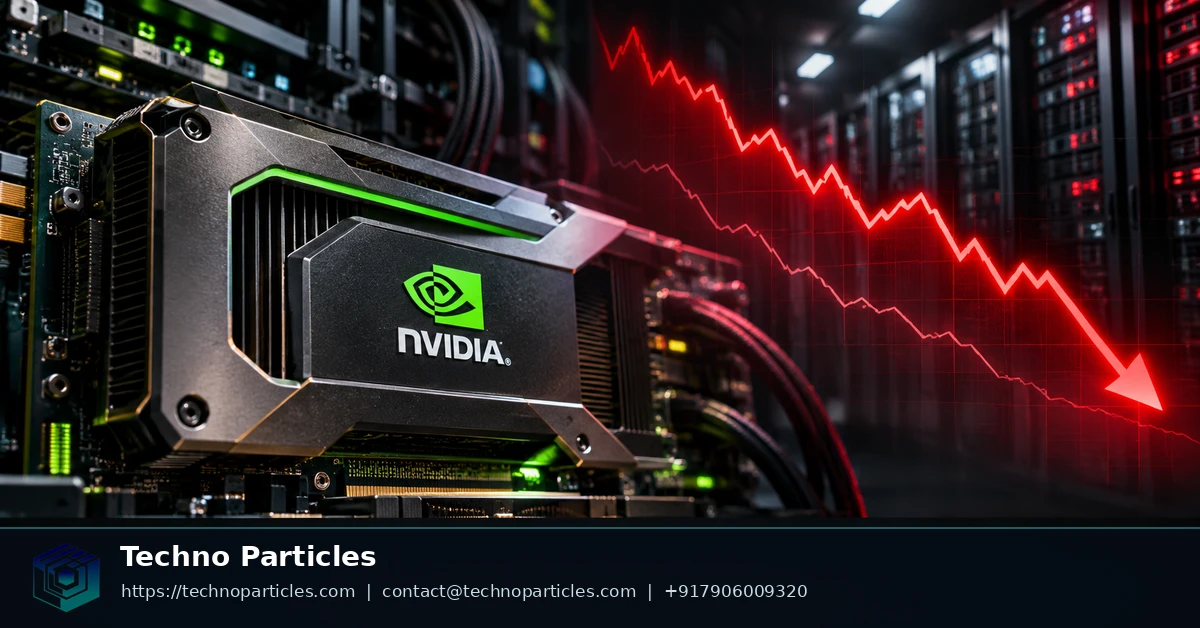
Nvidia’s leadership upheaval has arrived just before an earnings report that could shape how investors assess the AI infrastructure boom. The Nvidia crash spreads across AI stocks: what earnings could reveal is an urgent question for markets weighing company performance against uncertainty about leadership and spending.
On November 16, 2026, the Associated Press reported that concern about Nvidia and the sustainability of AI spending had spread across Asian markets. The company’s forthcoming results will provide operating evidence, though the market reaction alone does not establish that AI demand has weakened.
| Event | Official information |
|---|---|
| Leadership transition | Colette Kress became interim CEO after Jensen Huang resigned. |
| Fiscal Q3 results | Scheduled for November 17, 2026, at approximately 1:20 p.m. Pacific time. |
| Earnings call | Scheduled for November 17 at 2 p.m. Pacific time. |
What changed before Nvidia’s next earnings report
In its November 12 announcement, Nvidia said Huang had resigned as president, CEO and a board member, effective immediately. The company named Harvey C. Jones as board chair and said it expected operations, customer commitments and the product roadmap to continue. That continuity is the company’s assurance.
Nvidia’s October 28 earnings notice said the company would publish written CFO commentary alongside its results and host a webcast. Those materials will give readers a direct account of management’s view after the leadership change.
The market’s concern reaches beyond one company because AI applications depend on computing infrastructure and the organizations funding it. For businesses considering generative AI services, that connection makes infrastructure spending a useful context for understanding the broader market reaction.
The baseline Nvidia set in fiscal Q2
Nvidia’s August 26 fiscal Q2 results provide the starting point for assessing the next report. The company reported $96.2 billion in revenue, including $89.0 billion from its Data Center business, alongside a 75.0% gross margin and non-GAAP diluted earnings per share of $2.22.
The Data Center figure matters because it represents most of the revenue in that quarter. Total revenue shows the scale of Nvidia’s business, while the segment result gives readers a more focused view of the activity tied to AI infrastructure. A change in the company-wide figure alone would not show which part of the business drove it.
The published Q3 guide
For fiscal Q3, Nvidia projected revenue of $108.0 billion, plus or minus 2%, and a 74.0% gross margin, plus or minus 50 basis points. The revenue midpoint was $11.8 billion above the prior quarter’s reported total. The margin midpoint was one percentage point below the prior quarter’s reported margin.
Those figures serve different purposes. Revenue measures sales for the quarter; gross margin indicates the share of revenue remaining after the direct costs included in that measure. Comparing both with their respective outlooks can therefore show whether sales and margins moved as the company anticipated, rather than treating a single headline number as the whole result.
Nvidia also said its outlook assumed no Data Center compute revenue from China. That assumption defines what management included in its forecast; it should not be treated as a statement of the eventual result. The outlook itself is a company forecast, and actual results can differ.
For organizations evaluating the infrastructure behind their own AI plans, project consultation can help clarify requirements separately from a chipmaker’s quarterly sales outlook.

What fiscal Q3 earnings can actually test
The upcoming report can show whether Nvidia converted its forecast into sales and whether management expects that momentum to continue. The earnings notice says written CFO commentary will accompany the results, giving readers more context than the headline figures alone.
Demand and the product transition
Compare reported revenue with the midpoint and range of the prior guide, then examine the Data Center result separately. The segment figure can show whether the business most closely associated with AI infrastructure contributed to the outcome. Management’s explanation of orders and shipments can add context, although its statements about future customer demand remain company assessments.
The product mix also deserves attention. Nvidia’s fiscal Q2 filing said Blackwell accounted for most system shipments and that Vera Rubin production shipments began in fiscal Q3. Commentary on that transition could help readers understand how existing shipments and the next platform contributed to the quarter, and whether supply constraints affected delivery timing.
For teams planning applications that use AI, the distinction between demand for computing infrastructure and an individual project’s requirements matters. An overview of generative AI capabilities can help frame those requirements without treating a hardware supplier’s results as a proxy for every application.
Margins, geography and the next forecast
Read the reported gross margin against its guided range and look for management’s explanation of any difference. Revenue growth and margin performance answer different questions: a stronger sales result does not, by itself, explain what happened to the proportion retained after direct costs.
China is another question for the commentary: the prior outlook excluded Data Center compute revenue there, so any disclosed contribution would need to be understood against that assumption. Finally, distinguish the completed quarter from the next forecast. A revenue beat without a durable forward outlook may leave the market’s concern unresolved.
Why the shock can travel through the AI buildout
Nvidia sits within a network of organizations that finance, build and use computing infrastructure. A cloud provider may commit to equipment before its data center is ready, while an AI developer may depend on that provider for computing capacity. Changes in one organization’s spending plans can therefore affect decisions elsewhere in the chain, even when each business has different customers and financial constraints.
Supply and capacity commitments
Nvidia’s fiscal Q2 filing reported $279 billion in supply and capacity commitments as of July 26, 2026. Those commitments connect the company’s plans to suppliers and production capacity over time. They are not the same as realized revenue or final customer demand.
That distinction matters when considering the wider ecosystem. A supplier may make its own staffing or capacity decisions around expected orders, while a data-center operator must coordinate equipment deliveries with construction. The value of a commitment alone does not show when equipment will be delivered or when a customer will put it to use.
Customer funding and deployment risk
The same filing identifies customer financing and the availability of land, power and data-center shell capacity as factors that can affect adoption and revenue timing. A customer might plan to expand its computing infrastructure yet face delays securing electricity or completing a facility. Equipment demand and the timing of a usable deployment are related, but they are separate questions.
Nvidia’s fiscal Q2 earnings call also included management commentary on hyperscaler spending and supply constraints. Those remarks describe the company’s assessment of future demand, not an independently confirmed spending outcome. For businesses considering their own software projects, the scope of digital services is a separate consideration from the financing and infrastructure required for large-scale AI deployments.
How to read the first market reaction
A share-price move after earnings is a response to information and expectations, not a direct measure of the quarter alone. A result that looks strong in isolation may still disappoint investors who expected more, while a weaker result may draw a different response if expectations were already low. The size or direction of the move cannot establish which explanation mattered most.
Business signal versus price signal
Before the report, Associated Press reported that concern surrounding Nvidia and AI spending had spread across Asian markets. That provides context for sentiment, but it does not establish how Nvidia’s fiscal Q3 business performed. Short-term price action is not a reliable standalone measure of long-term business performance.
Leadership uncertainty is another potential influence on expectations. In its CEO transition announcement, Nvidia said its operations, customer commitments and product roadmap were expected to continue. That is the company’s assurance; the earnings materials may provide more evidence about the business, but a market move cannot verify the assurance on its own.
Evidence to prioritize
Separate the figures for the completed quarter from management’s forecast for the next period, and distinguish both from the immediate trading response. The first describes what Nvidia reported; the second expresses its expectations; the third reflects how market participants reacted to the information available to them.
For a business deciding whether to proceed with its own technology project, the same distinction can prevent a market headline from substituting for a project decision. Technology project consultation addresses requirements and scope, which can be assessed on their own merits alongside any relevant budget constraints.
What to watch next
For “Nvidia crash spreads across AI stocks: what earnings could reveal,” treat the selloff as unresolved until reported results and forward guidance either support or weaken the company’s published demand and margin outlook. This is an evidence-reading rule, not personalized investment advice.
After publication, read Nvidia’s fiscal Q3 release and CFO commentary through its official earnings announcement, then compare the actual figures with the prior guide.



Leave a comment
Your email stays private. You can see your comment immediately on this browser. Others see it after approval.