


Enterprise AI is moving beyond answering questions. On October 6, 2026, OpenAI and Atlassian announced an expanded partnership that will bring GPT-6-family frontier models across Atlassianâs platform and Rovo. The announcement places a sharper focus on turning scattered company knowledge into practical work, while keeping access tied to existing permissions.
Why the OpenAI and Atlassian Rovo partnership matters
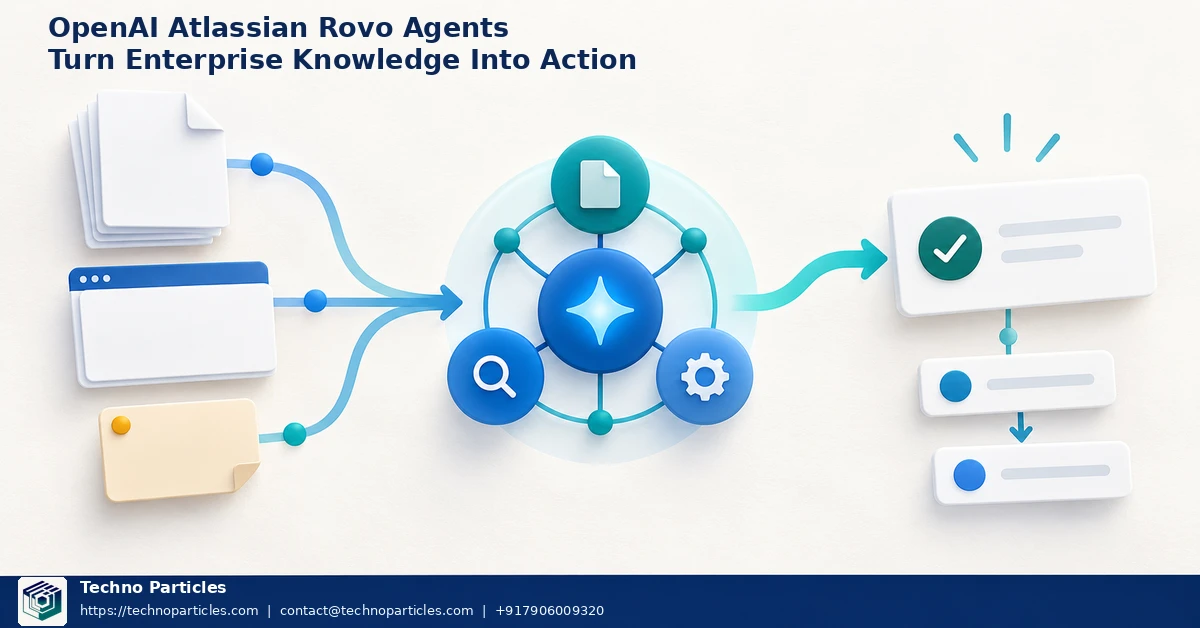
Rovo combines OpenAI intelligence with Atlassianâs Teamwork Graph, a connected view of people, projects, documents, decisions, and work relationships. That foundation gives an agent more context than a standalone search box or chatbot. Instead of producing a summary from one document, it can reason across the systems where a team actually plans, discusses, and tracks delivery.
Atlassianâs example is launch-readiness analysis. Rovo can connect Jira tickets, Confluence documents, and relevant discussions to identify blockers, missed milestones, and decisions that still need attention. It can then recommend next steps, helping a product or operations team move from âWhat is happening?â to âWhat should we do next?â
From enterprise search to permission-aware action
The important shift in OpenAI Atlassian Rovo agents turn enterprise knowledge into action is not simply stronger language generation. It is the combination of reasoning, connected work data, and permission-aware access. Atlassian Support says Rovo agents respect the requesting userâs existing permissions, which is essential when a workspace contains confidential customer, financial, employee, or product information.
Organizations considering this model should first improve the basics: document ownership, consistent project statuses, clear access rules, and defined approval points. Teams exploring related automation can also review Techno Particlesâ generative AI services for practical workflow and AI-agent planning.
What is announced nowâand what is still planned
Atlassian says deeper autonomous-agent integrations are on the horizon, including picking up work items, running tests, syncing session history to team boards, and coordinating multiple agents with human checkpoints. Those capabilities should be treated as planned, not as generally available features today. The announcements also did not document new partnership pricing or broad rollout details.
How teams can prepare for Rovo-powered workflows
The practical value of OpenAI Atlassian Rovo agents turn enterprise knowledge into action will depend on the quality of the work environment they can interpret. Before enabling broader automation, administrators should map which systems contain authoritative information, who owns each dataset, and how frequently project records are updated. A stale roadmap or incomplete Jira ticket can lead to a plausible but unhelpful recommendation.
Start with bounded, reviewable tasks
A sensible rollout begins with analysis and recommendations rather than unrestricted execution. For example, a team could ask Rovo to compare launch criteria with open Jira issues, highlight missing decisions in Confluence, and prepare a review queue for a project manager. The manager can then confirm priorities before any work is assigned or changed. This creates a clear boundary between machine-assisted reasoning and human accountability.
Permission-aware access is equally important. Because Atlassian Support says Rovo agents respect the requesting userâs existing permissions, the result should reflect what that user is allowed to see. However, permissions do not replace governance. Businesses still need retention policies, data classification, audit practices, and approval rules for sensitive workflows.
Where implementation expertise fits
Companies may also need to connect AI capabilities with existing CRM, ERP, CMS, employee, or lead-management processes. That work can involve API planning, role design, interface changes, testing, and monitoring rather than simply switching on an assistant. Teams evaluating a structured AI rollout can review Techno Particlesâ project consultation services when they need help defining use cases and implementation boundaries.
The partnershipâs longer-term direction is significant because it points toward agents that participate in coordinated work. Yet each proposed actionâsuch as running a test, updating a board, or handing work to another agentâwill require measurable success criteria and a way to stop or review the process. Human checkpoints can help organizations gain efficiency without turning incomplete context into automatic business decisions.
OpenAI Atlassian Rovo Agents Turn Enterprise Knowledge Into Action - Techno Particles
Designing the operating model around Rovo agents
For OpenAI Atlassian Rovo agents to turn enterprise knowledge into action reliably, organizations must define what an agent may observe, recommend, and change. A useful operating model separates read-only investigation from activities that create commitments. Rovo might prepare a risk report or draft a decision record automatically, while assigning owners, changing deadlines, or closing issues requires explicit approval.
Make evidence visible to reviewers
Every recommendation should be traceable to the work items, documents, or discussions that informed it. This gives project leaders a way to challenge outdated assumptions and helps technical teams investigate errors. A review screen can show the relevant Jira issue, Confluence page, decision, and unresolved dependency beside the proposed next step. That context is especially valuable when several teams use different naming conventions or maintain overlapping project records.
Administrators should also test access behavior with representative roles before expanding usage. A permission-aware agent can still produce uneven results when two users have different visibility into the same initiative. Documenting those differences helps explain why recommendations vary and prevents teams from treating one userâs output as a complete view of the business.
Measure workflow outcomes, not conversation volume
Early pilots should use practical measures such as time saved during launch reviews, fewer duplicate investigations, faster identification of blocked work, and the percentage of recommendations accepted after human review. These measures are more useful than counting prompts because they show whether the connected knowledge actually improves delivery.
Implementation teams may need to align Rovo workflows with existing applications, approval paths, and reporting requirements. Companies planning that broader systems work can explore Techno Particlesâ application development services for support with integrations and custom workflow design. The partnershipâs value will ultimately depend on disciplined data management and carefully bounded actions, not only on the modelâs ability to reason across more information.
What OpenAI Atlassian Rovo agents mean for enterprise architecture
The next challenge is connecting Rovoâs reasoning to the systems where teams actually make commitments. OpenAI Atlassian Rovo agents turn enterprise knowledge into action only when the surrounding architecture defines reliable sources, ownership, and permitted outcomes. A launch-readiness workflow, for instance, could treat Jira as the source for delivery status, Confluence as the source for documented decisions, and approved discussions as supporting context. That separation makes it easier to resolve conflicts instead of allowing an agent to blend inconsistent records into one confident answer.
Build an approval path before adding automation
Organizations should specify which recommendations can be accepted by a project lead and which require technical, security, legal, or business approval. The same workflow can use different thresholds for drafting a status update, proposing a new task, changing a milestone, or triggering a downstream process. Keeping those stages explicit gives reviewers a practical way to inspect evidence, reject weak recommendations, and record why an action was approved.
A phased implementation can also make testing more manageable:
- Observe: use Rovo to identify blockers, missing decisions, and conflicting project information without changing records.
- Recommend: allow it to prepare next steps, owners, or test plans for human review.
- Act with controls: permit selected updates only after role-based approval, logging, and rollback procedures are tested.
This approach is particularly relevant for Indian SMEs and larger distributed businesses that already rely on multiple operational tools. The partnership does not remove the need for integration planning, data cleanup, or change management. Teams considering those foundations can review Techno Particlesâ generative AI services when evaluating document automation, AI agents, and workflow-specific implementations.
Keep human checkpoints meaningful
A reviewer should see the evidence behind an action, understand its expected effect, and have enough time to intervene. That means designing concise approval screens, clear escalation rules, and monitoring for repeated errors. As Atlassian develops deeper agent integrations, these controls will help companies expand from knowledge analysis to coordinated execution without confusing automation with accountability.

Where the partnership could go next
The most important shift is not simply access to a more capable model. It is the possibility of making enterprise knowledge useful at the moment a team must decide or act. OpenAI Atlassian Rovo agents turn enterprise knowledge into action when an analysis leads to a clearly owned task, a documented decision, or a verified change in project status.
Start with narrow, repeatable workflows
Organizations should begin with processes that have stable inputs and visible outcomes. Launch-readiness reviews, weekly risk checks, support escalation summaries, and dependency tracking are suitable candidates because teams already understand the expected evidence and decision points. A limited pilot also makes it easier to compare Rovoâs recommendations with existing human-led reviews.
Before connecting additional systems, teams should define a data owner for each important source. Someone must be responsible for outdated project pages, duplicated issues, ambiguous terminology, and records that conflict across departments. Better model reasoning cannot fully compensate for incomplete or poorly maintained enterprise knowledge.
Prepare for agent coordination carefully
Atlassian has indicated that deeper integrations may eventually allow agents to pick up work items, run tests, synchronize session history with team boards, and coordinate with other agents. Those capabilities are planned rather than confirmed as broadly available in the announcements. Their usefulness will depend on clear boundaries between agents, especially when one agentâs recommendation becomes another agentâs input.
A practical design should assign each agent a defined role, limit the systems it can access, and require a human checkpoint before high-impact changes. Logging should capture the request, evidence considered, action proposed, approval decision, and final result. This creates an audit trail that can support troubleshooting and governance as workflows become more automated.
For businesses evaluating these foundations, Techno Particlesâ project consultation services can help map operational goals to suitable application, AI, and approval workflows. The partnershipâs real test will be whether teams can convert connected context into dependable progress while keeping responsibility visible.
What businesses should verify before scaling
Permission-aware access is an important starting point, but it is not a complete governance strategy. Teams should review which repositories Rovo can use, how often information is refreshed, and whether sensitive material is correctly classified. A userâs existing permissions can limit what an agent retrieves, yet inaccurate permissions or outdated documents can still produce an incomplete picture. Security, compliance, and business owners should therefore test representative projects before expanding access.
Organizations should also define success in operational terms. A useful pilot might measure whether launch reviews identify blockers earlier, reduce time spent searching across Jira and Confluence, or improve the clarity of ownership for unresolved decisions. These measures are more meaningful than simply counting generated summaries. They show whether the connection between enterprise knowledge and team action is producing dependable results.
Enterprise AI still needs accountable operators
The OpenAI and Atlassian announcements point toward a more active role for Rovo, but the available details do not establish a broad rollout timeline or new partnership pricing. Planned capabilities such as picking up work items, running tests, and coordinating multiple agents should be evaluated as future possibilities, not assumed features.

Leave a comment