

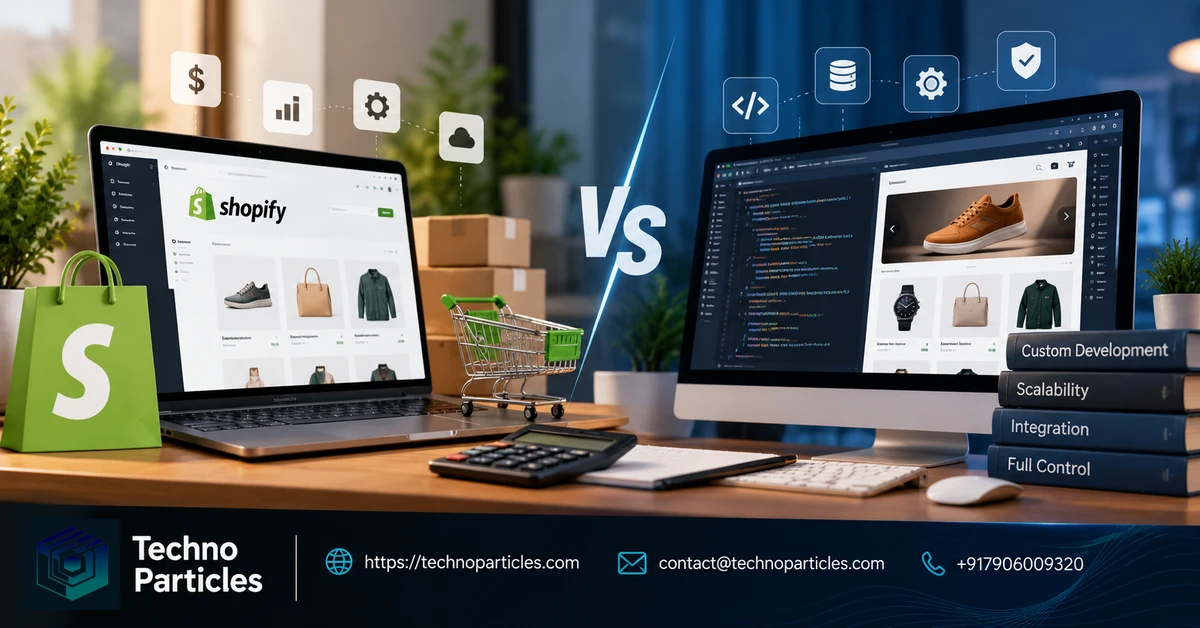
The Shopify vs custom ecommerce website development cost in India 2026 debate is not a choice between one platform price and one development quote. It compares recurring commerce infrastructure with one-time engineering, design, integration, and maintenance work. Shopify’s India pricing page lists plans from ₹1,499 per month when billed yearly, while independent Indian guides publish custom-store estimates from ₹2,00,000 to ₹10,00,000 or more. These figures measure different cost layers.
| Cost area | Shopify route | Custom route |
|---|---|---|
| Initial implementation | Setup, theme, apps, and configuration | Design, engineering, integrations, testing, and deployment |
| Recurring platform cost | Monthly or annual Shopify subscription | Hosting, infrastructure, support, and maintenance |
| Transaction costs | Plan-based third-party provider fees may apply | Payment gateway and infrastructure charges depend on the stack |
| Control | Plan and app model with bundled hosting and checkout | Greater control over application logic and infrastructure |
What changed in Shopify vs custom ecommerce website development cost in India 2026?
The key change is clearer cost separation. Shopify’s official India pricing page, marked accurate as of 9 September 2026, lists Basic at ₹1,499 monthly, Grow at ₹5,599, and Advanced at ₹22,680 when billed yearly. Monthly billing displays higher rates. Shopify also states that hosting, SSL, unlimited bandwidth, checkout, and support features are included, while apps, themes, domains, payment processing, shipping, taxes, and development can add costs. See the official Shopify India pricing details.
Shopify’s Help Center explains that billing is recurring and varies by country, currency, sales volume, and payment-provider use. The result is a lower engineering barrier, not a zero-cost store. A custom build shifts more spending to the beginning and may fit unusual pricing rules, ERP connections, warehouse workflows, or ownership requirements.
Before comparing quotes, document catalogue size, integrations, checkout needs, reporting, migration, and support through a structured ecommerce project consultation. This prevents a platform subscription from being compared with an incomplete implementation estimate.
How Shopify’s India pricing becomes a real store budget
Shopify’s annual-billing prices are only the starting point. Its India pricing page lists Basic at ₹1,499 per month, Grow at ₹5,599, and Advanced at ₹22,680. The same page shows higher monthly-billing rates of ₹1,994, ₹7,447, and ₹30,164 respectively. Shopify Plus starts at ₹1,75,000 per month when billed yearly. These figures should be checked before purchase because Shopify says pricing, promotions, payment options, and availability vary by country and can change. See the current Shopify India plan information.
Subscription is not the only recurring charge
Shopify includes hosting, unlimited bandwidth, SSL, checkout, product-selling tools, themes, and support features within its platform plans, reducing the infrastructure work required for launch. It also states that there are no setup fees. However, a store may still pay for a domain, premium theme, apps, development, shipping tools, tax services, analytics, and ongoing maintenance.
Third-party payment-provider fees are another variable. Shopify’s India page lists rates of 2% on Basic, 1% on Grow, and 0.6% on Advanced; Shopify Plus lists 0.2%. Card-processing or gateway charges can also apply under the relevant payment arrangement. The Shopify billing overview explains that recurring charges, local currency, payment processing, and transaction fees depend on the plan and account conditions.
When moving up a plan changes the calculation
Shopify’s plan-selection guidance positions Basic for new stores, Grow for teams needing additional staff access and reporting, and Advanced for higher-volume operations. The practical break-even point depends on sales volume, location, payment-provider use, and the value of added features. Teams planning custom integrations should define those requirements in a website development scope before selecting a plan, because app work and custom implementation can materially change the first-year budget.
What Indian custom ecommerce estimates actually cover
Custom ecommerce development has no single India-wide price because published estimates describe different scopes. SiteYatra’s India cost guide, updated 12 October 2026, places professional Shopify setup at ₹25,000–₹75,000 and custom-coded stores at ₹2,00,000–₹10,00,000 or more. These are editorial market estimates, not official Shopify prices or guaranteed quotations.
Preevee’s 2026 ecommerce cost guide uses different bands: ₹85,000–₹2,50,000 for Shopify theme-and-app work, ₹2,50,000–₹6,00,000 for a custom Shopify theme, and ₹6,00,000–₹20,00,000 for headless builds. The difference between these figures and SiteYatra’s ranges shows why labels such as “custom website” are too vague for budgeting.
The scope drivers behind a custom-store quote
A serious estimate should identify the design depth, catalogue size, product variants, customer accounts, search and filtering, checkout rules, payment gateways, shipping logic, tax tooling, analytics, and content migration. ERP, warehouse, CRM, marketplace, or accounting integrations can add discovery, API work, testing, error handling, and ongoing monitoring.
Ownership also affects the price. A business may pay more initially for a bespoke application, infrastructure control, source-code access, and workflows that do not fit efficiently within a platform and app model. Conversely, a smaller build may exclude accessibility review, security hardening, deployment support, documentation, training, backups, or post-launch maintenance.
Before accepting a proposal, turn the requirements into a written application development scope with deliverables, exclusions, milestones, integration responsibilities, ownership terms, and support coverage. Treat published ranges as planning signals; request a line-item quote for the actual store.
How to model Shopify vs custom ecommerce website development cost in India 2026
A useful comparison starts with four cost layers: one-time implementation, recurring platform or infrastructure charges, usage-based fees, and change-request or maintenance costs. Shopify’s recurring billing and payment-fee principles are described in its pricing and billing overview. A custom store may replace subscription charges with hosting, security, backups, monitoring, technical support, and periodic development.
Build the first-year budget before comparing totals
For Shopify, list setup or theme work, domain registration, paid apps, subscription charges, payment-provider costs, shipping and tax tools, migration, analytics, and launch support. For custom development, list discovery, UX and UI design, frontend and backend work, integrations, testing, deployment, hosting, maintenance, and training. Published Indian cost guides separate these categories differently, so SiteYatra’s ecommerce cost breakdown and Preevee’s cost bands should be treated as planning references rather than fixed market rates.
A simple first-year formula is: implementation + 12 months of recurring costs + usage-based fees + launch changes. Keep payment fees separate from the platform subscription because they rise with transaction volume. If the store has seasonal demand, calculate a low, expected, and high-sales scenario instead of using one annual number.
Use a three-year view for ownership decisions
The three-year model adds recurring subscriptions, app renewals, infrastructure, maintenance retainers, redesigns, migration risk, and integration changes. It should also record what the business owns at the end: theme customisations, source code, data exports, reusable integrations, documentation, and operational knowledge. This turns “cheaper” into a measurable decision rather than a comparison of an initial quote with a monthly plan.
Put the assumptions, exclusions, renewal terms, and ownership details into a written ecommerce budget consultation. That document should show which costs are fixed, which depend on sales or usage, and which require a future quote.

Which ecommerce route fits your operating model?
The better choice depends on how the store operates, not on the lowest opening quote. Shopify suits businesses that need a managed commerce foundation, fast launch, standard checkout, and predictable platform administration. Custom development suits businesses whose pricing, fulfilment, data, or internal workflows need deeper control.
Choose Shopify when speed and managed infrastructure matter
Shopify is a strong fit when the team wants to sell products without owning hosting, core checkout infrastructure, SSL management, and routine platform operations. It also works well when requirements fit available themes, apps, integrations, and plan features. Shopify’s plan guidance positions Basic for new stores, Grow for teams needing more staff access and reporting, and Advanced for higher-volume operations; the right break-even point depends on location, sales volume, and payment-provider use. Shopify’s plan-selection guide explains that decision logic.
For a small team testing demand, the platform model can reduce technical coordination. The business can focus on catalogue quality, fulfilment, customer service, and acquisition while paying recurring subscription, app, payment, and maintenance-related costs.
Choose custom development when workflows create the advantage
Custom development becomes more defensible when the store needs unusual pricing rules, complex product configuration, deep ERP or warehouse integration, bespoke account permissions, or a customer journey that standard apps cannot support cleanly. It can also fit organisations that require greater control over application behaviour, infrastructure, source code, and long-term change management.
That control brings responsibility. The owner must budget for hosting, security, backups, monitoring, upgrades, testing, support, and integration failures. A custom store may lower platform dependence, but it does not remove operating costs.
Use Shopify when speed, managed infrastructure, and conventional workflows outweigh platform constraints. Use custom development when distinctive operations or integration depth directly justify ownership costs. Document that boundary in a custom ecommerce implementation brief before requesting proposals.
The final 2026 ecommerce choice
Use this decision rule: choose Shopify when managed infrastructure and faster launch matter more than full technical control; choose custom development when unusual workflows, deep integrations, or long-term application ownership create measurable business value.
This rule keeps the comparison focused on operating needs. A store should not select custom development only because its first proposal appears more flexible. It should select custom development when that flexibility supports pricing logic, fulfilment, inventory, customer accounts, reporting, or integrations that the platform model cannot handle efficiently. Likewise, a business should not choose Shopify only because its subscription appears lower than a development quote. It should confirm that the required features, apps, payment setup, reporting, and operational processes fit the selected plan.
For anyone comparing Shopify vs custom ecommerce website development cost in India 2026, the next step is to request two written scopes built from the same requirements. Give both providers the same catalogue assumptions, payment flow, shipping rules, tax needs, integrations, user roles, analytics requirements, migration work, testing expectations, support period, and ownership terms.
Ask each proposal to separate one-time implementation, recurring platform or infrastructure costs, usage-based fees, third-party tools, maintenance, and future change requests. Require the proposal to show first-year and three-year totals. Mark every estimate as fixed, variable, excluded, or subject to a later quote.
Before signing, verify live Shopify India pricing, payment-provider conditions, app charges, taxes, hosting terms, and any promotional pricing on the relevant official pages. For a custom build, confirm source-code ownership, data access, deployment responsibility, security maintenance, documentation, and exit terms. The better route is the one whose full cost and responsibilities remain clear after launch.



Leave a comment
Your email stays private. You can see your comment immediately on this browser. Others see it after approval.