
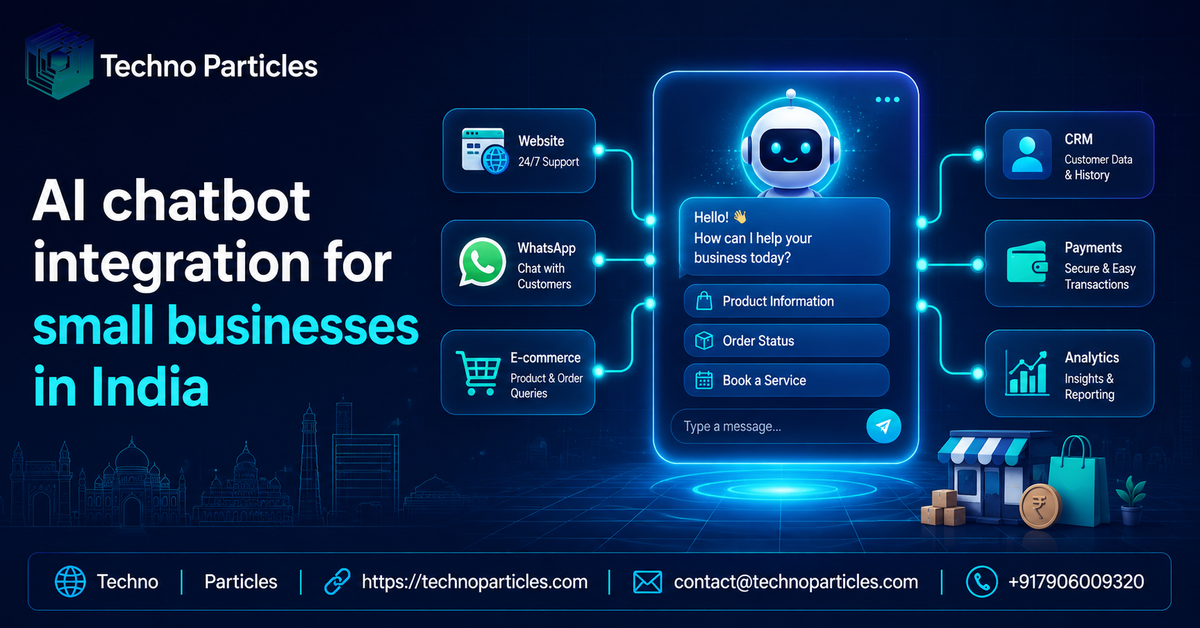
For many small businesses, answering every customer question quickly is difficult. Teams are busy managing orders, enquiries, staff, payments, and daily operations. AI chatbot integration for small businesses in India offers a practical way to provide fast, consistent assistance without requiring a large support department. A well-designed chatbot can respond to common questions, capture leads, recommend products, share updates, and transfer complex conversations to a human team member.
Modern chatbots are more capable than basic rule-based pop-ups. They can understand natural language, use information from approved business content, and connect with tools such as websites, WhatsApp, forms, calendars, help desks, and customer databases. The most valuable solution is not necessarily the most complicated one. It is the chatbot that solves specific customer problems while fitting the company’s existing workflow.
Why Indian small businesses are adopting AI chatbots
Customers increasingly expect immediate answers, especially when they are comparing suppliers, checking delivery details, or deciding whether to make a purchase. A delayed response can send a prospective buyer to a competitor. Chatbots help businesses remain available beyond office hours and manage repeated questions during busy periods.
Small businesses in India also serve varied audiences. A local retailer may need product and store information, while a manufacturer may receive enquiries about specifications, minimum order quantities, and distribution. An education provider may answer questions about courses and admissions. A travel company may handle itinerary requests, and a professional service firm may qualify leads before scheduling a consultation.
Language and channel preferences matter as well. Depending on the audience, a chatbot may need to support English, Hindi, or a combination of both. It may also need to work across a website and messaging platform so customers can begin a conversation where they are most comfortable. The objective should be convenient communication, not technology for its own sake.
Where a chatbot can create immediate value
- Lead capture: Ask visitors for their name, business requirement, budget range, and preferred contact method.
- Customer support: Answer questions about services, policies, operating hours, delivery, or documentation.
- Product discovery: Guide shoppers toward suitable products based on needs, use cases, or price preferences.
- Appointment booking: Collect details and connect users with a calendar or staff member.
- Order updates: Share status information when connected to an e-commerce or internal system.
- Internal assistance: Help employees find process instructions, forms, or frequently used information.
Businesses can begin with one focused use case and expand after reviewing real conversations. This reduces implementation risk and makes it easier to measure value.
Technology works best when it supports a clear customer journey. Businesses exploring a broader online improvement plan can review digital services for websites, applications, marketing, and business systems before selecting the right starting point.
AI Chatbot Integration for Small Businesses in India - Techno Particles
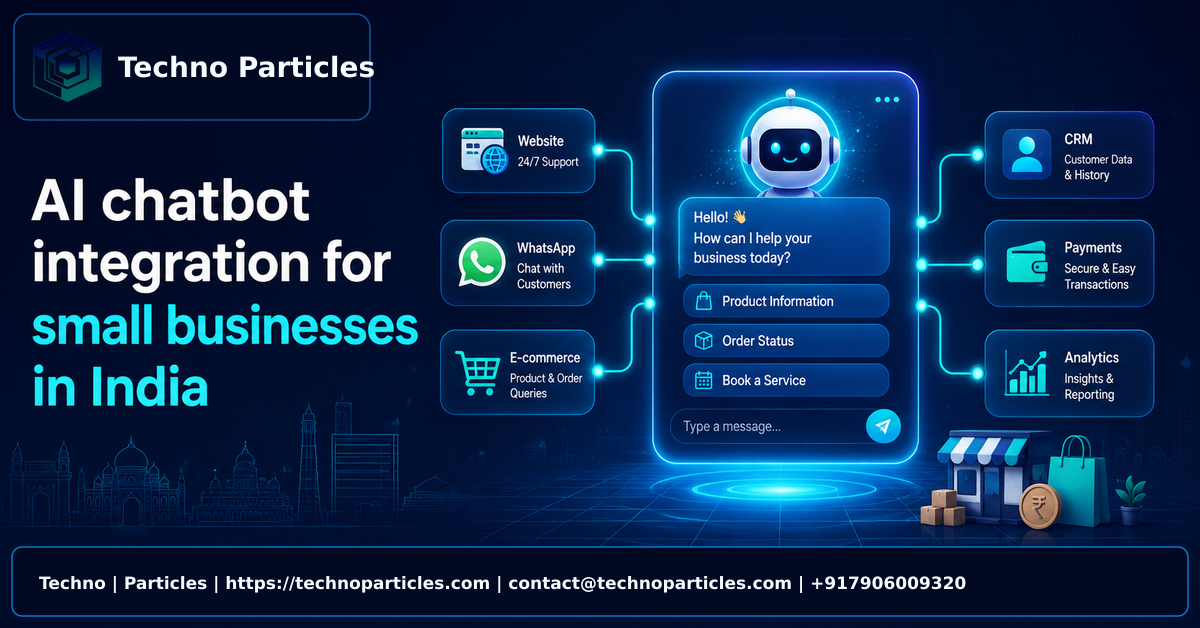
How AI chatbot integration works
A successful chatbot project usually begins with discovery. The business identifies its most common questions, priority customer groups, preferred communication channels, and the actions the chatbot should complete. This stage prevents vague expectations and helps define a useful first release.
The next step is preparing the chatbot’s knowledge base. Content may include service pages, product catalogues, pricing rules, return policies, operating procedures, brochures, and frequently asked questions. Information should be organized, reviewed, and kept current. If the source content is unclear or contradictory, the chatbot may provide inconsistent answers.
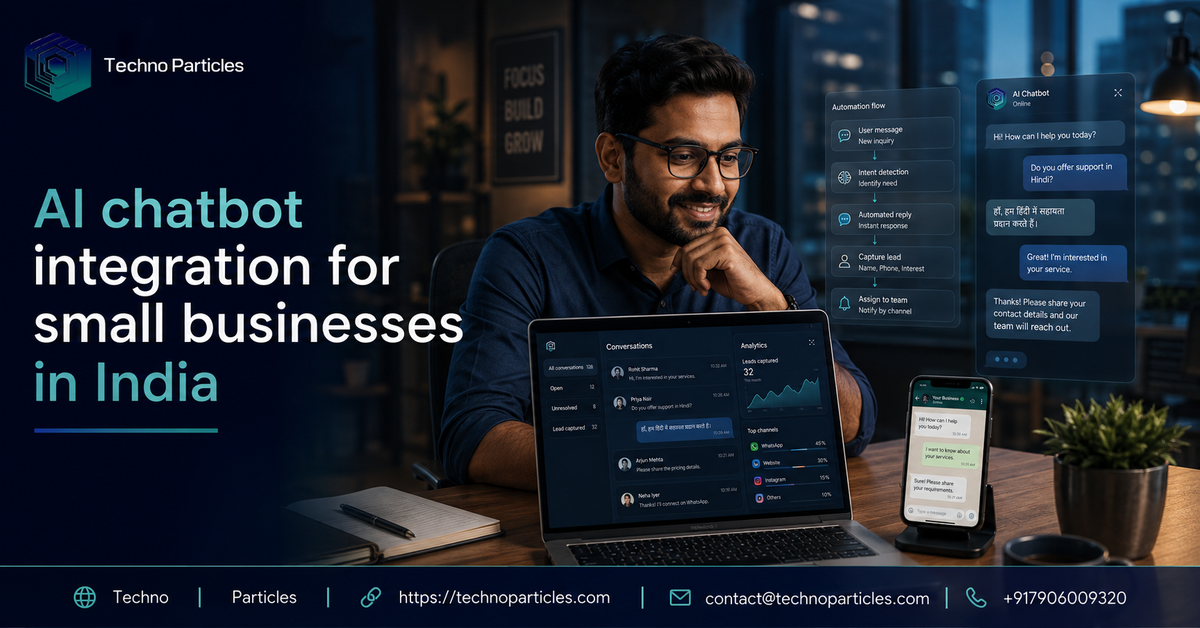
Conversation design is equally important. A good flow welcomes the user, understands intent, asks only necessary questions, provides a useful response, and offers a clear next step. It should recognize when it cannot help. In those cases, the chatbot can collect the conversation details and route the request to a person instead of creating frustration.
Integration connects the chatbot to the tools that make its responses actionable. For example, a website chatbot may send qualified leads to a lead management system, trigger an email notification, create an appointment request, or retrieve an order status. A WhatsApp-based assistant may use approved templates and pass high-value enquiries to the sales team.
Website, WhatsApp, and application chatbot options
A website chatbot is often the easiest starting point because the business controls the surrounding content and user experience. It can appear on service pages, product pages, landing pages, and contact screens. Website chatbots are especially useful for capturing visitors who are researching a company outside normal business hours.
WhatsApp chatbots can be valuable for businesses whose customers already prefer messaging. They may support enquiry handling, reminders, booking requests, and updates. However, the implementation must respect platform policies, customer consent, and message quality. A clear opt-in process is essential for responsible communication.
For businesses with more advanced workflows, chatbot capabilities can be built into a mobile or web application. An application assistant might help users navigate features, submit requests, access account information, or receive personalized guidance. This option requires careful planning around authentication, permissions, privacy, and backend architecture.
When the chatbot must support a complete digital experience, it helps to work with a team that understands both interface design and software engineering. Techno Particles provides responsive website development and custom application development for businesses that need connected customer journeys.
Key benefits for growing companies
The first benefit is faster response time. Visitors receive immediate guidance instead of waiting for a callback. The second is consistency. A chatbot can present approved information in the same way across repeated enquiries. The third is team efficiency, because staff spend less time answering routine questions and more time handling conversations that require judgment.
Chatbots can also improve lead qualification. By asking structured questions early, they help sales teams prioritize opportunities. Conversation data can reveal which products attract attention, where users abandon a journey, and what information customers repeatedly request. These insights can guide improvements to content, offers, and processes.
Results depend on implementation quality. A chatbot should be easy to find, simple to use, transparent about its role, and connected to a reliable handoff process. It should never make unrealistic promises or hide the option to speak with a person.
Planning the cost and scope
The cost of AI chatbot integration for small businesses in India depends on the chatbot’s purpose, channels, language support, knowledge sources, integrations, security requirements, and ongoing maintenance. A basic website assistant with frequently asked questions will require less work than a multilingual chatbot connected to inventory, CRM, payments, or appointment systems.
Instead of choosing a package only by feature count, businesses should define the desired outcome. Is the goal to generate more enquiries, reduce repetitive support work, improve product discovery, or help existing customers complete tasks? A focused objective makes it easier to select the right functionality and evaluate whether the investment is producing value.
A sensible rollout can include four stages:
- Discovery: Review customer questions, workflows, content, and technical requirements.
- Design: Create intents, conversation paths, escalation rules, and the chatbot’s tone of voice.
- Integration: Connect approved data sources, forms, messaging channels, and business systems.
- Optimization: Study conversations, correct weak answers, update knowledge, and improve conversion paths.
This phased approach allows a small business to learn from actual usage before expanding into more advanced automation.
Privacy, accuracy, and human support
Customer trust should remain central to every chatbot project. Businesses need to decide what information the chatbot can collect, where that information is stored, who can access it, and how long it is retained. Sensitive personal, financial, medical, or business information should receive appropriate protection and should not be requested casually.
Accuracy also requires ongoing ownership. Someone should review important answers, update outdated policies, and monitor conversations for misunderstandings. The chatbot should clearly identify itself as an automated assistant when appropriate. It should also provide a straightforward route to human support, particularly for complaints, complex purchases, or sensitive issues.
Language quality deserves attention in India’s diverse market. A literal translation may sound unnatural or create ambiguity. Businesses should test responses with real users and use terminology that matches their industry and audience. Short, clear answers are usually more effective than long paragraphs filled with technical language.
How to measure chatbot performance
Useful metrics depend on the business objective. A lead-generation chatbot may be measured by completed enquiries, qualified leads, appointment requests, and sales-team response rates. A support chatbot may focus on resolution rates, escalation volume, customer satisfaction, and the number of repetitive requests handled successfully.
Businesses should also review qualitative feedback. Look for questions the chatbot fails to understand, points where users leave, and situations where a human handoff happens too late. These observations often reveal improvements that a single conversion number cannot show.
Chatbot performance should be considered alongside the wider digital journey. A strong assistant cannot compensate for confusing navigation, slow pages, weak offers, or missing trust information. Combining chatbot insights with digital marketing strategy and SEO improvements can help attract the right visitors and guide them toward meaningful actions.
Choosing the right implementation partner
Look for a partner that asks about business processes, customer needs, content quality, integrations, and maintenance—not just the chatbot interface. The right team should be able to explain the proposed architecture, handoff process, data protections, testing plan, and ownership model in clear language.
For a growing company, AI chatbot integration for small businesses in India should be treated as a business improvement project. Start with a specific problem, build a dependable experience, monitor real conversations, and expand carefully. With thoughtful planning, a chatbot can help Indian small businesses respond faster, capture better opportunities, and give their teams more time for work that needs a human touch.
Businesses that need help defining the right automation roadmap can begin with project consultation from Techno Particles and create a practical path from idea to implementation.
Planning a practical chatbot rollout
A successful rollout begins with a focused first version. Instead of trying to answer every possible question, a small business can identify the conversations that occur most often or create the most delay. These may include service enquiries, product availability, appointment scheduling, delivery updates, pricing questions, or requests for basic documentation. A narrow scope makes it easier to prepare accurate responses and evaluate whether the chatbot is genuinely useful.
Prepare the information the chatbot needs
Before development starts, gather the material that will shape the assistant’s answers. This can include website pages, product details, service descriptions, frequently asked questions, return or cancellation policies, business hours, and internal response guidelines. Review this information for outdated wording and contradictions. If the source content is unclear, the chatbot may provide answers that sound confident but do not reflect current business practice.
- Define priorities: Decide whether the first goal is lead capture, customer support, appointment booking, or internal assistance.
- Set escalation rules: Identify questions that require a trained employee, such as complaints, sensitive account issues, or complex quotations.
- Choose useful channels: Consider the website, WhatsApp, social platforms, or other channels where customers already communicate.
- Assign ownership: Give specific team members responsibility for reviewing conversations and updating chatbot content.

Leave a comment