

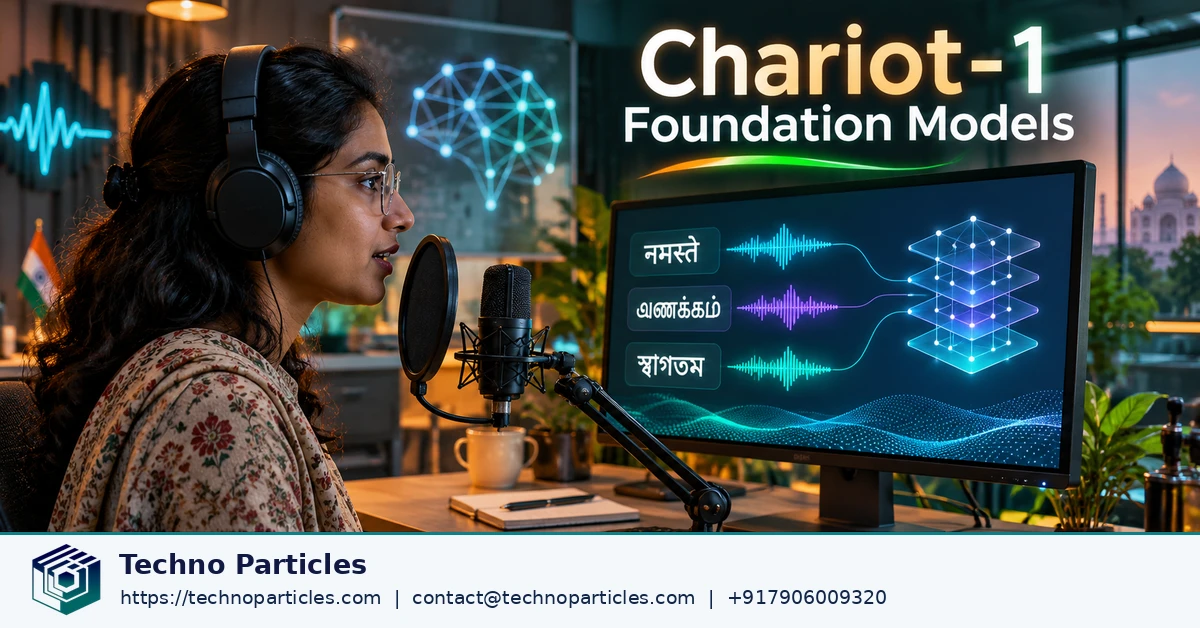
Chariot-1 Foundation Models: India’s New Multilingual AI Launch Explained begins with a significant distinction: the launch brings together a large language model and a text-to-speech model, two systems designed for different jobs. The language model works with text; the speech model turns written text into audio. Both are described as pretrained from scratch in India.
On 26 November 2026, the Ministry of Electronics and IT’s Press Information Bureau announcement said the IndiaAI Mission-supported models had been inaugurated by MeitY Secretary S. Krishnan at Bharat Mandapam in New Delhi. The announcement places multilingual technology alongside a broader effort to build AI capabilities in India.
| Launch detail | What the official announcement says |
|---|---|
| Foundation models | Chariot-1 LLM and Chariot-1 TTS |
| Training | Both are described as pretrained from scratch in India |
| Language model | An 11-billion-parameter mixture-of-experts model with 4 billion active parameters per token |
| Speech model | Text-to-speech support for English and 10 Indian languages, according to MeitY |
What changed at the Chariot-1 launch?
The announcement gives the two models a shared launch context while identifying separate roles. An LLM can serve as the text-processing component of an application, while TTS addresses the audio output a listener hears. That distinction matters when planning a multilingual experience: generating a response and speaking it are separate steps, even when a product combines them.
For teams considering conversational interfaces or document workflows, the launch is a reason to assess which part of an application needs language understanding and which needs speech output. A generative AI services overview describes related application areas such as conversational interfaces and document assistants.
The launch announcement confirms the models’ introduction, but it does not establish that their weights are universally accessible. Developers should distinguish the announcement of a foundation model from the terms under which a particular product or interface can be used.
How Chariot-1 approaches multilingual Indian AI
The Chariot-1 LLM uses a mixture-of-experts design. In this approach, a model has multiple groups of parameters, but only a portion is active for a given token, a unit of text processed by the model. MeitY describes Chariot-1 as an 11-billion-parameter model with 4 billion active parameters per token. Its 26 November 2026 announcement also lists models of 10.7 billion, 1.7 billion and 745 million parameters.
Those sizes give developers different model scales to consider when assessing a language application. Parameter count alone, however, does not establish how a model will perform on a particular task or device. A team building a multilingual interface would still need to evaluate its own workload and deployment requirements.
Three research ideas behind the language model
MeitY identifies IndicShift, Nested Training and Mixture of Vocabularies as research innovations associated with the model. The announcement presents these as part of the effort to develop language technology for India’s linguistic diversity. Their practical significance depends on how well the resulting model handles the languages and tasks an application actually needs.
For example, a mobile product may need to handle a customer’s request in one language and present information in another. That makes the language model’s behavior only one part of the experience: interface design, application integration and the quality of the underlying content also affect the result. The scope of application development can include these integration and testing decisions.
Speech that accounts for context
Chariot’s 12 November 2026 TTS announcement describes context-aware pronunciation and speech that mixes languages. This matters for text containing items such as prices, dates or abbreviations, where the spoken form depends on meaning rather than a simple character-by-character reading.
The official sources differ on language coverage: MeitY lists English and 10 Indian languages, while Chariot describes English and 11 Indic languages, including Urdu. Teams should check the product’s supported languages for their intended use.
Availability, pricing and usage limits
Chariot lists separate products for text-to-speech and speech-to-text, with different billing and usage rules. Its text-to-speech product page offers a free tier with 10,000 credits, described as approximately 10 minutes of audio, and five downloadable clips. Paid plans start at ₹499 per month.
The TTS page lists Starter, Creator, Startup and Scale plans with differing credit allowances, concurrency limits and commercial-use rights. Credits affect how much speech a team can generate, while concurrency affects how many requests it can handle at once. Both matter when comparing a small editorial workflow with an application serving multiple users simultaneously.
For speech-to-text, the official product page lists a rate of 1.5 credits per second. It also specifies limits of three minutes and 20 MB for recording uploads, and up to three hours for a WebSocket session. Upload and session limits describe different ways of submitting audio, so a workflow designed around recorded files should not assume the longer streaming session limit applies to each upload.
These published prices and limits belong to the TTS and speech-to-text products; they do not automatically establish pricing, quotas or access terms for the Chariot-1 foundation LLM. Teams budgeting for an application that both generates text and speaks it should account for the language-model component separately.
A useful planning distinction is whether an application needs audio generation, transcription or both. For example, a voice interface could transcribe a spoken request and then generate an audio response, making the two products’ separate usage rules relevant to the same interaction. A project consultation can help define those workflow requirements before a team chooses an implementation.
How developers can test Chariot-1 TTS
Developers can start with the Python example on Chariot’s text-to-speech product page. It uses the Python requests library to send text to the TTS API and receive generated audio. This is a speech-generation workflow; it does not establish an endpoint for the general-purpose Chariot-1 language model.
Prepare a speech request
The documented endpoint is https://api.chariot.in/v1/tts. The example passes an API key in the chariotai-api-key header and includes voice_id, text and model_type in the request. The documented model type is chariot-multilingual-v1. Use the product page’s example as the reference for the complete request and response handling.
The fields serve distinct purposes: the voice selection identifies the intended voice, the text field carries the words to speak, and the model type identifies the speech model. An application can keep these choices separate from its own interface, so an editor can change the text without changing the integration.
Fit generation into an application
The product page specifies a maximum of 1,000 characters per generation. For longer material, an application must divide the text into requests that fit the limit. Splitting at natural sentence boundaries can make the resulting clips easier to review and assemble, although teams should listen for changes in pacing between segments.
For a customer-facing feature, decide where the generated audio will appear and how users will access it. The documented audio format options can inform that choice. Teams planning the surrounding interface and integration can use the application development overview to identify related implementation work.

How to interpret the benchmark claims
Chariot reports several speech benchmarks, but each measures a different aspect of output. Its TTS evaluation reports a 7.60% Hindi character error rate, 93.78% English verbalization accuracy and a 4.901 Plain-English NISQA score. These figures address different questions and should not be combined into a single quality rating.
What the metrics measure
Character error rate compares recognized or transcribed characters with a reference. A lower rate means fewer character-level errors in that comparison. Verbalization accuracy concerns whether written material is spoken in the intended form. NISQA estimates aspects of perceived speech quality. A result on one metric does not establish performance on the others.
The MeitY announcement reports more than 97% verbalization accuracy on an Async TTS Pronunciation Benchmark. That is a different reported figure from Chariot’s English verbalization result. Without matching test definitions and conditions, readers should not treat them as interchangeable scores.
Compare methods before comparing scores
Test material matters. A public test set can make it easier to understand what was measured, but results still depend on the selected languages, speakers, recording conditions and scoring method. For example, a speech system evaluated on clean recordings may behave differently when users speak over background noise.
Chariot’s ASR announcement describes its own comparisons of streaming and batch speech recognition. Those comparisons concern recognition, not the TTS scores above. Check whether a comparison uses the same task and conditions before using it to assess a product choice.
These are reported results, not independent validation or evidence of a universal winner. A representative evaluation should reflect the actual workflow; the generative AI services page describes evaluation and human review as parts of that work.
Deciding whether to evaluate Chariot-1
Evaluate Chariot-1 Foundation Models: India’s New Multilingual AI Launch Explained as a candidate when your application needs to speak naturally across Indian languages and the people responsible for the product can assess the output in context.
For a first pilot, prepare a representative set of mixed-language text containing dates, prices and abbreviations, then have intended users listen to the generated audio.


Leave a comment
Your email stays private. You can see your comment immediately on this browser. Others see it after approval.