

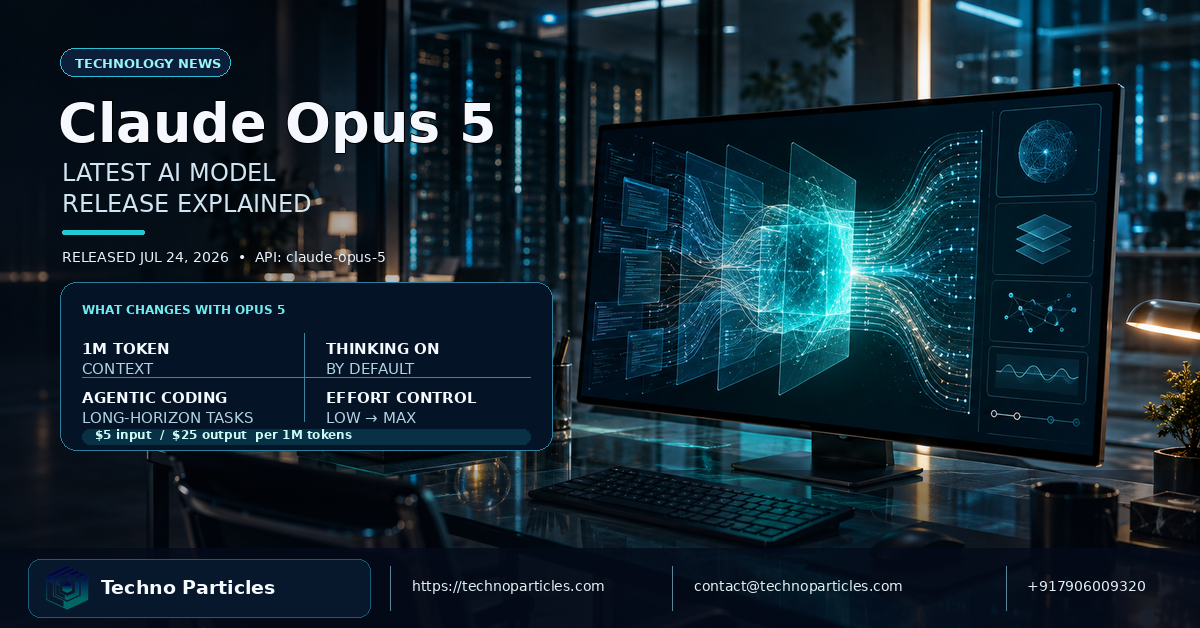
The Claude Opus 5 latest AI model release explained begins with a confirmed announcement: Anthropic introduced Claude Opus 5 on July 24, 2026, describing it as a major improvement for long-running agents, coding, and professional work. The release follows Claude Opus 4.8 and moves Anthropicâs premium Opus family to a new generation aimed at demanding, multi-step tasks.
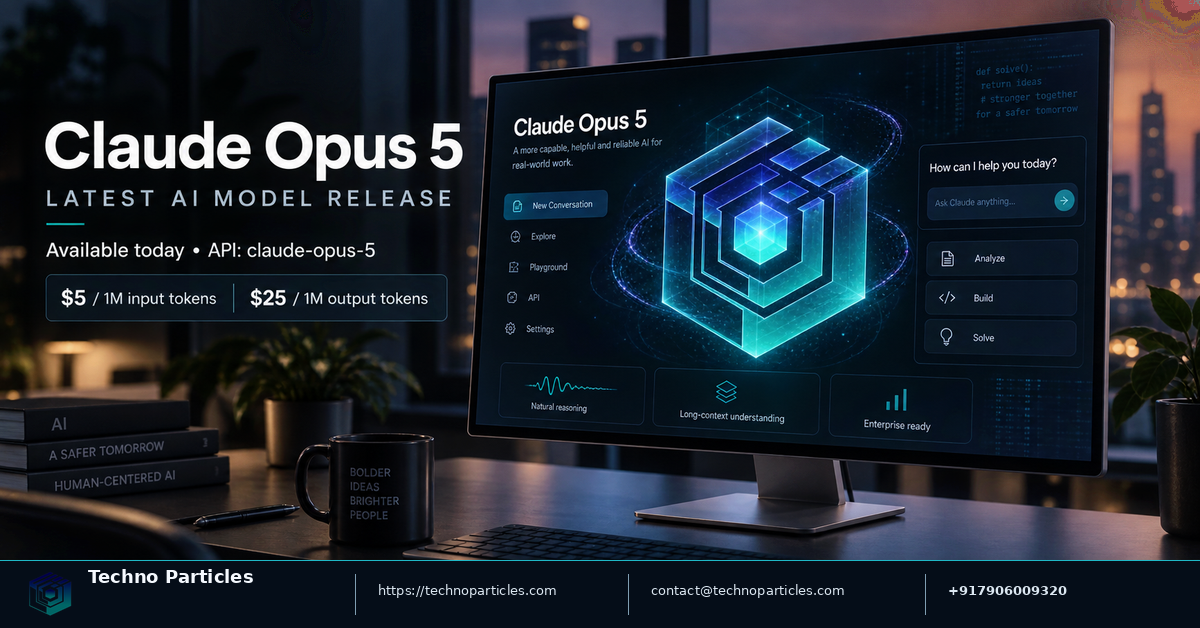
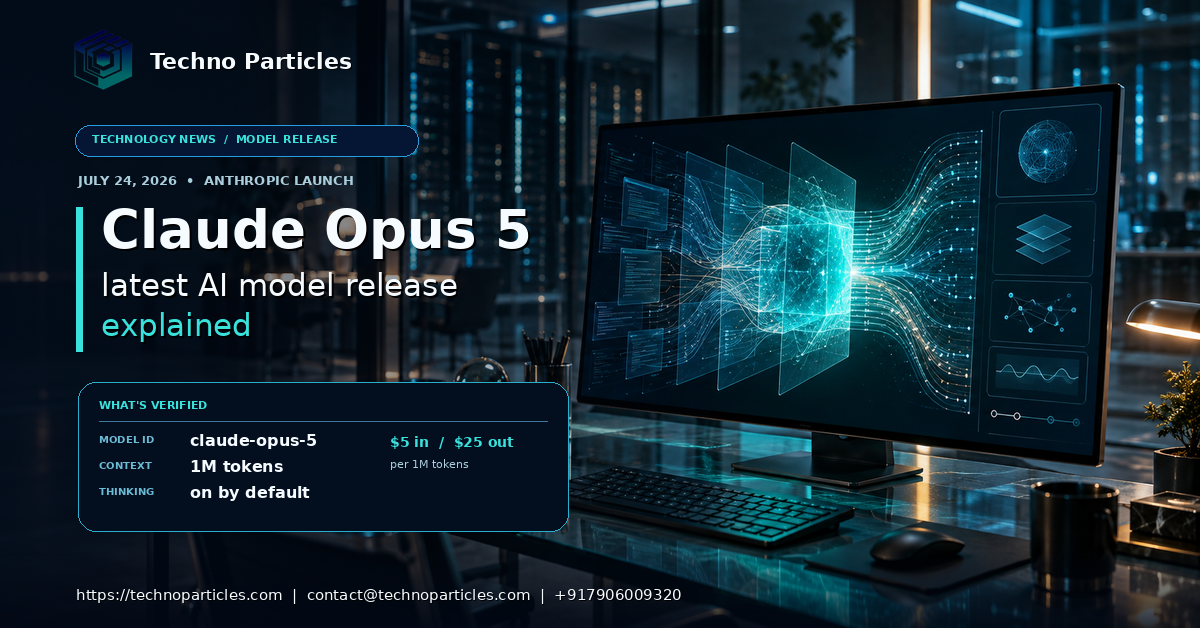
According to Anthropicâs announcement, Opus 5 is available immediately across Claudeâs consumer and business plans, the Claude API, Amazon Web Services, Google Cloud, and Microsoft Foundry. The model is identified in the API as claude-opus-5. Anthropic lists pricing at $5 per million input tokens and $25 per million output tokens, the same base pricing as Opus 4.8.
That combination of stronger capabilities and unchanged standard pricing is the central business story. Anthropic is not presenting Opus 5 simply as a chatbot upgrade. It is positioning the model as infrastructure for software engineering, AI agents, analysis, and complex document work that may continue for hours or across several sessions.
What changed in Claude Opus 5?
Anthropic says Opus 5 is a step-change improvement for the Opus tier. Its stated focus areas include advanced coding, agentic workflows, professional knowledge work, and better judgment during long tasks. The company says the model can plan carefully, verify its own work, preserve context across complex projects, and operate with less supervision than earlier Opus versions.
For developers, the most important change is not a single benchmark score. It is the modelâs ability to maintain a coherent plan while working through a large codebase or a sequence of tools. Anthropic describes Opus 5 as capable of handling feature development, debugging, code review, and architectural work while checking its output before reporting completion.
The company also highlights professional tasks involving spreadsheets, presentations, and documents. This suggests a broader target than programming alone. An enterprise user could ask the model to inspect a set of files, identify inconsistencies, prepare an analysis, create a draft presentation, and revise that presentation after feedback. The quality of the final artifact remains more important than the novelty of the workflow.
Why long-running agents matter
Traditional chat interactions are usually short and user-directed. An agentic workflow is different: the system may break a goal into steps, call tools, inspect results, revise its plan, and continue until it reaches a stopping condition. Opus 5 is designed for this longer horizon.
Anthropicâs announcement includes examples from early-access customers in coding, finance, legal work, design, research, and automation. These are company-published customer observations, so they should be understood as reported experiences rather than independent proof. Still, they illustrate the types of work Anthropic believes the model can support.
One highlighted capability is self-checking. In an example described by Anthropic, an agent monitoring a production service rechecked an apparent anomaly, determined that the signal was benign, recorded the correction in its memory, and retired unnecessary monitoring queries. That behavior points toward agents that can manage parts of their working context instead of repeatedly starting from the same assumptions.
Businesses should remain cautious. More autonomy can reduce repetitive supervision, but it also increases the importance of permissions, audit logs, approval gates, and recovery procedures. An agent that can make progress independently must also be prevented from making irreversible changes without authorization.
Techno Particles helps businesses assess practical AI automation through its Generative AI services, which can support use cases such as document automation, conversational systems, and workflow design.
Claude Opus 5 Latest AI Model Release Explained: What You Need to Know - Techno Particles
Claude Opus 5 for coding and software development
The Claude Opus 5 latest AI model release explained from a developerâs perspective is largely a story about reliability over long tasks. Anthropic says the model can understand large codebases, preserve requirements across multiple steps, catch mistakes during planning, and deliver production-ready code with minimal oversight. Those are ambitious company claims, so engineering teams should validate them against their own repositories before changing a production workflow.
Opus 5 may be particularly useful when a task has several connected parts. A developer could ask it to understand an existing service, propose a change, update multiple modules, write tests, run checks, inspect failures, and revise the implementation. Earlier systems often performed one step well but lost important context when the task became larger. Anthropicâs stated goal is to narrow that gap.
The practical advantage is not that the model replaces an engineering team. It is that experienced developers may delegate more of the mechanical work while keeping control of requirements, architecture, security, and release decisions. Human review remains necessary for authentication, payments, personal data, infrastructure configuration, and any change that could affect customers.
Effort settings and operational efficiency
Anthropic says Opus 5 includes effort settings that let users control how much reasoning the model applies. Higher effort is intended for difficult, high-value work, while lower effort can reduce cost and time for simpler tasks. This is important because model quality is only one part of the economics. A workflow that produces a strong answer but consumes excessive tokens or takes too long may not be suitable for routine business operations.
Anthropicâs official pricing begins at $5 per million input tokens and $25 per million output tokens. The company also states that prompt caching can provide savings of up to 90 percent and batch processing can provide 50 percent savings in supported scenarios. Those are official pricing claims, not a guarantee that every project will receive those reductions. Actual costs depend on prompt length, output size, cache behavior, request volume, retries, and the surrounding application.
Anthropic also offers a Fast mode that runs at approximately 2.5 times the default speed. The announcement says Fast mode costs twice the base price on the Claude Platform and is available through usage credits in Claude Code. Teams should compare the cost of faster completion with the value of reduced waiting time, especially for interactive development or customer-facing systems.
Availability across products and cloud platforms
For consumers and business users, Anthropic says Claude Opus 5 is available to Pro, Max, Team, and Enterprise subscribers. For developers, it is available natively on the Claude Platform and through AWS, Google Cloud, and Microsoft Foundry. Availability can still differ by account, region, contract, quota, or product surface, so organizations should confirm access in their own console and review the applicable terms.
Anthropic lists US-only inference at 1.1 times the standard input and output pricing for workloads that must run in the United States. That option may matter to organizations with contractual, regulatory, or internal data-location requirements. Buyers should also examine retention controls, administrator settings, logging, and data-processing terms before sending confidential material.
Teams integrating the model into an application should pin the documented model identifier, maintain evaluation tests, and create a fallback path. Even a compatible model update can change response style, refusal behavior, latency, tool calls, or formatting. Automated systems should validate outputs rather than assuming that a successful API response is a correct business result.
Techno Particlesâ application development services can be relevant when a company needs to connect an AI model with an existing portal, dashboard, CRM, or internal workflow. The model is only one layer of a reliable product.
Safety limitations and responsible use
The Claude Opus 5 latest AI model release explained fairly must include Anthropicâs safety disclosures. The company says its pre-deployment behavioral audit found Opus 5 to be its most aligned model to date, with lower reported rates of deceptive behavior and reduced susceptibility to misuse than the models included in its comparison. These are Anthropicâs own evaluation results and should be read alongside the accompanying system card, not treated as proof that the model is error-free.
Anthropic says Opus 5 does not advance the frontier in risky dual-use capabilities and remains behind its separate Mythos 5 model in biology research and offensive cybersecurity. The company also says it intentionally avoided training Opus 5 on cyber tasks, although general improvements have made it better at finding vulnerabilities. Safeguards restrict certain activities, including binary-based vulnerability scanning, penetration testing, and exploit generation.
Some flagged cyber requests in Claude.ai, Claude Code, and Claude Cowork can fall back to Opus 4.8 by default. Anthropic also describes automatic fallbacks for API users and a Cyber Verification Program for approved enterprises and researchers who need access for legitimate security work. These controls show why developers should design around the modelâs safety behavior instead of treating refusals as random failures.
How businesses should evaluate Opus 5
Companies should begin with a small, representative test set. Include real but properly protected examples from the intended workflow: long documents, ambiguous instructions, multilingual requests, incomplete records, structured outputs, and cases where the correct answer is uncertainty. Compare Opus 5 with the model currently in use on accuracy, consistency, latency, token consumption, tool-call quality, and human review time.
For an Indian SME, useful pilot projects might include extracting information from purchase orders, summarizing customer conversations, drafting proposals, classifying leads, reviewing website content, or assisting developers with a custom business application. In each case, define what the system may do automatically and what requires approval. Do not let a model send customer messages, change financial records, or modify employee data without suitable controls.
Context management is another priority. Opus 5 may work well with large amounts of information, but a large context window does not automatically make every answer accurate. Source documents can conflict, contain outdated instructions, or omit key details. Retrieval systems, document versioning, citations, validation rules, and clear escalation paths remain important.
What the release means for creators and digital teams
Creators may use Opus 5 for research planning, content outlines, presentations, interface concepts, and iterative editing. Its value will depend on the quality of the brief and the review process. A polished draft still needs fact-checking, brand judgment, accessibility review, and an understanding of the audience. Businesses should use AI to expand creative capacity while keeping people responsible for claims and final decisions.
For teams building websites or online campaigns, the surrounding digital experience matters as much as the model. Fast pages, clear navigation, useful content, analytics, and search visibility determine whether visitors can benefit from an AI feature. Techno Particles supports website development, SEO, and UI/UX design for organizations connecting new technology with a broader digital presence.
Final takeaway
The clearest conclusion from this Claude Opus 5 latest AI model release explained is that Anthropic is treating its flagship model as a work-oriented agent platform, not merely a faster chatbot. The July 24, 2026 release emphasizes sustained coding, professional knowledge work, tool use, self-checking, and longer-running projects. Opus 5 is available through Anthropicâs major product and cloud channels, with base API pricing of $5 per million input tokens and $25 per million output tokens.
Its strongest fit will likely be demanding workflows where better reasoning and fewer supervision cycles justify premium-model costs. Smaller models may remain more efficient for routine tasks.


Leave a comment