
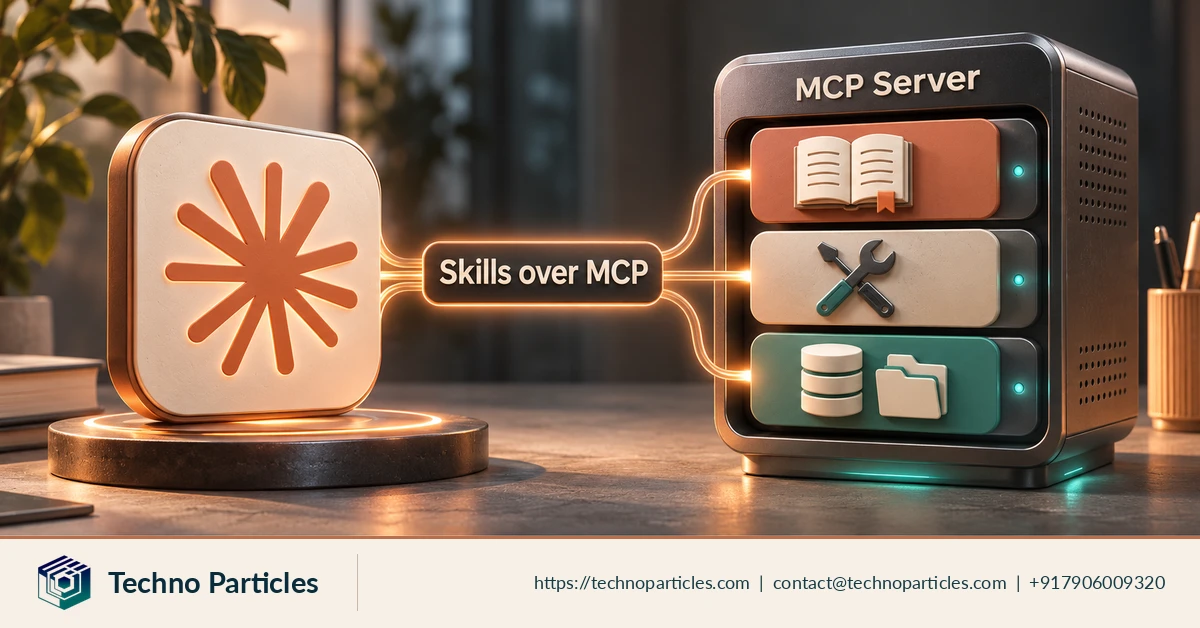
Claude Skills over MCP is a question about how an agent uses expertise alongside its connections to outside systems. Anthropic’s Agent Skills give agents reusable instructions and resources for specific tasks. The development is a change in stewardship: Anthropic announced that it was donating the standard to the Agentic AI Foundation.
The timeline matters for teams deciding how to document agent workflows. Skills began as an Anthropic capability, became an open standard, and are moving toward foundation governance. Each step affects how teams can think about sharing and maintaining procedural knowledge across agent platforms.
| Milestone | What Anthropic announced | Why it matters |
|---|---|---|
| October 16, 2025 | Agent Skills introduced | Reusable task guidance could be packaged with supporting resources. |
| December 18, 2025 | Agent Skills published as an open standard | The format was designed for use across compatible platforms. |
| October 22, 2026 | Donation to the Agentic AI Foundation announced | Stewardship was set to move toward vendor-neutral governance. |
What changed in Anthropic’s Agent Skills strategy
In its October 16, 2025 announcement, updated on December 18, 2025, Anthropic described a Skill as a folder centered on a SKILL.md file, with optional scripts and reference material. The update introduced Agent Skills as an open standard, giving other platforms a common format for compatible implementations.
On October 22, 2026, Anthropic announced the donation of Agent Skills to the Agentic AI Foundation. Anthropic also reported adoption by more than 70 agent platforms; that figure is the company’s claim. The donation changes stewardship rather than the basic Skill format.
For a business planning an agent project, the distinction makes workflow ownership easier to discuss: reusable instructions can be maintained as an asset alongside the application that uses them. An IT project consultation can help define where those instructions belong within a wider delivery scope.
Claude Skills over MCP: the capability split
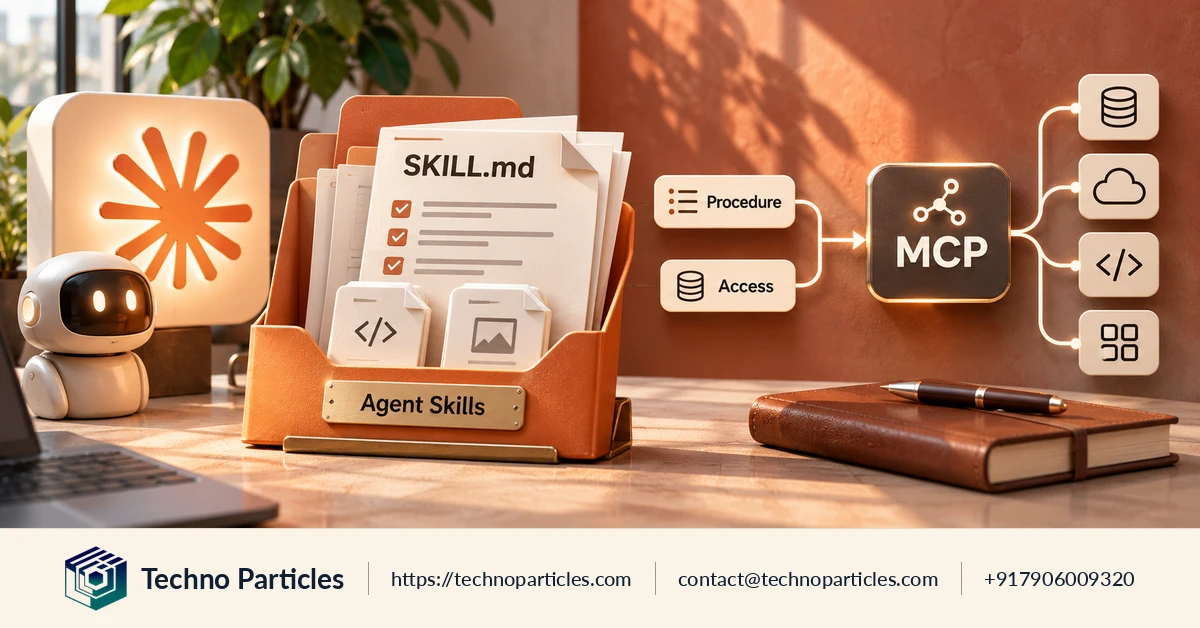
Skills and the Model Context Protocol (MCP) address different parts of an agent’s job. A Skill supplies procedural knowledge: instructions and supporting material that help an agent carry out a recurring task. MCP connects the agent to external services and data sources. Anthropic’s guide to Skills describes the two as complementary: MCP provides connectivity, while Skills give the agent guidance for using that access.
Consider an agent preparing a sales handoff. An MCP connection could let it access a lead-management system and retrieve the relevant record. A Skill could describe which information belongs in the handoff, how to organize it and which internal terminology to use. The connection gives the agent a way to reach the system; the procedure gives it a repeatable approach to the task.
That distinction also separates two kinds of change. If a team revises its handoff format, it can update the procedure. If it moves lead records to another system, it must address the connection to that system. In practice, a change can affect both layers, but naming them separately helps teams identify which part of the workflow needs attention.
Anthropic’s November 4, 2025 MCP research describes MCP as a standard for connecting agents to external systems. A Skill does not replace those connectors: instructions alone do not give an agent access to a live record or the ability to act in another application.
For teams designing an agent, the useful question is therefore not which layer wins, but where the required capability belongs. Work on generative AI services can involve both defining the agent’s task and integrating it with the systems that hold the information needed to perform it.
How an agent loads and executes a Skill
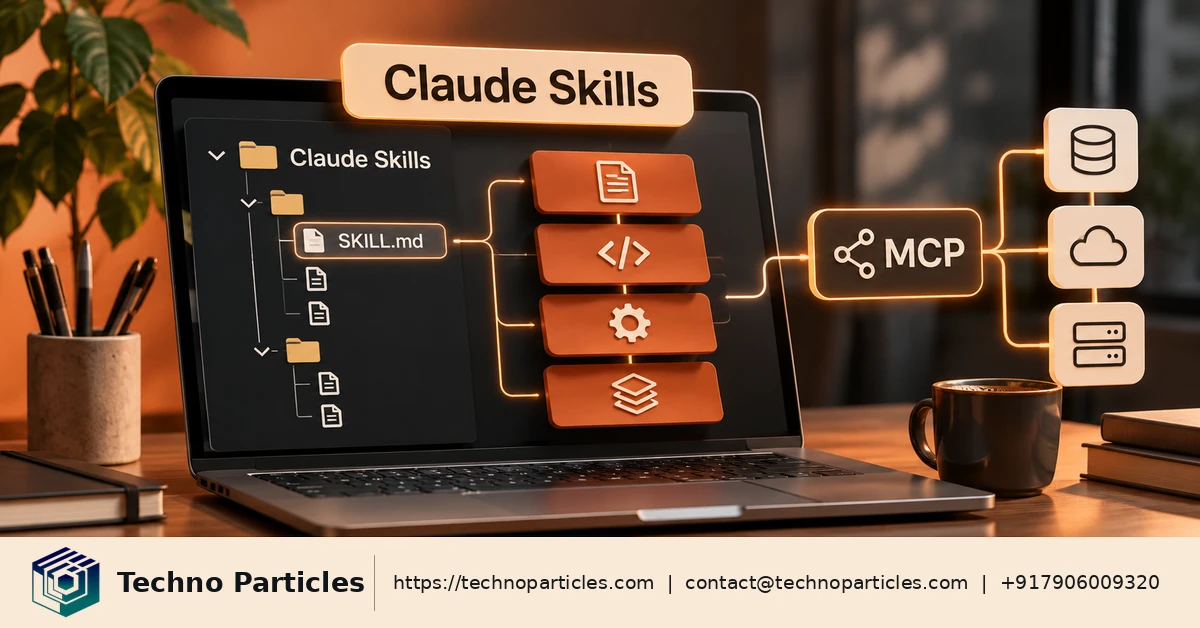
A Skill does not need to place its complete instructions in the agent’s context from the start. Under the Agent Skills specification, an agent first sees metadata describing the available Skills. When a task calls for one, it can load the corresponding SKILL.md instructions and consult supporting resources as needed. This staged approach is called progressive disclosure.
The distinction matters when a team maintains many procedures. A Skill for preparing a document might describe the task in its main instruction file while keeping a template and detailed reference material in separate files. The agent can identify the relevant procedure from its description before reading the supporting material. Authors can update those resources as part of the Skill package.
Instructions and executable resources
A Skill can also include scripts for work that benefits from repeatable execution. Anthropic’s Agent Skills research gives PDF form extraction as an example: code can handle a defined operation while the instructions guide the surrounding task. Execution behavior depends on the host agent and its available sandbox.
In the Claude API Skills guide, developers configure selected Skills through container.skills and enable the code execution tool. Anthropic’s Python example selects the pptx Skill with type anthropic and version latest. The configuration identifies the packaged expertise the request can use; it does not require copying the whole procedure into the user’s prompt.
For teams building an application around an agent, this packaging creates a distinction between the application’s request and the instructions maintained with a Skill. A developer can identify the Skill in the request while keeping its task-specific resources together. That can make a reusable workflow easier to maintain across application features, including those considered during application development.
Availability, plans and API limits
Anthropic’s Skills availability guide lists support for Claude Free, Pro, Max, Ultra, Team and Enterprise plans when code execution is enabled. Skills are also available in Claude Code. For API users, Anthropic describes Skills support as beta.
For an organization, access involves more than deciding which employees can use an agent. Team and Enterprise owners can provision Skills across their organization, giving them a way to distribute a shared procedure. That can be useful when several people need to follow the same document preparation or reporting process, while the organization maintains the instructions centrally.
API request and workspace boundaries
The API guide sets a limit of 20 Skills per request and states that custom Skills are private to the workspace. API builders therefore need to decide which procedures belong in each request and where custom packages should be maintained. The guide also requires a compatible model and code execution for Skills.
The request limit is a design boundary, not a recommendation to include 20 Skills every time. An application that supports several distinct tasks can select the procedures relevant to each task instead of treating every available Skill as a necessary part of every request. Workspace privacy also matters when teams plan how to maintain custom procedures across their development environments.
These choices can affect the scope of an agent project. When a workflow involves shared instructions as well as integrations, teams assessing generative AI development can define who maintains each custom Skill and which requests need it. Separate Skill pricing or credit allowances are not established by the cited sources.
What changes for MCP-heavy agent architectures
As an agent gains access to more external systems, the descriptions of available tools can consume a growing share of its context. Anthropic’s November 4, 2025 research on code execution with MCP also identifies a second source of overhead: intermediate results may pass through the model even when only a small part is needed for the final task.
Consider a workflow that gathers records from one service and updates another. If the agent must inspect every intermediate result, a large volume of data can compete with the instructions and conversation for context space. Anthropic describes an alternative in which code calls MCP tools and processes results before returning the relevant information to the model. The model can then work with a narrower result while the connected tools handle access to the underlying systems.
Orchestration choices and their trade-offs
Code-side orchestration is one approach to managing a large tool library. In its November 24, 2025 advanced tool-use research, Anthropic also describes tool search and programmatic tool calling as related ways to manage tool discovery and multi-step operations. The choice depends on where a workflow accumulates complexity: finding the right tool and processing a large intermediate result are different problems.
These techniques can reduce context pressure, but running code adds infrastructure and security complexity. Teams need to consider the execution environment, sandboxing and monitoring alongside the permissions granted to connected tools. A project consultation can help define those boundaries when planning an agent workflow.
Skill review belongs in that architecture as well. Anthropic’s Agent Skills security guidance notes that Skills can include executable resources. Review the instructions, bundled scripts and references before introducing a third-party package, and assess how it interacts with the tools and data available to the agent.
Choose the layer that owns the problem
For Claude Skills over MCP: what Anthropic’s new agent workflow changes, the decision is to use MCP for access and actions, Skills for reusable procedures, and both when a workflow needs live systems and institutional knowledge.
Start with one repeatable workflow: package its procedure as a versioned Skill, connect one narrowly scoped MCP service, and evaluate how the agent behaves.


Leave a comment
Your email stays private. You can see your comment immediately on this browser. Others see it after approval.