

Anthropic has released Claude Sonnet 5, a new model designed to move coding assistants closer to autonomous software-engineering agents. Announced on June 30, 2026, Sonnet 5 can plan work, use browsers and terminals, inspect project context, and continue through multi-step tasks with less supervision. The release is important because Anthropic is positioning a mid-tier Sonnet model near the capability of its larger Opus family while keeping the price lower.
For developers, the change is not simply a faster chatbot that writes snippets. Sonnet 5 is intended to investigate bugs, edit code, run tests, use tools, and verify results as part of one workflow. Anthropic says the largest improvements over Claude Sonnet 4.6 are in coding and agentic tasks, including situations where an AI must maintain a plan across several actions rather than answer one isolated question.
What Anthropic announced
Claude Sonnet 5 is available through the Claude API under the model ID claude-sonnet-5. Anthropic also lists availability through Claude, Amazon Bedrock, Claude Platform on AWS, Google Cloud, and Microsoft Foundry. On consumer and workplace plans, it is available to Free, Pro, Max, Team, and Enterprise users, with Sonnet 5 becoming the default for Free and Pro accounts.
The company describes Sonnet 5 as its most agentic Sonnet model yet. In practical terms, that means the model is optimized for sustained reasoning and tool use. A coding agent can examine a repository, identify relevant files, form a plan, make changes, execute a test command, review the output, and revise the implementation. The model still needs a controlled environment and appropriate permissions, but the intended workflow is much closer to delegation than traditional autocomplete.
Why the release matters for coding teams
Agentic coding is valuable when the difficult part is not producing a line of syntax but understanding a system. Real projects contain legacy code, undocumented conventions, hidden dependencies, failing tests, deployment constraints, and business rules that are scattered across files. A model that can maintain context and use tools can potentially handle more of the investigation before a human engineer reviews the final change.
That could help teams with repository maintenance, test generation, documentation updates, migration work, bug reproduction, and routine feature delivery. Startups may use an agent to move quickly across a smaller codebase, while established businesses could use it for brownfield systems that are expensive to understand manually. In India, SMEs that do not maintain large internal engineering teams may also find this model relevant when working with an external application-development partner.
However, âagenticâ does not mean reliable autonomy in every environment. A model can misread requirements, choose an inefficient approach, introduce a security issue, or stop after a superficially successful test. Human review, version control, isolated execution, secrets management, and a clear approval process remain essential. The most useful mental model is an exceptionally capable junior-to-mid-level engineering collaborator that can work quickly but still requires supervision.
Businesses evaluating this technology should first map the workflow, not merely compare model names. A well-scoped task with tests, documentation, and limited permissions is a better starting point than allowing an agent unrestricted access to production systems. Teams building such workflows can combine AI with custom application development, backend controls, and audit logging so that automation remains accountable.
Claude Sonnet 5 Agentic Coding Model Release Explained - Techno Particles
Technical changes developers should understand
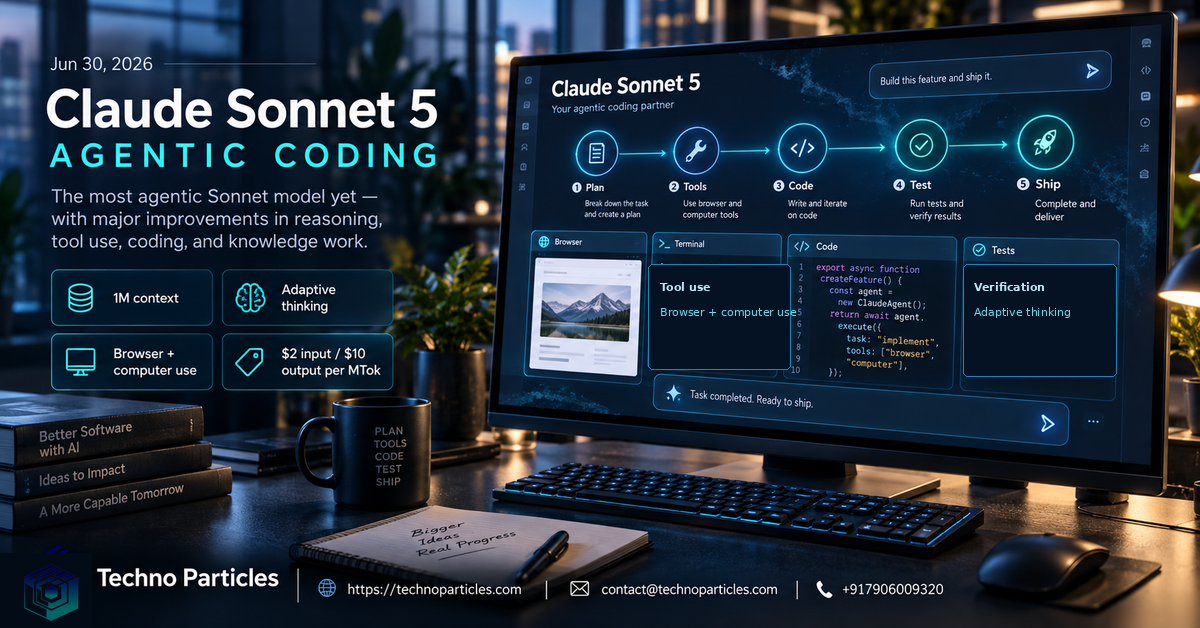
Anthropicâs documentation describes Claude Sonnet 5 as a drop-in upgrade from Claude Sonnet 4.6, but migration still requires attention. The model supports a one-million-token context window by default and a maximum output of 128,000 tokens. That creates room for long repository investigations, extensive documents, and multi-step agent traces. The context window is useful, but it does not remove the need for good retrieval, summarization, and prompt organization.
One important behavior change is adaptive thinking. On Sonnet 5, adaptive thinking is enabled by default for requests that do not explicitly disable thinking. Developers can use an effort setting to influence how much reasoning the model applies, or disable thinking when a workload needs a simpler response. Because the total output limit includes thinking and visible response text, applications that were tuned on Sonnet 4.6 should review their max_tokens settings.
Manual extended thinking is no longer supported. Requests using the older configuration with budget_tokens return a 400 error, so integrations should migrate to adaptive thinking. Non-default values for temperature, top_p, or top_k also return a 400 error. Anthropic recommends removing those parameters and using system instructions when an application needs behavioral guidance.
The tokenizer trade-off
Sonnet 5 introduces a new tokenizer. Anthropicâs documentation says the same input text produces approximately 30% more tokens than it did with Sonnet 4.6, although the increase depends on the content. This matters for more than billing. Token counts, context capacity in terms of actual text, output limits, caching calculations, and monitoring dashboards may all change.
The per-token price is lower: $2 per million input tokens and $10 per million output tokens, compared with the documented $3 and $15 pricing for Sonnet 4.6. Yet a comparable request may not become 33% cheaper because the new tokenizer can represent the same text with more tokens. Developers should measure real prompts with Sonnet 5 rather than estimating savings from the headline rates alone.
The model also adds browser-use support and a stable computer-use tool version on the Claude API and Google Cloud. These capabilities can connect coding or business agents to interfaces and web workflows, but they introduce additional operational risk. Browser automation may encounter prompt injection, misleading content, permissions problems, or irreversible actions. Applications should restrict domains, separate browsing from sensitive credentials, and require approval before sending messages, changing records, or publishing code.
Comparing Sonnet 5 with Opus and older Sonnet models
Anthropic says Sonnet 5 substantially improves reasoning, tool use, coding, and knowledge work over Sonnet 4.6. The company also says higher-effort Sonnet 5 can match Opus 4.8 on some tasks while offering a broader range of cost-performance options. These are company-reported comparisons, not a guarantee that every repository or workflow will show the same result.
The sensible choice depends on task complexity. Sonnet 5 may fit frequent coding, customer-support automation, documentation, and workflow agents where cost and speed matter. Opus remains the better candidate for unusually difficult reasoning or specialized work when the additional price is justified. Haiku-class models may still be preferable for simpler classification, extraction, or high-volume low-latency tasks. A production team should test representative tasks instead of choosing from a benchmark headline.
For implementation planning, teams can pair model evaluation with generative AI development, project consultation, and an SEO-aware web or application architecture. The model is most valuable when it is placed inside a measurable process with clear inputs, tests, human checkpoints, and rollback options.
Safety, access, and practical limitations
Anthropic says its pre-deployment assessments found lower rates of undesirable behavior, hallucination, and sycophancy than Sonnet 4.6, along with better resistance to prompt-injection hijacking. The company also reports that Sonnet 5 has weaker dangerous cybersecurity capability than its current Opus models. These findings are useful context, but they remain Anthropicâs evaluations and should not be treated as proof that an agent is safe without application-level controls.
Sonnet 5 launched with real-time cybersecurity safeguards enabled by default. High-risk or prohibited requests can be blocked, and the documentation says such refusals return a successful HTTP response with a refusal stop reason rather than an API error. Legitimate security teams may need the Cyber Verification Program for eligible workflows. Anthropic recommends Opus 4.8 for cybersecurity work that requires reduced guardrails.
Availability is broad, but platform details differ. The API is available to all customers, while cloud deployments use their respective Anthropic integrations. Sonnet 5 supports zero data retention for organizations with suitable agreements. It is also not available through every legacy integration, and the documentation identifies Priority Tier as an exception among Sonnet 4.6 platform features. Teams should confirm region, contract, rate limit, logging, retention, and tool availability before committing to a migration.
What businesses can do with Claude Sonnet 5
Software teams can use Sonnet 5 to review pull requests, create regression tests, explain unfamiliar modules, draft migration plans, or triage incoming issues. Product teams can ask an agent to turn approved requirements into a technical checklist and prototype. Operations teams can connect controlled tools to CRM, CMS, ERP, or lead-management workflows, provided every action is authorized and auditable.
For an e-commerce company, an agent might inspect catalog data, identify formatting problems, propose corrections, and prepare a review queue. For an education business, it might help maintain a learning platform or organize support tickets. A manufacturer could use it to summarize technical documentation and route requests to the right internal team. These examples are workflow patterns, not guarantees of autonomous success, and they require integration design around permissions and data quality.
Creators and marketers should also be realistic. Sonnet 5 can help with content planning, code-based landing pages, analytics queries, and campaign operations, but generated output still needs brand, factual, accessibility, and search-quality review. An organization investing in SEO services or UI/UX design can use the model to accelerate production while keeping strategy and final judgment with specialists.
Claude Sonnet 5 agentic coding model release explained: final takeaways
The Claude Sonnet 5 agentic coding model release explained in simple terms is this: Anthropic has made sustained coding and tool use more accessible at Sonnet pricing. The model can plan, browse, use computer tools, reason adaptively, and produce long outputs, while its API price is $2 per million input tokens and $10 per million output tokens.
The important caveat is that lower per-token pricing does not automatically equal lower workflow cost because the tokenizer produces more tokens for the same text. Migration also requires changes to thinking settings, sampling parameters, and output budgets. Teams should run a pilot on real repositories, compare completed tasks and token usage, and measure review time rather than relying only on vendor benchmarks.
For Techno Particles and the businesses it serves from Agra across India, the release signals a broader shift in software delivery: AI is becoming a participant in the workflow, not just a chat window beside it. The strongest results will come from combining capable models with secure integrations, well-designed applications, clean data, human approval, and dependable testing. Sonnet 5 may reduce the effort required for many engineering and automation tasks, but responsible system design remains the difference between an impressive demo and a dependable business tool.
Organizations exploring that path can begin with the technology services overview and identify one repeatable, low-risk process for a measured proof of concept. That approach keeps the benefits concrete while leaving room to learn where Claude Sonnet 5 genuinely improves speed, quality, and operational efficiency.


Leave a comment