

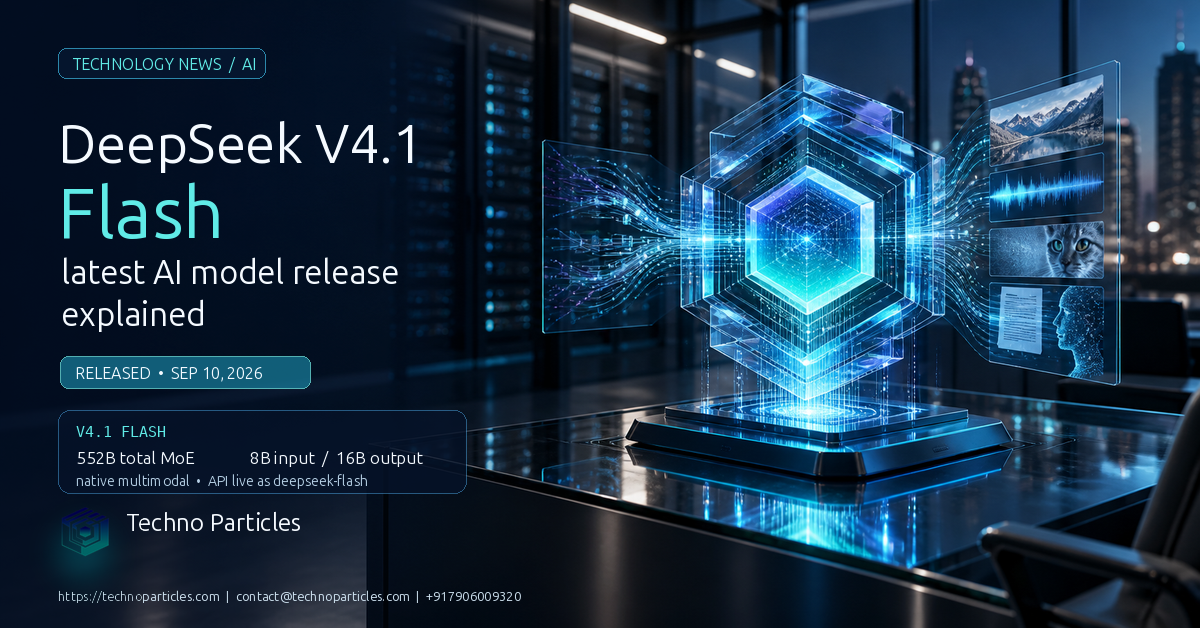
DeepSeek V4.1 Flash is the latest AI model release from Chinese AI company DeepSeek, and it arrives with a notable change in priorities: more useful agent capabilities, native image understanding, faster inference, and lower memory costs. DeepSeek announced the model on September 10, 2026, describing it as the smallest model in a new architecture family.
The announcement matters because Flash is no longer positioned simply as a cheaper companion to DeepSeek V4 Pro. DeepSeek says V4.1 Flash has surpassed its larger predecessor across performance, cost, speed, and total runtime in extensive testing. Those are company claims, so they should be read alongside the published evaluation setup and independent testing as it becomes available. Still, the release signals an important direction for AI infrastructure: efficiency can be as important as raw parameter count.
What DeepSeek V4.1 Flash changes
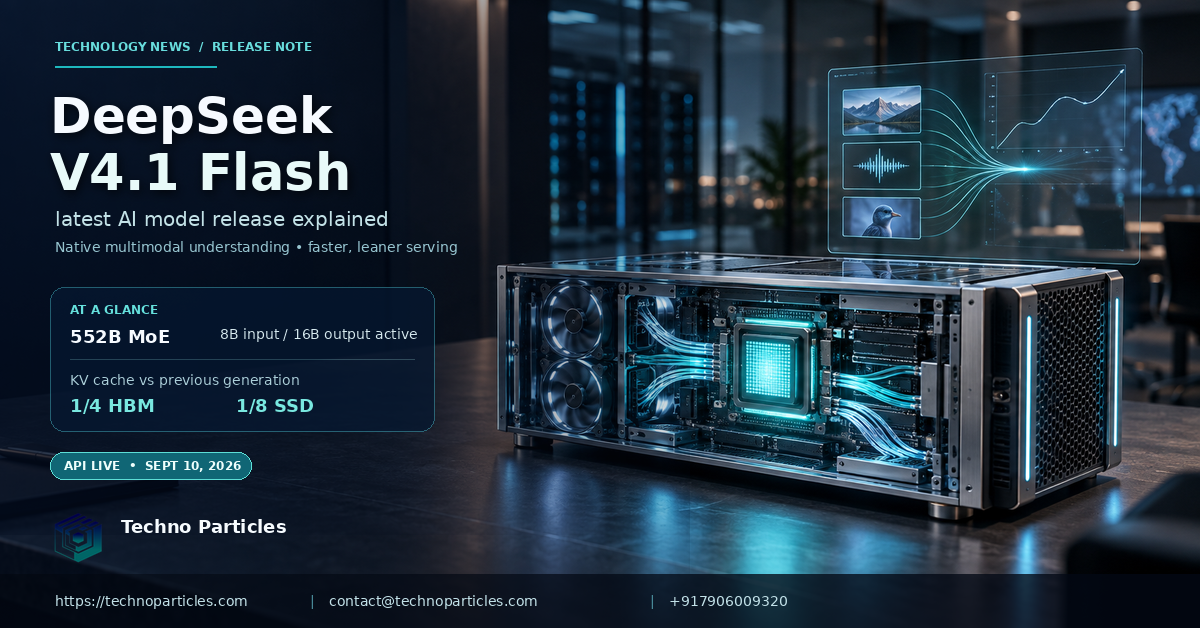
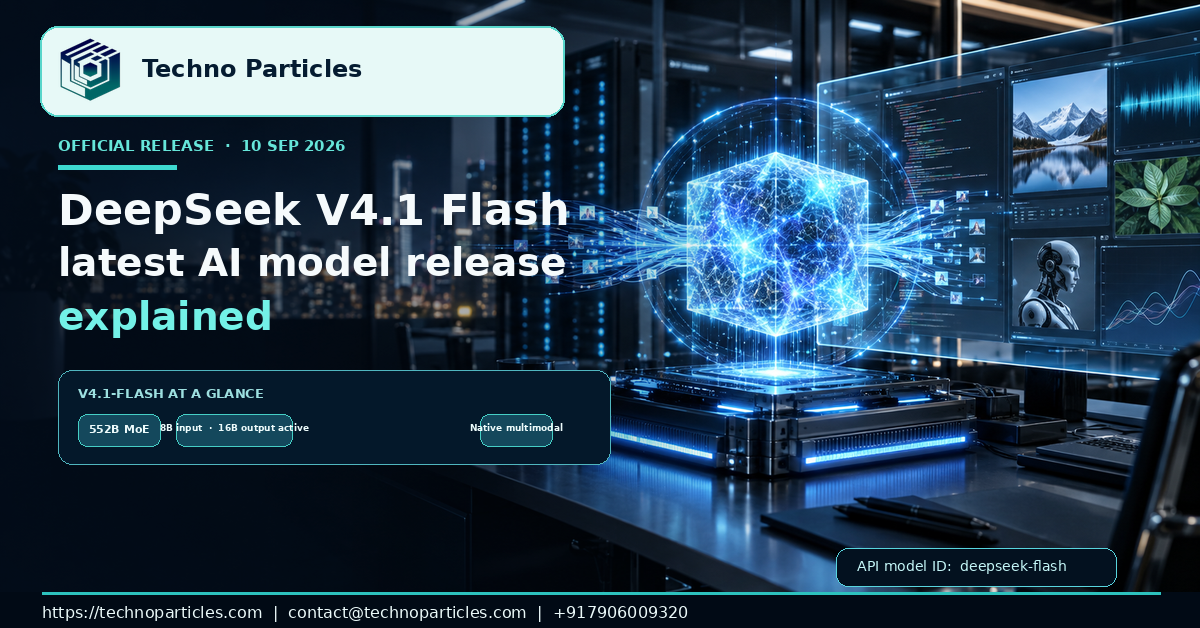
At the center of the release is a 552-billion-parameter mixture-of-experts model using a new Causal Encoder-Decoder architecture. DeepSeek reports that only 8 billion parameters are active during input processing and 16 billion during output generation. In practical terms, the model retains a large knowledge and capability base while limiting the computation required for each token.
This asymmetric design is especially relevant to agents. An agent may repeatedly read long instructions, source files, documents, screenshots, or tool outputs before producing a comparatively short action. Reducing the cost of that input-heavy stage can improve both response time and operating economics. For companies building internal assistants, coding agents, research systems, or workflow automation, that can be more valuable than a small improvement on a conventional chatbot benchmark.
DeepSeek also reports a context window of up to one million tokens. A context window of that size can help an application work across large codebases, lengthy contracts, product catalogs, support archives, or multi-step project records. However, a maximum context window is not the same as guaranteed perfect recall. Developers still need retrieval, document organization, careful prompting, and testing for lost details or conflicting instructions.
Native multimodal understanding arrives in Flash
Another major upgrade is native visual understanding. V4.1 Flash can process images together with text, which opens the door to chart interpretation, document analysis, interface review, visual troubleshooting, and image-assisted coding. DeepSeekâs technical report describes a vision encoder and a projector that connect visual embeddings with the language model during training.
For a business, this could mean an assistant that reviews a photographed invoice, identifies information in a product image, summarizes a dashboard, or explains a software screenshot. The quality of each use case will depend on image resolution, layout complexity, language, and the surrounding prompt. Native vision is a confirmed capability; it is not proof that every visual task will be reliable without human review.
The model is available through the generative AI development services that businesses may use when turning model capabilities into practical applications. A model alone does not create a dependable product. Data handling, authentication, interface design, monitoring, and fallback workflows remain essential.
Why the architecture matters for AI costs
DeepSeek says V4.1 Flash reduces its global key-value cache footprint to roughly one-quarter of DeepSeek V4 Flash and requires one-eighth of the previous generationâs SSD storage for the cache. The technical report attributes the reduction to several components, including compressed sparse attention, bounded replay, FP4 key-value caching, and the Causal Encoder-Decoder structure.
KV cache is temporary information kept while a model processes a conversation or long-running task. In an agent system, cache storage can become a major expense because the model repeatedly refers to a growing history. Smaller caches can lower memory pressure, improve throughput, and make long-context workloads more practical. DeepSeek says off-peak API rates remain half of peak rates, with revised pricing taking effect alongside the release, although teams should consult the live pricing page before budgeting.
DeepSeek V4.1 Flash: The Latest AI Model Release Explained - Techno Particles
Benchmarks show a stronger agent focus
DeepSeekâs published results place V4.1 Flash above V4 Pro on several agentic and coding evaluations. The company reports scores of 90.6 on Terminal-Bench 2.1, 74.2 on DeepSWE v1.1, 64.0 on NL2Repo-Bench, 88.1 on CyberGym, and 54.8 on AutomationBench. It also reports a Codeforces rating of 3471 and a GPQA Diamond score of 90.9.
These numbers are useful indicators, but they are not universal guarantees. The technical report says the code-agent tests used DeepSeek Harness settings, long contexts, and maximum reasoning effort. Some evaluations used specific scaffolds, temperatures, or tool configurations. Results can change when the same model is connected to a different agent framework, repository, operating system, tool set, or prompt strategy.
One particularly important detail is the reasoning-effort control. DeepSeek V4.1 Flash supports a continuously adjustable reasoning effort from 1 to 100. A lower setting can reduce latency and cost for routine requests, while a higher setting can allocate more computation to difficult problems. This gives developers a practical control knob instead of forcing every request through the same expensive reasoning path.
API availability and model naming
DeepSeek says V4.1 Flash is live on its API with native multimodal support. Developers should use the model name deepseek-flash when calling the latest version. The older names deepseek-v4-flash and deepseek-v4-flash-vision-exp are temporarily routed to V4.1 Flash for compatibility, according to DeepSeekâs announcement.
There is also a significant transition for V4 Pro users. DeepSeek said that from September 14, 2026, requests using deepseek-v4-pro would be routed to V4.1 Flash and billed at V4.1 Flash rates until V4.1 Pro launches. Teams with production integrations should verify their model routing, response format, image handling, token limits, and billing records rather than assuming that an old identifier still represents the same model.
DeepSeek identified WorkBuddy, including CodeBuddy, and OpenCode as official partners supporting the new model. The model repository on Hugging Face lists an MIT license and provides instructions for Transformers, vLLM, SGLang, Docker Model Runner, and quantized deployments. That expands experimentation options, although local operation is still a substantial infrastructure project because the model has a very large total parameter count.
What developers can build with it
The combination of long context, tool use, coding performance, and vision is a natural fit for software agents. A development team could use V4.1 Flash to inspect a repository, propose a change, run tests, interpret screenshots, and prepare a review summary. The agent should still operate inside controlled permissions, isolated environments, and approval gates.
Businesses can also explore document workflows. A model that reads text and images may help classify forms, extract fields, compare versions, answer questions about manuals, or route support cases. For Indian SMEs, manufacturers, distributors, education companies, and e-commerce operators, these workflows can connect AI to existing CMS platforms, CRM systems, inventory tools, or customer portals.
Long-context capabilities are also relevant to enterprise search. Instead of asking an assistant to answer from a single short passage, teams can provide larger collections of policies, specifications, product data, and project history. The right architecture may still use retrieval and ranking to control relevance. Passing an entire archive into a prompt is not automatically more accurate or more secure.
Limits and practical risks
V4.1 Flash remains a probabilistic system. It can produce incorrect explanations, misunderstand a chart, generate flawed code, or follow a misleading instruction inside an uploaded document. Security testing is particularly important for tool-using agents because prompt injection, unsafe commands, excessive permissions, and data leakage can turn a language-model error into an operational incident.
Companies should also check regional availability, data-retention terms, latency, service status, compliance needs, and support expectations before moving sensitive workloads to production. API pricing can change, and peak versus off-peak schedules may affect monthly costs. A pilot with real business examples is more informative than relying only on a headline benchmark.
For teams that need an end-to-end implementation, application development support can cover the interface, backend services, authentication, integrations, logging, and deployment around the model.
How V4.1 Flash compares with larger models
The most interesting comparison is with DeepSeek V4 Pro. V4 Pro has a larger parameter footprint, but DeepSeek now says Flash performs better in the combination of capability, speed, cost, and total runtime. That does not mean Flash wins every task. The published base-model table shows mixed results across knowledge, reasoning, long-context, coding, and multimodal categories. Model selection should therefore follow the workload rather than the model label.
Flash may be the better fit for high-volume requests, interactive tools, coding assistance, and agents that repeatedly process long inputs. A larger model can still be attractive for complex reasoning, specialized analysis, or cases where the additional capability justifies higher infrastructure or API costs. The best production design may route easy tasks to Flash and reserve a stronger model for exceptions.
Compared with earlier V4 Flash models, the latest release is more than a routine refresh. DeepSeek changed the model identifier, introduced native visual input, revised the architecture, reduced cache requirements, and published a broader set of agent benchmarks. The migration issue is important: compatibility routing can keep older applications running, but it may also hide changes in latency, output behavior, reasoning style, or cost.
What the release means for businesses
For businesses building online products, V4.1 Flash lowers the barrier to experimenting with intelligent features. A support portal could summarize customer conversations and inspect attachments. An e-commerce system could help enrich product data or answer questions from specifications. An internal operations tool could combine text requests, spreadsheets, screenshots, and workflow rules.
However, successful implementation requires product thinking. Teams must define what the model is allowed to do, what needs approval, which sources it may trust, and how errors are escalated. They should record prompts and outputs where lawful, measure task completion rather than only response quality, and create evaluation sets from real customer or employee scenarios.
Website performance and discoverability still matter when AI features are added to a public service. A responsive interface, accessible controls, structured content, and clear privacy messaging can determine whether users trust the experience. Businesses planning a customer-facing rollout can review website development solutions and UI/UX design expertise alongside their model evaluation.
Should you try DeepSeek V4.1 Flash now?
Developers should consider a controlled test if they need multimodal input, long-context processing, coding assistance, or cost-sensitive agents. Start with non-sensitive data and compare V4.1 Flash against the current model on accuracy, latency, tool reliability, context retention, and total cost. Test both low and high reasoning-effort settings because a benchmark run at maximum effort may not represent the production configuration.
Businesses should avoid treating the announcement as an automatic reason to replace an existing AI stack. Confirm API behavior, image support, model routing, rate limits, pricing, license implications, and deployment requirements. If self-hosting is considered, estimate GPU memory, storage, quantization trade-offs, monitoring, and model-update procedures. Open weights expand control, but they also transfer more operational responsibility to the deploying organization.

Leave a comment