

A certificate-security incident involving eMudhra has prompted browser and operating-system vendors to block affected certificate authorities. The company says eight intermediate CA certificates were created with cryptographically weak keys during an April 30, 2025 key-generation ceremony. eMudhra revoked all eight on October 18, 2026, and reports that none issued end-entity certificates, while its investigation continues.
The practical risk is the potential creation of fraudulent HTTPS certificates. If an attacker obtained a usable private key, a forged certificate could make a malicious website appear trusted to visitors whose software had not received the relevant revocation or blocklist updates.
| Confirmed detail | Current response |
|---|---|
| Eight affected intermediate CAs | eMudhra says all were revoked on October 18 |
| Potential HTTPS certificate misuse | Mozilla blocked the intermediates through Firefox OneCRL |
| Six TLS and two code-signing intermediates identified by Apple | Apple began automatic blocking on October 19 |
| Root-cause investigation remains open | Organizations should verify their own trust stores and assets |
What the eMudhra certificate compromise means
Certificate authorities issue digital certificates that help browsers, operating systems and applications authenticate websites or signed software. An intermediate CA sits between a trusted root and an end-entity certificate. Weak keys at that intermediate level can therefore create a trust problem even when a website itself has not been hacked.
Mozilla reported on October 20 that the affected keys could enable fraudulent HTTPS certificates and said Firefox updates addressed users who missed the blocklist update. Apple identified both TLS and code-signing impact, and began blocking the emSign ECC Root CA - G3 on October 23. eMudhra says the incident is limited to a single U.S. customer ecosystem and that most other TLS certificates and Indian digital-signature and eSign services are unaffected.
For a structured review of certificate-dependent applications, teams can use project consultation support to map systems, integrations and deployment environments before changing trust settings.
How to detect forged SSL certificates
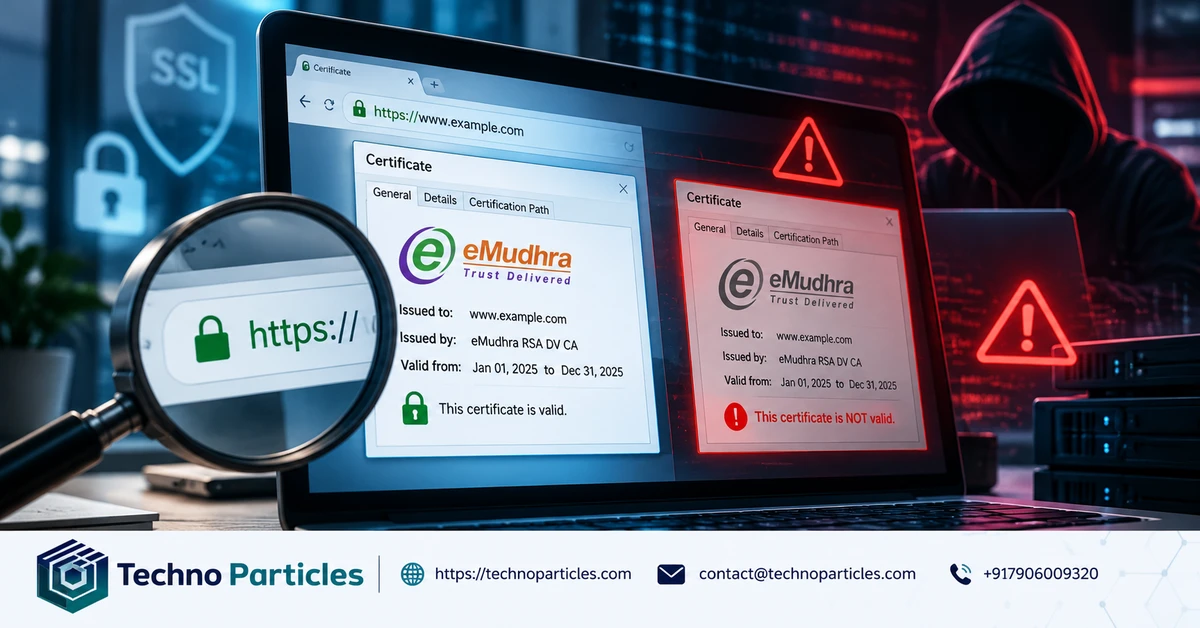
Start with the certificate chain rather than the page design or padlock icon. Open the site’s certificate details and record the subject, issuer, validity period, serial number and fingerprints. An unexpected eMudhra intermediate, a revoked chain or a browser warning should be treated as a signal to stop and investigate, not as a problem to bypass.
Check browsers, operating systems and trust stores
Update Firefox, Chromium-based browsers, operating systems and security software before making manual changes. Mozilla says Firefox blocklisted the affected intermediates through OneCRL, while Firefox 158.0.1 and later updates addressed users who missed the blocklist update. Apple also began automatic blocking and warns that some macOS command-line tools, including curl and git, may use /etc/ssl/cert.pem separately from browser trust decisions.
For servers and applications, inspect every environment that validates certificates: container images, reverse proxies, API gateways, JVM or language runtimes, mobile applications and embedded CA bundles. A browser may reject a chain while an outdated backend still accepts it, or the reverse. Teams reviewing certificate-dependent applications can use application development support to map these validation paths before changing production trust settings.
Look for evidence in logs and inventories
- Search TLS handshake and proxy logs for unexpected issuer names or failed chain validation.
- Inventory certificates issued by the affected intermediates, including internal services and staging systems.
- Compare certificate fingerprints and issuer details with the eMudhra, Mozilla and Apple advisories.
- Review Certificate Transparency records and vendor reports rather than assuming that a familiar domain is safe.
If an affected certificate is found, replace it through the issuing provider, deploy the replacement across all endpoints and remove obsolete copies from load balancers, caches and backups. Do not delete trusted roots or intermediates indiscriminately: eMudhra says the root-cause investigation remains ongoing, so vendor-specific instructions should guide any manual trust-store change.
What to do when a certificate looks suspicious
Detection should lead to containment and verification, not an immediate trust bypass. First capture the complete certificate chain, the affected hostname, the time of the failure and the software that reported it. Preserve the evidence before renewing or replacing anything so security teams can compare the original chain with the corrected deployment.
Next, determine whether the certificate was actually issued by one of the affected eMudhra intermediates. Check the issuer and Authority Key Identifier, then compare the certificate’s serial number and fingerprints with internal inventories, Certificate Transparency results and the vendor advisories. A familiar domain name does not prove that its current certificate is legitimate.
Separate browser checks from application checks
Certificate validation is distributed across more systems than a typical browser session reveals. Test public endpoints from updated browsers, but also test APIs, scheduled jobs, service meshes, email gateways and monitoring tools. Command-line clients may use a separate CA bundle, and container or virtual-machine images can preserve outdated trust data after a host operating-system update.
For each affected asset, record the certificate owner, issuing chain, renewal path, deployment locations and rollback plan. Replace certificates through the issuing provider when necessary, then confirm that load balancers, reverse proxies, caches and secondary regions serve the new chain. Retire old certificates from automation secrets and machine images where they could be reused accidentally.
Organizations with large inventories can formalize this review through enterprise management support, especially when certificate validation is spread across departments, environments or customer-facing systems. The goal is traceability: every accepted chain should have a documented owner and an approved reason for remaining trusted.
Do not treat every failure as proof of forgery
A failed handshake can also result from an expired certificate, an incomplete chain, clock drift or a stale local trust store. Conversely, a successful connection does not prove that every client has received the latest blocklist. Compare results across updated and isolated environments, document the software versions tested and escalate unexplained differences to the relevant vendor or certificate authority.
Build a repeatable certificate-response process
The eMudhra incident also exposes a broader operational issue: certificate security depends on inventory quality. Maintain a current register of public and internal certificates, including hostnames, issuing authorities, expiry dates, renewal owners and deployment locations. Link each certificate to the service that uses it, so an alert can be traced to a responsible team without delaying containment.
Automated discovery should run across production, staging, disaster-recovery environments and externally reachable subdomains. Record the complete chain, not only the leaf certificate, and alert on unexpected issuer changes, short-notice renewals, revoked intermediates or certificates that do not match the approved inventory. Monitoring should test from more than one client type because browsers, operating systems and application runtimes may update their trust decisions at different times.
Use vendor guidance as the change-control baseline
Before editing a trust store, identify which software consumes it and whether the change will affect unrelated services. Apply updates through normal patching and configuration-management processes, then record the version, affected asset and validation result. Teams coordinating complex environments can use project consultation support to document dependencies and assign remediation owners before production changes are approved.
Do not rely on a single successful browser test. Validate the replacement chain from client devices, command-line tools, application runtimes, containers and monitoring systems. Check both successful connections and expected failures for retired certificates. Where a service uses certificate pinning, custom roots or an embedded CA bundle, confirm that the replacement process accounts for those controls rather than assuming an operating-system update is sufficient.
Questions security teams should answer
- Which assets currently use, or previously used, an affected eMudhra intermediate?
- Have replacement certificates propagated to every endpoint and region?
- Which trust stores or embedded bundles require separate updates?
- Can logs prove when the old chain stopped being accepted?
Keep the investigation open until inventories, logs and vendor advisories agree. eMudhra has said its root-cause review remains ongoing, so teams should preserve evidence and revisit assumptions as authoritative guidance changes.

Verify remediation across every trust path
Remediation is complete only when each client that connects to the service reaches the same trust decision. Mozilla says Firefox blocked the affected eMudhra intermediates through OneCRL, while Firefox 158.0.1 and later updates addressed users who had not received the blocklist update. Apple began automatic blocking on October 19 and separately warned that some macOS command-line tools may rely on /etc/ssl/cert.pem. Browser success therefore should not be treated as proof that command-line or application traffic is protected.
Run controlled checks from updated browsers, macOS and Windows hosts, Linux servers, container images, mobile clients and CI runners. Capture the complete certificate chain, issuer, Authority Key Identifier, serial number, fingerprint, validation result and software version for every test. If results differ, identify the trust store or embedded CA bundle responsible before changing configuration.
Review logs for unexpected chains
Search reverse-proxy, API gateway, service-mesh, monitoring and client logs for handshake failures, revoked-intermediate errors, issuer changes and repeated attempts to present retired certificates. Compare timestamps with vendor revocation and blocking actions. An unexpected eMudhra chain may require certificate replacement, while an isolated failure may instead indicate a stale trust store, incomplete chain or clock problem.
Where certificates were issued through an affected ecosystem, confirm the replacement chain with the issuing provider and verify propagation across load balancers, failover regions, caches and automation secrets. Application teams should also inspect custom CA bundles and pinned certificates; these can follow different update paths from the operating system. A documented application development workflow can help assign owners for services that validate certificates inside code or deployment pipelines.
Preserve evidence before making manual changes
Save the original chain, diagnostic output, relevant logs and affected software versions before removing trust entries or renewing certificates. eMudhra says its root-cause investigation remains ongoing, and its assessment relies partly on Certificate Transparency records. Preserve evidence so later vendor guidance can be compared with the organization’s own findings and remediation decisions.
What the eMudhra certificate compromise means now
The eMudhra certificate compromise is a reminder that certificate security depends on every layer between an issuing authority and the client making a connection. A service can appear healthy in one browser while a command-line tool, container, mobile app or embedded runtime still follows an outdated trust path. Treat those differences as evidence to investigate, not as harmless inconsistencies.
For affected teams, the immediate priority is to identify certificates issued through the affected intermediate authorities, replace them where necessary and confirm that the new chains are deployed everywhere. That includes load balancers, reverse proxies, failover environments, secrets managers, automation pipelines and customer-facing applications. Do not remove broad root certificates or make manual trust-store changes unless the vendor’s guidance and your asset inventory show that they are required.
Practical detection checklist
- Update browsers, operating systems, runtimes, containers and endpoint trust stores.
- Inspect the complete chain, issuer names, serial numbers and fingerprints for exposed services.
- Test browsers, command-line clients, application runtimes, CI systems and mobile endpoints separately.
- Review logs for revoked intermediates, unexpected issuers and repeated presentation of retired certificates.
- Preserve diagnostic output and timestamps before renewing certificates or changing trust configuration.



Leave a comment
Your email stays private. You can see your comment immediately on this browser. Others see it after approval.