
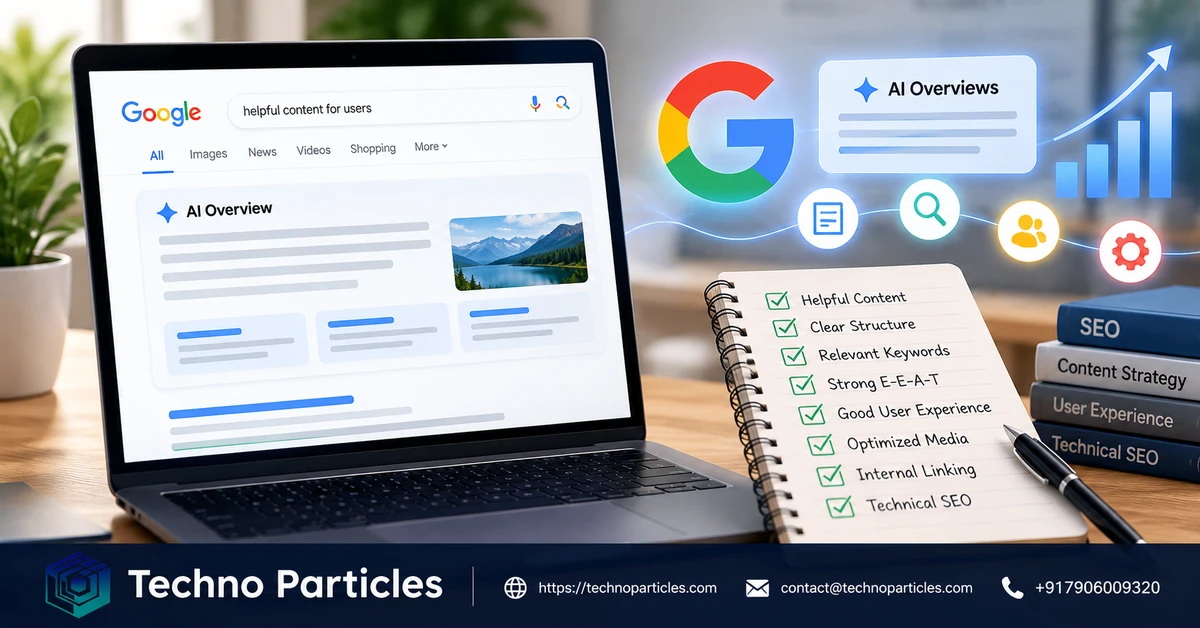
Google’s latest guidance makes the central rule for AI Overviews clear: websites do not need special AI schema, an AI text file, or a separate optimization system. Existing SEO fundamentals still determine whether pages are eligible to appear in Google Search and be considered for generative features. However, indexing and inclusion are never guaranteed.
| Area | Google’s confirmed guidance | Practical priority |
|---|---|---|
| Content | Original, useful, reliable, people-first information | Answer a real audience need |
| Technical access | Crawlable, indexable pages eligible for Search snippets | Check robots controls and indexing |
| On-page structure | Clear text, useful internal links, and strong page experience | Make important information easy to find |
| Structured data | Markup must match visible content | Validate accuracy; do not expect guaranteed display |
What Changed in Google AI Overviews SEO Guidance?
Google’s official AI features guidance confirms that the same foundations supporting ordinary Search remain relevant to AI Overviews and AI Mode. Pages should provide crawlable text, descriptive organization, meaningful internal links, relevant media, and a satisfactory page experience. Structured data can help systems understand eligible content, but it is not a shortcut around quality or technical access.
The newer generative AI optimization guide adds sharper editorial direction: prioritize unique, non-commodity information that genuinely helps people. Tactics such as unnecessary llms.txt files, artificial content chunking, or manufactured mentions should not replace useful reporting, expertise, and clear answers.
For publishers, the practical takeaway is straightforward. Start with a clear audience and task, then improve the page through a disciplined on-page SEO review. AI Overviews are an additional discovery surface, not a promised ranking position, citation, or traffic source.
How to Audit Helpful Content Before Optimization
Before changing titles, headings, or markup, test whether the page deserves attention from a real reader. Google’s people-first content guidance asks whether material serves an intended audience, demonstrates relevant knowledge, and leaves visitors able to complete their task. Search visibility cannot compensate for weak usefulness.
Check purpose, originality, and evidence
Write down the page’s primary audience and decision it supports. Remove sections that exist only to capture queries without helping that audience. Google does not require a preferred word count, so expand or shorten the page according to the subject rather than an arbitrary target.
Next, identify what the page contributes that commodity summaries do not. Add first-hand observations, original examples, documented processes, comparisons, or analysis. Claims should be accurate and easy to verify. The guidance on generative AI content also emphasizes fact-checking, reviewing metadata, validating structured data, and adding context when automation materially contributes.
Make responsibility visible
Clear authorship helps readers judge expertise and accountability. Show who wrote or reviewed the page when that information matters, and keep author descriptions accurate. Human review must do more than approve grammar: reviewers should check facts, sources, examples, images, and claims that could mislead readers.
- Audience: Can a defined reader explain why this page exists?
- Original value: Does it add evidence, experience, or analysis beyond common summaries?
- Accuracy: Are important claims current, supported, and reviewed?
- Authorship: Can readers understand who created or checked the work?
- Page experience: Can visitors read and use the content without avoidable friction?
Use this audit before a broader digital marketing review. If the page fails on purpose, originality, or accuracy, fix that weakness first. On-page changes have more value when they clarify genuinely useful work.

Turn Helpful-Content Principles Into an Editorial Review
A useful page should help readers make progress without forcing them to assemble the answer from scattered sections. Review each page against the task it promises to solve. If the title promises a comparison, include decision criteria. If it promises instructions, show the sequence, prerequisites, and likely failure points.
Test whether evidence supports the promise
Mark every important factual claim, recommendation, example, and conclusion. Then ask what supports it: first-hand experience, a documented source, a transparent calculation, or a clearly labelled editorial judgment. Replace unsupported certainty with precise language, or remove the claim. This check matters especially when generative tools helped produce a draft. Google’s guidance on generative AI content emphasizes accuracy, fact-checking, metadata review, and structured-data validation.
Review examples for usefulness, not decoration. An example should show how a reader applies the idea, where the approach may fail, or how two choices differ. Generic examples that could appear on any competing page add little original value. Add concrete observations only when they are accurate and relevant to the page’s purpose.
Separate editing from substantive review
Grammar review cannot replace subject-matter review. A substantive reviewer should challenge outdated facts, missing conditions, ambiguous wording, unsupported comparisons, and conclusions that exceed the evidence. The reviewer should also confirm that images, captions, author details, dates, and metadata describe the page honestly.
Use a short review record for recurring publishing work: page purpose, intended reader, primary evidence, reviewer, unresolved limitations, and next update trigger. This creates accountability without forcing every article into a fixed length or template. For larger sites, connect the record to a broader technical SEO assessment so editorial weaknesses and access problems are evaluated together.
Publish only when the page offers a clear reason to exist. A strong editorial standard is not “how much text can this page contain?” It is “what can a qualified reader understand or do after reading it?”
Run a Reader-Task Test Before Publishing
Helpful content must solve a defined problem without making readers perform unnecessary research. State the page’s promised outcome in one sentence, then test whether the opening, headings, examples, and conclusion all support it. Remove sections that target unrelated queries or repeat common advice without adding evidence.
Audit the page as a real visitor
Ask a colleague unfamiliar with the draft to complete its intended task. Record where that person hesitates, searches for missing context, or questions a claim. These observations expose weak explanations that keyword checks cannot detect. Google’s people-first content guidance prioritizes satisfying the reader’s purpose, useful experience, and content created for people rather than search traffic alone.
- Promise: Does the page answer the question implied by its title?
- Sequence: Can readers follow the reasoning without opening several unrelated pages?
- Evidence: Do examples show the method, limits, or decision criteria?
- Distinct value: Would removing the page leave a meaningful gap?
- Maintenance: Is there a clear event that should trigger a future review?
Review for search-engine-first patterns
Look for repeated introductions, inflated sections, unnatural keyword variations, and claims added only because competitors mention them. Google’s generative AI optimization guidance says unique, non-commodity value matters more than AEO or GEO shortcuts. It also reinforces that ordinary SEO fundamentals remain relevant.
Use a UI/UX review when layout, navigation, or interaction blocks comprehension. Use a project consultation when the page supports a complex workflow and its audience or success criteria remain unclear. For site-wide patterns, connect the findings to an SEO assessment, but keep editorial decisions tied to reader needs.
Set the next review trigger before publication: a product change, policy update, new evidence, or recurring reader question. This keeps helpfulness tied to accuracy over time.
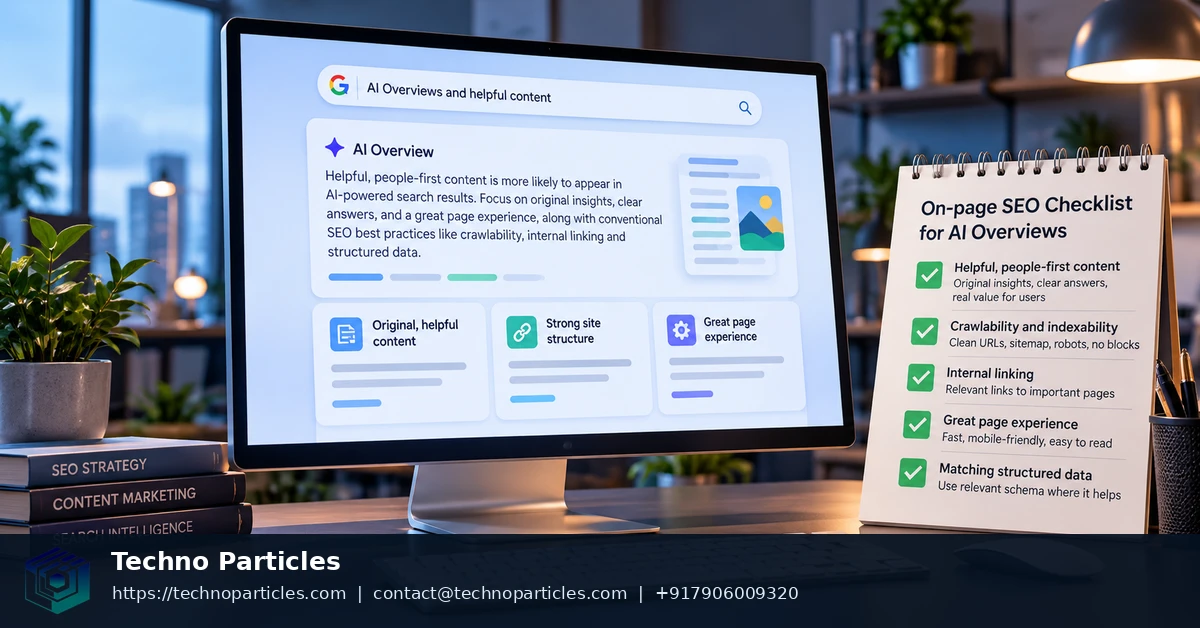
Measure Google AI Overviews Visibility Without Guesswork
Search visibility in Google AI Overviews needs measurement beyond traditional rankings. Google’s dedicated Search Console generative-AI reports show impressions, appearing pages, countries, devices, and performance over time for eligible Search experiences. The rollout announcement also records worldwide completion on August 31, 2026. See Google’s official generative-AI performance report announcement for the documented scope and rollout details.
Separate visibility from business value
Start by identifying pages that appear in the report, then compare their visibility with engagement and conversions in your analytics platform. An impression confirms exposure in the measured Search experience. It does not prove that a user clicked, read the page, or completed a business action.
Review changes over a consistent period. Compare impressions, appearing pages, countries, and devices with organic sessions, qualified leads, purchases, sign-ups, or other page-specific outcomes. A page with more AI Overview exposure but weaker engagement may need a clearer answer, stronger evidence, or better alignment between the search promise and the landing page.
Use reporting to choose the next audit
Prioritize pages that already receive relevant visibility but underperform after the visit. Check whether the opening answers the likely task, whether supporting details are easy to find, and whether the page provides a reason to continue. Then review crawlability, internal navigation, and page experience. Google’s guidance for AI features and websites describes these fundamentals and warns that inclusion, citations, and traffic are not guaranteed.
For site-wide problems, pair report findings with a technical SEO service review. Keep the decision evidence-based: improve pages with a clear audience, measurable demand, and specific weaknesses before expanding content volume.
Google AI Overviews On-Page SEO Checklist: Choose the Right First Audit
The most useful decision is not whether to create a separate “AI search” version of a page. Google’s guidance says existing SEO fundamentals remain relevant for AI Overviews and AI Mode, with no special schema, AI file, or guaranteed visibility shortcut. Pages still need to be crawlable, indexed, eligible for Search, and genuinely useful to a defined audience. Google’s guidance for AI features and websites also makes clear that eligibility does not guarantee inclusion, citations, or traffic.
Choose the first audit according to the page’s clearest weakness:
- Unclear purpose: rewrite the page around one audience, task, and useful outcome.
- Thin or interchangeable information: add original evidence, first-hand insight, meaningful examples, or decision criteria.
- Strong content but weak access: inspect crawling, indexing, internal links, visible text, page experience, and snippet controls.
- Valid markup but no enhanced display: confirm that structured data describes visible content, passes testing, and uses a supported feature; valid markup still does not guarantee a rich result. Google’s structured-data guidelines explain these limits.
- Uncertain impact: use Search Console’s generative-AI reporting alongside engagement and conversion data, rather than treating impressions as business success. Google’s performance-report announcement documents the available visibility metrics.
For a Google AI Overviews on-page SEO checklist that remains useful as interfaces change, prioritize the page with the clearest audience and the most measurable weakness. Improve that page, observe its visibility and outcomes, then use the evidence to set the next audit.



Leave a comment
Your email stays private. You can see your comment immediately on this browser. Others see it after approval.