
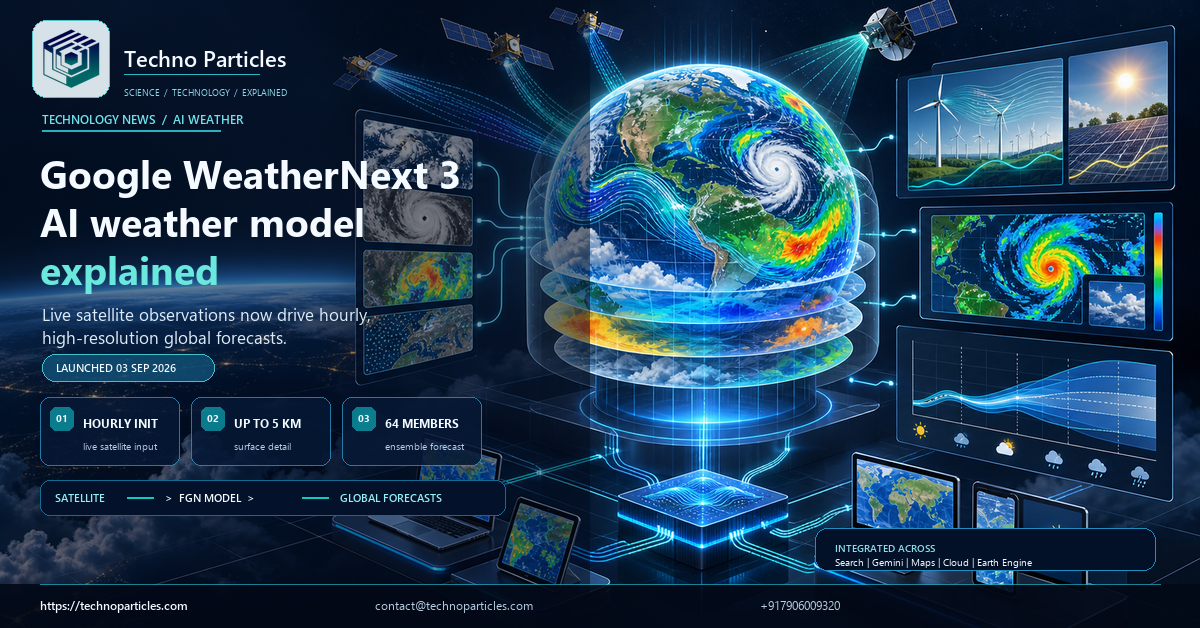
Google WeatherNext 3 AI weather model explained in simple terms: Google DeepMind and Google Research have introduced a global forecasting system designed to make weather predictions more local, more frequently updated, and more useful for real-world decisions. Announced on September 3, 2026, WeatherNext 3 uses live satellite observations alongside historical weather information. Google says the model is now being integrated into Search, Gemini, Google Maps, Google Maps Platform, Google Earth Engine, BigQuery, and Google Cloud Storage.
The announcement matters because weather can change faster than traditional forecast cycles. A six-hour update may miss the early development of a rain band, storm, or temperature shift. WeatherNext 3 is built to generate a new forecast every hour. Google also says its system can produce surface forecasts at resolutions as fine as five kilometres, giving it more detail around mountains, coastlines, valleys, and other areas where broad global models can smooth away important local differences.
What is Google WeatherNext 3?
WeatherNext 3 is an artificial intelligence weather model, but it is not a chatbot that simply describes the sky. It is a forecasting system that learns relationships between atmospheric observations and future weather states. Its architecture uses a Functional Generative Network mesh transformer, according to Google’s technical description. The system produces dense weather fields, cyclone tracks, and station-level predictions from different kinds of input.
One important change is the type of data used during forecasting. Earlier WeatherNext systems relied heavily on data generated by numerical weather prediction models. Those physics-based systems remain essential, but their outputs can involve computational expense and time delays. WeatherNext 3 directly ingests mosaics of live geostationary satellite imagery, allowing the model to begin from a more current view of cloud systems and atmospheric conditions.
Google describes WeatherNext 3 as an ensemble model. That means it can represent more than one possible future rather than presenting uncertainty as a single number. Weather is inherently probabilistic, so a useful system must account for several plausible outcomes. A developer building a logistics dashboard, for example, may need to know not only the expected rainfall but also how likely a heavier event could be.
Why hourly satellite data changes the forecast
Raw satellite data helps the model observe rapidly evolving features before they are fully represented in a conventional forecast cycle. Clouds, storm boundaries, convection, and snow systems can develop or move considerably within a few hours. More frequent updates do not eliminate uncertainty, but they can reduce the gap between what is happening now and what a forecast assumes was happening several hours earlier.
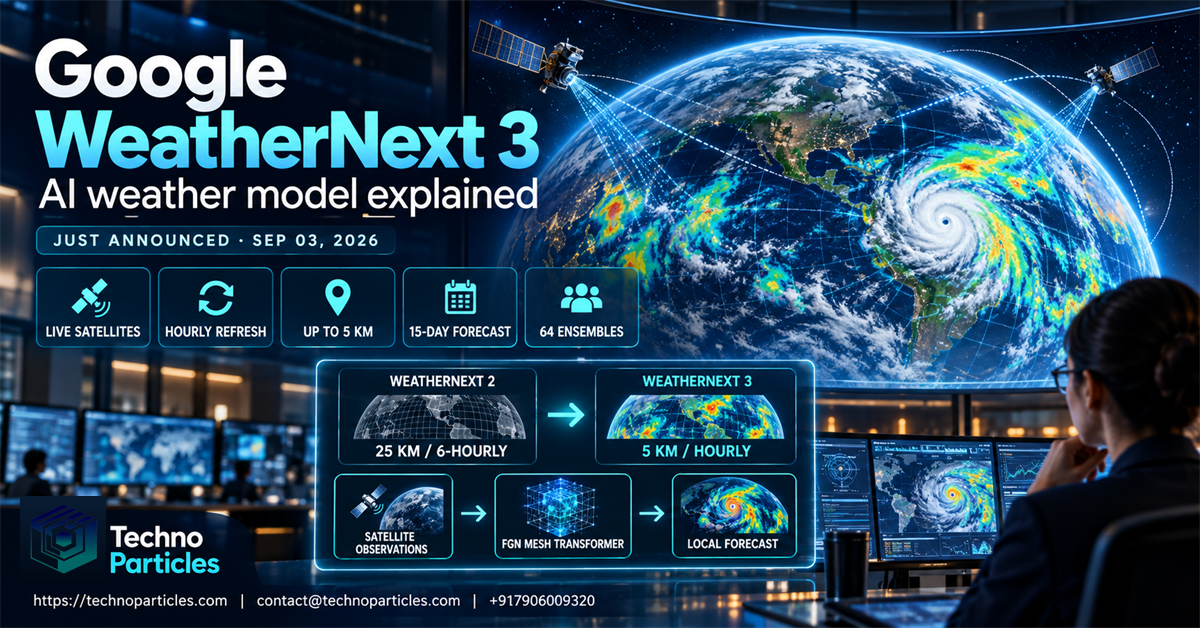
Google’s September announcement says WeatherNext 3 predicts temperature and moisture at five-kilometre resolution, other surface variables at ten kilometres, and atmospheric variables such as wind speed at twenty-five kilometres. The company describes this as a global weather picture roughly five times sharper than WeatherNext 2, which used a twenty-five-kilometre grid and six-hour forecast increments.
That distinction is especially relevant in India, where conditions can vary across dense cities, agricultural districts, coastal zones, and mountain regions. However, a finer grid should not be interpreted as a guarantee that every neighbourhood receives a perfect forecast. Resolution describes the scale at which information is represented; accuracy still depends on observations, terrain, forecast horizon, and the specific weather event.
How accurate is WeatherNext 3?
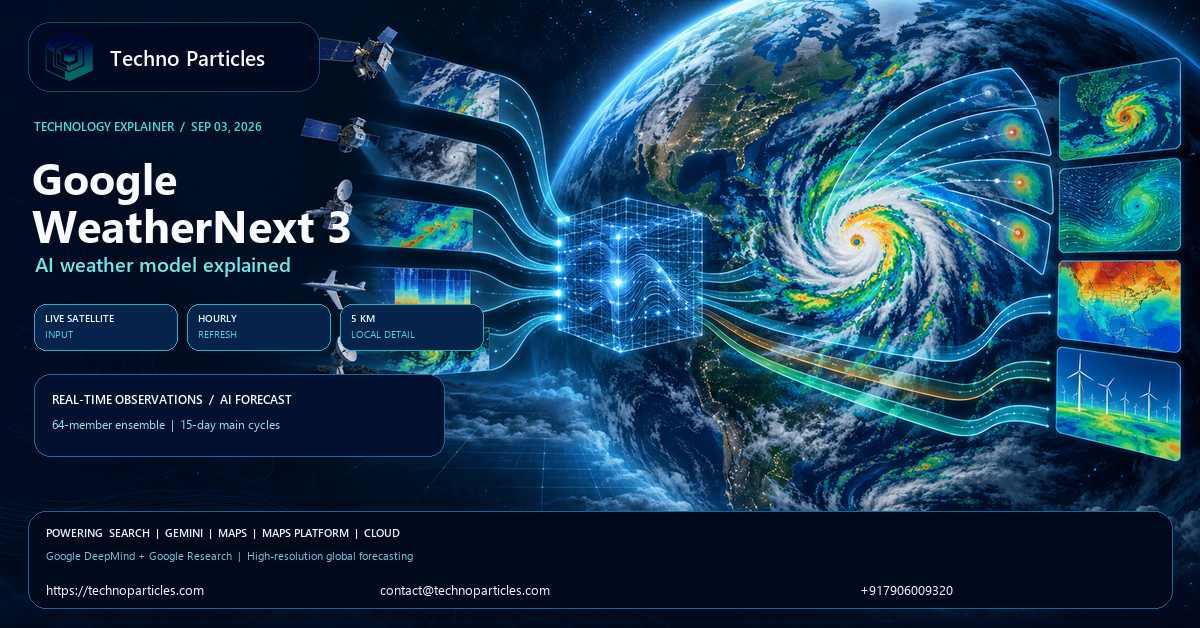
Google calls WeatherNext 3 its most advanced and accurate global weather model to date, based on independent live evaluations by Brightband. The company says precipitation forecasts planned a day or more ahead can be up to 50% more accurate, with the largest improvements in areas where earlier forecasts were less reliable. This is a company-reported result, so readers should treat it as evidence of the claimed improvement rather than a universal promise for every location or forecast.
The distinction between an independent evaluation and an independent product audit is important. Brightband’s Operational WeatherBench provides a comparison environment for weather models, but performance can vary by variable, region, lead time, and evaluation period. A model may improve rain probability while still facing difficulty with a small thunderstorm, unusual heat event, or rapidly intensifying cyclone. For safety decisions, local meteorological agencies remain the authoritative source for warnings.
WeatherNext 3 versus WeatherNext 2
The clearest comparison is the update cycle and spatial detail. WeatherNext 2 generated global forecasts on a twenty-five-kilometre grid at six-hour increments. WeatherNext 3 uses live satellite observations to support hourly forecasts and provides selected surface variables at five kilometres. This gives users a more current and locally detailed view, particularly for temperature, humidity, precipitation, cloud cover, and wind-related planning.
The newer model also expands the range of information aimed at industry. Google says WeatherNext 3 can forecast one-hundred-metre wind speeds, approximately the height relevant to many wind turbines, as well as cloud cover and solar radiation. These variables can help renewable-energy operators estimate production and plan around changing supply. They do not replace physical inspections, grid controls, or specialist operational models, but they can provide another data layer for planning and analysis.
For businesses, the difference is less about replacing an entire weather team and more about reducing the effort needed to obtain forecast data. Google says organizations can access high-resolution forecasts through BigQuery, Earth Engine, and bulk downloads from Google Cloud Storage. WeatherNext 3 is also being integrated with the Google Maps Platform Weather API. Exact quotas, commercial pricing, service limits, and regional availability should be checked in the relevant Google Cloud documentation because they may differ by product.
Who can use Google WeatherNext 3?
Ordinary users may encounter WeatherNext 3 through weather experiences in Google Search, the Gemini app, and Google Maps as the rollout reaches their region and product surface. A person planning a trip, outdoor event, delivery route, or school activity may benefit from more frequent rain and temperature updates. Gemini can make the information easier to ask about conversationally, but a natural-language answer should still be checked against the displayed forecast and official warnings when conditions are severe.
Developers and data teams have a broader set of options. They can use cloud-based weather data in applications for agriculture, logistics, aviation support, retail staffing, construction scheduling, tourism, and energy forecasting. An e-commerce company might use hourly rain probabilities to improve delivery notifications. A farm-management tool could combine temperature and moisture predictions with crop calendars. A travel platform could use forecasts to explain weather-sensitive itinerary risks.
These use cases require careful product design. Forecast data should show its update time, location, units, horizon, and uncertainty. A dashboard that hides those details may look precise while encouraging overconfidence. Teams should also create fallback behavior for missing data, compare forecasts with local observations, and avoid turning probabilistic predictions into absolute claims.
For companies building these experiences, strong application development practices matter as much as the model itself. Reliable APIs, caching, authentication, responsive interfaces, and monitoring determine whether a weather feature is genuinely useful. A high-quality UI/UX design can make uncertainty understandable instead of burying users beneath technical measurements.
Limitations and practical cautions
Google WeatherNext 3 is a significant forecasting development, but it is not a crystal ball. The atmosphere remains chaotic, and small differences in initial conditions can grow over time. Hourly updates improve freshness, while higher resolution improves geographic detail, but neither removes uncertainty. Short, intense storms can still be difficult to predict precisely, especially when local terrain, urban heat, or sparse observations influence conditions.
Another limitation is that WeatherNext 3 is an AI model trained from observations and historical patterns. It can learn useful regularities without reproducing every physical process in the atmosphere in a transparent way. That makes validation essential. Weather agencies, businesses, and developers should evaluate results for their own locations and decisions rather than assuming that a global headline applies equally to every city.
Users should also distinguish between a consumer weather display and an emergency warning system. Google’s own WeatherNext 3 material advises people to consult local meteorological agencies or national weather services for official forecasts, severe-weather warnings, and public-safety advisories. In India, that means checking the India Meteorological Department and relevant local authorities during dangerous conditions.
Why the launch matters for businesses
The larger significance of WeatherNext 3 is that advanced forecasting is becoming easier to place inside ordinary digital workflows. A business no longer needs to design a complete meteorological model before adding weather-aware decisions to a customer portal, operations dashboard, mobile app, or internal system. The difficult work shifts toward selecting useful variables, interpreting uncertainty, protecting data access, and connecting forecasts to actions.
For a retailer, weather signals could support inventory and promotion planning. For logistics companies, they may help prioritize routes or communicate delays. For manufacturers and construction firms, forecasts can inform staffing and outdoor work windows. For solar and wind operators, cloud, radiation, and turbine-height wind information can support output estimates. These are opportunities for better planning, not automatic guarantees of savings or operational performance.
Businesses also need a responsible data strategy. Forecasts should be stored with timestamps and version information so teams can review what the system knew at the time of a decision. Important workflows should include human review and alternative sources. Where weather affects health, safety, insurance, or public communications, organizations should document thresholds and escalation procedures instead of allowing an AI-generated summary to make the final call.
Weather data becomes even more valuable when presented through an optimized digital product. A company exploring a weather-aware customer experience may combine responsive website development, generative AI solutions, and analytics. Search visibility also matters if the product explains local weather risks, seasonal services, or travel planning; thoughtful SEO strategy can help people find useful information without exaggerating forecast certainty.
Final takeaway
Google WeatherNext 3 AI weather model explained: the model’s central advance is the combination of live satellite observations, hourly forecast updates, and finer global resolution. Google says it improves precipitation forecasting and adds variables designed for clean-energy planning, while access is expanding through Google products and cloud platforms. The practical benefit is a faster, more detailed starting point for daily decisions and business systems.
Still, better AI forecasting should be used with clear timestamps, uncertainty labels, local validation, and official warnings. WeatherNext 3 can make weather intelligence more accessible, but responsible interpretation remains the difference between an impressive forecast interface and a dependable real-world tool. For organizations considering implementation, project consultation can help translate a promising model into a measured, user-focused workflow.
What WeatherNext 3 means for forecast users
The importance of Google WeatherNext 3 AI weather model explained in practical terms is not that it removes uncertainty from forecasting. Its value is that it can refresh a broad picture of atmospheric conditions more frequently and make that information easier to adapt for different locations and decisions. An hourly update may be especially useful when conditions change quickly, such as during thunderstorms, heavy rainfall, strong winds, or rapidly clearing skies.



Leave a comment
Your email stays private. You can see your comment immediately on this browser. Others see it after approval.