

Voice assistants usually take turns: one side speaks, the other listens. OpenAI’s GPT-Live 1 changes that interaction model with full-duplex voice, allowing the system to listen and speak simultaneously while a backend agent handles reasoning and tools. For teams exploring GPT-Live-1 API full-duplex voice with telephony setup, the important story is not just more natural conversation. It is the combination of live audio, backend actions, and phone connectivity in one application architecture.
What GPT-Live 1 adds to a voice application
OpenAI’s model documentation, checked September 30, 2026, lists audio and text input and output, streaming, function calling, and the v1/live/sessions endpoint. A voice session can therefore receive a caller’s speech, respond continuously, and delegate selected work to backend services. The model can continue speaking while backend work runs, but that does not remove the need for application controls. Developers should define which tools are allowed, when a user must confirm an action, how sensitive information is handled, and what happens when a tool or connection fails.
Three ways to connect GPT-Live 1
OpenAI’s Getting started guide describes WebRTC for browser-based voice experiences and WebSockets for server-side audio processing. For phone calls, the documented route is SIP. A business can use a SIP trunk provider, configure an OpenAI incoming-call webhook, and route the trunk to sip:$PROJECT_ID@sip.api.openai.com;transport=tls, or to the European endpoint where appropriate. The webhook provides a call_id, which the server can use to accept, reject, monitor, refer, or end a call through the API.
What a production telephony setup must protect
API keys should remain on the server, and webhook signatures should be verified before call instructions are trusted. OpenAI lists voice sessions at $0.05 per minute, billed per second, while backend model and tool usage are charged separately. Carrier fees, regional availability, and compliance obligations remain deployment-dependent. Teams planning the web, server, or phone layer can also review application development services for help designing the surrounding workflow.
GPT-Live-1 API full-duplex voice with telephony setup: a practical call flow
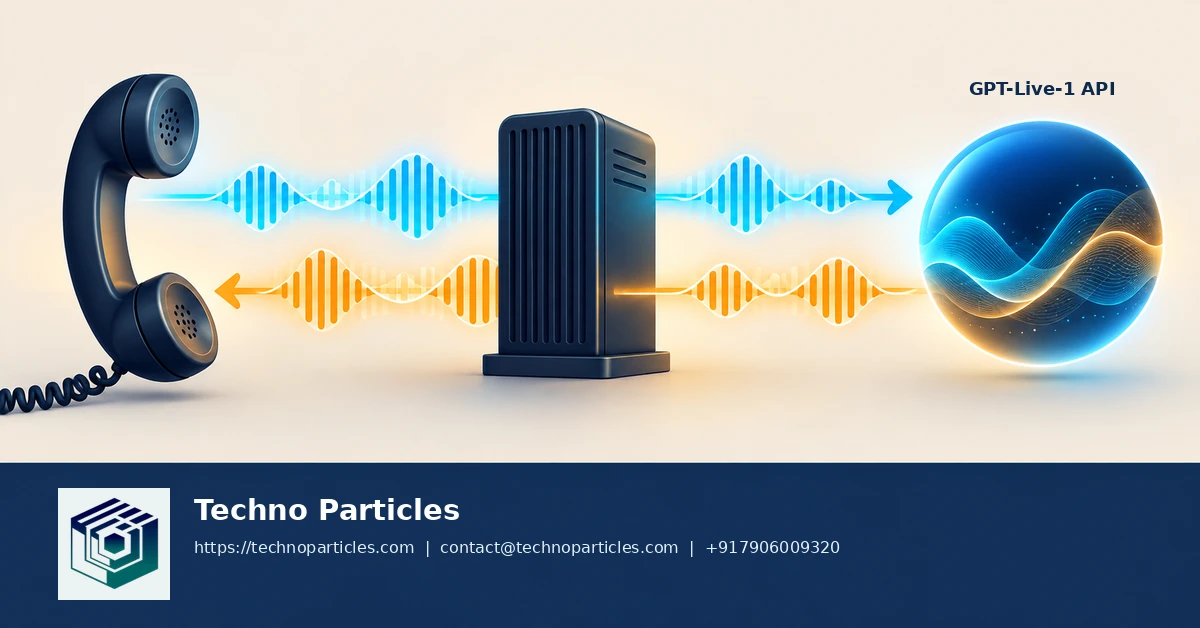
A reliable phone integration begins before the first model response. The SIP provider receives the call and routes it to OpenAI’s SIP endpoint over TLS. OpenAI then sends the incoming-call webhook to the application server. After verifying the webhook signature, the server can use the supplied call_id to accept the call and apply the intended session configuration. This separation keeps carrier routing, call control, and business logic distinct.
Design the backend around controlled actions
The voice model should not directly receive unrestricted access to business systems. Instead, expose narrowly defined functions for tasks such as checking an order, creating a support ticket, scheduling a callback, or retrieving approved account information. Each function should validate inputs, enforce the caller’s permissions, and return a concise result that the assistant can explain naturally. Actions with financial, legal, privacy, or account-changing consequences should require an explicit confirmation step.
Plan interruptions, failures, and handoffs
Full-duplex conversation is useful because the caller can interrupt, clarify, or continue speaking while backend work is in progress. The application still needs predictable behavior when speech is unclear, a tool times out, the SIP connection drops, or the caller asks for a human. A production design should define retry limits, a short fallback message, call recording and retention rules where applicable, and a handoff path to a human or alternate channel. These policies depend on the business, region, carrier, and applicable privacy requirements.
For an Indian SME, this architecture could support an order-status line, lead qualification, appointment intake, or internal help desk without forcing staff to monitor every call. The model session cost is only one part of the budget: backend inference, tools, SIP service, carrier charges, storage, monitoring, and compliance work also matter. Teams evaluating the surrounding workflow can explore project consultation for application and automation planning before selecting a deployment design.
GPT-Live-1 API full-duplex voice with telephony setup: a practical call flow
A reliable phone integration begins before the first model response. The SIP provider receives the call and routes it to OpenAI’s SIP endpoint over TLS. OpenAI then sends the incoming-call webhook to the application server. After verifying the webhook signature, the server can use the supplied call_id to accept the call and apply the intended session configuration. This separation keeps carrier routing, call control, and business logic distinct.
Design the backend around controlled actions
The voice model should not receive unrestricted access to business systems. Instead, expose narrowly defined functions for tasks such as checking an order, creating a support ticket, scheduling a callback, or retrieving approved account information. Each function should validate inputs, enforce caller permissions, and return a concise result that the assistant can explain naturally. Actions with financial, legal, privacy, or account-changing consequences should require explicit confirmation.
Plan interruptions, failures, and handoffs
Full-duplex conversation lets callers interrupt, clarify, or continue speaking while backend work is in progress. The application still needs predictable behavior when speech is unclear, a tool times out, the SIP connection drops, or the caller requests a human. Define retry limits, fallback messages, recording and retention rules where applicable, and a handoff path to a human or alternate channel. These policies depend on the business, region, carrier, and applicable privacy requirements.
For an Indian SME, this architecture could support an order-status line, lead qualification, appointment intake, or internal help desk. The model session cost is only one budget component: backend inference, tools, SIP service, carrier charges, storage, monitoring, and compliance work also matter. Teams assessing the wider workflow can explore project consultation for application and automation planning before selecting a deployment design.
GPT-Live-1 API full-duplex voice with telephony setup: deployment checklist
Once the call flow is mapped, the next task is to define the operating boundaries around it. Start with a narrow use case and a controlled set of intents. An order-status assistant, appointment intake line, or lead-qualification flow is easier to test than a general-purpose phone agent connected to every internal system. Document what the assistant may answer, what information it may request, and which requests must be transferred to a person.
Configure access before connecting customers
Keep OpenAI API keys and telephony credentials on the server, never in browser code or client-side applications. The incoming-call webhook should verify its signature before processing the event. Store the call_id with the minimum operational metadata needed for monitoring and support, and restrict access to logs because call data may contain personal or business information.
Test the conversation as a system
Testing should cover more than whether the model can speak. Measure whether callers can interrupt naturally, whether the assistant waits for tool results without becoming confusing, and whether sensitive actions require confirmation. Include noisy audio, accents, silence, repeated questions, invalid account details, failed tools, dropped calls, and requests for a human. Confirm that the fallback path remains understandable when the backend or SIP provider is unavailable.
Teams should also separate model behavior from business rules. Prompt instructions can guide tone and conversation, but permissions, eligibility checks, escalation rules, and irreversible actions belong in backend code. This makes the system easier to audit and change when policies evolve. For organizations that need the surrounding dashboard, CRM connection, or staff handoff workflow, application development services can help turn the voice prototype into a maintainable product.
The practical lesson is that GPT-Live-1 can provide the conversational layer, while the business application remains responsible for identity, authorization, privacy, reliability, and human oversight.

What to verify before a GPT-Live-1 phone launch
A pilot should make the operational limits visible before the number is advertised to customers. Track whether callers reach the intended outcome, how often they repeat themselves, when transfers are requested, and which tool calls fail. These observations are more useful than treating voice quality as the only success measure. Review transcripts or event logs under an approved retention policy, and remove unnecessary personal data from stored records.
Confirm regional and commercial dependencies
OpenAI documents the GPT-Live voice-session rate at $0.05 per minute, billed by the second, while backend model and tool usage are charged separately. A production estimate must also include the SIP trunk, carrier charges, storage, observability, support, and any compliance work. Telephony availability and regional requirements can vary, so confirm them with the selected providers before committing to a rollout.
Choose a measured rollout path
Begin with a limited call queue, defined operating hours, and a small set of approved actions. Route uncertain requests to staff instead of stretching the assistant beyond its verified scope. Compare the automated path with the existing process using measures such as successful resolution, transfer quality, response latency, and customer complaints. Keep a manual fallback available while the team learns from real conversations.
The same controls matter when GPT-Live is connected to a CRM, booking system, help desk, or internal knowledge base. The voice interface may feel immediate, but every connected system adds permissions, failure modes, and data-governance decisions. Businesses planning that broader architecture can review workflow and employee-management software capabilities when evaluating how calls should reach staff and operational teams.
For developers, the key design principle is separation of responsibilities: GPT-Live handles natural full-duplex interaction, while the application enforces identity, permissions, business rules, auditability, and escalation. That division gives teams room to improve the conversation without weakening the safeguards around real-world actions.
GPT-Live-1 API full-duplex voice with telephony setup: final takeaways
GPT-Live-1 gives developers a practical way to build phone experiences in which the assistant can listen and speak at the same time, while backend systems handle reasoning, tools, and business data. OpenAI’s documented SIP workflow connects an incoming call through a supported trunk, sends the event to an application webhook, and lets the server manage the call through the API. That architecture can support appointment intake, order-status calls, lead qualification, and first-line support without placing sensitive credentials in client-side code.
The technology does not remove the need for careful product design. A reliable deployment must define the assistant’s permitted actions, protect caller information, verify webhook signatures, and require confirmation before consequential changes. It also needs clear behavior for silence, interruptions, failed tools, uncertain answers, abusive calls, and requests for a human. These controls should live in the surrounding application and operational process, not only in a prompt.
OpenAI lists GPT-Live voice sessions at $0.05 per minute, billed by the second, with backend model and tool usage charged separately. The total phone-system budget may also include SIP and carrier fees, monitoring, storage, support, and compliance work. Regional availability and telephony requirements should be confirmed with the selected providers before launch.
For teams evaluating GPT-Live-1 API full-duplex voice with telephony setup, the strongest path is a measured pilot: one call type, a limited action set, defined escalation rules, and a manual fallback. Track successful resolution, transfer quality, latency, tool failures, and customer feedback. Then expand only when the evidence supports it.


Leave a comment
Your email stays private. You can see your comment immediately on this browser. Others see it after approval.