

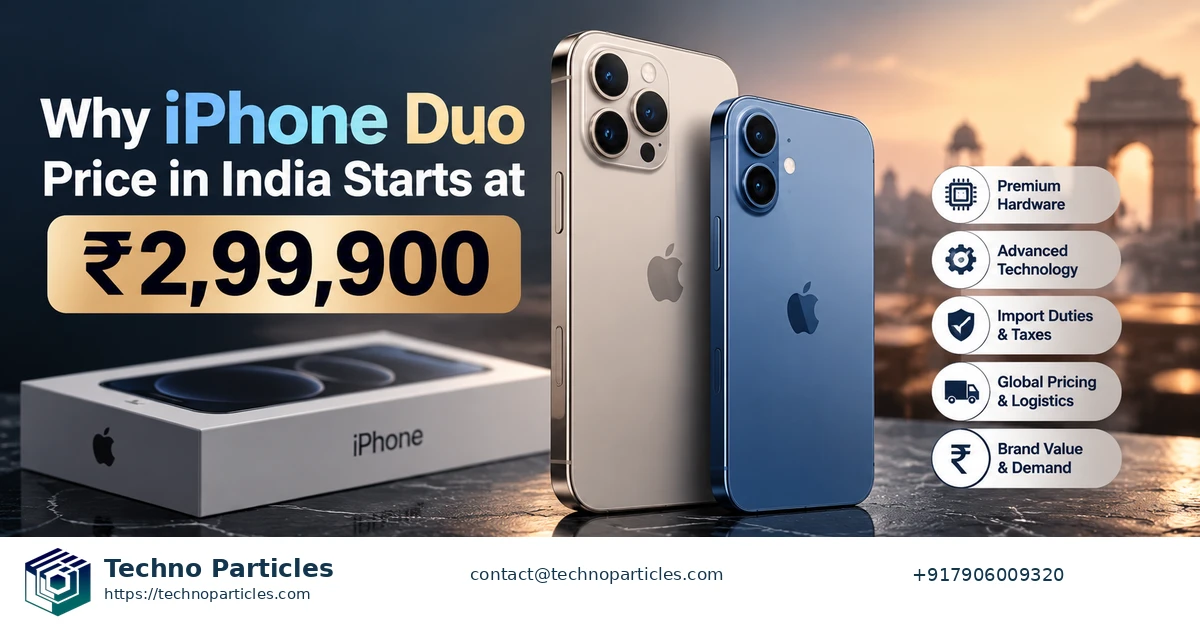
Apple’s first foldable iPhone Duo is now available in India, with sales beginning on 23 October 2026 after pre-orders opened on 16 October. The starting price of ₹2,99,900 is for the 256GB model, making the question of why iPhone Duo price in India starts at ₹2,99,900 especially relevant for buyers comparing it with conventional premium smartphones.
| iPhone Duo model | Apple India listed price | What changes |
|---|---|---|
| 256GB | ₹2,99,900 | Entry storage tier |
| 512GB | ₹3,24,900 | More built-in storage |
| 1TB | ₹3,74,900 | Higher storage capacity |
| 2TB | ₹4,49,900 | Maximum listed storage |
Why iPhone Duo price in India starts at ₹2,99,900
The main confirmed explanation is the device’s hardware design, not a published component-by-component cost breakdown. Apple says the iPhone Duo combines a 7.6-inch inner display with a 5.4-inch outer display, allowing one device to function as both a phone and a larger screen for productivity or media.
Its foldable construction also includes a precision hinge with more than 100 components, grade 5 titanium, a nano-texture folding display, dual batteries and a custom vapour chamber. The A20 Pro chip, dual 48MP cameras and IP68 resistance add to the flagship specification. Together, these features indicate that buyers are paying for a complex first-generation foldable system as well as storage.
Apple’s India store lists prices including taxes, but Apple does not publicly attribute the Indian price to specific import costs, currency factors, supply-chain expenses or profit margins. Those may influence retail pricing, but they remain unconfirmed. Buyers evaluating the project consultation approach used for complex technology products can view the iPhone Duo as a compact phone-tablet proposition, with trade-in and EMI options potentially reducing the effective upfront cost.
What buyers receive for the iPhone Duo price in India
The iPhone Duo’s price reflects a different product category from a conventional smartphone. Its 7.6-inch inner screen can support reading, multitasking and video viewing, while the 5.4-inch outer display is intended for everyday phone use when the device is folded. That flexibility is the central value proposition, but it also introduces engineering requirements that do not apply to a standard slab phone.
Apple’s design uses a precision hinge containing more than 100 components, two batteries and a custom vapour chamber. The titanium frame, nano-texture folding display and IP68 resistance are also part of the specification. These features may improve durability, thermal management and usability, but they do not prove how much the device costs Apple to manufacture. The company has not published a component-level explanation for the Indian retail price.
Storage is the second major price variable
The ₹2,99,900 starting price applies only to 256GB. Moving to 512GB raises the listed price to ₹3,24,900, while the 1TB and 2TB versions cost ₹3,74,900 and ₹4,49,900 respectively. Buyers should therefore choose storage based on expected photo, video and app usage rather than treating the entry model as the only price point.
Accessories add to the ownership cost. Apple lists the iPhone Duo Case at ₹8,900 and the Folio with Kickstand at ₹14,900. Trade-in credits and EMI plans may lower the immediate payment, but they do not change the official listed price. Buyers planning a companion app, workflow or customer-facing experience around new hardware can also review the application development service as a relevant planning reference.
Important limitations before buying
The device is eSIM-only, and some AI features may have regional or language restrictions. Apple has also scheduled Apple Pencil support for later in 2026, so buyers should not assume every advertised ecosystem capability is available on day one.

How to evaluate the iPhone Duo’s premium
The iPhone Duo is best understood as a phone-tablet hybrid rather than simply an unusually expensive smartphone. Its inner display may be useful for documents, video, reading and multitasking, while the outer display keeps routine calls, messages and quick interactions closer to a conventional phone experience. Whether that flexibility justifies the starting price depends on how often buyers will use both formats.
Storage should be considered alongside the form factor. The 256GB version is the lowest-cost entry point, but people who record substantial video, keep large offline libraries or use demanding apps may need 512GB or more. The higher tiers increase the purchase price significantly, so selecting capacity in advance is more practical than relying on later storage expansion.
Ownership costs extend beyond the handset
Apple’s listed accessories add ₹8,900 for the iPhone Duo Case or ₹14,900 for the Folio with Kickstand. Buyers should also confirm eSIM compatibility with their carrier before ordering, particularly if they regularly switch devices or depend on physical SIM cards while travelling. These considerations do not change the official price, but they affect the real setup experience.
Trade-in and EMI offers can make the purchase easier to manage, although the benefit depends on the eligible device, condition, financing terms and promotional period. Buyers should compare the total amount payable, not only the monthly instalment. Businesses planning services around foldable interfaces may also want to review UI/UX design support for responsive product experiences, because a larger inner screen can require different navigation, layouts and testing assumptions.
Who should consider buying iPhone Duo?
The device may appeal to early adopters, professionals who value a larger mobile workspace and users who want one product for phone and tablet-style tasks. It may be less suitable for buyers seeking the lowest cost, maximum simplicity or a familiar physical-SIM setup. Apple Pencil support is scheduled for later in 2026, so creative and note-taking workflows should be assessed against the features available at purchase.
What the iPhone Duo price means for everyday use
The value of the iPhone Duo depends on whether its folding design changes how a buyer works. A larger inner screen can make long documents, spreadsheets, video calls and research more comfortable, while the outer display keeps quick tasks compact. However, the benefit is practical only when the device is opened frequently enough to justify its premium over a conventional flagship phone.
The hardware also calls for realistic expectations. A precision hinge, dual-battery design and custom vapour chamber show the engineering complexity of fitting two displays into one device, but specifications alone cannot guarantee long-term durability or performance in every use pattern. Buyers should review Apple’s warranty, service and return terms before committing to a first-generation form factor.
A sensible buying checklist
- Confirm connectivity: verify that your carrier supports the device’s eSIM-only configuration and that your existing number can be transferred smoothly.
- Choose storage deliberately: compare your photo, video, offline media and app requirements with the 256GB, 512GB, 1TB and 2TB options.
- Budget for protection: include the case or Folio with Kickstand if the folding display needs additional protection for your routine.
- Check software timing: treat later features, including scheduled Apple Pencil support, as future availability rather than an immediate purchase benefit.
Businesses should assess more than the handset price if employees will use iPhone Duo devices for field work, sales, approvals or customer demonstrations. The larger inner display may support richer workflows, but applications need responsive layouts, touch-friendly controls and testing across folded and unfolded states. Teams planning such experiences can explore website development support as part of a broader compatibility review.
Is the iPhone Duo worth ₹2,99,900?
At ₹2,99,900, the iPhone Duo is positioned as a premium phone-tablet hybrid. It makes the strongest case for buyers who will regularly use the larger screen and accept the eSIM, accessory and first-generation trade-offs. For everyone else, a conventional iPhone may provide a simpler and more economical experience.
What the price reveals about Apple’s foldable strategy
The iPhone Duo’s pricing also signals how Apple is positioning foldable hardware. The 256GB model begins at ₹2,99,900, while the 512GB, 1TB and 2TB versions rise to ₹3,24,900, ₹3,74,900 and ₹4,49,900 respectively. These tiers make storage a major part of the purchase decision, but the central premium remains the folding design and the engineering required to support it.
Apple’s specifications point to several components that are uncommon in a standard phone: a 7.6-inch inner display, a 5.4-inch outer display, a hinge containing more than 100 components, dual batteries and a custom vapour chamber. Grade 5 titanium, a nano-texture folding display, dual 48MP cameras and IP68 resistance add to the device’s technical profile. However, these specifications do not provide a verified component-cost breakdown. Apple has not publicly attributed the Indian price to any single manufacturing, tax or margin factor.
Why the form factor matters for businesses
For businesses, the larger screen could make mobile approvals, field reporting, sales presentations and document workflows more comfortable. That benefit will depend on software support: an application must respond properly when the device changes between folded and unfolded states, preserve user context and keep controls accessible on both displays. Teams evaluating such deployments should test real workflows instead of assuming that an existing phone interface will scale automatically.
This is especially relevant for customer-facing apps, internal dashboards and mobile commerce. A responsive product review may reveal where navigation, tables, forms or media need separate layouts. Organisations planning that assessment can review application development support alongside device procurement, testing and rollout planning.
What buyers should verify before ordering
- Check whether your carrier supports eSIM activation and number transfer.
- Compare the total cost of the handset, protection and financing.
- Confirm whether delayed features, including Apple Pencil support, affect your intended workflow.
- Review return, warranty and service terms before adopting a first-generation foldable device.
The bottom line on the iPhone Duo price in India
The iPhone Duo price in India starts at ₹2,99,900 because Apple is positioning the device as a premium phone-tablet hybrid rather than a conventional flagship smartphone. Its two displays, precision hinge, titanium construction, dual-battery architecture and specialised thermal design represent a more complex hardware package. Those features help explain the premium, but they do not amount to a published breakdown of Apple’s manufacturing costs, taxes or margin.
For buyers, the decision should centre on usage rather than headline specifications. The device may be compelling for people who regularly read documents, manage spreadsheets, review creative work, join video calls or demonstrate products on a larger mobile screen. The case is weaker for users who mainly message, photograph, stream content or browse casually, since a conventional premium phone may meet those needs with fewer compromises.
What to expect after launch
As Apple’s first foldable iPhone, the Duo will also reveal how well its hardware and software behave over sustained daily use. Reviews and customer experience will be important for evaluating hinge reliability, display durability, battery endurance, application layouts and repair convenience. Buyers should treat future software additions as potential benefits, not as features already included in the purchase decision.


Leave a comment
Your email stays private. You can see your comment immediately on this browser. Others see it after approval.