

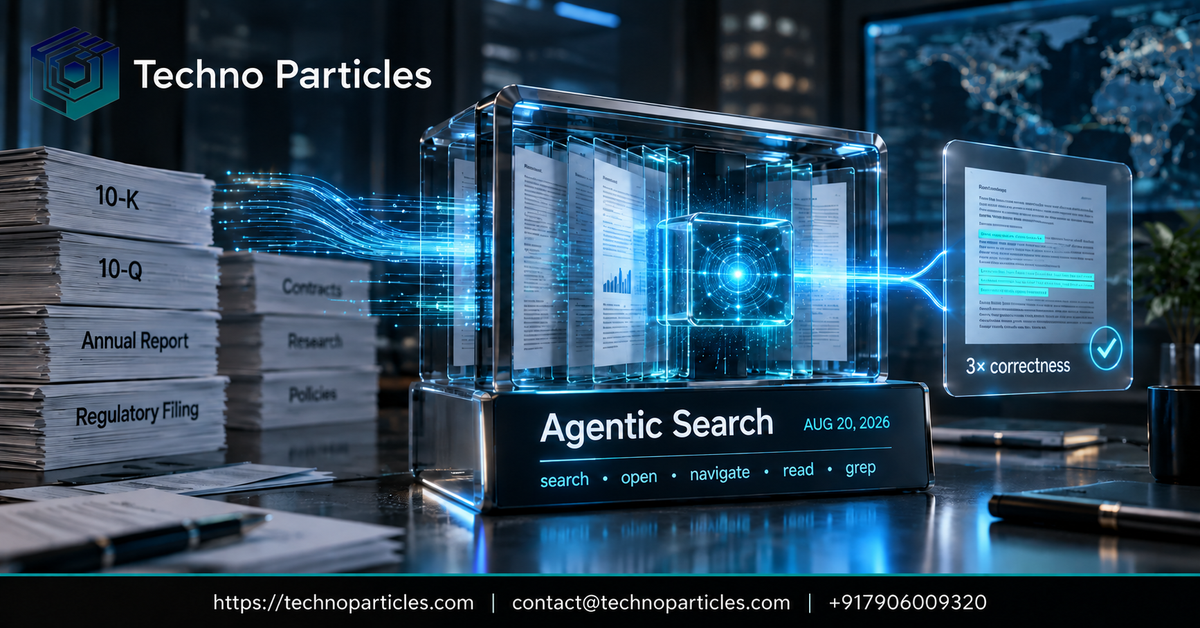
Mistral has introduced Agentic Search, a retrieval layer designed to help AI systems search, inspect, navigate, and verify information inside complex documents. Announced by Mistral on August 20, 2026, the update targets one of the biggest weaknesses in conventional retrieval-augmented generation, or RAG: an AI model may receive relevant-looking text chunks but still miss the table, clause, footnote, or second document that contains the real answer.
The Mistral Agentic Search latest AI retrieval update is important because it changes retrieval from a single lookup into an investigation. Instead of asking an index for a fixed set of passages and immediately generating an answer, an AI agent can search an existing corpus, open a promising document, move to a relevant page or section, read the surrounding material, and look for a specific term. It can then search again when the first result is incomplete.
Mistral says Agentic Search is available through its Search Toolkit and Libraries, including access through Studio and Vibe. The company positions the system for cloud and on-premises deployments, particularly where organizations need to work with sensitive financial, legal, operational, technical, or government data without moving everything across isolation boundaries.
What changed in Mistralâs retrieval approach?
Traditional RAG normally follows a predictable sequence. A user asks a question, a search system retrieves the highest-ranking chunks, and a language model writes a response from those chunks. This approach remains useful for direct lookups and short, clean documents. However, it becomes fragile when the answer is distributed across several sources or depends on document structure.
For example, a financial question might require a number from a table, a definition from a footnote, and a comparison with an earlier filing. A legal question may depend on a clause and an exception several pages later. A product-support question may require a model to inspect a manual rather than rely on a short paragraph extracted during indexing. Fixed chunk retrieval can surface the right document while hiding the exact evidence.
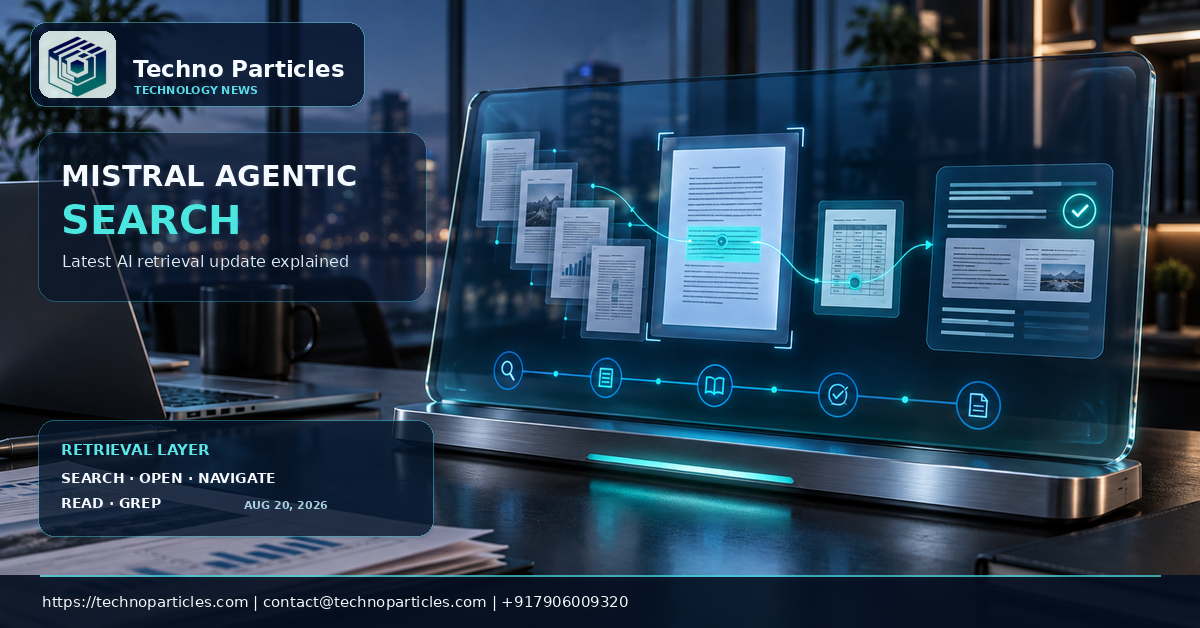
Mistralâs answer is a multi-step retrieval loop. Its Search Toolkit provides five main tools: search, open, navigate, read, and grep. Search identifies likely documents. Open loads a selected source. Navigate moves to a page, section, or region. Read retrieves material from that location, while grep finds a pattern inside an open document.
This design gives the model a more active role. The index remains responsible for finding likely sources, but the model decides what deserves closer inspection. That distinction matters: better reasoning can improve retrieval quality without requiring every organization to redesign its entire index whenever a stronger model becomes available.
Why the announcement matters for enterprise AI
Many business AI projects do not fail because language models cannot write fluent answers. They fail because the model cannot reliably locate and verify internal knowledge. Mistral Agentic Search addresses that gap directly. It is aimed at organizations whose most valuable information is stored in long reports, contracts, specifications, manuals, filings, and internal records rather than neatly structured databases.
For an Indian manufacturer, distributor, education company, healthcare provider, logistics operator, or e-commerce business, that could mean searching product documentation, compliance files, service records, policy documents, or customer material more intelligently. The practical value depends on the quality of the source data, indexing configuration, permissions, and evaluation process. Agentic retrieval is not a substitute for clean governance.
Mistralâs announcement also fits a broader shift from chatbot answers toward AI systems that can investigate before responding. For teams building a customer portal, internal knowledge assistant, or workflow automation product, the update offers a way to make document search more deliberate and auditable. Businesses exploring these systems can review generative AI development services and custom application development when planning a production implementation.
Mistral Agentic Search Latest AI Retrieval Update Explained - Techno Particles
How Agentic Search works in practice
The workflow begins with an existing search index. Mistralâs Search Toolkit includes open modules for ingesting, embedding, and indexing data, and it can run in cloud, on-premises, or edge environments. Teams can select parsers, chunking strategies, embedding models, and extractors according to their documents and file types.
Once the corpus is indexed, an agent receives retrieval tools rather than only a ranked list of passages. It might begin with a broad search, inspect the first result, and decide that the answer is probably located in a specific section. It can navigate there, read additional context, search for a phrase, and compare evidence from another source. The model can also avoid repeatedly processing chunks it has already seen.
This is especially useful for multi-document questions. Suppose an analyst asks how a companyâs risk statement changed between two annual filings. A one-shot system may return two relevant passages but fail to align their definitions or locate the associated table. An agentic system can search for both filings, open the relevant sections, navigate to the risk discussion, read the nearby text, and verify the comparison before producing an answer.
Performance claims from Mistral
Mistral reports substantial gains on two evaluation settings. On FinanceBench, the company says correctness increased from 26.7% to 86% in its testing, which it describes as roughly three times better. On OfficeQA Pro, a benchmark involving table-heavy, multi-document questions, Mistral reports an improvement from 6.3% to 51.9%, or a 45.6 percentage-point gain.
Mistral also reports efficiency improvements. The full navigation loop reduced token usage by 23.9% for Mistral Medium 3.5 and 33.7% for GLM-5.2 compared with a search-only loop in the companyâs analysis. It says p90 latency was reduced by up to 39.6% in relevant cases, while token consumption fell by as much as one-third.
These figures are company-reported results, not a universal guarantee. Mistral says the answers were scored by an LLM judge calibrated against human labels, and that its tests used Mistral Medium 3.5 and GLM 5.2. Results can vary with corpus quality, document formats, model selection, indexing, permissions, query complexity, and evaluation design. Organizations should reproduce the tests on representative internal questions before making procurement or architecture decisions.
Agentic Search versus ordinary RAG
Agentic Search does not make traditional RAG obsolete. Mistral explicitly identifies situations where indexed retrieval remains the right starting point. Direct lookups, high-volume searches, and simple predictable questions generally benefit from fast keyword or semantic retrieval without a reasoning loop. Adding multiple model actions to every query could increase unnecessary complexity.
The strongest use case is the difficult middle ground: questions that look simple to a user but require evidence from a particular page, table, clause, or group of documents. In those cases, the initial search result is only the beginning. The model needs tools for targeted investigation, and the retrieval system needs to preserve enough document structure for those tools to work.
There are still limitations. Agentic Search depends on the underlying index, parsers, permissions, and source quality. Scanned documents may need reliable optical character recognition. Poorly extracted tables can remain difficult to interpret. A model can also choose an unhelpful search path or misread a document, so citations, source locations, human review, and application-level safeguards remain important.
What developers should evaluate
Before adopting the update, developers should identify which questions are genuinely hard for current search. Measure answer correctness, evidence coverage, citation accuracy, latency, token consumption, and failure recovery. Include long PDFs, tables, cross-document comparisons, scanned pages, and documents with conflicting versions.
Teams should also test access control. A retrieval agent must never expose a document merely because its contents are technically searchable. Indexing and tool calls should respect user, department, tenant, and document-level permissions. Logging is equally important because multi-step retrieval makes it useful to see which sources were searched, opened, navigated, and read.
Mistralâs update is therefore best understood as an architectural option rather than a magic switch. A well-configured index remains foundational.

What Mistral Agentic Search means for businesses and users
The Mistral Agentic Search latest AI retrieval update points toward a more capable generation of enterprise assistants. The goal is not simply to produce a polished answer faster. It is to let an AI system investigate the underlying material before answering, especially when the evidence is scattered across dense documents.
For business users, the benefit could appear in several forms. An employee assistant might locate a precise policy exception instead of returning a general summary. A finance workflow could compare figures across filings and identify the source location. A support system might inspect the correct product manual before suggesting a repair step. A research assistant could assemble evidence from several reports rather than repeating the first plausible passage.
For developers, the announcement reduces the pressure to build every retrieval behavior from scratch. Search Toolkit provides a composable foundation for ingestion, indexing, retrieval, and evaluation, while Agentic Search supplies the tools needed for deeper inspection. The open and portable positioning may also appeal to organizations that need cloud flexibility, private infrastructure, or more control over sensitive data.
How it could affect AI application development
The update is relevant to more than internal chatbots. Customer portals, CRM assistants, document-management systems, analytics dashboards, and workflow applications can all benefit from retrieval that understands when an initial result is insufficient. An AI agent connected to a companyâs approved data can help staff move from searching for a document to answering a business question grounded in that document.
However, product teams should keep the user experience visible. People need to know when an answer is based on one source, several sources, or an uncertain interpretation. Interfaces should expose citations, document names, page references, update dates, and permission-aware links where appropriate. A longer reasoning path should produce better evidence, not an opaque answer that users cannot verify.
Businesses also need a content-maintenance plan. If old contracts, duplicate manuals, or outdated policies remain in the index, a stronger retrieval loop may find them more effectively without knowing that they are obsolete. Versioning, retention rules, metadata, access controls, and regular evaluation are part of the system. AI retrieval quality is ultimately tied to information management quality.
For companies building a broader digital platform, Agentic Search could sit alongside responsive website development, UI/UX design, and employee management systems. The best implementation will connect retrieval to a clearly defined workflow, such as document review, lead qualification, compliance support, or service operations, instead of adding AI without a measurable business outcome.
Final takeaways
Mistralâs August 20, 2026 announcement makes Agentic Search one of the companyâs clearest moves toward reasoning-based retrieval. Its five toolsâsearch, open, navigate, read, and grepâlet an agent move beyond fixed chunks and inspect evidence inside long documents and across multiple sources. Mistralâs reported FinanceBench, OfficeQA Pro, token-use, and latency results suggest that targeted navigation can improve both answer quality and efficiency, although independent teams should validate those claims on their own data.
The update does not eliminate ordinary RAG. Simple searches still benefit from fast indexed retrieval, while complex questions may justify an agentic loop.

Leave a comment