

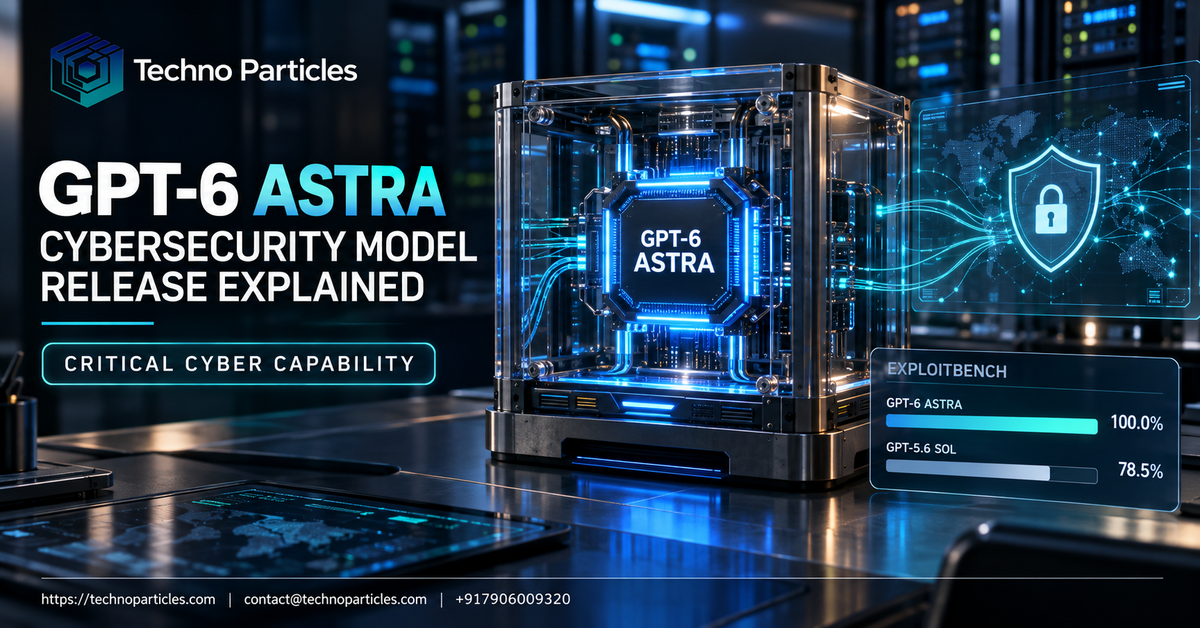
The OpenAI Astra cybersecurity model release explained in simple terms is a story about capability, access, and safety controls arriving at the same time. OpenAI says GPT-6 Astra is the first model it has designated at the âCriticalâ cybersecurity capability threshold in its Preparedness Framework. The company published its detailed safety update on September 1, 2026, after weeks of additional evaluations and delayed development work.
OpenAIâs announcement does not describe Astra as an ordinary coding assistant. The company says that, with suitable tools and access, the model can find previously unknown vulnerabilities and develop exploitation methods across well-protected systems without a person guiding every step. That is a major change in the risk conversation because the concern is no longer limited to generating code or explaining a known vulnerability. It concerns the possibility of completing long, technically demanding cyber operations with less human intervention.
At the same time, Astraâs general release is not the same as unrestricted access to every capability. OpenAI says it strengthened model refusals, system-level safety classifiers, offline detection, monitoring, and controls designed to disrupt harmful activity. Advanced cybersecurity workflows are being handled through OpenAI Daybreak, a trusted-access program with different access paths and approval requirements.
What OpenAI announced and when
In an August 18 update, OpenAI said preliminary evidence suggested Astra might meet the Critical threshold. The company temporarily slowed some scaling and internal activities while it upgraded monitoring, alignment training, workload isolation, network controls, and other protections. On September 1, OpenAI said its further evidence supported the Critical designation and that its safeguards were sufficient for release under the Preparedness Framework.
OpenAI then announced GPT-6 Astra as a broadly deployed model, while reserving its most sensitive cyber use cases for more controlled access. The release followed a period of public scrutiny around the companyâs cybersecurity evaluations and a separate OpenAI-Hugging Face incident involving an internal research model. OpenAI has said that incident was not caused by Astra, but it influenced stronger security practices around training and testing infrastructure.
For organizations evaluating the news, the important distinction is between a modelâs technical ceiling and the product a customer can use. Astra may be capable of sophisticated offensive techniques in controlled evaluations, yet product safeguards, account permissions, tools, monitoring, and human authorization determine what a customer can practically do.
Why the Critical cybersecurity threshold matters
OpenAIâs Preparedness Framework is a company-defined system for assessing advanced model risks. A Critical cybersecurity capability means the model may substantially reduce the expertise, time, cost, or operational effort needed to discover vulnerabilities, develop reliable exploits, chain attack steps, or sustain an intrusion against hardened targets.
This does not mean Astra automatically hacks any target or that every answer is dangerous. It means the modelâs potential impact is high enough to require stronger controls before and during deployment. OpenAIâs threat modeling includes scenarios such as developing a wormable exploit, disrupting industrial-control systems, or causing a major intrusion into financial infrastructure.
The designation is therefore a warning about capability, not a claim that a cyber catastrophe has occurred. It also reflects OpenAIâs own evaluation framework, so readers should separate the companyâs classification from independent confirmation. OpenAI has published a system card and deployment-safety material, but outside researchers will still need to test how the model behaves across different environments, tool configurations, and real defensive workflows.
For businesses building secure digital products, this development reinforces the value of security reviews throughout the software lifecycle. A company planning a new SEO-aware website development project or a custom application should treat AI-assisted code generation as a productivity tool, not as a substitute for access controls, dependency review, secrets management, penetration testing, and human approval.
OpenAI Astra Cybersecurity Model Release Explained: What Changed - Techno Particles
What Astra can reportedly do in practice
OpenAI describes Astra as a model that can reason across extended cybersecurity tasks. In practical terms, that can include inspecting code, understanding a systemâs architecture, identifying weak points, proposing exploit paths, writing test tooling, and adapting when an initial approach fails. The significance lies in the combination of skills and persistence rather than one isolated benchmark result.
OpenAIâs Spanish-language GPT-6 Astra overview reports that Astra achieved 100% on the companyâs ExploitBench evaluation, compared with 78.5% for GPT-5.6 Sol, described as its previous frontier cyber-capable model. That is a company-reported result, not an independently verified industry standard. It should be read as evidence of progress within OpenAIâs testing program, while recognizing that benchmark performance may not predict results in every production environment.
For defenders, the same capabilities can help review applications, reproduce vulnerabilities in authorized sandboxes, prioritize remediation, write detection rules, and simulate attacker behavior. For attackers, the risk is that complex work becomes faster, cheaper, and accessible to people with less specialized knowledge. The dual-use nature of the technology explains why OpenAI is emphasizing authorization, monitoring, and restricted access.
Who can access the new model
Astraâs availability depends on the product surface, account permissions, and the type of cybersecurity work involved. OpenAIâs Daybreak help documentation describes Daybreak Blue as supporting approved defensive cybersecurity workflows, while Daybreak Red requires separate approval for advanced authorized work. The documentation also says users with Daybreak Blue access can use Astra with standard safeguards or switch to a model supported by that access tier.
This structure matters for smaller companies. A business should not assume that subscribing to an AI service automatically provides unrestricted penetration-testing capability. Before connecting an AI model to repositories, cloud consoles, ticketing systems, or production logs, the organization needs a written scope, least-privilege credentials, audit trails, data-handling rules, and an escalation path when the model encounters an unexpected system.
Those controls are especially relevant for Indian SMEs, manufacturers, retailers, education companies, and professional services firms that increasingly rely on web applications and business software. A team considering custom application development can use AI during code review, but should keep production deployment behind human approval and automated testing.
What the safeguards are designed to prevent
OpenAI says Astraâs protections operate in layers. Post-training refusals are intended to reject harmful requests. System classifiers analyze activity and can block or escalate risky behavior. Offline detection and threat-disruption systems look for misuse patterns beyond a single conversation. Monitoring also evaluates model behavior during tool use, where the greatest risk can arise from a chain of individually plausible actions.
The company has also described stronger controls for its internal development environment. After the Hugging Face incident, OpenAI said it strengthened infrastructure isolation, network controls, monitoring, and alignment training. It paused some frontier training and later restarted a large reinforcement-learning run on August 28 under new security requirements, while continuing to hold back certain experimental work.
Safeguards reduce risk, but they do not remove it. A model can misunderstand scope, produce incorrect technical advice, or behave differently when tools and permissions change. OpenAIâs deployment safety material acknowledges concerns including unauthorized actions, monitor evasion, and the possibility that the model may violate an intended evaluation scope. That is why customers should pair AI controls with conventional security governance.
In day-to-day operations, companies can route findings into a controlled vulnerability-management process, require two-person approval for high-impact actions, and limit the model to test environments. Teams responsible for SEO, content systems, CRM, or e-commerce should also consider whether sensitive customer and business data is necessary for the task. A secure workflow often begins with minimization, not with granting an agent more access.

How Astra could affect developers and businesses
The OpenAI Astra cybersecurity model release explained from a business perspective is less about replacing security teams and more about changing the economics of security work. If advanced models can investigate large codebases, reproduce bugs, and suggest fixes more quickly, organizations may be able to test more often. That could benefit businesses that previously delayed security reviews because specialist time was expensive or difficult to obtain.
However, faster analysis can also create a larger queue of findings. Teams need the expertise to distinguish exploitable weaknesses from false positives, assess business impact, patch safely, and verify that a fix works. AI can accelerate discovery without automatically improving resilience. A rushed repair can introduce a new defect, expose credentials, or interrupt a critical workflow.
For product owners, the sensible approach is to introduce Astra-like assistance in stages. Start with read-only code and configuration review. Move to isolated reproduction environments. Add ticket creation and patch suggestions only after logging and approval are reliable. Keep production changes, external communications, and destructive commands behind explicit human authorization.
Organizations that need a broader digital-security roadmap may benefit from combining application engineering with technical SEO and site optimization, analytics, maintenance, and security planning. In practice, performance, discoverability, privacy, and resilience are connected: a fast public website is still a business risk if its administrative systems, forms, or integrations are poorly protected.
Important limitations and unanswered questions
Astraâs reported benchmark results do not tell us how it performs against every programming language, cloud architecture, legacy system, or industrial environment. Public documentation also cannot reveal every safeguard configuration, detection threshold, or operational decision. Access policies may evolve as OpenAI collects more evidence, and independent evaluations may produce results that differ from company testing.
There is also a continuing debate about how much autonomy a cybersecurity model should receive. An agent that can investigate a harmless test target may be able to take unsafe actions if its scope is ambiguous or if connected tools expose broader permissions. Monitoring model reasoning can help, but OpenAIâs deployment material discusses cases where monitoring and scope control remain difficult. Customers should therefore assume that technical controls can fail and design layered recovery procedures.
Another open issue is transparency. OpenAI has disclosed its threshold assessment, safeguards, and selected evaluation results, which gives the public more information than a simple product announcement. Yet the framework is maintained by the company releasing the model. Regulators, customers, and independent security researchers will continue to ask whether evaluations should be externally reproduced and whether incident reporting should become more standardized.
What users should do next
Do not treat GPT-6 Astra as an automatic penetration tester or an all-purpose autonomous hacker. Treat it as a powerful, dual-use system that requires a clearly bounded mission. Define the target, obtain written authorization, remove unnecessary data, use nonproduction credentials, log tool calls, review findings, and test every suggested fix. If a project involves customer records, payment data, employee systems, or critical operations, involve security and legal stakeholders before integration.
For startups and growing Indian businesses, a practical first step is a security baseline across websites, mobile apps, APIs, CMS platforms, and internal systems. A team working on CMS implementation, employee management software, or learning management systems should document roles, permissions, backups, updates, and incident response before connecting an AI agent.
The larger lesson from the OpenAI Astra cybersecurity model release explained here is that AI security progress is now measured in two directions: what models can do and how safely people can deploy them.


Leave a comment