


Google has announced Gemini 4 Argon, a new AI model aimed at tasks that require extended reasoning, large context, and sustained work across complex projects. In its September 30, 2026 announcement, Google DeepMind said Argon is initially being offered to trusted cyber defenders through the Fairwind Program. Wider access is planned first for paid API customers and Google AI Ultra subscribers, but Google has not announced a general public release date.
Why Gemini 4 Argon matters for software teams
The most notable specification is its 1 million-token output limit, compared with the previously stated 64,000-token limit. In practical terms, developers could use Gemini 4 Argon to inspect large codebases, map dependencies, propose migration plans, and produce detailed implementation documents in a single workflow. It could also help coordinate multi-step engineering tasks where requirements, source files, tests, and technical documentation must remain aligned.
Google presents Argon as a model for long-horizon software engineering, enterprise knowledge work, finance, legal workflows, creative writing, and cybersecurity defense. Developers exploring these use cases can connect model outputs to carefully permissioned repositories, document stores, issue trackers, or internal knowledge bases. Teams planning this kind of system may find relevant implementation guidance through custom application development services, particularly when an AI workflow needs authentication, audit logs, human approvals, and integrations.
Early opportunities, with important limits
Potential projects include automated code-review preparation, legacy framework migration analysis, contract and policy comparison, research dossier creation, and security triage. Google reports scores such as 77.9% on DeepSWE v1.1 and 68% on CWE-bench v1, but these are company-presented results rather than independent verification. They should guide testing priorities, not replace tests or expert review.
Introductory API pricing is listed at $2 per million input tokens and $10 per million output tokens, with cached input discounted by 95%. Google says those rates will later rise to $4 and $20 respectively. That makes usage forecasting, redaction, access controls, and human validation essential before deploying Argon in production.
How developers could turn Argon into working systems
The strongest opportunity may be combining Gemini 4 Argon with existing engineering tools instead of treating it as a standalone chat interface. A development team could provide a repository snapshot, architecture notes, open issues, and test results, then ask the model to identify dependencies, group migration risks, and produce a staged plan. Each proposed change should move through a normal branch, code review, automated testing, and rollback process.
For document-heavy operations, Argon could compare policy versions, extract obligations from contracts, prepare compliance checklists, or assemble research packets from approved internal sources. A business application can keep these workflows controlled by limiting which documents the model may access, recording citations and prompts, and routing sensitive decisions to designated employees. Teams building such integrations can explore generative AI development services for help connecting models with business data and approval workflows.
A practical pilot structure
- Choose one bounded process. Start with a task such as dependency mapping, vulnerability triage, or internal document comparison rather than an unrestricted agent.
- Define measurable outputs. Track review time, missed issues, correction rates, token consumption, and the percentage of recommendations accepted by experts.
- Protect the input. Remove unnecessary personal or confidential data, apply least-privilege permissions, and document retention rules before sending material to an API.
- Keep a human approval gate. Argon may draft code, analysis, or recommendations, but qualified people should approve production changes, legal interpretations, financial actions, and security responses.
The Fairwind-first rollout also signals that cybersecurity use cases will receive unusually close scrutiny. Developers should expect safety evaluations, access restrictions, and changing availability as Google learns from trusted defenders. Until broader testing and independent comparisons appear, the sensible approach is to treat Argon as a promising component for supervised experiments, not as an autonomous replacement for software engineers, security teams, or domain specialists.
Gemini 4 Argon Limited Rollout: What Developers Can Build - Techno Particles
Building reliable workflows around Argon
The practical value of Gemini 4 Argon will depend less on its maximum output length than on how developers structure the surrounding system. A large context window can bring source files, architecture decisions, tickets, test logs, and migration notes into one working session, but the inputs still need clear boundaries. Teams should label authoritative files, identify outdated material, and ask Argon to separate confirmed findings from assumptions before it proposes changes.
For a legacy application, a useful workflow could begin with dependency discovery and compatibility analysis. Argon might group modules by migration risk, identify likely breaking changes, draft test cases, and produce a sequence of small pull requests. Developers should preserve the existing build pipeline, review generated patches line by line, and test each stage independently. This makes the model useful for planning and acceleration without giving it unchecked control over production code.
Where document-heavy automation fits
Enterprise teams can also use Argon to compare policy revisions, extract obligations from contracts, assemble an internal research brief, or turn scattered operating procedures into a structured checklist. These workflows become more dependable when every important statement is tied to a supplied document and a reviewer can inspect the original passage. A custom integration may combine model access with identity management, retention controls, audit trails, and approval queues; teams exploring that architecture can review generative AI development services.
- Start with read-only access. Let the model analyze repositories and documents before allowing it to create tickets or modify files.
- Measure error patterns. Record omissions, unsupported recommendations, review time, and token usage across representative tasks.
- Design for fallback. Keep conventional scripts, search tools, and manual procedures available when Argon is unavailable or its output is uncertain.
These safeguards matter because the reported benchmarks do not establish how Argon will perform on every organizationâs data, codebase, or compliance requirements. Broader developer access and independent evaluations will provide a clearer basis for deciding which workflows deserve production investment.
What developers should test first
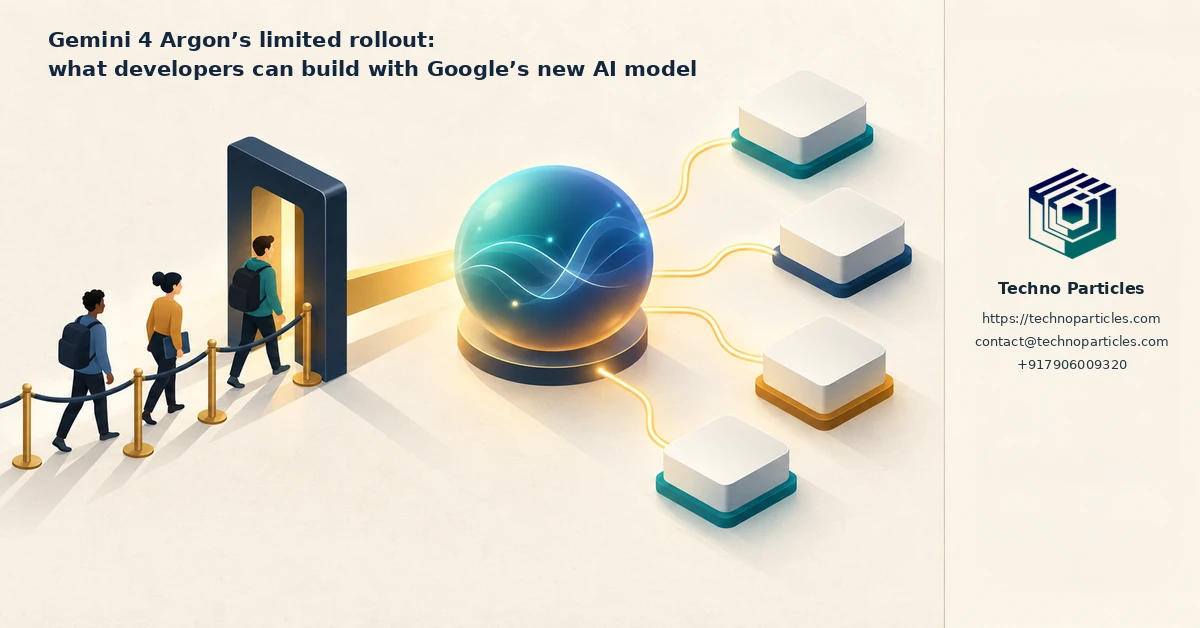
Gemini 4 Argonâs limited rollout makes access strategy part of the technical story. Google says the model is first reaching trusted cyber defenders through its Fairwind Program, with wider availability planned for paid API customers and Google AI Ultra subscribers. Because no general public release date has been announced, teams should design experiments that can pause or switch models without disrupting their applications.
Its reported 1 million-token output limit could be useful for unusually large engineering tasks, such as mapping dependencies across a legacy codebase, consolidating long incident records, or producing a detailed migration plan. That capacity does not remove the need for modular prompts. Developers should ask for inventories, assumptions, risk categories, and proposed next actions separately, then verify each result against source files and tests.
Cost and control still matter
Google lists introductory pricing of $2 per million input tokens and $10 per million output tokens, with cached input discounted by 95%; it says those prices will later rise to $4 and $20 respectively. Actual operating costs will depend on prompt size, repeated context, retries, and human review. A pilot should therefore record token use alongside time saved and error rates. Teams can use application development services to connect model experiments to existing authentication, databases, dashboards, and approval workflows.
Security teams may test Argon on vulnerability triage, patch-impact analysis, and defensive code review, but sensitive repositories require strict access controls and logging. A model recommendation should remain a lead for an analyst to investigate, not evidence that a vulnerability exists or that a patch is safe. The same principle applies to legal, financial, and operational documents: require source citations, flag uncertainty, and route consequential decisions to qualified reviewers.
For now, the most defensible implementation pattern is a reversible, read-only pilot with a fixed evaluation set. That lets developers compare Argon with their current tools while Googleâs access rules, pricing, and independent performance evidence continue to develop.

Turning Argon access into a controlled pilot
For developers who obtain access, the first useful experiment should be narrow, measurable, and reversible. Instead of asking Gemini 4 Argon to run an entire engineering project, teams can provide a defined repository snapshot, a fixed set of tasks, and explicit output requirements. The model can then produce an architecture map, identify dependencies, explain unfamiliar modules, and propose a review queue for human engineers.
Large-codebase analysis is especially suitable for this approach. A team maintaining an older application might ask Argon to trace authentication flows, locate duplicated business rules, and identify components that could complicate a framework migration. Each finding should include the relevant file, evidence, confidence level, and a suggested verification step. That structure makes it easier to distinguish useful analysis from plausible but unsupported commentary.
Keep production boundaries firm
Argon should initially operate in a sandbox with read-only repository access and no direct path to production credentials. Generated patches can be evaluated through existing tests, static analysis, dependency checks, and peer review. For security work, the same boundary applies: use isolated test environments, redact secrets, and require an analyst to reproduce or reject every reported issue.
Document-heavy workflows also need governance. When processing contracts, financial records, or internal policies, developers should define retention rules, permissions, audit logging, and escalation paths before connecting the model to business data. A custom system can combine these controls with approval screens, structured outputs, and existing databases; teams planning that integration may explore project consultation services.
- Compare Argon with the current tool on the same evaluation tasks.
- Track accuracy, omissions, review time, retries, and token consumption.
- Require source evidence for consequential recommendations.
- Keep a fallback workflow available if access, pricing, or model behavior changes.
This testing discipline is important because Googleâs reported benchmark results are company-presented, while independent evidence and broader access remain limited. Early adopters should treat the rollout as an opportunity to learn where the model adds measurable value, not as proof that every long-running workflow is ready for automation.
What Gemini 4 Argonâs limited rollout means for developers
Gemini 4 Argonâs limited rollout is best understood as an invitation to test ambitious workflows under controlled conditions, not as a signal that every development task is ready for autonomous execution. Google has positioned the model for long-horizon software engineering, enterprise knowledge work, and cybersecurity defense, but access remains restricted to trusted cyber defenders through the Fairwind Program. Wider access is planned for paid API customers and Google AI Ultra subscribers, with no general public release date announced.
Developers who gain access can begin with a fixed evaluation set covering codebase discovery, migration planning, documentation extraction, and security review. The same inputs should be tested against existing tools so teams can measure accuracy, omissions, review time, token usage, and recovery from incorrect answers. Googleâs benchmark figures are company-presented results, so they should guide questions rather than serve as independent proof of performance.
The practical takeaway
The modelâs reported 1 million-token output limit may help with unusually broad analysis, but larger context does not guarantee reliable reasoning.
Leave a comment