
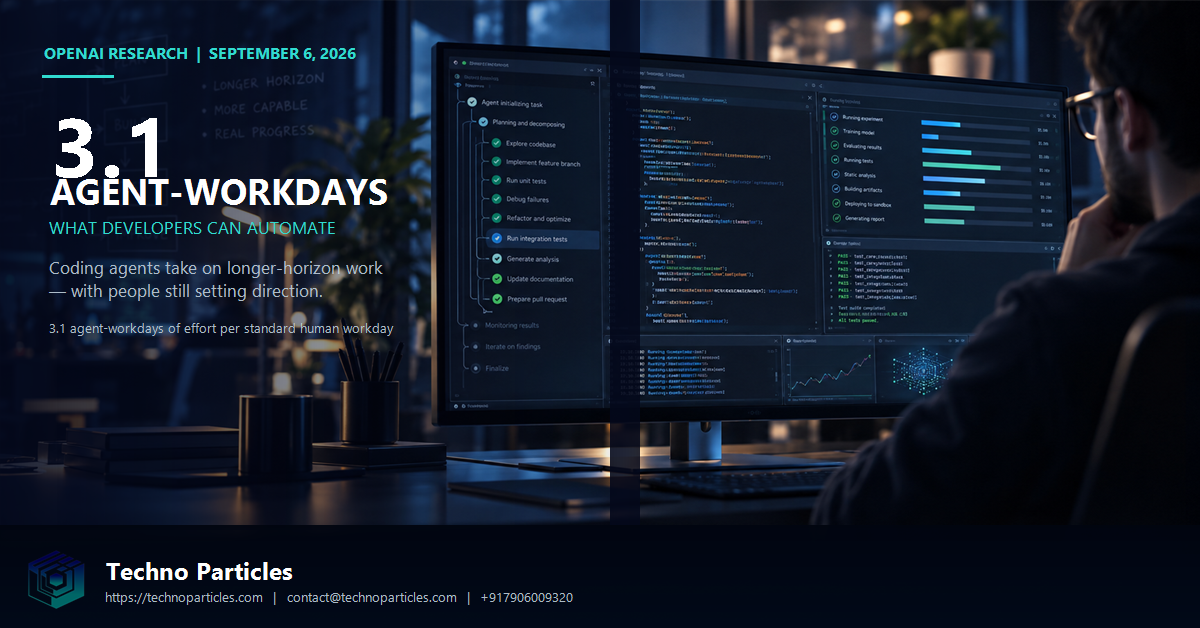
OpenAI says its research organization now uses 3.1 agent-workdays of effort for every standard eight-hour workday of human labor. The figure, published in the company’s September 2026 research-acceleration update, is a striking signal that coding agents are moving beyond autocomplete and short code suggestions. They are becoming parallel workers that can investigate repositories, write changes, run experiments, review results, and prepare follow-up tasks.
The number needs careful interpretation. It does not mean one researcher has been replaced by 3.1 perfect digital employees, nor does it prove that every software team will immediately achieve a 3.1-times productivity gain. OpenAI is measuring aggregate agent runtime and effort across its research organization. That is a company-reported operational metric, not an independent benchmark of shipped software or business value. Still, it offers a useful window into how an AI-native engineering environment is organized.
What the 3.1 agent-workdays figure actually measures
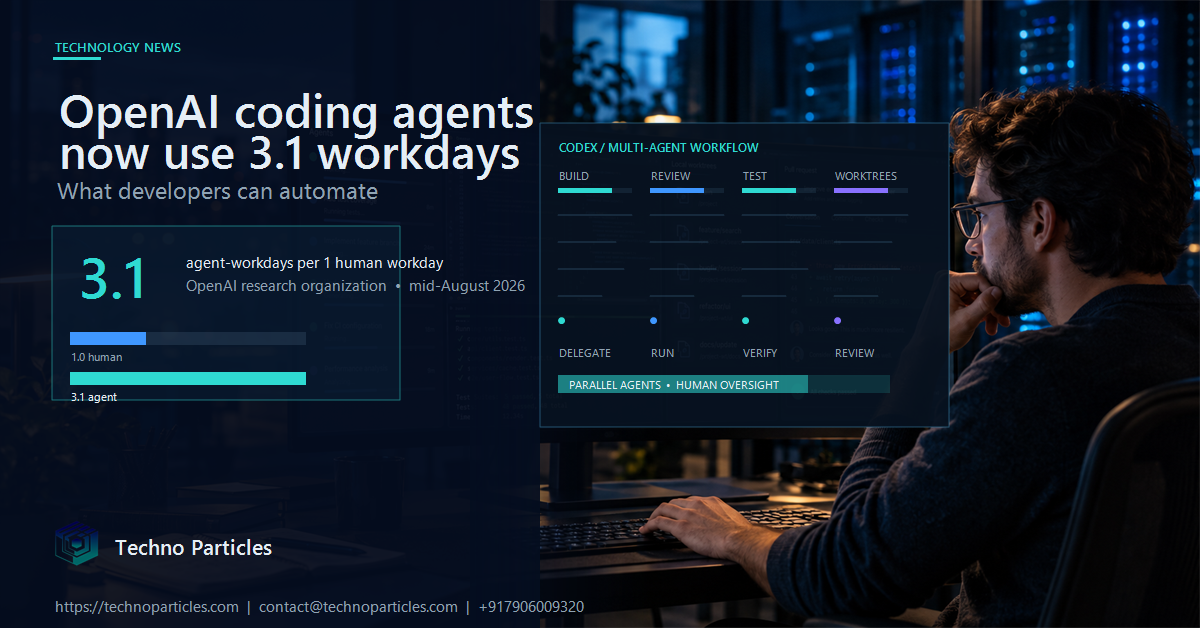
OpenAI describes a standard workday as eight hours and reports the amount of agent effort used for each human workday in its research operation. The measurement includes agents started directly by researchers and subagents launched downstream from those tasks. It also reflects concurrent usage: several agents can work on separate problems, branches, tests, or investigations at the same time.
That distinction matters. A human can spend a morning waiting for a long test suite, searching documentation, or comparing implementation options. An agent can perform those tasks while the researcher works on architecture or another experiment. In this model, “workday” describes available execution time, not a guaranteed quantity of finished work. Quality, task difficulty, review time, infrastructure cost, and failed attempts still determine whether the extra runtime creates value.
OpenAI also says the median researcher ranked by agent usage was using coding agents daily by mid-August and consuming more than $600 per day of inference at API prices. That cost is an internal usage signal, not a universal price for Codex or a recommendation that smaller companies spend at the same level. Teams should measure their own workload, model choice, tool calls, and review burden before estimating a return.
Why coding agents are becoming parallel teammates
Traditional coding assistants respond to a prompt inside an editor. Modern agents can take a longer assignment, inspect the surrounding code, use a shell or cloud environment, make changes, run tests, and return an artifact for review. OpenAI’s Codex positioning emphasizes cloud environments, worktrees, parallel tasks, and longer-running software work. These capabilities change the unit of delegation from a line of code to a bounded engineering outcome.
For a product team, that could mean assigning one agent to map an unfamiliar service, another to add test coverage, and a third to investigate a failing build. The human developer remains responsible for task definition, permissions, design decisions, and acceptance criteria. The advantage comes from reducing idle time and keeping several low-risk investigations moving simultaneously.
This pattern is especially relevant to businesses maintaining websites, mobile apps, customer portals, CRM systems, and internal software. An agent can prepare a migration plan, identify duplicated components, draft API documentation, or test a responsive interface across defined viewports. The work becomes more useful when it is connected to a repository, test environment, issue tracker, and review process rather than treated as a free-form chatbot conversation.
For teams planning this transition, application development services can help establish the architecture, integrations, and deployment controls that make automation dependable.
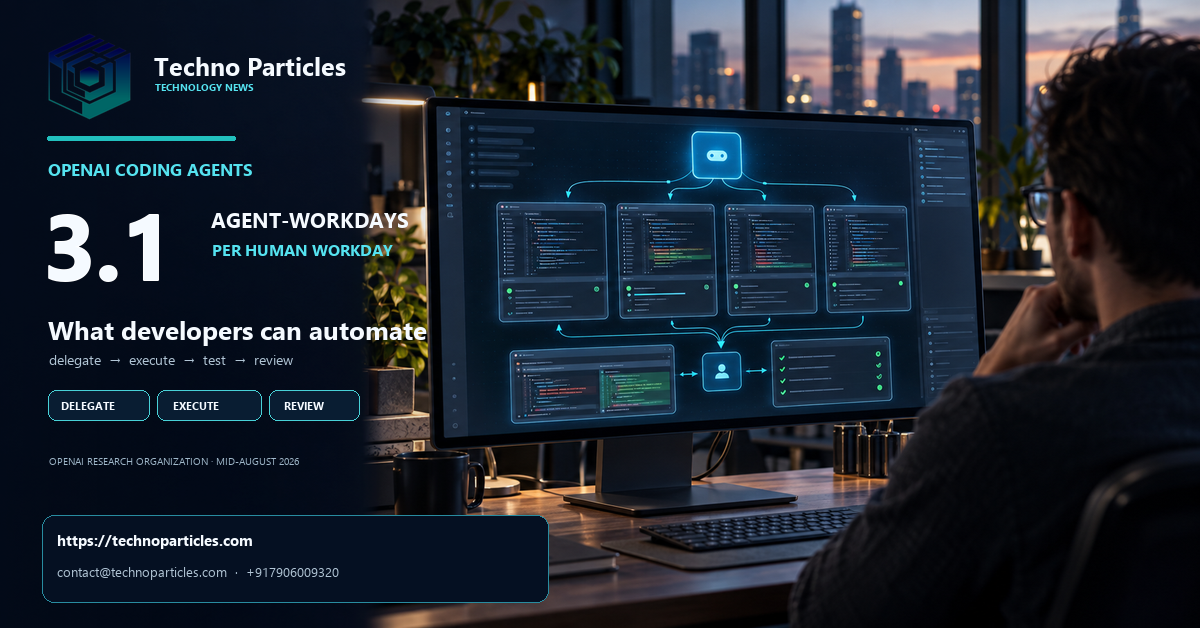
What developers can automate first
The safest starting point is repetitive work with clear inputs, observable outputs, and a human approval step. Coding agents can scan a repository and create a dependency inventory, summarize service boundaries, locate unused feature flags, or identify tests missing from a changed module. They can then produce a proposed patch or a report instead of directly merging code.
1. Test creation and maintenance
Agents can generate unit-test cases from existing behavior, expand edge-case coverage, update fixtures, and run targeted test suites after a change. Developers should inspect whether the tests assert meaningful behavior rather than merely matching the implementation. A test that passes because it repeats the same flawed assumption is automation theater, not quality improvement.
2. Documentation and code understanding
Long-running agents are useful for turning scattered implementation details into onboarding notes, API references, migration guides, and release summaries. They can compare documentation with source code and flag contradictions. This is valuable in older systems where knowledge is distributed across tickets, configuration files, database schemas, and deployment scripts.
3. Dependency and maintenance work
Routine upgrades, lint fixes, formatting changes, dead-code removal, and feature-flag cleanup are strong candidates when the repository has reliable tests. An agent can create an isolated worktree, update packages, run checks, and prepare a pull request that a maintainer reviews. The task should specify compatibility constraints, security requirements, and rollback expectations.
4. Data transformation and internal tooling
OpenAI’s broader research on Codex describes usage beyond traditional engineering, including automation, data transformation, debugging, and structured analysis. A developer might ask an agent to convert a collection of CSV files into a validated import format, build a small reporting utility, or reconcile schemas between a legacy system and a new application. Sensitive data should be minimized, access should be scoped, and generated outputs should be checked against known samples.
5. Quality assurance for web applications
Agents can run defined browser checks, inspect forms, reproduce a reported bug, compare screenshots, and record console or network errors. For an e-commerce site, a workflow could verify product search, cart updates, checkout validation, and mobile layouts. The agent should operate in a test environment with synthetic accounts and payment data. Production access is unnecessary for most first-stage QA.
Website teams can also connect agent-assisted maintenance to responsive website development, especially when recurring content, accessibility, performance, and compatibility checks are already documented.
A practical automation workflow
- Choose a narrow task: Define one outcome, such as adding tests for a payment-status module or documenting an existing API.
- Describe the boundaries: Name allowed files, prohibited changes, required commands, coding standards, and expected artifacts.
- Give the agent a safe environment: Use a branch or worktree, least-privilege credentials, masked secrets, and a network policy appropriate to the task.
- Require evidence: Ask for changed files, test output, assumptions, unresolved risks, and a concise summary of what was not verified.
- Review before merging: A developer should inspect the diff, run independent checks, and confirm that the change fits the product’s design and security model.
This workflow turns the 3.1 agent-workdays story into a manageable engineering practice: more parallel execution, with accountability remaining visible at every handoff.
The limits behind the headline
The most important limitation is that agent runtime is not the same as delivered productivity. An agent may spend hours exploring an ambiguous problem, retrying a broken command, or producing a patch that requires substantial correction. More parallel tasks can also create more review queues, merge conflicts, infrastructure consumption, and decisions for humans to supervise.
OpenAI’s figure is based on its own research environment, where repositories, tools, models, compute access, and engineering practices may differ from those at a startup or Indian small and medium-sized business. The result should therefore be read as evidence of adoption and operational possibility, not as a promise. Independent teams need measurements such as cycle time, escaped defects, review time, infrastructure cost, and percentage of agent changes accepted with minor edits.
Security and governance become engineering requirements
Giving an agent permission to read code, execute commands, browse internal systems, or modify files creates a broader attack surface. Prompt injection can appear in repository files, issue descriptions, web pages, documents, or generated content. A malicious instruction embedded in an otherwise ordinary artifact may try to expose secrets or redirect the agent’s actions.
Controls should match the risk. Keep credentials short-lived and narrowly scoped. Separate development, staging, and production environments. Block destructive commands unless explicitly approved. Log tool calls and file changes. Require review for authentication, payments, data deletion, infrastructure, database migrations, and customer-facing behavior. When an agent needs network access, permit only the domains and operations required for the assignment.
OpenAI has described using Codex logs alongside security triage processes and has published guidance on safe operation. The broader lesson applies to every coding-agent platform: supervision cannot be added after deployment as a cosmetic policy. It belongs in permissions, sandboxing, testing, audit trails, and incident response.
How businesses should evaluate the opportunity
Start with a two-week pilot around a backlog category that is easy to measure. Good examples include documentation gaps, regression-test expansion, accessibility checks, dependency maintenance, analytics scripts, and internal dashboards. Avoid beginning with an autonomous rewrite of a core system. Record the human time spent specifying tasks, reviewing output, fixing mistakes, and maintaining the workflow.
For teams building a website or application, an agent can accelerate implementation, but product discovery and user experience decisions still need human judgment. A clean interface, reliable checkout, useful CRM workflow, or effective SEO structure depends on business context that a repository alone cannot provide. UI/UX design support and project consultation can help translate automation into a system that customers can actually use.
Marketing and content operations can benefit too. Agents may classify leads, prepare campaign variants, audit metadata, summarize analytics, or suggest internal-link opportunities. Those outputs should be checked for factual accuracy, brand tone, privacy, and compliance. A suitable SEO workflow uses automation to surface opportunities while keeping strategic decisions and publication approval with people.
What developers should take away
OpenAI coding agents now use 3.1 agent-workdays for every human workday in its research organization, according to the company’s latest update. The number shows how far parallel, long-running automation has advanced inside a frontier technology company. It does not establish a universal productivity multiplier.
Developers can act on the signal by delegating bounded maintenance, testing, documentation, QA, data transformation, and investigation tasks. The winning setup will combine capable agents with isolated environments, explicit instructions, reliable tests, careful permissions, and thoughtful review. In other words, the future suggested by the 3.1 agent-workdays figure is not software built without developers. It is software teams spending less time waiting and more time directing, validating, and improving the work that agents can safely automate.
A practical automation map for development teams
The clearest way to use OpenAI coding agents now use 3.1 workdays is to divide engineering work by risk, repeatability, and review effort. The safest starting point is work that has a clear input, a measurable output, and a straightforward rollback. This makes it easier to judge whether the agent saved time or merely moved effort into supervision.
Low-risk tasks to delegate first
- Repository maintenance: Ask an agent to update dependencies, identify deprecated APIs, or prepare a controlled migration plan. Require a change summary and a list of files that need human attention.
- Test creation: Agents can inspect existing behavior and propose unit, integration, or regression tests for uncovered paths.


Leave a comment
Your email stays private. You can see your comment immediately on this browser. Others see it after approval.