

Salesforce SMB Growth Kit India brings Agentforce Sales, Slack and Tableau into one package for small businesses seeking a more connected CRM foundation. Salesforce announced the offering on July 16, 2026, describing it as an India-focused package available through select reseller partners. The launch release says businesses can go live in four to six weeks, while the product page presents a four-week implementation target. Those estimates describe the same partner-led offer but should not be treated as a guaranteed deadline. Businesses planning a rollout can also review a project consultation service when defining requirements and ownership.
| Area | What Salesforce describes |
|---|---|
| Core products | Agentforce Sales, Slack and Tableau |
| Sales operations | Lead assignment, pipeline visibility, opportunity support and forecasting |
| Collaboration | Workflow connections and coordinated work through Slack |
| Management insight | Live business dashboards through Tableau |
| Rollout | Four to six weeks in the launch release; four weeks on the product page |
| Availability | India, through select reseller partners |
What Salesforce changed with its India SMB Growth Kit
The July 16, 2026 announcement positions the kit as a connected operating layer for sales teams rather than a standalone chatbot or isolated CRM add-on. Salesforce says Agentforce Sales supports pipeline visibility, lead assignment, AI-assisted opportunity scoring, forecasting and recommendations. Slack connects the work around those records, while Tableau supplies live management views. These are Salesforce’s published capabilities in the launch announcement.
The timing matters because the offer combines three familiar business functions in one implementation conversation: selling, team coordination and reporting. Salesforce says the package was immediately available in India through select reseller partners on the announcement date. Its separate SMB Growth Kit page uses the shorter four-week target, so buyers should ask which estimate applies to their scope and participation.
How Salesforce SMB Growth Kit India connects sales work
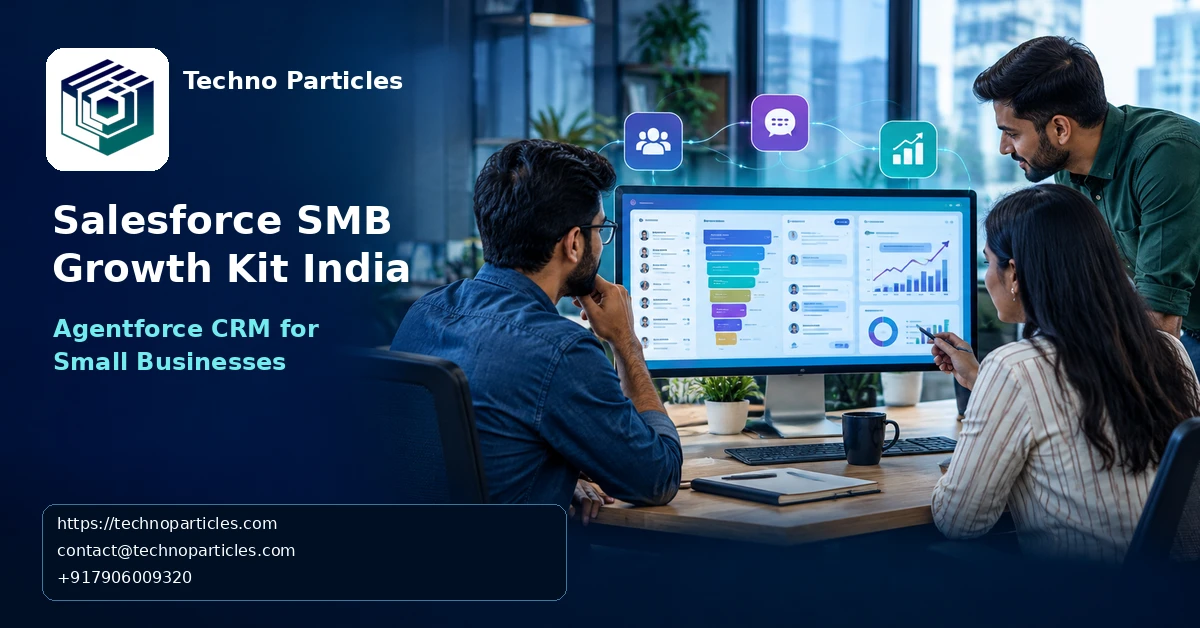
The package separates three jobs while keeping them connected. Agentforce Sales is the working layer for lead capture, assignment, account records, opportunities, pipeline management and forecasting. Salesforce’s SMB Growth Kit overview describes these functions as one operating flow for small teams, rather than separate tools that require manual handoffs.
Slack handles the coordination around customer records. A sales representative can bring colleagues into deal discussions, share updates and connect workflow activity with the sales process. Tableau then turns operational data into management views, helping leaders monitor pipeline movement and business conditions through dashboards. The exact data model and dashboard scope still depend on the customer’s implementation.
Where developer tooling fits
Packaged onboarding does not mean every customer must build an agent from scratch. Salesforce also documents an optional Agentforce DX path for teams that need controlled development or customization. Its official guide uses the Salesforce CLI to locate relevant commands:
agent generate agent-specThe Agentforce agent-spec documentation describes this command as part of generating an agent specification. Salesforce’s Agentforce DX setup guide also documents the developer workflow. This is an optional technical path, not evidence that every SMB Growth Kit deployment requires custom code.
For buyers, the practical question is ownership: decide which sales rules, permissions and reporting definitions belong in the initial package. A requirements consultation can help teams document those boundaries before implementation begins.
Why the connection matters for a small sales team
The value of the package is the handoff between work stages. A new lead can enter the sales process, receive an assignment, and become part of an account or opportunity record. That record gives the team a shared reference point instead of leaving customer history in separate inboxes or spreadsheets. Salesforce describes these lead, account, contact and opportunity functions on its SMB Growth Kit overview.
Slack adds a coordination layer around that shared information. The team can discuss a deal in the same operating rhythm as the sales process, while managers retain a structured view of pipeline activity. Tableau serves a different audience: it converts business data into dashboards for people who need to compare movement, identify changes and decide where attention is required. Salesforce presents this connection as a combination of sales execution, collaboration and reporting rather than as one product performing every task.
That division also creates an implementation question. The business must define which events deserve a notification, which updates belong in the CRM record, and which measures should appear in management dashboards. Those decisions affect permissions, ownership and reporting quality more than the product names alone. Teams mapping internal workflows may find a business software planning service relevant when documenting those responsibilities.
For a small company, the connected model is most useful when each tool has a clear job: Agentforce Sales organizes revenue work, Slack coordinates people, and Tableau helps leaders interpret the resulting activity. The package can therefore reduce manual handoffs only when the underlying sales process is defined clearly enough for the systems to reflect it.
What the connected model changes operationally
The main change is shared context. Sales staff work from customer and opportunity records, collaborators discuss the work around those records, and managers read aggregated activity through dashboards. That structure can shorten handoffs because each role receives a different view of the same commercial process. Salesforce describes the package as combining sales execution, collaboration and analytics for Indian small businesses in its small-business CRM overview.
Integration does not remove the need for operating rules. A business must define when a lead becomes an opportunity, who owns each stage, which updates require team attention, and which measures represent healthy pipeline movement. Without those definitions, automation can move incomplete or inconsistent data faster without improving decisions.
Where AI assistance needs human ownership
Agentforce can support tasks such as lead follow-up, opportunity scoring and recommendations, but the business still controls permissions, escalation paths and acceptance criteria. Managers should decide which recommendations may trigger routine action and which require human approval. This keeps the CRM record as the source of business accountability, rather than treating an AI suggestion as a final decision.
That boundary matters for teams connecting customer data with internal workflows. A documented generative AI service approach can help clarify permitted data, review points and ownership before automation is expanded. The goal is not maximum automation. The goal is reliable movement from customer signal to assigned work, coordinated action and measurable outcome.
Developer tooling remains a separate option for organisations that need deeper control. Salesforce’s Agentforce DX documentation supports specification-based development, but the existence of that path does not make custom agent development part of every packaged deployment. Small teams can therefore evaluate the Growth Kit first as a defined operating model, then assess custom work only where standard workflows cannot express an approved business rule.

What Indian SMB buyers should verify before choosing the kit
The first question is whether the business can access the package through an eligible Salesforce reseller. Salesforce’s launch announcement says the SMB Growth Kit is available in India through select reseller partners, so availability is not the same as universal direct access. Buyers should ask which partner will deliver the package, what customer participation is expected, and which responsibilities remain with the business. Salesforce’s announcement should be the reference point for that availability claim.
Questions to put into the reseller scope
- Which lead, account, contact and opportunity data will be migrated, cleaned or excluded?
- Who owns sales-stage definitions, permissions, assignment rules and dashboard measures?
- Which of the advertised onboarding activities, including zero-code automations, training, sandbox sessions and hypercare, are included?
- Which Agentforce capabilities and usage entitlements apply to the proposed Salesforce edition and customer agreement?
- What is the written implementation timeline, and what customer decisions could delay it?
These questions matter because a connected CRM is only useful when records, ownership and reporting definitions are dependable. Salesforce’s small-business materials position Agentforce as part of a broader CRM environment, while its India SMB playbook describes fragmented applications as a business challenge and presents AI assistance as a possible way to connect work. Those market observations are Salesforce-reported context, not independent measurements of implementation success.
Buyers should also request a written price and packaging schedule. Salesforce has not published a specific public price for this offer in the supplied product information, and the company states that packaging may change under customer agreements. A scoped implementation consultation can help a team turn its data, ownership and reporting questions into a checklist for that reseller conversation.
No independent performance benchmark or verified customer outcome establishes that the kit will improve every SMB’s sales results. The sensible evaluation is therefore operational: can the proposed scope connect the business’s actual lead process, collaboration habits and management reporting within the agreed entitlement and timeline?
The decision rule for Salesforce SMB Growth Kit India
Choose Salesforce SMB Growth Kit India when your business needs one connected operating foundation for sales records, team collaboration and management reporting, and you accept partner-led onboarding. This rule fits teams that want shared visibility across leads, opportunities, conversations and dashboards. It does not mean every small business needs the same configuration. The value depends on whether your current process has enough recurring sales activity, coordination and reporting complexity to justify a structured CRM rollout.
Do not choose the kit only because it includes AI. Agentforce assistance matters when your team has clear ownership rules, usable customer data and defined actions for follow-up, scoring or recommendations. Without those conditions, a packaged CRM can preserve unclear processes at greater scale. The relevant question is whether the proposed setup can support accountable decisions, not whether it contains the most automation.
For a business that meets that threshold, the product page provides the correct starting point for examining the intended package, onboarding model and included capabilities: Salesforce’s SMB Growth Kit overview.
Next step before commitment
Ask an eligible Salesforce reseller for one written proposal covering scope, customer responsibilities, implementation timeline, product editions, Agentforce entitlements, training, support, data work and total price. Require the proposal to identify which activities are included and which depend on later approval or separate commercial terms.
Then compare that proposal with your actual lead stages, ownership rules and reporting needs. Sign only when the reseller can map those business requirements to named deliverables, accountable owners and measurable acceptance conditions. This gives the Salesforce SMB Growth Kit India decision a concrete boundary: proceed when the scope is explicit and operationally fit; pause when access, entitlements or cost remain unclear.


Leave a comment
Your email stays private. You can see your comment immediately on this browser. Others see it after approval.