

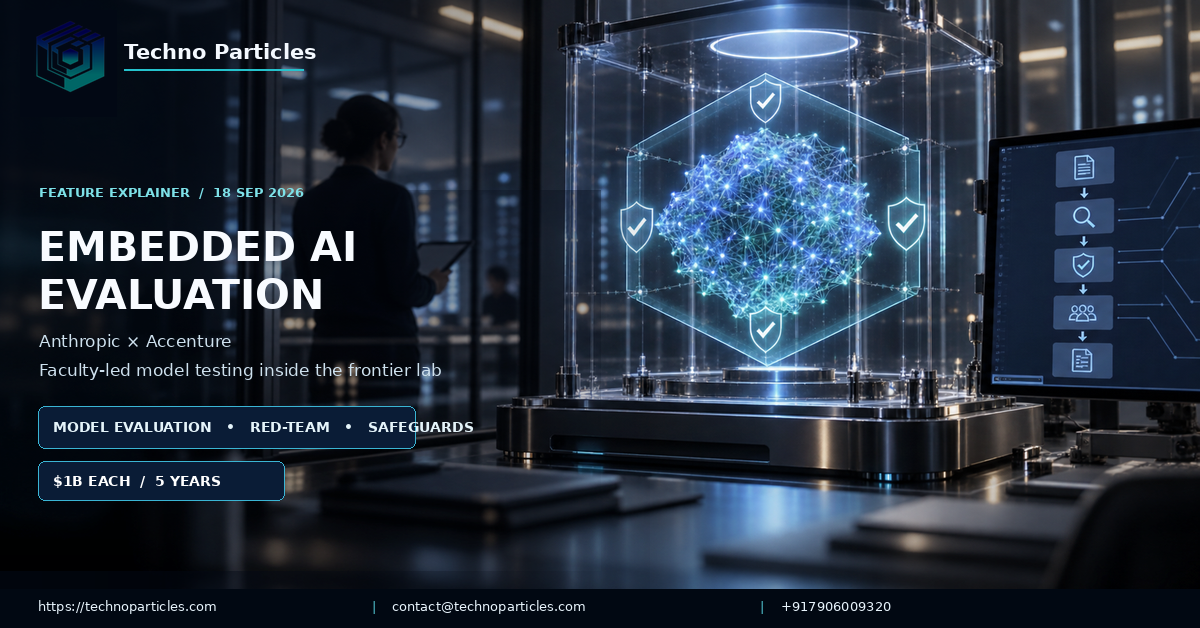
Anthropic and Accenture have announced a new partnership to place independent evaluators inside Anthropicâs model-development environment. Announced on September 18, 2026, the arrangement is designed to examine frontier AI systems while they are being trained, tested, and prepared for deployment. This Anthropic Accenture embedded AI evaluation partnership explained guide looks at what is confirmed, what remains undecided, and why the model could influence how advanced AI companies demonstrate safety.
The work will be led by Faculty, Accentureâs specialist AI business. According to Anthropic and Accenture, the team will evaluate and red-team models, conduct alignment assessments, and test safeguards. The companies each expect to invest at least $1 billion in building AI-safety capacity over the next five years. That figure describes the companiesâ broader expected investment in safety, not a published price for a customer-facing service.
What the partnership actually changes
Traditional external evaluation usually happens outside an AI lab. An evaluator receives a model, an interface, documentation, or limited access, then produces findings based on that boundary. Embedded evaluation is intended to place evaluators alongside the companyâs internal teams, with access comparable to that of an employee. This could let them observe how models are developed, understand decisions affecting training and deployment, and discuss concerns directly with staff.
That vantage point is the central change. An evaluator may be able to inspect more than a final chatbot response. The team could follow model behavior across development stages, examine safeguards before release, and identify organizational blind spots that are difficult to see from outside. Anthropic says embedded evaluators could also report incidents and help the public understand both the benefits and risks of frontier systems.
What Faculty and Accenture bring
Accenture says Faculty will assemble people with AI, security, and industry expertise. Faculty is now part of Accenture and has worked on complex AI systems in areas including government, defense, healthcare, and infrastructure. That background matters because model risk is not limited to benchmark performance. A system used in a hospital, public service, financial workflow, or industrial operation can fail through poor integration, weak permissions, misleading outputs, or unclear human oversight.
Accentureâs enterprise experience may therefore add a practical perspective to safety work. The evaluator can ask not only whether a model produces a dangerous answer in a test, but also how that behavior could interact with real processes, sensitive data, access controls, and decision-making responsibilities. This is a company-described rationale, not evidence that the partnership has already produced measured safety improvements.
Why embedded evaluation matters for frontier AI
Frontier models are increasingly capable of reasoning across long tasks, using tools, writing software, and operating within business workflows. Their risks can emerge from interactions among the model, tools, users, and surrounding systems. A short public test may miss a failure that appears only after many steps or under unusual conditions.
Embedded evaluators could help close that gap by seeing the development context earlier. They may test safeguards during model changes, challenge assumptions behind deployment decisions, and compare intended behavior with observed behavior. The approach could also make safety commitments more verifiable, because independent specialists would have a deeper opportunity to inspect how those commitments are implemented.
For businesses considering generative AI solutions, the broader lesson is practical: responsible deployment requires evaluation throughout the workflow, not only a quality check at launch. Smaller organizations will rarely need a frontier-lab-style program, but they still benefit from testing prompts, permissions, data handling, escalation paths, and human review before an AI feature reaches customers.
Anthropic Accenture Embedded AI Evaluation Partnership Explained - Techno Particles
How the evaluation could work in practice
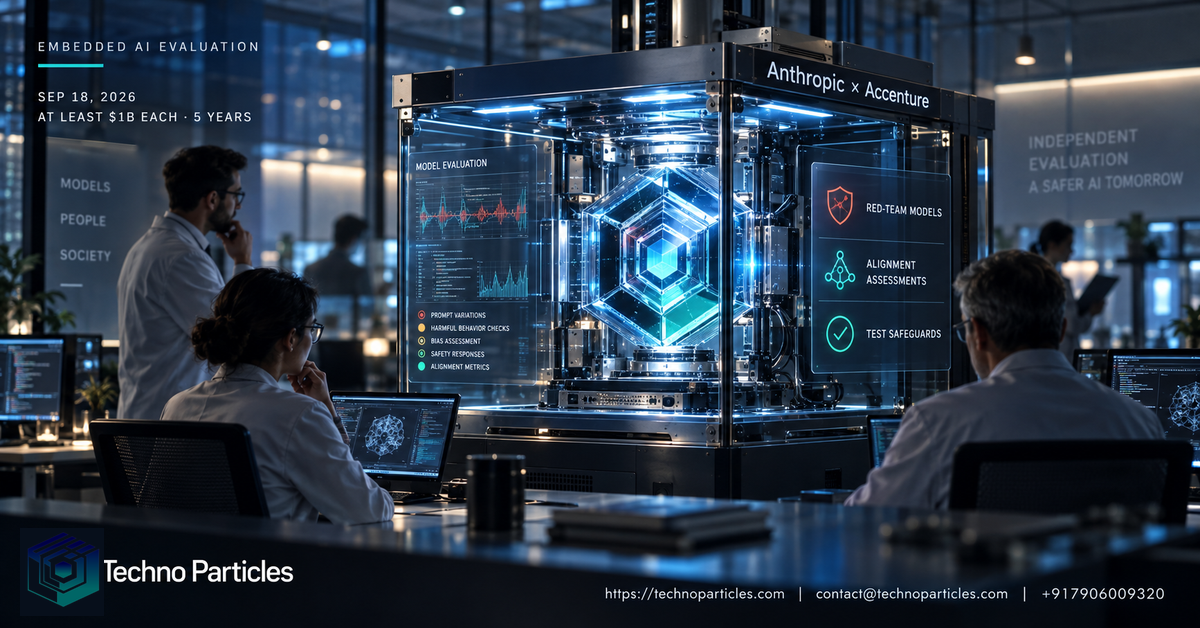
The announcement does not publish a detailed operating manual, so the following describes the likely structure rather than a confirmed schedule. Facultyâs team could work with Anthropic researchers and engineers during model development, create adversarial tests, inspect how safeguards respond, and assess whether a modelâs behavior matches its stated alignment goals. Red-teaming may include attempts to elicit harmful or restricted behavior, exploit tool access, or expose weaknesses in a modelâs ability to follow safety rules.
Alignment assessments are broader than checking whether a model refuses a small set of prompts. They can examine whether the system reliably follows intended instructions, handles uncertainty, respects boundaries, and remains stable when users apply pressure or provide conflicting directions. Safeguard testing may focus on filters, monitoring, policy enforcement, tool restrictions, and escalation procedures around deployment.
In an enterprise context, these questions connect directly to website development, applications, customer support, analytics, and internal business systems. An AI assistant that drafts content may need different controls from an agent that updates a CRM or triggers a transaction. Evaluation should reflect the consequences of failure, the sensitivity of the data, and the amount of autonomy granted to the system.
Independence is the difficult part
Anthropic describes the evaluators as independent, but the team will be funded directly by Anthropic for this initial work. That creates a tension that the announcement openly acknowledges. Embedded evaluators need sufficient access and freedom to report uncomfortable findings, while the host company controls the environment, information, and practical conditions of the engagement.
Anthropic says independent embedded evaluators do not reduce the companyâs accountability; instead, they can make safety commitments more verifiable. That distinction is important. The partnership does not transfer responsibility for model behavior to Accenture or Faculty. Anthropic remains responsible for the systems it trains and releases, and an evaluation is not a guarantee that every risk has been found.
The companies also say that standards for embedded evaluation are not yet settled. There is no agreed global rule specifying what information evaluators should receive, how conflicts should be handled, or how findings should be reported publicly. Anthropic is also in discussions with METR and other nonprofit evaluators to pilot elements of the approach using their own funding. The stated long-term direction is an ecosystem of evaluators operating with shared standards, potentially supported by pooled or government funding.
What is confirmed and what is not
- Confirmed: Anthropic and Accenture announced the partnership on September 18, 2026.
- Confirmed: Faculty will lead Accentureâs work, with activities covering evaluation, red-teaming, alignment assessments, and safeguard testing.
- Confirmed: each company expects to invest at least $1 billion in AI safety over five years.
- Confirmed: Anthropic will fund Accentureâs embedded evaluation work directly, and the partnership is non-exclusive.
- Not yet published: a detailed testing calendar, public scorecard, evaluator staffing level, or customer pricing.
- Not yet settled: common standards for evaluator access, reporting, and long-term funding.
That separation helps prevent the announcement from being mistaken for a finished certification scheme. No public evidence yet shows that the partnership gives ordinary Claude users a new feature, subscription benefit, or special access tier. It is an internal safety and governance arrangement around Anthropicâs development process.
For organizations building AI-enabled products, the immediate takeaway is to ask vendors for evidence rather than rely on partnership names. Useful questions include which risks were tested, whether the tests match the intended use case, how incidents are escalated, what human approvals remain, and how changes to the model are monitored. A strong UI/UX design process can also make uncertainty and handoffs clearer for users, but interface quality cannot replace technical evaluation.
What the partnership means for businesses and users
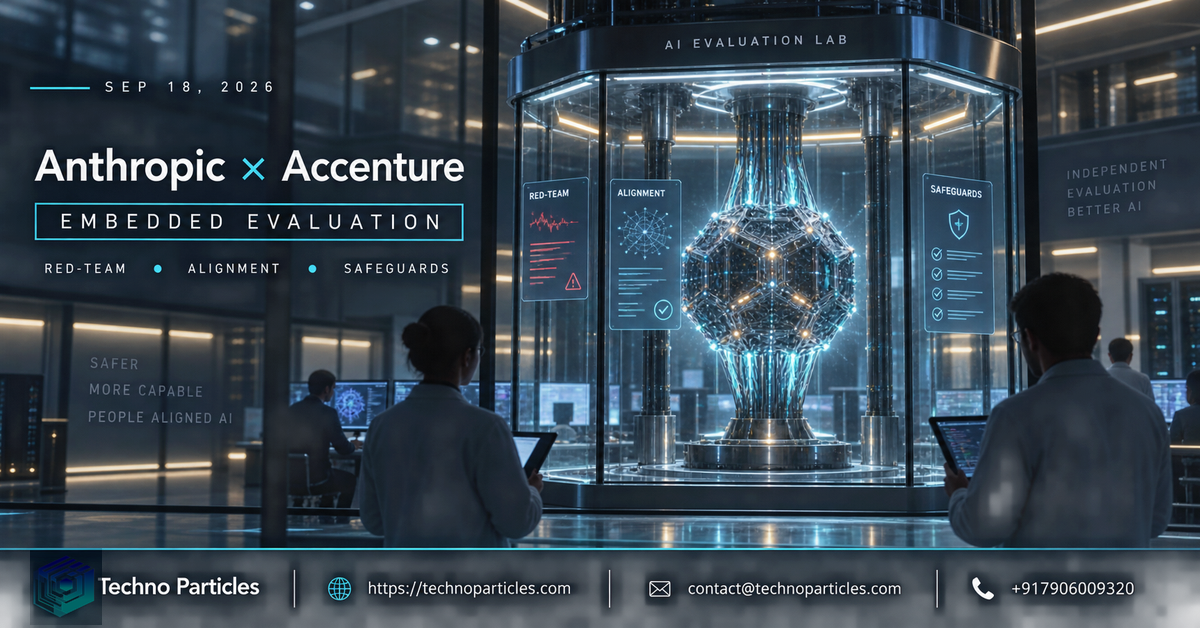
The most important near-term effect may be cultural rather than product-specific. If embedded evaluation becomes common, frontier AI companies could be expected to bring independent scrutiny into the development process instead of treating safety review as a final gate. That would resemble the way mature industries use testing, quality assurance, security review, and incident response throughout a product lifecycle.
For businesses, the announcement reinforces a growing distinction between buying access to a model and deploying a dependable AI system. A model can be impressive in a demonstration yet unsuitable for a workflow involving regulated information, financial decisions, employee records, or customer commitments. Companies need their own evaluation plan covering accuracy, privacy, security, bias, failure recovery, permissions, monitoring, and human accountability.
Indian SMEs and startups may not have the resources of Anthropic or Accenture, but the principle scales down. A company introducing an AI lead assistant can test whether it invents customer details, mishandles consent, or sends an inappropriate message. A retailer can check product data and escalation rules. A coaching organization can review whether generated explanations are clear and safe. A manufacturer can limit automation to recommendations until reliability is demonstrated.
Those projects can be supported by application development, custom backend controls, analytics, and carefully designed approval steps. For public-facing visibility, organizations should also connect AI changes to SEO and content governance, because publishing large volumes of unchecked generated material can create accuracy and trust problems even when the underlying model is capable.
Comparison with ordinary third-party testing
External testing remains valuable because distance can protect objectivity. An independent lab that is not embedded in the company may be more willing to publish criticism or compare systems across vendors. However, outside evaluators may lack the internal context needed to understand training choices, deployment constraints, monitoring systems, or why a safeguard behaves differently in production.
Embedded evaluation offers the opposite trade-off. Greater access can produce richer findings and earlier warnings, but proximity can create dependence or make public reporting harder. The strongest future model may combine both approaches: embedded teams with meaningful access, external evaluators with institutional distance, nonprofit research groups, government oversight, and transparent reporting where disclosure is safe.
What to watch next
Readers should look for evidence that the partnership moves beyond an announcement. Important signals would include published evaluation methods, examples of findings, explanations of how disagreements are resolved, information about evaluator protections, and clarity about which results can be shared publicly. It will also matter whether Anthropic works with several evaluators, as it says it plans to do, and whether Accenture performs similar work for other AI developers without creating inconsistent standards.
The partnershipâs non-exclusive structure is significant. Anthropic says it expects frontier labs to work with multiple organizations, while Accenture will work with other AI developers in similar capacities. That could prevent one company from becoming the sole gatekeeper of AI safety judgments. It could also encourage competition among evaluators, provided the work remains transparent enough to compare.
Final takeaway
The Anthropic Accenture embedded AI evaluation partnership explained in simple terms is an attempt to put independent safety expertise closer to the point where frontier models are built. Its confirmed scope includes model evaluation, red-teaming, alignment assessments, and safeguard testing, supported by major planned investment from both companies. Its limitations are equally clear: operating standards, public reporting, funding models, and measurable outcomes are still developing.
For users, there is no announced new Claude feature or pricing change to act on. For businesses, the news is a reminder to treat AI governance as an ongoing engineering and management responsibility. Teams planning an AI implementation can seek help with project consultation, workflow design, testing, and deployment controls before automation reaches customers or employees.


Leave a comment