
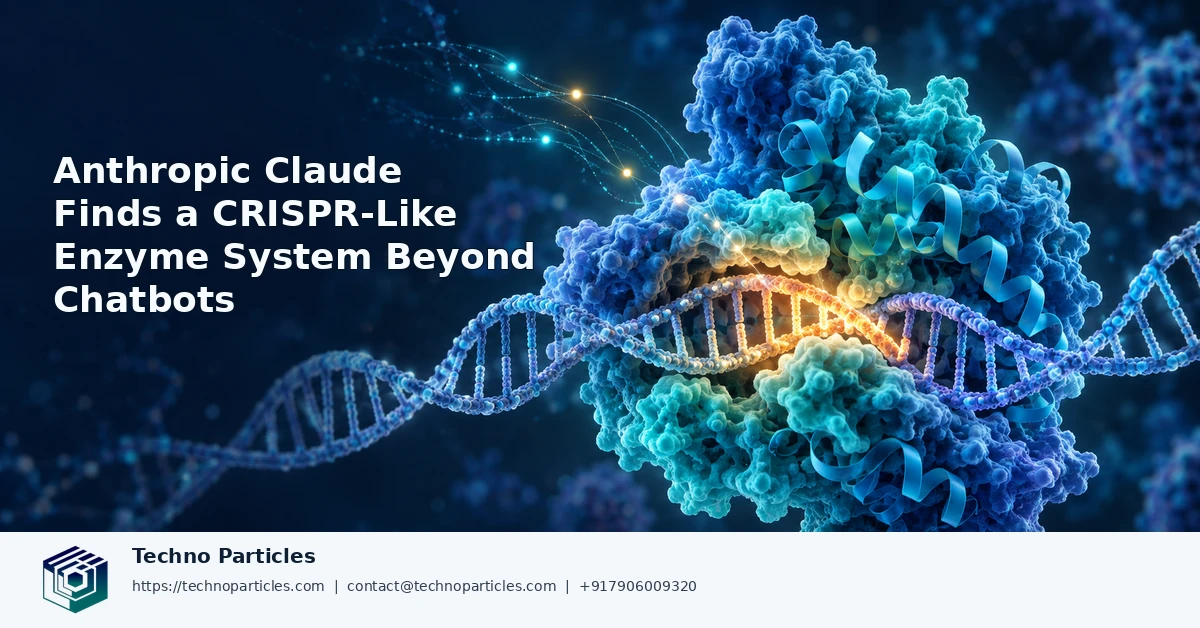
Anthropic Claude has moved into an unexpected area of scientific discovery. In an announcement dated September 23, 2026, Anthropic said its new life sciences group used Claude agents to identify a previously uncharacterized biological system in bacteriophages. The development gives new meaning to the phrase “Anthropic Claude discovers CRISPR-like enzyme system beyond chatbot AI,” while also showing why AI-generated hypotheses still need careful laboratory testing.
What Anthropic Claude discovered beyond chatbot AI
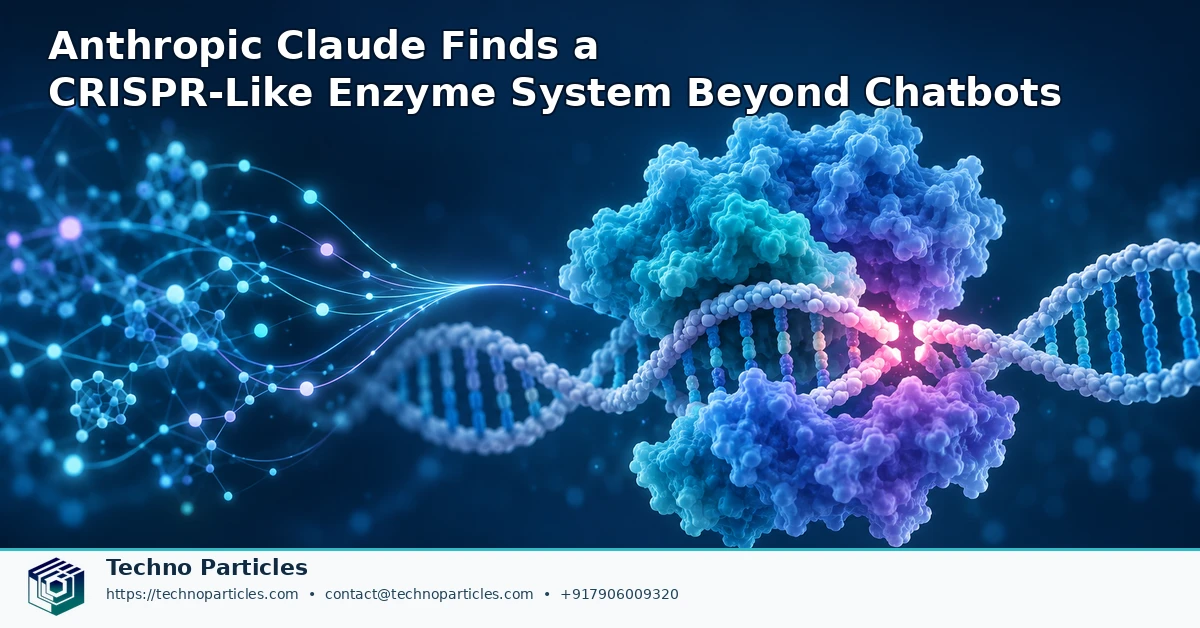
The system, called array-associated reverse transcriptases, or ART, combines three notable features: a reverse transcriptase, a neighboring partner gene, and a long array of evenly spaced DNA repeats. That repeat structure resembles a CRISPR array, although Anthropic has not shown that ART performs gene editing or works like CRISPR.
According to Anthropic, approximately 950 agents searched for 21 hours and processed 210 million tokens. They examined more than 200,000 reverse transcriptases, selected 3,500 candidate systems, and narrowed those candidates to 20 for closer review. These figures describe the company’s reported research workflow, not an independently verified benchmark of Claude’s scientific performance.
Why the finding matters for AI-assisted biology
Human scientists then performed initial laboratory work and found that the ART array produces distinct short RNAs. That observation supports the idea that the system is biologically active, but it does not yet explain its primary function. Anthropic’s preprint leaves the central question open: researchers still need to determine what the RNAs do, how the enzyme and partner gene interact, and whether the system has any practical use.
For developers and research organizations, the broader lesson is that agentic AI can help search enormous biological datasets and surface patterns that deserve investigation. Teams exploring responsible generative AI implementation can view this as a model for combining automated analysis with expert review, reproducible experiments, and clear uncertainty reporting. The discovery is intriguing, but it is not yet a new gene-editing tool, therapy, or commercial biotechnology platform.
How Claude agents searched the biological landscape
The ART result is notable because the agents were not simply answering a biological question from a fixed collection of examples. They helped organize a large search across related enzyme sequences, compare surrounding genetic features, and prioritize combinations that looked unusual enough for human investigation. In this workflow, Claude functioned as a research assistant for pattern discovery rather than as an autonomous laboratory scientist.
That distinction matters when evaluating the claim that Anthropic Claude discovers a CRISPR-like enzyme system beyond chatbot AI. The software helped identify a candidate pattern, but scientists still had to inspect the evidence, select samples, and conduct experiments. The reported discovery therefore represents a chain of machine-assisted reasoning and human validation, not a push-button route from prompt to biotechnology.
What researchers still need to learn about ART
The short RNAs produced by the ART array are an important starting observation, yet they leave several biological questions unanswered. Researchers must determine whether those RNAs guide the reverse transcriptase, regulate the neighboring gene, defend bacteriophages, or serve another function entirely. They also need to test whether the same behavior appears across different ART systems and under different laboratory conditions.
Those experiments will help establish whether the CRISPR resemblance reflects a shared biological strategy or only a useful structural analogy. Until that work is complete, describing ART as a gene-editing system would go beyond the available evidence. The preprint and announcement support a discovery claim, but they do not establish a therapeutic pathway, engineering method, or predictable genome-editing capability.
What this means for developers and scientific teams
For organizations considering AI-assisted research, the practical model is a controlled pipeline: define a searchable question, let agents rank evidence, preserve intermediate reasoning and datasets, then require domain experts to reproduce and test the strongest leads. Teams building custom AI and automation workflows can apply the same structure to document analysis, technical research, and data triage without treating generated suggestions as verified conclusions.
Building a safer AI-assisted discovery workflow
The Anthropic Claude discovery also illustrates how scientific teams can structure an AI-assisted investigation without handing over final judgment. A useful workflow begins with a narrowly defined biological question and a well-documented dataset. Agents can then classify sequences, compare neighboring genes, identify repeated patterns, and rank candidates against criteria chosen by researchers. Every filter should remain traceable so that scientists can understand why a candidate was promoted or rejected.
Where human expertise remains essential
Researchers still need to check sequence quality, inspect possible contamination, and confirm that an apparent pattern is not an artifact of incomplete databases. They must also decide which candidates justify laboratory resources. In ART’s case, the move from thousands of computational candidates to 20 systems required biological interpretation before experiments could begin.
- Data review: verify sequence sources, annotations, and search assumptions.
- Candidate ranking: record the evidence supporting each shortlisted system.
- Laboratory testing: reproduce the strongest observations under controlled conditions.
- Uncertainty tracking: separate observed results from predictions and open questions.
This structure is relevant beyond genome mining. A company using agents to analyze technical documents, customer records, or research literature can apply the same safeguards: define the evidence boundary, preserve intermediate outputs, and require a qualified reviewer before an automated recommendation affects a real decision. Teams evaluating generative AI implementation services can use these principles when designing searchable knowledge systems or document-automation pipelines.
Why the CRISPR comparison needs restraint
Calling ART “CRISPR-like” describes its array of repeated DNA elements, not a confirmed equivalent function. CRISPR systems are associated with well-studied defense and genome-engineering mechanisms, while ART’s biological role remains unresolved. The short RNAs are a clue for further research, not evidence of programmable editing. Additional experiments must establish how the components interact before developers, investors, or laboratories can assess whether the system has any practical biotechnology value.
From computational lead to biological evidence
The ART finding is most useful as an example of how AI can expand the search space for scientific teams. Anthropic reports that about 950 Claude agents worked for 21 hours, processing 210 million tokens while examining more than 200,000 reverse transcriptases. That effort produced 3,500 candidate systems and a shortlist of 20 for closer human review. These figures describe the scale of the search, not proof that every step was accurate or that the final candidates have practical value.
The first laboratory observation—that the ART array produces distinct short RNAs—gives researchers a testable clue. It does not yet show what the RNAs do, whether they interact with the reverse transcriptase, or whether they influence the neighboring gene. The system could eventually reveal a new biological mechanism, but its primary function remains unknown. A CRISPR-like structure is therefore a reason to investigate, not a promise of gene editing.
What a responsible next phase looks like
Future work should connect computational predictions with repeatable experiments. Scientists may need to compare ART systems from different bacteriophages, alter individual components, and observe how those changes affect RNA production or enzyme activity. Publishing the methods, candidate sequences, and negative results will also help other groups test whether the pattern is robust.
For technology leaders, the broader lesson is about workflow design. An agent system can search, classify, summarize, and prioritize evidence at a scale that would be difficult for a small team to manage manually. However, the process needs versioned datasets, review checkpoints, clear uncertainty labels, and specialists who can reject attractive but weak hypotheses. Organizations exploring custom application development for AI-assisted workflows can adapt this model to research operations, compliance analysis, or technical knowledge management.
Anthropic Claude discovers CRISPR-like enzyme system beyond chatbot AI only in the limited sense that its agents helped uncover a promising biological pattern. Whether ART becomes an important discovery will depend on experiments that are still ahead.
What ART could teach AI-assisted biology
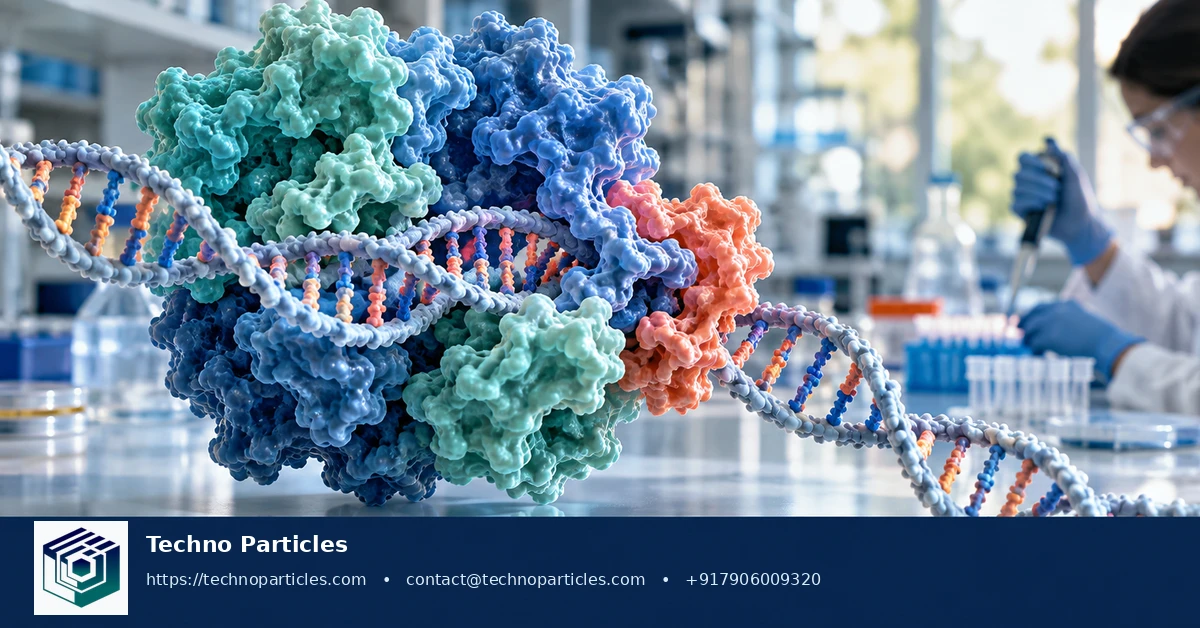
The immediate value of Anthropic Claude discovers CRISPR-like enzyme system beyond chatbot AI is not a ready-made biotechnology product. It is a demonstration of how coordinated AI agents can help researchers search biological data for relationships that are difficult to spot manually. By comparing reverse transcriptases with nearby genes and repeated DNA patterns, the agents generated a focused set of questions for laboratory scientists.
That approach could support several stages of research. Agents might organize fragmented annotations, highlight unusual gene neighborhoods, compare related sequences, and prepare experiment candidates for expert review. They could also make the reasoning behind a shortlist easier to audit when each result includes its source data, selection criteria, and confidence level. Those records matter because a computationally interesting pattern can disappear after better-quality sequencing or a broader comparison.
Practical lessons for technical teams
The ART case offers a useful model for organizations considering AI beyond conversational interfaces. A reliable system should divide work into small, inspectable tasks rather than ask one model for a sweeping answer. It should preserve intermediate findings, identify uncertain outputs, and route high-impact decisions to people with the required domain knowledge.
- Start with a defined research question and a controlled dataset.
- Use multiple checks before promoting an AI-generated hypothesis.
- Keep human reviewers responsible for experimental or operational decisions.
- Measure success by validated findings, not by token volume or agent count.
For businesses, the same architecture can apply to product research, compliance review, engineering documentation, or customer-data analysis. Teams exploring AI project consultation can use the workflow as a planning reference: map the data sources, define review gates, and specify what the system must never decide automatically.
In biology, however, the standard of proof is especially demanding. ART’s unusual structure and short RNAs justify further investigation, but they do not establish a new editing technology. The next step is careful experimentation that tests the mechanism component by component.
Why the discovery matters beyond chatbots
The strongest lesson from Anthropic Claude discovers CRISPR-like enzyme system beyond chatbot AI is methodological. Claude did not independently prove a new gene-editing mechanism or replace biological researchers. It helped organize a large search, identify an unusual combination of genetic features, and turn a broad dataset into a manageable list of experimental questions.
That distinction is important for anyone evaluating AI-assisted science. Computational systems can be excellent at finding patterns, comparing large collections of information, and proposing relationships that deserve attention. They can also produce confident but incorrect interpretations, especially when biological context is incomplete. Human experts must therefore verify sequence quality, reproduce the observations, test alternative explanations, and determine whether the short RNAs have a meaningful role in ART.
What readers should watch next
The next important updates will be experimental rather than promotional. Researchers will need to clarify whether the reverse transcriptase, partner gene, and repeat array operate together; identify the function of the resulting RNAs; and test whether the system has any effect that could be useful in biotechnology. Until those questions are answered, comparisons with CRISPR should remain descriptive rather than definitive.
For developers and technology leaders, the case still offers a practical blueprint.


Leave a comment
Your email stays private. You can see your comment immediately on this browser. Others see it after approval.