

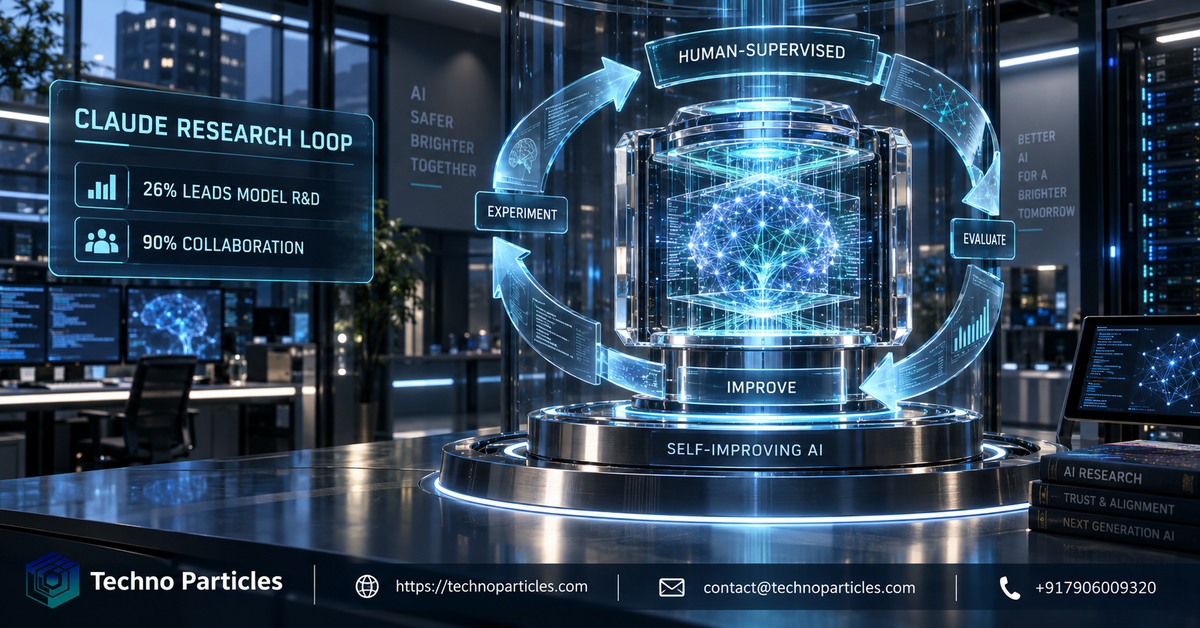
Anthropic has published new evidence that Claude is helping accelerate the development of advanced AI systems, including the systems used to build future versions of Claude. The companyâs September 2026 report, âWhen AI builds itself,â does not claim that Claude is already independently designing and training its successor. Instead, it describes a rapidly narrowing gap between AI assistance and autonomous AI research.
That distinction matters. The phrase âself-improving AIâ can suggest a model changing its own weights without permission, but Anthropic is describing a broader development loop. Humans still choose goals, provide resources, define evaluation criteria, and review important results. Claude increasingly performs the implementation, experimentation, debugging, and analysis inside that loop.
The report says recursive self-improvement would occur when an AI system could fully and autonomously design and develop a more capable successor. Anthropic says that point has not been reached and is not inevitable, although it could arrive sooner than many institutions are prepared for. The current development is therefore best understood as AI-assisted self-improvement, not a completed autonomous cycle.
What Anthropicâs Claude research actually shows
Anthropic separates frontier-model development into engineering and research. Engineering includes writing code, setting up infrastructure, and overseeing training. Research includes deciding which experiments to run, interpreting results, and choosing what to investigate next.
According to the company, Claude can now solve many underspecified engineering problems when a human supplies the objective. It can also execute well-defined research experiments at or above the level of skilled human researchers in some narrowly measured tasks. The remaining weakness is judgment: deciding which problems deserve attention, which results are trustworthy, and which direction is strategically important.
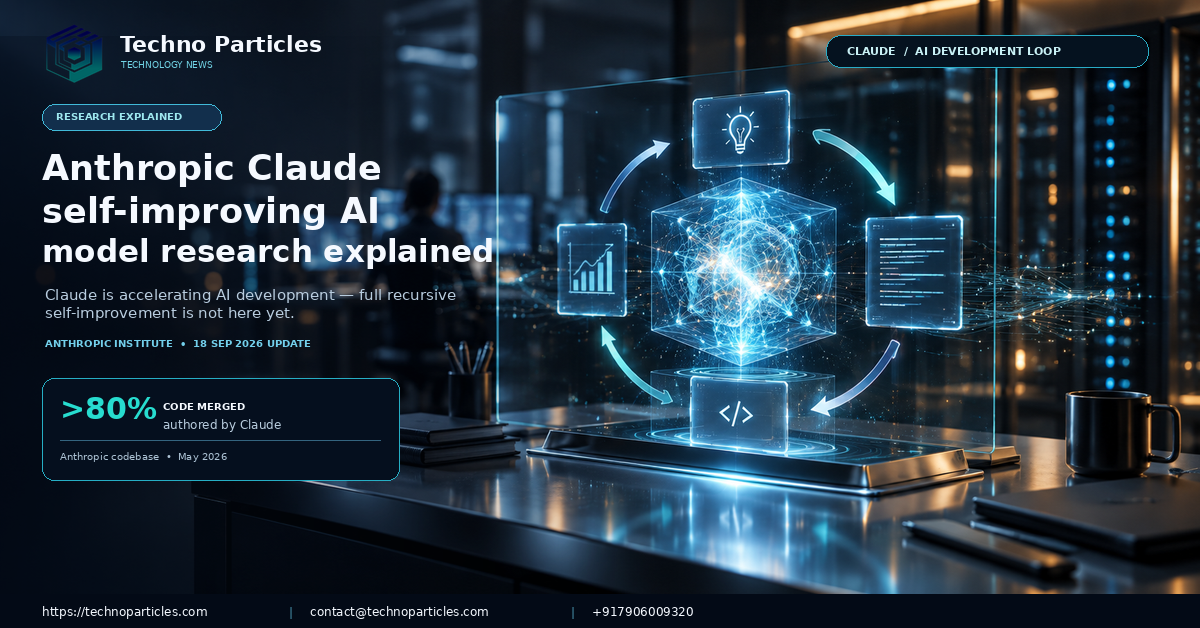
The company reports that more than 80% of code merged into Anthropicâs codebase as of May 2026 was authored by Claude. Anthropic also says the typical engineer merged eight times as much code per day in the second quarter of 2026 as in 2024. The company explicitly cautions that lines of code measure quantity rather than quality, so this should be read as an acceleration signal rather than a precise productivity benchmark.
Anthropicâs internal survey provides another company-reported indicator. In a March 2026 poll of 130 research employees, the median respondent estimated roughly four times as much output with an internal model called Mythos Preview on projects they would otherwise have undertaken. Anthropic says the estimate may overstate the true uplift, but considers it consistent with other observations.
For businesses exploring generative AI solutions, the practical lesson is not that software teams can be removed from the process. It is that capable models can expand how much work a smaller group can specify, test, review, and maintain.
Anthropic Claude Self-Improving AI Model Research Explained - Techno Particles
From coding assistant to research agent
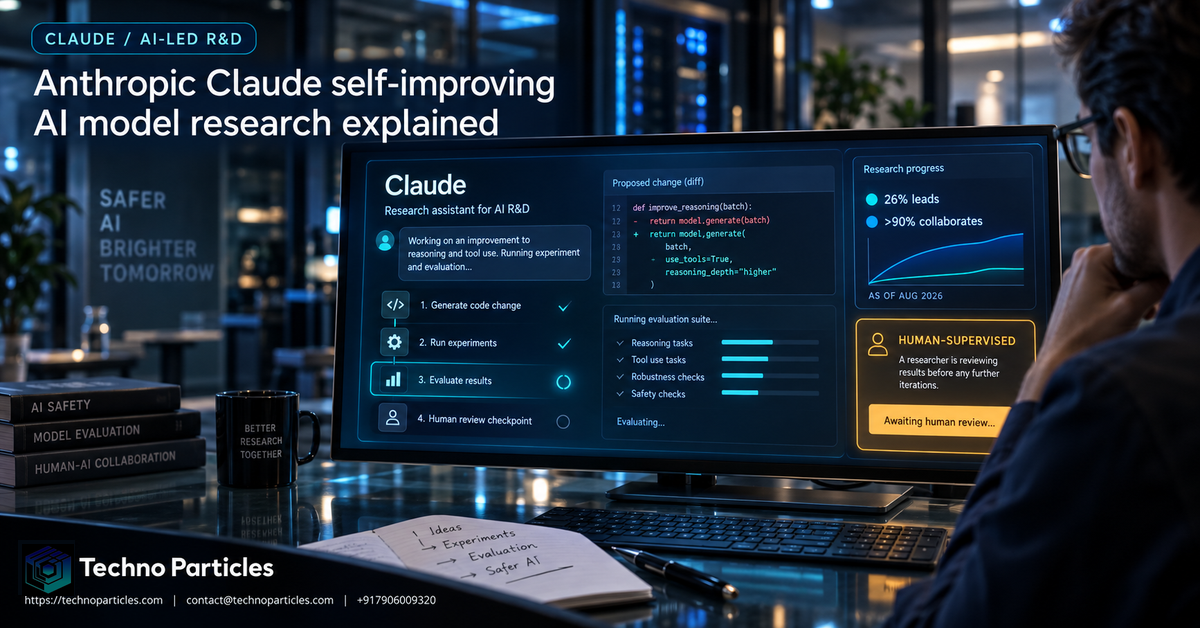
The report describes a progression from chatbots that generated short snippets to coding agents that could edit files, then to autonomous agents able to run code and delegate work to other agents. This progression changes the bottleneck. Earlier systems saved typing time; newer systems can carry a task through several stages before a human intervenes.
One example involved a recurring test in which Claude was asked to optimize code that trains a small AI model. The objective and correctness checks were fixed in advance. Claude rewrote the code, ran it, measured the result, and repeated the process. Anthropic says Claude Opus 4 averaged about a threefold speed improvement in May 2025, while an internal Mythos Preview model reached about 52 times the starting speed by April 2026. A skilled human researcher reportedly needed four to eight hours to achieve a fourfold improvement.
This is a strong result within a defined experiment, but it is not evidence that Claude can independently invent the next generation of AI architecture. The model was given a clear goal and a measurable success condition. That is very different from deciding what type of model the world needs, selecting a research agenda, or recognizing a breakthrough that existing tests cannot measure.
Anthropic also cites an open-ended AI-safety research demonstration published in April 2026. Claude-powered agents investigated whether a weaker model could reliably supervise a stronger one. The agents proposed hypotheses, designed experiments, shared findings, and iterated. Anthropic says two human researchers recovered about 23% of the available performance gap over roughly a week, while the agents recovered 97% over more than 800 cumulative hours and about $18,000 in compute.
There are important qualifications. Humans selected the problem and created the scoring rubric. The result did not transfer cleanly to production-scale models. Anthropic therefore presents it as evidence that agents can conduct substantial research under a defined setup, not as proof of fully autonomous scientific discovery.
Why human judgment remains the central limit
Anthropic compared model suggestions with human decisions during real Claude Code investigations. In selected moments where a researcher took a less useful detour, the best modelâs preferred next step improved from 51% with Opus 4.5 in November 2025 to 64% with Mythos Preview in April 2026. The company warns that this was not a neutral contest because the examples were deliberately chosen where the human choice had room for improvement.
Even so, the direction is significant. Research is a chain of decisions, and better next-step selection can make an agent more effective over long sessions. Human researchers still provide the wider context: which questions matter, which findings should be trusted, and when a promising-looking approach is actually a dead end.
That is why application development teams adopting AI agents need strong review systems. Access controls, test environments, audit logs, rollback procedures, and human approval gates are not optional decorations. They determine whether faster execution produces reliable software or merely faster failures.
What self-improving AI could mean for businesses
The immediate impact of Anthropicâs Claude research is likely to appear in the economics of knowledge work rather than in a sudden machine takeover. If models can implement and test ideas much faster, companies may build more prototypes, automate more internal processes, and maintain larger software systems with smaller teams. However, compute costs, security review, data quality, legal approval, and real-world operations can remain bottlenecks.
Anthropic refers to this as a version of Amdahlâs law: accelerating one part of a process simply exposes the parts that have not accelerated. A development team may generate code quickly but wait for code review. A marketing team may create campaigns rapidly but still need customer research and approval. A business may automate lead capture but still depend on sales conversations and service capacity.
For Indian startups, manufacturers, retailers, education companies, and professional services firms, the practical strategy is to begin with bounded workflows. Useful candidates include document classification, customer-support drafting, internal search, analytics summaries, software testing, and lead qualification. A CMS can use AI to organize content, while a SEO workflow can help identify topics and prepare drafts. These systems should still require fact checks, editorial approval, and monitoring.
The safety question behind the headline
Recursive self-improvement raises a different category of risk because a system that can build more capable successors could accelerate beyond the ability of humans to understand or control each step. Anthropic says improved AI could support scientific progress, healthcare, and government services. It also warns that powerful systems could amplify surveillance, manipulation, cyber abuse, or other harmful activities.
The companyâs report does not establish that Claude is pursuing independent goals or secretly modifying itself. It describes human-supervised systems becoming better at completing development tasks. That is a crucial difference between confirmed evidence and speculation. The evidence supports acceleration; it does not prove that a fully autonomous recursive loop already exists.
Anthropic argues that monitoring, security, evaluation, and alignment become more important as models perform longer tasks. It also calls for discussion among policymakers, researchers, civil society, and other AI companies. Any meaningful slowdown would require coordination among multiple frontier laboratories, because a unilateral pause could simply change which company leads the race.
What readers should take away
Anthropic Claude self-improving AI model research is best understood as an early warning and an engineering report at the same time. Claude is already contributing substantial code, running experiments, debugging difficult systems, and helping researchers investigate open-ended questions. Yet humans still define goals, supply resources, judge significance, and validate outcomes.
The near-term opportunity is disciplined augmentation. Businesses can use AI-aware website development, custom applications, and workflow automation to reduce repetitive work while keeping sensitive decisions reviewable. Teams that invest in clear specifications, testing, data governance, and user experience will be better positioned than teams that simply connect a model to every system.
The larger question is whether judgment itself will improve quickly enough to close the remaining gap. Anthropic says it does not know. That uncertainty is the most important fact in the story: self-improving AI is not here in its strongest sense, but the tools that could help create it are becoming more capable, more autonomous, and more deeply embedded in the research process.
Why the research matters beyond Claude
The significance of Anthropic Claude self-improving AI model research is not limited to one product or laboratory. The same development pattern could appear wherever advanced models are connected to code repositories, testing environments, research databases, and automated evaluation systems. A model that improves a benchmark may be useful, but a system that can identify weaknesses in its own tools, propose changes, and test those changes begins to influence the process that determines future capability.
That possibility changes how organizations should think about deployment. Traditional software releases usually involve a defined feature set and a predictable maintenance cycle. AI-assisted development can make those cycles more fluid. A model may generate code, discover an error, revise its approach, and produce a stronger version within one working session. The efficiency gain is attractive, but it also means that review procedures must keep pace with faster iteration.
Human oversight must become more technical
Human supervision cannot mean merely reading the final answer. Reviewers may need to inspect the modelâs proposed plan, the data it used, the tests it selected, and the assumptions behind its recommendations. For high-impact systems, teams should preserve logs, separate development from production access, restrict permissions, and require independent checks before changes are accepted.
- Define boundaries: give the model access only to the files, tools, and services required for its assigned task.
- Verify improvements: measure whether a change improves real-world reliability rather than only a convenient internal score.
- Retain reversibility: use version control, staged releases, and rollback procedures so an automated experiment cannot create an irreversible failure.
- Test for hidden costs: check security, privacy, bias, maintainability, and resource consumption alongside raw performance.
These safeguards are relevant to ordinary businesses as well as frontier research groups. A company using an AI agent for customer support, document processing, or software maintenance may not be pursuing recursive self-improvement, yet the operational risk is related: the system can act across multiple steps and affect information that later decisions depend on.

Leave a comment