

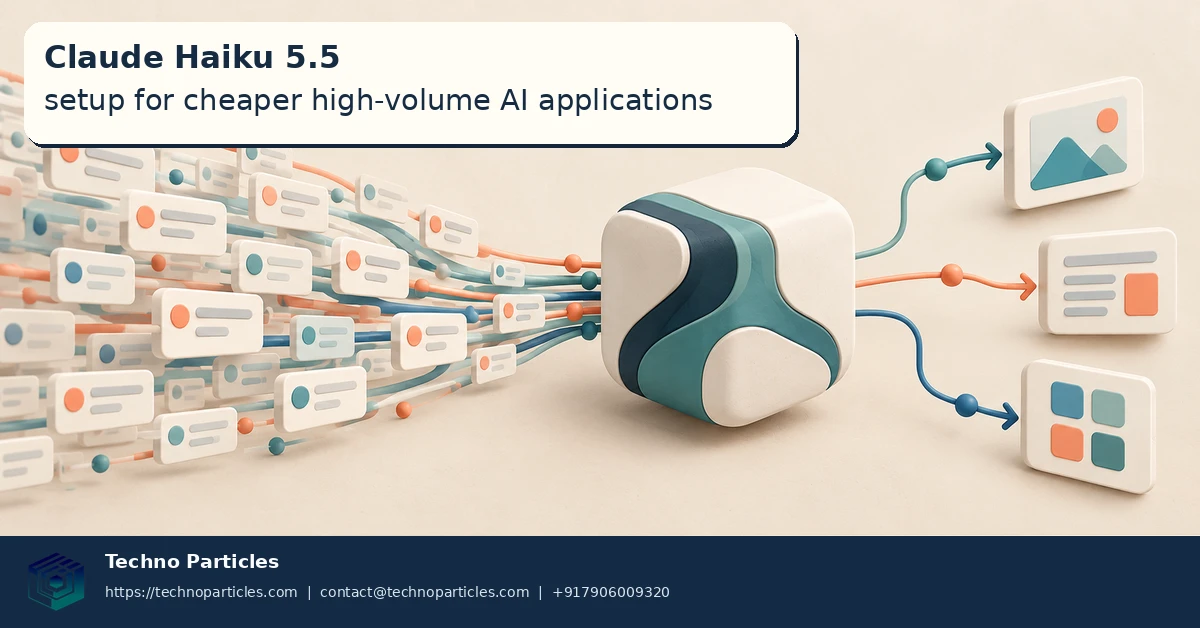
Anthropicâs Claude Haiku 5.5, announced on October 7, 2026, is aimed at developers building fast, high-volume AI applications without paying flagship-model prices for every request. The model targets classification, extraction, routing, summarization, prompt compaction, and subagent tasks where low latency and predictable operating costs matter.
Anthropic lists Claude Haiku 5.5 at $0.10 per million input tokens and $0.50 per million output tokens for prompts up to 100,000 tokens. Larger prompts are priced at $0.50 per million input tokens and $2.50 per million output tokens. Cache reads cost $0.01 and $0.05 per million tokens respectively, while the Batch API offers a 50% discount on input and output processing.
What the Claude Haiku 5.5 setup includes
The model is available through the Claude API, Amazon Bedrock, Google Cloud, Microsoft Foundry, and Claude Platform on AWS. The Claude API model ID is claude-haiku-5-5, while Amazon Bedrock uses anthropic.claude-haiku-5-5. Developers can use its 1-million-token context window and up to 128,000 output tokens for long documents, multi-stage workflows, and compacting conversation history.
Adaptive thinking is controlled through the effort parameter, allowing teams to balance response quality and speed. Anthropic describes Haiku 5.5 as its fastest comparative model, but those performance charts and customer examples are company-published claims rather than independent validation.
Why the pricing matters for production workloads
Anthropic says Haiku 5.5 costs 90% less than Haiku 4.5 for prompts up to 100,000 tokens and 50% less above that threshold. However, its newer tokenizer may use approximately 30% more tokens for the same text, so teams should measure real workloads before forecasting savings. Businesses planning AI-powered websites, applications, or workflow automation can review Generative AI development services for help designing routing, caching, monitoring, and fallback strategies.
Claude Haiku 5.5 setup: configure the request carefully
A practical Claude Haiku 5.5 setup starts with a small, representative workload rather than an immediate production migration. Create a test route for the API or your chosen cloud platform, then record input tokens, output tokens, latency, cache usage, retries, and task accuracy. This baseline will show whether the lower list price produces lower real operating costs after tokenizer differences and application overhead are included.
For the Claude API, use the model ID claude-haiku-5-5. On Amazon Bedrock, use anthropic.claude-haiku-5-5 and configure the required AWS permissions, region, and observability controls. AWS documentation confirms that Bedrock deployments can use IAM, CloudTrail, and CloudWatch integrations, which is useful when an application needs access control, audit records, and operational monitoring.
Important API parameters and safeguards
Use the effort parameter to control adaptive thinking when the task needs a deliberate balance between response quality and speed. Do not send non-default temperature, top_p, or top_k values: Anthropicâs documented behavior is that these settings return a 400 error for Haiku 5.5. Removing those parameters from shared client defaults can prevent avoidable failures during deployment.
For high-volume systems, route predictable work such as document fields, support-ticket labels, lead qualification, and content summaries through Haiku 5.5. Keep validation in the application: require structured outputs, check missing fields, and send uncertain cases to a stronger model. Repeated instructions may benefit from prompt caching, while offline workloads can use the Batch APIâs 50% processing discount. Teams building this kind of monitored workflow can explore application development services for implementation support.
When Haiku 5.5 is not the right model
Haiku 5.5 is not a universal replacement for larger models. Complex agentic coding, difficult reasoning, and tasks requiring deeper judgment may still justify Sonnet or Opus. A staged routing policy lets the cheaper model handle volume while preserving a stronger fallback for exceptions.
Claude Haiku 5.5 Setup for Cheaper High-Volume AI Applications - Techno Particles
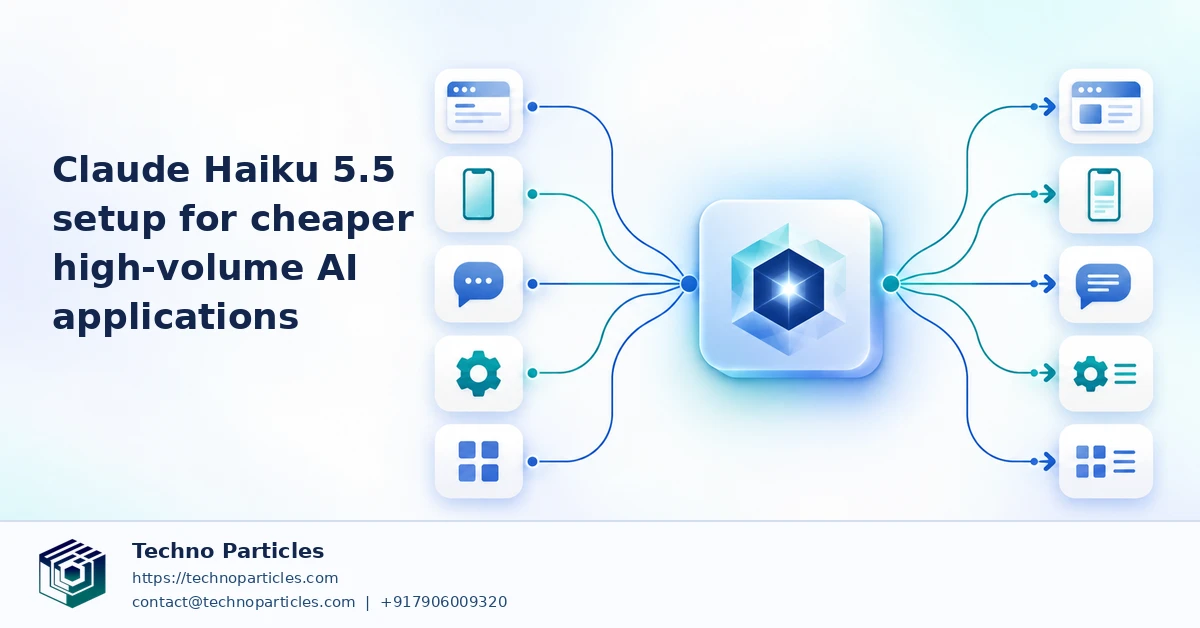
Claude Haiku 5.5 setup for cheaper high-volume AI applications: build a routing layer
The most reliable production pattern is a routing layer between the user request and the model. Start by defining which tasks are safe for Haiku 5.5, such as intent classification, invoice-field extraction, FAQ summarization, lead categorization, and conversation-history compaction. Set confidence rules around each task, then send ambiguous outputs, failed validations, or unusually complex requests to Sonnet or Opus.
Structured output is especially important in high-volume systems. Ask the model for a narrowly defined JSON shape, validate required fields in application code, and reject malformed or incomplete responses before they reach a CRM, database, or customer-facing screen. Keep prompts short where possible, because the tokenizer difference reported by Anthropic can affect the expected savings even when the published per-token price is lower.
Measure cost, latency, and quality before scaling
A useful pilot should contain real examples from different users, document formats, languages, and failure conditions. Track cost per completed task rather than cost per request alone. Include retries, cache reads, batch processing, platform charges, and the cost of escalations in the calculation. Also measure time to first response and total completion time, since a cheaper model may still require additional validation or fallback calls.
- Log the model ID, prompt size, output size, effort setting, latency, and validation result.
- Compare Haiku-only routing with a mixed-model policy on the same test set.
- Redact sensitive information and define retention rules before sending business data to an AI platform.
- Review regional availability and data-residency requirements when deploying through a cloud provider.
For teams turning this pilot into a customer-facing product, project consultation services can help map model routing, security controls, monitoring, and fallback behavior to the existing business workflow.
Operational controls for a Claude Haiku 5.5 setup
After the pilot, production readiness depends on more than selecting a low-cost model. Version prompts alongside application code, record which model handled each request, and preserve validation outcomes so quality changes can be traced after an update. A routing service should also enforce request-size limits, timeout behavior, retry policies, and fallback rules before traffic reaches the model.
Privacy and governance need to be designed into the workflow. Remove unnecessary personal or confidential data before transmission, restrict credentials to the services that need them, and define how logs are retained. When using Amazon Bedrock, review the selected region and data-residency requirements with the organizationâs compliance team. IAM, CloudTrail, and CloudWatch can support access control, auditability, and operational monitoring, but they do not replace application-level controls.
Design the workflow around measurable tasks
Do not evaluate Claude Haiku 5.5 with a single impressive demonstration. Create separate acceptance tests for classification, extraction, summarization, routing, and compaction. For extraction, measure field-level accuracy and missing values. For summaries, have reviewers assess whether key facts, actions, and uncertainty are preserved. For routing, test ambiguous wording and requests that belong to multiple categories.
Keep a stronger-model path available for failures. An escalation can be triggered by low confidence, invalid JSON, a missing required field, repeated retries, or a request that exceeds the defined complexity boundary. This mixed-model design can control spend while avoiding the risk of forcing every task through the cheapest route.
- Use prompt caching for repeated instructions only after confirming that the cache behavior fits the platform and workload.
- Use Batch API processing for suitable non-urgent jobs, while keeping real-time requests on the interactive path.
- Recalculate savings when prompt sizes exceed 100,000 tokens because the published pricing tier changes.
- Review token usage after launch because Anthropic reports that the newer tokenizer may process more tokens for equivalent text.
Teams integrating these controls into portals, CRMs, or internal dashboards can combine the model layer with CMS solutions that support structured content workflows, permissions, and publishing approvals.

Claude Haiku 5.5 setup for cheaper high-volume AI applications: control the cost curve
Cost estimates should reflect the complete request lifecycle, not only the headline token rate. Anthropic lists lower prices for prompts up to 100,000 tokens, while larger prompts move to a higher pricing tier. Cache reads and Batch API processing can change the calculation again. Build a per-task budget that includes input tokens, output tokens, retries, validation calls, cache usage, batch discounts, and any escalation to a larger model.
Prompt design is another practical control. Keep system instructions focused, remove repeated background that does not affect the decision, and pass only the document fields needed for the task. Because Anthropic reports that Claude Haiku 5.5âs tokenizer may use approximately 30% more tokens than Haiku 4.5 for equivalent text, compare actual token consumption in your workload rather than assuming the published price difference will equal the final savings.
Protect reliability as traffic grows
High-volume applications need safeguards that remain effective during spikes. Add rate-limit handling, bounded retries, request timeouts, and idempotency keys so a temporary failure does not create duplicate CRM updates or repeated customer messages. Store the original request, model response, validation status, and escalation reason in an appropriately protected audit trail.
- Use a fixed evaluation set before changing prompts, effort settings, or routing thresholds.
- Separate user-facing latency targets from background workloads that can use Batch API processing.
- Test malformed documents, incomplete records, mixed languages, and adversarial instructions.
- Set alerts for rising token usage, validation failures, latency, and fallback frequency.
For an application that combines AI processing with customer records, approvals, and reporting, an application development team can help connect the model gateway to secure APIs, role-based workflows, and monitoring dashboards without placing model calls directly inside every business feature.
Before broad rollout, compare the measured quality and total cost of the Haiku 5.5 route with the existing workflow. Keep the stronger-model fallback available until the data shows that the cheaper path is dependable for each task category.
What teams should decide before adopting Claude Haiku 5.5
The right question is not whether Claude Haiku 5.5 is the cheapest model available. It is whether the model delivers acceptable accuracy, latency, and operational control for a clearly defined class of requests. Its pricing and high-volume design make it a strong candidate for repetitive workloads, but the result depends on prompt size, output length, caching, batch processing, tokenizer behavior, and the number of requests that require escalation.
Start with a limited production pilot. Select representative traffic rather than unusually easy examples, then compare Claude Haiku 5.5 with the current workflow using the same inputs and acceptance criteria. Track cost per successful task, response time, validation failures, retry volume, and fallback frequency. Review a sample of outputs manually, especially when the application handles customer data, financial information, compliance-related content, or automated business actions.
A practical rollout checklist
- Define which tasks are suitable for classification, extraction, summarization, routing, or compaction.
- Set maximum prompt and output sizes before the model receives live traffic.
- Keep temperature, top_p, and top_k at their supported defaults because non-default values can produce a 400 error.
- Measure actual token consumption instead of relying only on the advertised per-token discount.
- Document when requests must move to a larger Sonnet or Opus model.
- Recheck pricing, model identifiers, platform availability, and documentation before a major deployment.


Leave a comment