

Google has introduced Gemini 3.8 Flash and its security-focused sibling, Gemini 3.8 Flash Cyber, in a major update for AI developers and cybersecurity teams. Announced on September 2, 2026, the release combines a fast general-purpose model for coding and agentic workflows with a more specialized model designed to discover software vulnerabilities and generate fixes.
The news matters because Google is moving beyond the idea that one model should handle every task. Gemini 3.8 Flash is aimed at developers, businesses, and consumers who need strong reasoning at Flash-family speed. Gemini 3.8 Flash Cyber is designed for trusted defenders facing a growing number of vulnerabilities across complicated software projects.
Google describes 3.8 Flash as its most intelligent Flash model yet. The company says it improves on Gemini 3.7 Flash in software engineering, autonomous agents, and multi-step reasoning while keeping the same introductory pricing. The Cyber version uses the shared foundation but receives additional training and safeguards for defensive security work.
What is Gemini 3.8 Flash Cyber?
Gemini 3.8 Flash Cyber is a cybersecurity model built to help defenders find, validate, and patch vulnerabilities. Rather than focusing primarily on offensive exploitation, Google says it prioritized vulnerability fixing and defensive capabilities. The model can navigate complex codebases, identify hidden weaknesses, and produce validated code changes for review.
According to Google DeepMindâs model page, the system has been evaluated across codebases spanning 20 programming languages. That is important for businesses whose applications combine several languages, frameworks, and legacy components. A security assistant that only works reliably with one language would have limited practical value in enterprise environments.
However, the model is not a public chatbot that anyone can freely select. Google says Gemini 3.8 Flash Cyber is available to trusted defenders through the Fairwind Program. The initial audience includes government authorities, critical infrastructure operators, and software maintainers. Access is therefore controlled because highly capable vulnerability research systems can have dual-use risks.
How the latest AI model differs from regular Gemini Flash
Regular Gemini 3.8 Flash is a broad workhorse model. The application development services many companies need can involve code generation, debugging, documentation, tool calls, data analysis, and long-running tasks. Googleâs new model is built to handle those workflows with text, image, video, audio, and PDF inputs.
The Gemini API documentation lists support for function calling, file search, code execution, search grounding, structured outputs, URL context, and computer use in preview. Thinking is available at low, medium, and high effort levels. Audio generation, image generation, and the Live API are listed as unsupported on the model page, so users should not assume that every Gemini feature is included.
Gemini 3.8 Flash supports an input limit of 1,048,576 tokens and an output limit of 65,536 tokens, according to Googleâs developer documentation. Those limits can help with large repositories, long documents, and multi-step workflows, although a large context window does not guarantee perfect understanding. Developers still need careful prompting, retrieval design, testing, and human review.
Why the announcement matters
The release shows how AI competition is shifting toward specialized, repeatable work. For a small business, faster code review may reduce the time between discovering and addressing a problem. For a large software team, an AI system that can repeatedly inspect repositories and propose patches could expand the number of issues engineers can examine.
For organizations building a digital product, the practical lesson is to match the model to the job. Gemini 3.8 Flash may suit general coding and automation. Gemini 3.8 Flash Cyber is more relevant to authorized security operations, maintainers, and infrastructure teams with strict access controls.
Gemini 3.8 Flash Cyber: Google’s Latest AI Model Explained - Techno Particles
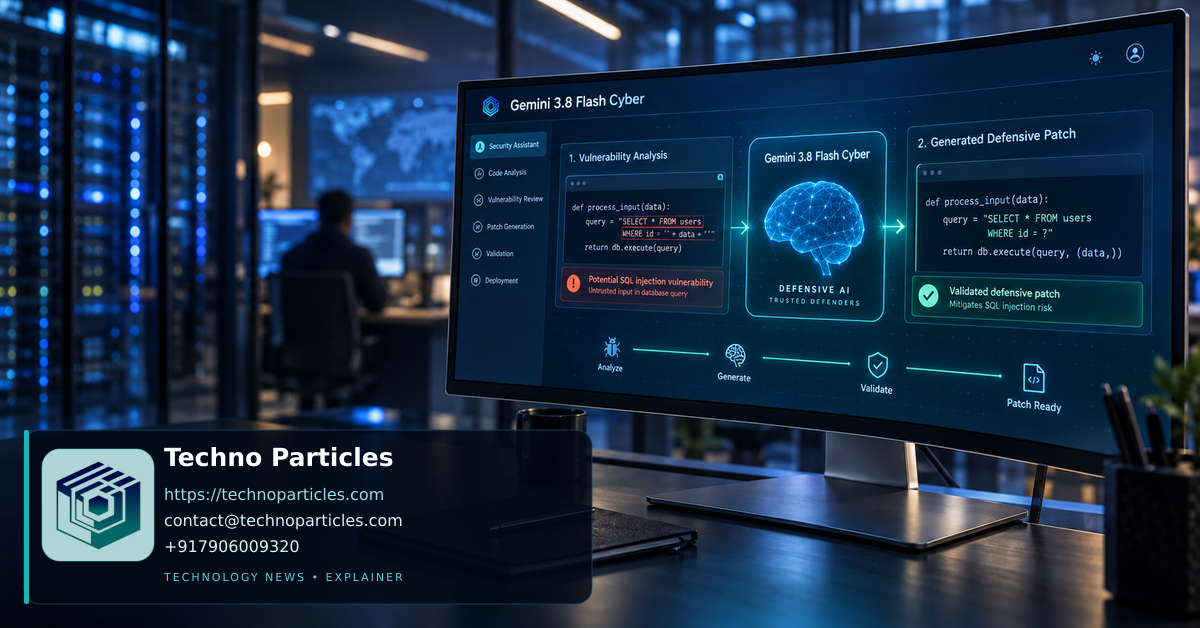
Gemini 3.8 Flash Cyber benchmarks and real-world claims
Googleâs announcement reports strong results for Gemini 3.8 Flash Cyber on vulnerability discovery and patching tests. On CyberGym, a benchmark for autonomous vulnerability discovery, Google DeepMindâs published comparison lists a Pass@1 score of 86.2 percent. The same chart places Gemini 3.5 Flash Cyber at 77.5 percent and compares the new model with several larger systems.
Google also reports results from an internal benchmark covering complex codebases in 20 programming languages. Gemini 3.8 Flash Cyber reached 71 percent on that evaluation, compared with 58.9 percent for Gemini 3.7 Flash and 46.6 percent for Gemini 3.5 Flash Cyber. Because this is an internal benchmark, readers should treat the result as a company-reported measurement rather than an independently reproduced industry standard.
For automated patching, Google cites CWE-Bench, an external benchmark run by Collinear. Gemini 3.8 Flash Cyber recorded a Pass@1 result of 47.2 percent, close to the 47.8 percent reported for a leading frontier model in Googleâs comparison. The companyâs central argument is that the Cyber model reaches a similar level of patching performance at substantially lower cost.
Google additionally describes internal and production-related observations. Its Chrome Security team reportedly found that the model generated 2.6 times more correct patches for Chrome vulnerabilities than larger commercial models. Google says Wiz observed higher recall at lower cost on its internal penetration-testing benchmark, while Google Cloud Vulnerability Research used the model to find a critical foundational vulnerability in less than two hours.
These claims are noteworthy, but they should not be read as proof that the model can secure an application without engineers. Benchmark scores depend on task design, evaluation rules, available tools, prompts, and the definition of a successful result. A patch can compile and still introduce a regression, weaken performance, or miss a related vulnerability.
Pricing and availability for Gemini 3.8 Flash
Google lists an introductory price of $0.75 per million input tokens and $3.75 per million output tokens for Gemini 3.8 Flash. The announcement says that pricing applies through December 31, 2026. From January 1, 2027, Google says the rates will become $1.50 per million input tokens and $7.50 per million output tokens.
Developers can explore the model through generative AI development workflows, Google AI Studio, the Gemini API, Google Antigravity, Android Studio, and related Google tools listed in the announcement. Enterprises can access Gemini 3.8 Flash through Gemini Enterprise. Google also says consumers can use the model through Google AI Pro and Ultra subscriptions in the Gemini app, AI Mode in Search, and Gemini in Google Sheets.
Those access routes are different from Gemini 3.8 Flash Cyber. Google has not announced an ordinary public API or open consumer access for the Cyber model in the cited release. Fairwind access is prioritized for trusted organizations whose work requires advanced defensive cybersecurity capabilities.
What businesses should evaluate before adoption
Companies should begin with a narrow, authorized workflow. Good starting points include dependency review, code explanation, vulnerability triage, test generation, and patch suggestions in a controlled repository. Teams should define who can approve changes, how secrets are removed, and how generated code is tested.
A secure deployment also needs logging, access management, sandboxing, and a rollback process. AI output should pass through static analysis, unit tests, integration tests, and human review. Businesses working with customer data should examine retention, privacy, contractual terms, and the handling of proprietary source code before sending information to any model.
For Indian startups and SMEs, the economics may be attractive for repetitive engineering and security checks, but token pricing is only one part of total cost. Integration, monitoring, review time, cloud usage, and incident-response readiness can determine whether an AI pilot creates measurable value. A well-designed project consultation process can help teams choose an appropriate scope and success criteria.
Limitations, safety controls, and the access question
Gemini 3.8 Flash Cyber is powerful enough that access restrictions are central to the announcement. Google says the Cyber model uses a more permissive set of cybersecurity mitigations than regular Gemini 3.8 Flash and is therefore limited to trusted defenders. That policy reflects a basic security reality: the same ability that helps locate a flaw can also reduce the effort required to misuse technical information.
Regular Gemini 3.8 Flash still includes safeguards for cyber offense and other sensitive domains. Google also reports improvements in prompt-injection robustness across the Gemini 3.8 family, measured with Gray Swanâs benchmark. Prompt injection remains an important concern for agentic systems because untrusted text, documents, websites, or code can attempt to manipulate the modelâs instructions.
Businesses should not confuse safety mitigations with a guarantee of safe behavior. A model may misunderstand a repository, accept a misleading comment, overlook a subtle logic flaw, or recommend a change that creates a new risk. Agentic workflows increase the importance of permission boundaries because a system that can call tools or modify files has more opportunity to make consequential mistakes.
What Gemini 3.8 Flash means for developers
The general model is positioned for long-horizon software engineering and autonomous agents. Google says it can work through complex tasks, use tools iteratively, and spend additional reasoning effort when the problem demands it. That design may help with multi-file changes, debugging sessions, documentation updates, and workflows that require repeated evaluation.
Developers can choose lower effort levels when cost or latency matters, while higher effort levels may use more tokens. Google notes that Gemini 3.7 Flash remains supported for efficiency-first workloads. This gives teams a practical migration choice instead of requiring every application to move immediately.
Model selection should be based on measured performance in the companyâs own environment. Teams should compare error rates, latency, token consumption, tool-call reliability, and review burden. A model that performs well on a public benchmark may still behave differently when handling an unfamiliar codebase, internal terminology, or region-specific business rules.
Practical use cases for Indian businesses and agencies
An e-commerce company could use Gemini 3.8 Flash to summarize product documents, generate structured catalog data, or assist with customer-support workflows. A manufacturer could connect it to internal documentation while preserving approval controls. An education business might use it to organize course material and draft software features, provided that confidential student information is handled appropriately.
For teams improving their online presence, model-assisted coding can support responsive websites, content systems, analytics dashboards, and internal tools. The result still depends on architecture, design quality, accessibility, testing, and maintenance. Businesses exploring these workflows can review website development solutions or SEO services alongside their AI plans, because faster generation does not automatically produce a useful or discoverable digital product.
Security should remain part of the product lifecycle rather than a final inspection. Teams can combine code review, dependency monitoring, secure configuration, backups, and incident response with carefully supervised AI assistance. A UI/UX design process is equally important when an AI feature changes how employees or customers interact with a system.


Leave a comment