


Googleâs Gemini 4 Argon changes the API conversation around agentic software. The model, identified as gemini-4-argon, is designed for complex coding, research, science, and multi-step workflows that may need unusually large context and extended output. For developers planning a Gemini 4 Argon API setup for long-running coding and research agents, the key challenge is not simply sending a prompt. The application must manage timeouts, background execution, state, permissions, and cost.
Googleâs October 13, 2026 launch announcement says the model is globally available to developers and enterprises through paid access. The latest API documentation states that it is unavailable on the Free tier and Google AI Pro plan. Availability and billing should therefore be checked in the account used for deployment before production work begins.
What to Configure Before Calling Gemini 4 Argon
Start with the gemini-4-argon model ID through the Gemini API or Google AI Studio. Its unified context window supports up to 1,048,576 input and output tokens, while configurable thinking levels are low, medium, and high. Medium is the default, but Google recommends testing each level because reasoning depth can affect latency, quality, and spending.
Synchronous responses are limited to 65,536 output tokens. For longer coding plans, research reports, or agent traces, use background execution with background: true and a larger max_output_tokens value. Your client should poll for completion, handle retries, and resume interrupted work rather than assuming one request will finish immediately.
Long-running sessions should also preserve server-side conversation state with previous_interaction_id. Explicit context caching is unsupported, although implicit caching is enabled for prompts of at least 4,096 tokens and receives a documented 95% discount on cache hits. Teams building reliable workflows can review application development practices for production-grade API integrations before connecting tools or business systems.
Design the Gemini 4 Argon Control Loop
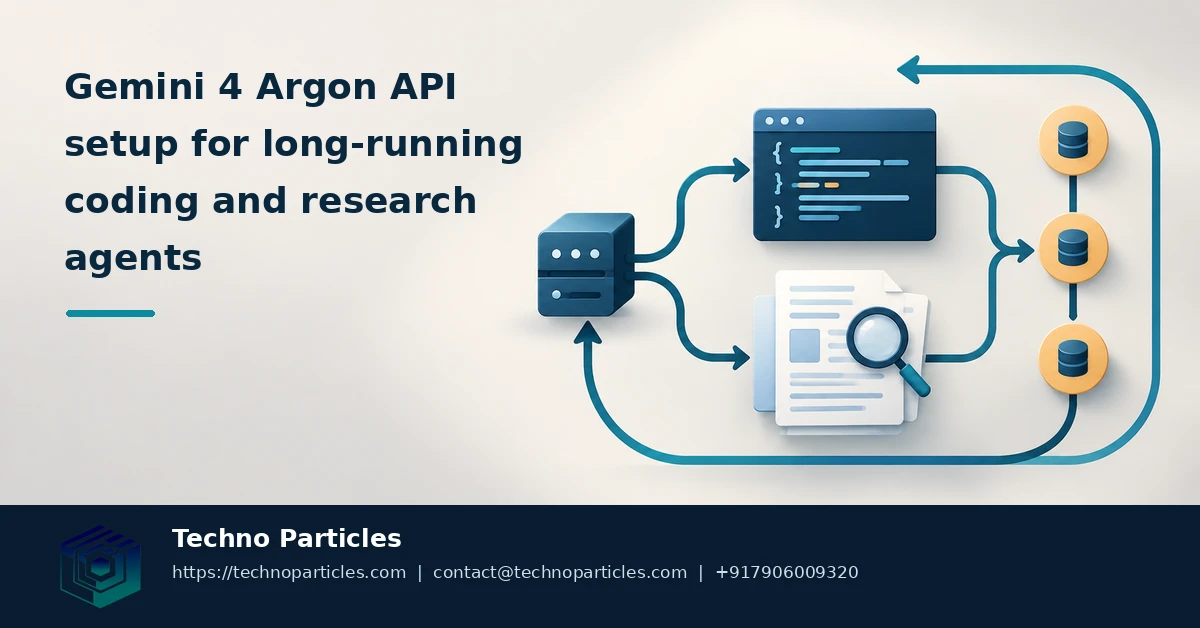
A dependable Gemini 4 Argon API setup for long-running coding and research agents needs an orchestration layer around the model call. Store the job ID and interaction state, then poll background work with bounded intervals and exponential backoff. If a request times out, retry safely or continue from the last confirmed previous_interaction_id instead of submitting the entire task again. Log prompts, tool calls, status changes, token usage, and failure reasons so an operator can inspect an agent run without reconstructing it from memory.
Separate planning from execution when the agent can modify repositories, databases, cloud resources, or customer records. Give each tool the narrowest permission it needs, validate arguments on the server, and require human confirmation before irreversible actions. A research agent may draft a result automatically, while publishing, deleting, sending, purchasing, or deploying should remain behind an explicit approval step. These safeguards are especially important when the model can produce very long traces or operate across multiple stages.
Control Thinking, Tokens, and Spending
Use low thinking for straightforward transformations, medium for the normal workflow, and high only when the additional reasoning is justified by the task. Set max_output_tokens according to the expected result rather than the maximum available window, and enforce application-level budgets for every job. Google lists introductory pricing at $2 per 1 million input tokens and $10 per 1 million output tokens through November 30, 2026; the listed rates rise to $4 and $20 from December 1. Billing dashboards and per-workflow alerts should be part of deployment.
Before production, test short synchronous requests and longer background jobs with representative codebases and research material. Measure latency, incomplete responses, tool-error recovery, and output quality at every thinking level. The documentation also lists important boundaries: explicit context caching is unsupported, Live API and audio generation are unavailable, and computer use is marked Preview. Teams integrating these workflows into a product can review project consultation for API architecture and automation planning before committing to a production design.
Gemini 4 Argon API Setup for Long-Running Coding and Research Agents - Techno Particles
Make the Gemini 4 Argon Agent Resilient
A production-ready Gemini 4 Argon API setup for long-running coding and research agents should treat every run as recoverable work. Keep the task definition, approved tools, interaction identifiers, and intermediate artifacts in durable storage rather than relying on process memory. If a worker restarts, it should be able to inspect the last successful step, retrieve the related server-side state, and continue without duplicating a database update or repository change.
Use separate queues for interactive requests and background jobs. A short request can return a quick status message, while a long research or coding task can move to a worker that monitors completion and records partial progress. Set maximum runtime, retry counts, and cancellation rules at the application layer. These controls prevent a stalled model call from consuming resources indefinitely and give users a clear way to stop work that is no longer needed.
Connect Tools Without Expanding Risk
Tool access should be explicit, typed, and limited by the jobâs purpose. A coding agent may read selected files and propose a patch, but write access should be restricted to an approved workspace. A research agent may collect documents from permitted sources, while outbound messages, payments, production deployments, and record deletion require a separate confirmation path. Store tool results with timestamps and source labels so reviewers can distinguish model-generated reasoning from retrieved evidence.
For business applications, expose progress through a dashboard or notification layer instead of displaying raw reasoning traces. Show the current stage, waiting state, requested approval, completed actions, and any failure requiring intervention. Teams planning this kind of workflow can combine generative AI implementation guidance with application monitoring and access-control design before connecting the agent to CRM, ERP, CMS, or internal data.
Finally, evaluate the system with repeatable tasks rather than a single impressive demonstration. Track completion rate, useful output, tool mistakes, recovery time, token consumption, and human-approval frequency across representative workloads. That evidence will show whether higher thinking levels or million-token responses create enough value to justify their additional latency and cost.
Test the Gemini 4 Argon API Setup Before Production
A reliable Gemini 4 Argon API setup for long-running coding and research agents should be tested with tasks that resemble real workloads. Start with a short synchronous request, then verify the background path using background: true and a larger max_output_tokens value. Confirm that the client timeout is long enough for extended decoding and that the application can poll for completion without blocking an interactive request.
Test continuation behavior deliberately. Save each returned interaction identifier, resume from the latest confirmed previous_interaction_id, and simulate a worker restart between stages. The retry policy should distinguish a temporary network failure from a completed model operation whose response was not received. Idempotency checks are essential before allowing an agent to update files, create records, or call an external service again.
Measure Quality Alongside Runtime
Evaluate low, medium, and high thinking levels on the same representative tasks. Compare useful output, incomplete answers, tool errors, latency, and token consumption rather than treating a longer response as automatically better. For research workflows, review citations and source handling; for coding workflows, inspect patches with automated tests and human review. Googleâs benchmark and safety statements should be treated as company-reported evidence, not as a substitute for testing your own workload.
Long prompts may benefit from implicit caching when they meet Googleâs documented minimum of 4,096 tokens, but explicit context caching is unsupported. Include cache-hit behavior in cost estimates, and monitor input and output tokens per job. Introductory pricing is scheduled to change after November 30, 2026, so alerts should account for the documented rate increase.
Because agent deployments combine model calls, tools, permissions, and business data, an architecture review can expose failure points early. Teams building a production workflow can explore application development services for agent-enabled systems alongside their own security and operational testing.

Operational Controls for Gemini 4 Argon Agents
Before deployment, define what the Gemini 4 Argon API setup for long-running coding and research agents may do without approval. Separate read-only actions from changes that affect customers, finances, production systems, or published content. A useful policy can allow document retrieval and draft generation automatically, while requiring confirmation before merging code, sending messages, changing records, or triggering a deployment.
Keep secrets outside prompts and provide tools through narrow server-side functions. Validate file paths, database queries, URLs, and returned parameters before execution. Log the request, model setting, tool call, result, approval decision, and final status, but avoid storing sensitive data unnecessarily. These records make it easier to investigate an incorrect action and demonstrate how an automated workflow reached its result.
Plan for Limits and Changing Costs
Argonâs million-token context window can support large repositories, document collections, and extended task history, but sending more context is not automatically efficient. Select relevant files, remove duplicated material, and summarize completed stages when the task no longer needs every earlier detail. This can reduce latency and token usage while preserving the information required for the next decision.
Teams should also confirm availability and pricing for the account they intend to use. Googleâs documentation says Gemini 4 Argon is unavailable on the Free tier and Google AI Pro plan, while paid API access is available globally. Introductory rates apply through November 30, 2026, with higher listed rates afterward. Budget alerts, per-job limits, and monthly spending caps should be part of the implementation from the beginning.
Some workloads may need a different model or interface. Argon does not support the Live API or audio generation, and computer use is marked Preview in the model documentation. A team needing real-time voice interaction, mature browser control, or lower-cost routine classification should compare alternatives before making Argon the default. For a broader system review, project consultation for AI workflow architecture can help map model limits to business requirements.
What a Production-Ready Argon Deployment Looks Like
A dependable Gemini 4 Argon API setup for long-running coding and research agents is therefore more than a model name and an API key. It is a controlled workflow that can wait for background jobs, recover from interruptions, preserve conversation state, and request approval before taking consequential action. The application should expose progress to users instead of appearing frozen during lengthy reasoning or decoding.
Start with a narrow pilot: choose one coding or research process, define its expected output, and record latency, token usage, tool failures, revisions, and human interventions. Use the lowest thinking level that meets the quality requirement, then test medium and high settings only when their additional reasoning produces measurable value. This keeps the Gemini 4 Argon API setup for long-running coding and research agents aligned with actual business outcomes rather than headline specifications.
Key Takeaways for Developers and Businesses
- Use synchronous requests for smaller responses and background execution for jobs that may exceed the 65,536-token synchronous limit.
- Store interaction identifiers and implement polling, retries, continuation handling, and restart recovery on the server.
- Protect business data with restricted tools, validation, logging, approval gates, and clear separation between drafts and irreversible actions.

Leave a comment