

Techno Particles generative AI services for business automation span document assistance, conversational interfaces and other workflow applications. OpenAI’s Agents API adds an infrastructure option for teams considering more complex tasks: a managed environment for agents that use tools and continue work across longer sessions. The announcement does not establish that Techno Particles uses this API; it offers a development worth examining when planning an automation project.
| Capability | Verified availability | Business relevance | Cost signal |
|---|---|---|---|
| Managed agent sessions | Agents API public beta | Supports longer-running, tool-connected tasks | Model usage is billed at selected model API rates |
| Execution environments | Applications select an environment | Determines where an agent performs its work | OpenAI-hosted sandboxes use standard container rates |
| Tools and subagents | Agents can use tools and delegate work | Enables workflows involving multiple steps | OpenAI tools use standard rates |
These details come from OpenAI’s Agents API announcement and Agents API overview.
What OpenAI announced on September 10, 2026
In its September 10, 2026 announcement, OpenAI described the Agents API as a public beta built around a managed Codex harness. OpenAI handles sessions, orchestration, context compaction and recovery; the application supplies tools and selects an execution environment. As a beta, the product may change.
What the managed harness changes
For a development team, the practical shift is less infrastructure to assemble for maintaining an agent’s session and recovering its work. Agents can also execute code, edit files, produce artifacts and delegate tasks to subagents. These capabilities provide building blocks, while the application still defines the business task and its tools.
Why environment choice matters
The execution environment determines where an agent works and which resources it can reach. That choice matters when a workflow needs access to files or connected systems. Techno Particles describes document, data and conversational applications on its generative AI services page; an environment would need to suit the particular application being built.
From chatbots to bounded business workflows
A conversational interface gives people a way to ask questions or provide instructions. A rules-based workflow follows predetermined steps, such as sending a completed form to a specific queue. An agent adds a different operating pattern: it uses a model to manage a task and can select tools as it works toward an outcome. OpenAI describes this distinction in its practical guide to building agents.
The difference matters when choosing how to automate a business process. A chat window can be useful for finding an answer, but the interface alone does not determine whether the system can act on that answer. Likewise, a process can be automated without letting a model decide which action comes next.
When an agent fits
An agent is a candidate when a task requires several connected actions and the route through them varies with the information encountered. For example, a document request might require identifying the relevant records, consulting an approved information source and preparing a response for review. The developer must define which tools are available and what those tools can do.
The choice depends on task complexity, the quality of available data and the cost of an incorrect action. An agent may help manage variation, but that does not make it the right design for every process. A project consultation can help define the workflow and assess the implementation scope before a team commits to an approach.
When conventional automation fits better
Choose a deterministic workflow when the inputs, conditions and required actions can be specified reliably in advance. If every approved form goes to the same destination, for instance, a routing rule can express that requirement directly. A team can still add a conversational interface for users without giving it control over the routing decision.
Some processes warrant both approaches: fixed rules can handle known conditions, while a bounded agent addresses the portion that requires interpretation. The division should follow the actual work rather than the appeal of adding an agent.

How a Techno Particles automation project could be scoped
A useful implementation brief starts with one business process and defines its boundaries before selecting integrations. Techno Particles describes a research-to-handover process for its generative AI offerings; the brief can give that process a concrete starting point without assuming a particular provider or architecture.
Define the workflow contract
Name the person responsible for the process, the event that starts it and the output that person expects. Identify the approved records the application may read, the systems it must connect to and the actions it may propose or perform. For each action, specify whether the agent can execute it directly or must request a person's approval.
For example, a document-handling brief could specify that an agent may read a designated folder and prepare a draft, while only an authorized employee can approve its release. The contract should also say what happens when a record is missing or a request falls outside the agreed scope.
Add tools, review, and recovery
Translate the contract into tool permissions and an execution environment. The official Agents API quickstart documents API-key permissions and a hosted-sandbox setup. Keep API credentials outside the agent sandbox and grant only approved access scopes.
Prepare evaluation cases that include ordinary requests, missing information and attempts to trigger actions outside the contract. Record the expected result for each case, including when the agent should stop and ask for a person. This gives reviewers a way to judge whether the implementation respects the workflow's boundaries before it handles operational work.
Finally, assign ownership for monitoring and recovery. The brief should identify who receives failure alerts, what information is recorded for investigation and who can resume or close interrupted work. OpenAI's Agents API overview describes managed recovery; the application still needs a process for handling the business consequences of an interruption.
Availability, pricing, and operating-cost choices
Planning an agent pilot requires two separate budgets: platform usage and the work needed to build and operate the application. The OpenAI announcement describes the Agents API as a public beta. Its billing model combines charges for the selected model, any OpenAI tools used and any OpenAI-hosted sandbox containers, as explained in the Agents API overview.
What public beta access means
Public beta describes the release stage, not a fixed project package. Before estimating a pilot, an implementation team should confirm that its intended account and API credentials can use the required features. The Agents API quickstart specifies the API-key permissions needed for its setup.
The application also needs an execution environment suited to its work. That choice affects what infrastructure the team must provide and which platform charges may apply. Teams considering a customer-facing or internal application can include those environment requirements in an application development brief.
How model, tool, and container charges accumulate
Model usage is billed at the selected model's API rates, and OpenAI tools use their standard rates. For OpenAI-hosted containers, the official pricing page lists charges per container for a 20-minute session: $0.03 for 1 GB, $0.12 for 4 GB, $0.48 for 16 GB and $1.92 for 64 GB. A budget should account for container size and the number of sessions as well as model and tool use.
These platform charges are not a Techno Particles implementation quote. A project budget also needs to account for integration, maintenance and monitoring work; no fixed service package price has been verified. Estimate those costs separately so a change in usage does not obscure the cost of delivering and supporting the application.
A realistic automation example and measurement plan
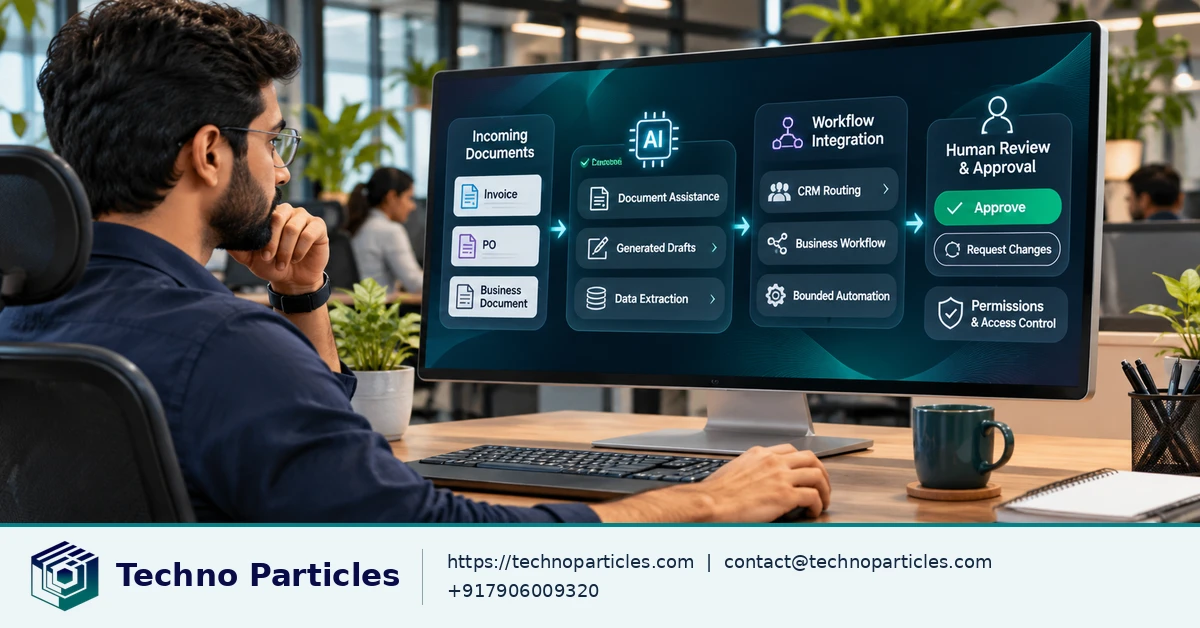
Consider an internal document-intake workflow in which a team receives requests and prepares responses. This example is illustrative, not a verified Techno Particles customer result. The company describes document and data automation among its generative AI services, while OpenAI’s guide to building agents discusses choosing workflows and evaluating agent performance.
Example workflow
A request arrives with supporting documents. An agent reads the permitted files, identifies the information needed for a response and retrieves relevant internal material through an authorized tool. It then prepares a draft that identifies the documents it used and flags details it could not establish.
The application routes the draft to the designated employee. That person can edit, reject or approve it before release. Afterward, the application records the disposition and any corrections for operational reporting. The agent’s role ends at the defined approval boundary; the employee retains responsibility for the final response.
To make the example concrete, suppose a request lacks a required supporting document. Instead of filling the gap with an assumption, the draft can identify the missing item and leave the affected response incomplete. The reviewer can then request the document or resolve the issue through the team’s normal process.
Measures that reveal value and failure
Compare elapsed handling time with the team’s existing process, using the same definition of when a request starts and ends. Track how often drafts need substantial correction and classify the reasons, such as an unsupported statement or a missed document. These measures distinguish faster drafting from a shift of work onto reviewers.
Also record how often requests reach the wrong outcome, including drafts sent for approval with missing evidence. Review rejected drafts alongside completed ones: a low average handling time alone can conceal cases that take much longer to resolve. Report usage costs per completed request alongside these quality measures so the team can assess operational value in context.
Conclusion: the decision rule for business automation
For Techno Particles generative AI services for business automation, choose an agent when a task requires multiple steps and connected tools within defined permissions and human oversight; use simpler automation when rules fully define the task.
Before requesting a project scope, write a one-page brief naming one repetitive task, its approved data and integrations, the approval owner, a success measure and expected usage.



Leave a comment
Your email stays private. You can see your comment immediately on this browser. Others see it after approval.