

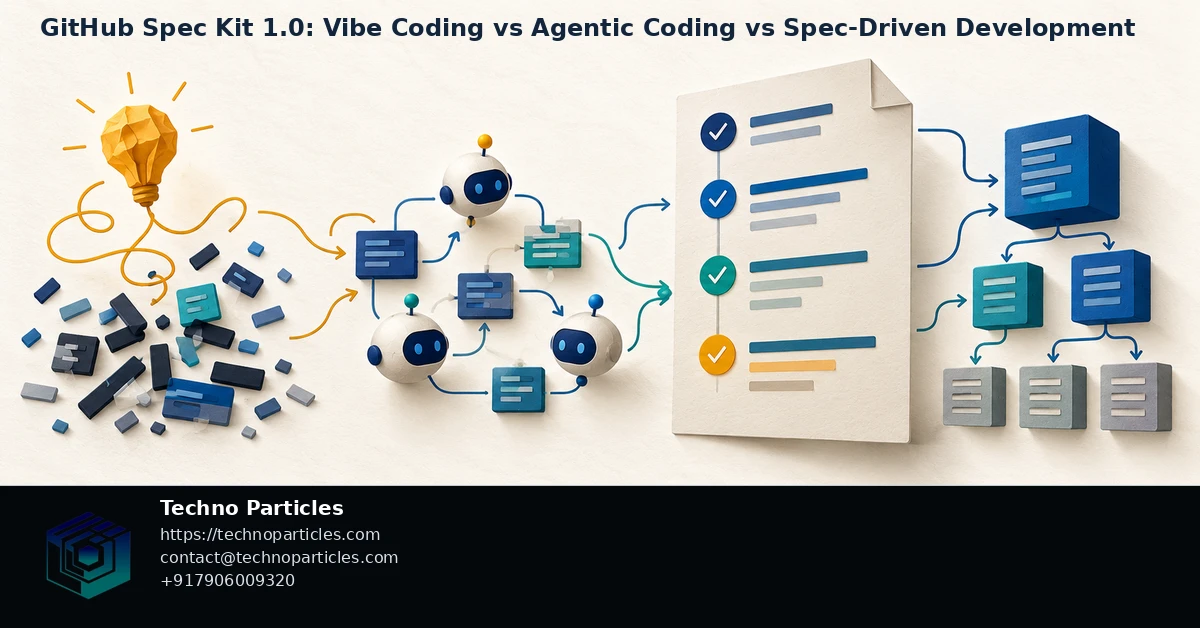
GitHub Spec Kit 1.0 marks an important shift in how AI coding tools can be used: from generating quick code through prompts to organizing software work around explicit requirements, plans, tasks, and validation. GitHubâs official project history records the 1.0.0 release on August 21, 2026, describing it as a first-anniversary milestone rather than a finished or frozen product.
The open-source toolkit gives coding agents structured processes, reusable templates, and durable artifacts. Its current workflow moves through a constitution, specification, clarification, planning, task breakdown, implementation, and convergence. That structure makes the comparison between vibe coding, agentic coding, and spec-driven development more practical than a simple debate about which approach is âbest.â
What changed with GitHub Spec Kit 1.0?
Version 1.0 introduced five composable primitives: integrations, extensions, presets, workflows, and workflow steps. Together, they are intended to make the development process adaptable across different teams, projects, and AI coding environments. GitHub documents support for 38 coding-agent integrations, including Copilot, Claude, Codex, Gemini, Kiro, Zed, and a generic integration.
That breadth matters for businesses evaluating AI-assisted development. A team can preserve its preferred coding agent while adding a more repeatable process for documenting requirements, resolving ambiguity, and tracking implementation work. For organizations building a website, application, CRM, or internal automation system, this can make project consultation and development handoffs easier to inspect through structured project consultation.
Vibe coding, agentic coding, and spec-driven development
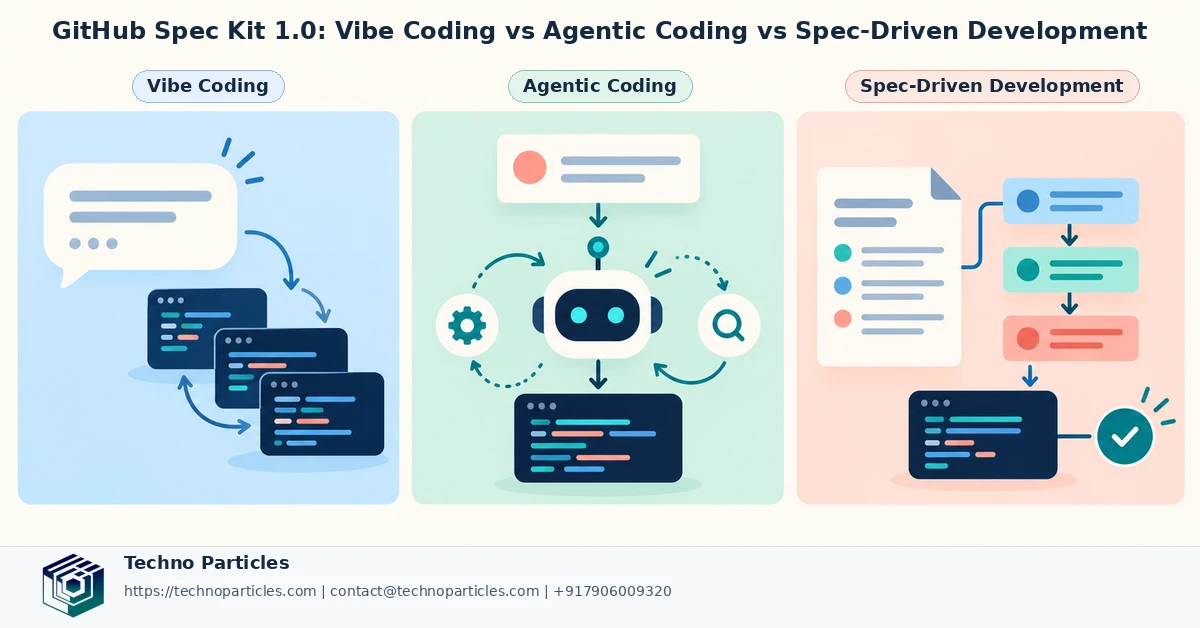
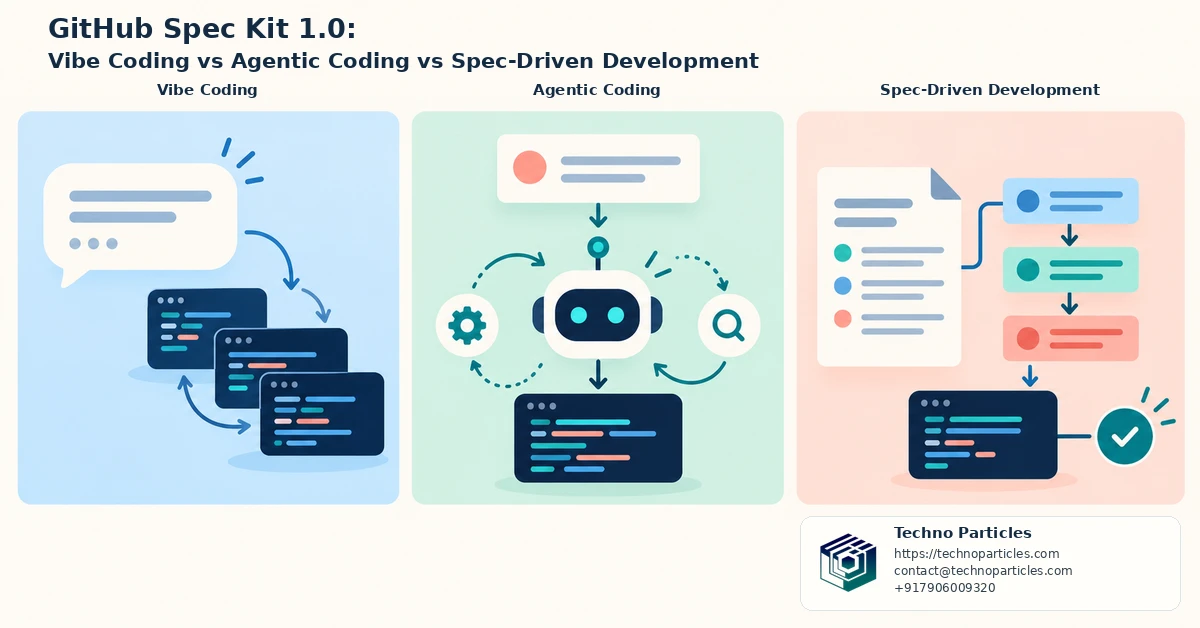
Vibe coding is prompt-led and informal: a developer describes an idea, reviews generated output, and iterates quickly. Agentic coding goes further by allowing an AI agent to handle multiple connected steps, such as editing files, running commands, and responding to feedback. Spec-driven development adds explicit requirements, plans, task lists, validation gates, and traceable artifacts before and during implementation.
How the three approaches differ in practice
The main difference is where structure enters the process. With vibe coding, structure often appears after the first generated result, when the developer notices missing requirements or unexpected behavior. This can be effective for prototypes, experiments, and small interface changes, but important assumptions may remain inside prompts or conversation history.
Agentic coding improves execution capacity rather than automatically improving requirements. An agent can inspect a repository, modify several files, run tests, and revise its work across a connected task. However, it still needs clear boundaries, suitable tools, and human decisions about architecture, security, data handling, and acceptable trade-offs. More autonomous execution can make an unclear request move faster without making the request more correct.
Spec-driven development places those decisions into durable artifacts. A constitution establishes project principles, the specification records expected behavior, clarification exposes ambiguity, and the plan connects requirements to implementation choices. A task list then gives the agent smaller, reviewable units of work. The result is not a guarantee of defect-free software; it is a clearer trail for checking whether the implementation matches the intended product.
When Spec Kit is useful for real projects
Spec Kit is especially relevant when several people must understand the same AI-assisted work. A product owner can review requirements, a designer can examine expected user flows, and developers can inspect the plan before implementation begins. The artifacts can also support later maintenance when the original prompt is no longer available.
For a business commissioning an e-commerce site, mobile app, CRM, or workflow automation system, this approach can turn broad goals into testable capabilities. Teams can connect the specification to application development services, UI decisions, integrations, and acceptance checks without treating the coding agent as the project manager.
GitHubâs documentation still presents human review, testing, and technical judgment as necessary. Spec Kit organizes those activities; it does not replace them.
GitHub Spec Kit 1.0: Vibe Coding vs Agentic Coding vs Spec-Driven Development - Techno Particles
What teams should expect before adopting Spec Kit
The practical value of GitHub Spec Kit depends on the quality of the decisions captured in its artifacts. A vague specification can still produce vague software, even when the agent follows every workflow step. Teams should therefore define the users, constraints, integrations, security expectations, and acceptance criteria before asking an agent to implement a feature.
The workflow also adds an upfront time cost. Writing a constitution, resolving clarification questions, and reviewing a plan may feel slower than immediately generating code. That trade-off becomes easier to justify when a project has multiple contributors, sensitive data, external integrations, or a long maintenance period. For a short-lived prototype, a lighter prompt-led process may remain more efficient.
Where the human remains responsible
Spec-driven development does not transfer product ownership or engineering accountability to an AI agent. People still need to decide whether a requirement is valuable, whether an architecture is appropriate, and whether the resulting behavior is safe and usable. Human reviewers should inspect generated changes, run relevant tests, evaluate error handling, and verify that documentation reflects the actual system.
This is particularly important for business software. A lead-management workflow, employee system, or e-commerce checkout can appear functional while mishandling permissions, personal information, failed payments, or operational exceptions. A durable specification helps reviewers ask better questions, but it cannot replace domain expertise or security review. Teams planning such systems can pair the workflow with SEO-aware website development or custom application planning according to the productâs needs.
Spec Kitâs evolving direction
GitHubâs release history shows that the project is still evolving. Although version 1.0.0 was an important first-anniversary milestone, the official releases page lists version 1.1.0 from October 2, 2026. One notable change is the deprecation of the core /speckit.taskstoissues command in favor of a GitHub extension, a reminder that teams should check current documentation before standardizing their workflows.
That change also illustrates an important distinction between a stable engineering idea and an evolving toolkit. The core concept of spec-driven development can remain useful while commands, extensions, and integrations change. Teams should pin the version they test, record the selected agent integration, and review release notes before updating a shared workflow.
How to choose between vibe coding, agentic coding, and Spec Kit
Vibe coding remains a practical option when the goal is exploration: testing a layout, sketching a small script, or learning an unfamiliar API. Its speed comes from keeping planning lightweight, but the developer must be ready to discard generated work when requirements change.
Agentic coding fits tasks with a defined outcome and several connected operations. For example, an agent might update a feature, add tests, inspect failures, and revise the implementation. Before starting, teams should specify the repository boundaries, permitted tools, expected files, and conditions that require human approval.
Spec Kit becomes more valuable when the work needs repeatability and shared understanding. A team building a customer portal, internal dashboard, or automation platform can use durable requirements and task artifacts to make reviews more focused. It can also align product, design, and engineering decisions before implementation expands. Businesses evaluating this approach may benefit from project consultation for AI-assisted software planning.
A practical adoption path
- Start with one feature whose requirements can be reviewed by both technical and non-technical stakeholders.
- Write acceptance criteria that describe observable behavior, including failure and permission cases.
- Use the agent for a bounded implementation, then inspect the diff, tests, and resulting user experience.
- Document lessons from the run before applying the workflow to a larger project.
The useful question is not whether one method will replace the others. Vibe coding, agentic coding, and spec-driven development occupy different points on a spectrum from speed to structure. GitHub Spec Kit 1.0 makes the structured end of that spectrum more accessible, while its continuing releases show that teams should treat the workflow as adaptable engineering practice rather than a finished formula.
How Spec Kit changes day-to-day development
The biggest shift is not that an AI agent writes more code. It is that the team creates a shared record of why the code should exist and how it should behave. In a vibe-coding session, those decisions may remain inside a conversation. With GitHub Spec Kit, requirements, plans, tasks, and validation steps become durable artifacts that can be reviewed after the agent finishes.
That structure can improve handoffs. A developer joining a project can inspect the specification before studying every prompt or generated change. A product owner can challenge an unclear acceptance criterion earlier. A reviewer can compare the implementation with the intended behavior instead of judging a large diff without context. These benefits are especially relevant when a feature crosses frontend screens, backend services, databases, and third-party APIs.
Questions to answer before the first command
- What user problem does the feature solve, and which users are out of scope?
- What data may enter the system, and which roles can view or change it?
- What should happen when an integration, payment, notification, or database request fails?
- Which tests and observable outcomes will determine whether the feature is complete?
Answering these questions does not guarantee a correct implementation, but it gives the agent and its reviewers a stronger target. It also exposes decisions that might otherwise appear only after deployment. For organizations building customer portals, workflow software, or e-commerce systems, this planning discipline can complement custom application development by making requirements easier to trace across the build.
Why the comparison matters
Vibe coding, agentic coding, and spec-driven development are best understood as different operating modes. The first prioritizes rapid exploration, the second expands delegated execution, and the third adds a formal control layer for repeatable delivery. Teams can move between them as a project changes, using lightweight prompts for discovery and stronger specifications when the feature becomes business-critical.
What teams should remember before adopting Spec Kit
The right starting point is the risk and coordination level of the work, not the novelty of the tool. A quick prototype may benefit from vibe coding because speed and discovery matter most. A bounded feature with a clear outcome may suit agentic coding, provided the agent has defined permissions and review points. A customer-facing or business-critical system usually needs the stronger traceability offered by spec-driven development.
GitHub Spec Kit 1.0 does not turn software delivery into an automatic process. Human reviewers still need to test behavior, question assumptions, inspect security and data-handling decisions, and confirm that the result serves real users. The toolkit supplies structure around those responsibilities; it does not replace engineering judgment.
A balanced operating model
- Use informal prompts to explore ideas and identify promising directions.
- Convert the selected idea into explicit requirements before committing to implementation.
- Let an agent handle suitable multi-step work within documented boundaries.
- Keep code review, automated testing, accessibility checks, and deployment approval under human control.
- Record changes to specifications when business rules or technical constraints evolve.
This balanced model also reduces the risk of treating generated code as disposable when it has already entered a production system. Durable artifacts make later maintenance easier because future developers can see the intended behavior, not only the final implementation.


Leave a comment