

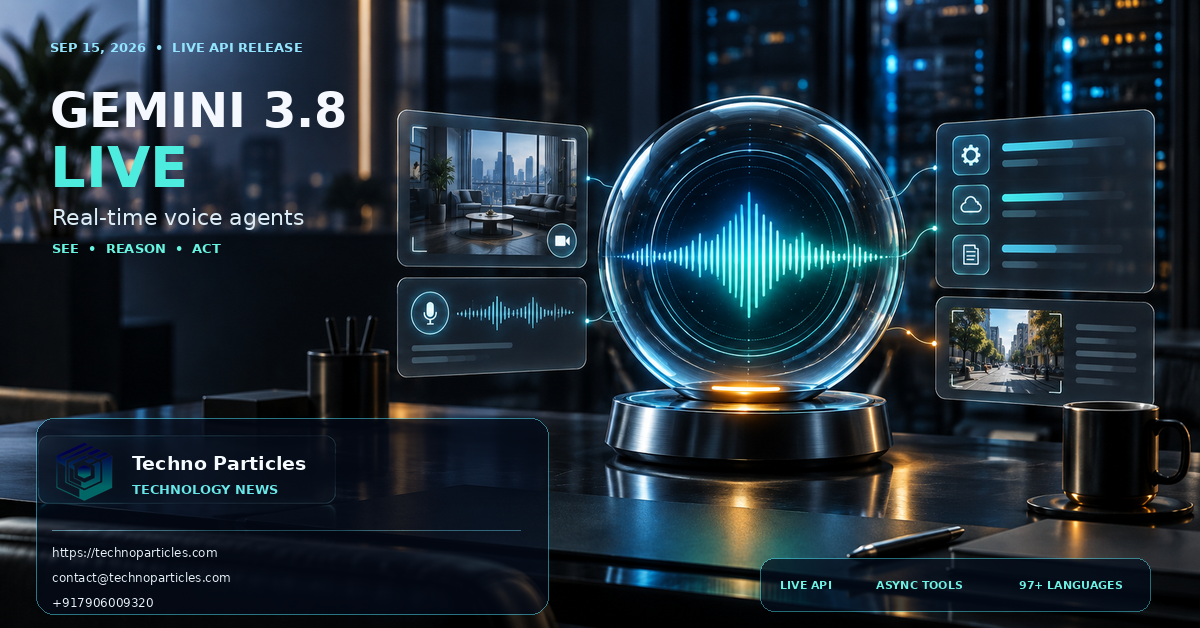
Google has released Gemini 3.8 Live and Gemini 3.8 Live Extended Thinking, two native audio models designed to make voice agents more conversational, visually aware, and capable of completing tasks while a discussion continues. The September 2026 launch is aimed at developers, enterprises, Gemini users, and businesses building real-time voice-first products.
The important change is not simply that Gemini can speak. Google says the models can listen, respond, process visual context, call tools asynchronously, and keep the conversation moving while an API request or background task completes. That architecture could make customer support, sales qualification, employee help desks, education, healthcare administration, and commerce assistants feel less like telephone menus and more like collaborative software.
What Google announced
Googleâs developer announcement on September 15, 2026, introduced Gemini 3.8 Live and Gemini 3.8 Live Extended Thinking through the Gemini API and Google AI Studio. The company describes 3.8 Live as the faster, scale-oriented option for low-latency conversations. Extended Thinking is intended for harder tasks that require deeper, multi-step reasoning while preserving a natural spoken exchange.
Googleâs broader product announcement says the models are also rolling out across Search Live, the Gemini app, and selected Google Workspace experiences. For enterprises, access is initially described as private preview in Gemini Enterprise, with broader Customer Experience availability planned. That distinction matters: an API developer can begin testing, but an organisation should not assume every enterprise deployment channel is generally available.
The models are based on Gemini 3 Pro, according to Google DeepMindâs model card. They accept audio, images, video, and text, and can return audio and text. The model documentation lists a 131,072-token input limit and a 65,536-token output limit. These specifications provide room for substantial conversational context, although real-world cost, latency, media duration, and application design still determine how much context is practical.
Why live voice agents are different
Traditional voice applications often use a cascade: speech recognition converts audio into text, a language model reasons over the transcript, and text-to-speech generates the reply. This modular approach remains useful because each component can be replaced, inspected, or tuned. However, it can introduce delays and lose information carried by tone, timing, interruptions, or overlapping speech.
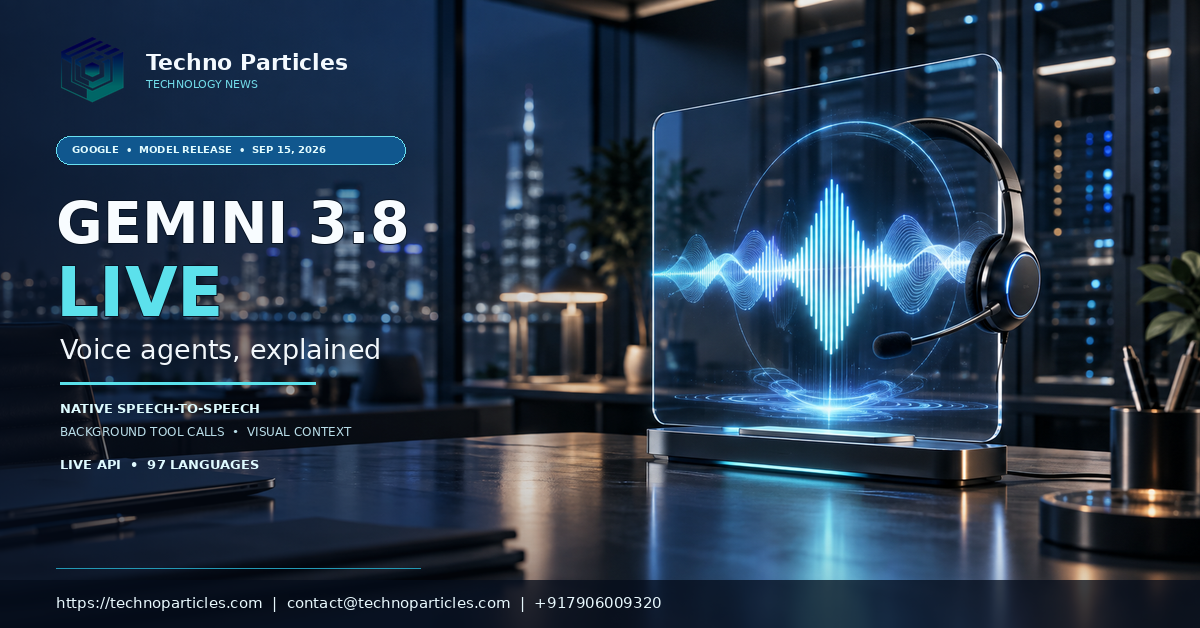
Gemini 3.8 Live is a native speech-to-speech model. Google presents it as a more streamlined alternative for real-time dialogue. The model can handle interleaved reasoning, built-in audio streaming, and asynchronous function calling. In practical terms, an agent could acknowledge a customer, retrieve an order record, and continue speaking instead of falling silent until the database request finishes.
Google also highlights alphanumeric precision for details such as confirmation codes, claim numbers, and technical data. That is particularly relevant for service desks and logistics workflows, where one misheard character can create a serious operational error. Developers still need validation, confirmation prompts, and deterministic backend checks before allowing an agent to change records or approve transactions.
For companies planning a new custom application development project, this release is best understood as an upgraded interaction layer, not a complete business system. The agent still needs identity management, permissions, monitoring, escalation paths, data connectors, and a reliable interface to the underlying CRM, ERP, CMS, or ticketing platform.
Google Gemini 3.8 Live Voice Agents: Release Explained - Techno Particles
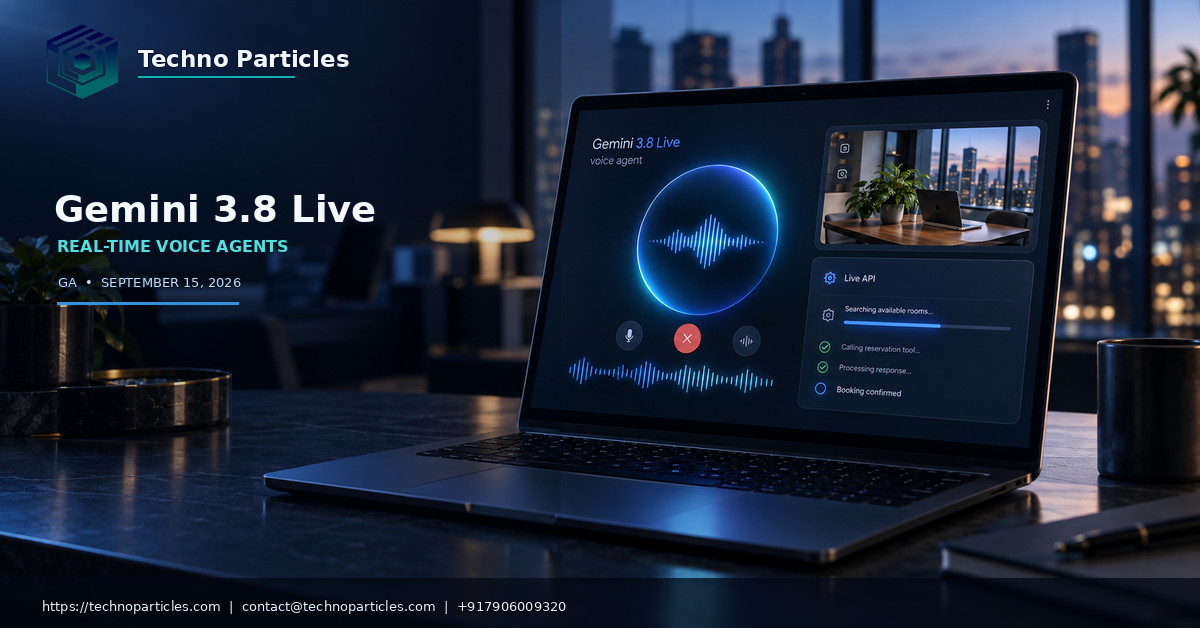
Gemini 3.8 Live versus Extended Thinking
The two models target different operating points. Gemini 3.8 Live is the default choice for most low-latency voice-agent experiences, according to Googleâs API documentation. It is designed for responsive dialogue without reasoning-induced delays. It supports function calling, Search grounding, interleaved reasoning, audio generation, and the Live API, but the documentation currently lists code execution, file search, structured outputs, URL context, image generation, and Google Maps grounding as unsupported capabilities.
Gemini 3.8 Live Extended Thinking is intended for situations where the agent must plan, compare options, or complete a multi-step workflow. Google says it can reason and speak simultaneously, narrate progress, and continue handling a conversation while tools work in the background. A booking assistant, for example, might ask a clarifying question while checking availability and preparing several possible choices.
This does not mean Extended Thinking should automatically replace the faster model. Longer reasoning can increase complexity, latency, and cost. A simple FAQ, appointment confirmation, or product lookup may be better served by the standard Live model. A complicated support case or multi-stage planning task may justify the reasoning-oriented version. Teams should test both models against their own conversations rather than selecting solely from benchmark headlines.
Capabilities developers can use
Google lists near-real-time visual context as a central feature. An agent can use live images or video frames to ground a conversation, making scenarios such as equipment troubleshooting, employee onboarding, visual inspection, and guided learning more practical. A user might point a camera at a device while asking what to do next, or show a form while requesting help completing it.
The models also support multilingual conversations. Googleâs developer announcement describes coverage for more than 97 languages and automatic language transitions during a conversation. That could help Indian businesses serve customers who switch between English and regional languages, although production teams should test accents, code-switching, names, addresses, and industry terminology in their target markets.
Asynchronous function calling may be the most consequential capability for business software. Instead of blocking the dialogue, an agent can start a tool or API call in the background and continue producing audio. The result can then be incorporated into the conversation. A carefully designed system could check a leadâs status in a CRM, retrieve a shipment update, or create a service ticket without forcing the customer through repeated pauses.
For organisations that need stronger workflow foundations, a structured digital strategy and SEO program remains relevant even when voice interfaces become more important. Voice agents do not replace discoverable websites, clear product information, accessible support pages, or measurable customer journeys. They add another route into those systems.
Pricing and access
Googleâs developer announcement lists pricing of $0.005 per minute for audio input and $0.018 per minute for audio output, with a note that the estimate is based on token pricing. Actual bills can depend on usage patterns, context, tools, and the surrounding Google platform. Businesses should model both sides of a conversation, background calls, retries, logging, and peak demand before committing to a production budget.
Developers can access the models through the Gemini API and Google AI Studio. Google also names ecosystem partners including LiveKit, Agora, Fishjam, LangChain, Pipecat, Vercel, and Vision Agents. These providers can help with media streaming and deployment infrastructure, but the application owner remains responsible for security, consent, data handling, and user experience.
Google says generated audio is watermarked with SynthID. That improves transparency and detection of AI-generated speech, but watermarking is not a substitute for disclosure, audit trails, abuse prevention, or human review in sensitive settings.
Limitations businesses should understand
The release is promising, but it does not remove the normal risks of foundation models. Google DeepMindâs model card warns that Gemini 3.8 Live and Extended Thinking can hallucinate, experience occasional slowness or timeouts, and inherit broader limitations from the Gemini 3 family. The model card also lists a January 2025 knowledge cutoff, so a voice agent that needs current facts should use approved retrieval or search mechanisms rather than relying on memory.
Real-time interaction creates additional engineering challenges. A system must decide when the user has finished speaking, how to handle interruptions, what happens when a tool fails, and when a human should take over. Audio quality, network conditions, microphone permissions, noisy environments, and speaker accents can all affect the result. Visual input also requires careful control of frame frequency and context size, especially when cost and privacy matter.
Tool access is another boundary. A voice agent should not be allowed to send money, delete records, issue refunds, or expose private information merely because a spoken instruction sounded plausible. Strong systems verify identity, constrain available functions, validate arguments, request confirmation for consequential actions, and keep an auditable record of tool calls. These controls are as important as the model selection.
What the release means for Indian businesses
For Indian SMEs and startups, Gemini 3.8 Live could lower the barrier to building voice-based support and operations software. A retailer might let customers check delivery status by speaking naturally. A manufacturer could provide guided maintenance instructions. An education company could create interactive practice sessions. A travel business could handle itinerary changes, while a healthcare administrator could collect non-diagnostic information before routing a case to staff.
Language flexibility is particularly relevant in India, where customers often move between English and regional languages in a single exchange. However, companies should validate the complete journey, including names, addresses, product codes, payment details, consent language, and escalation messages. A fluent conversation can still be operationally unsafe if the agent misunderstands a critical number.
Teams evaluating the technology should begin with a narrow workflow and measurable outcomes. Track successful task completion, transfers to human staff, correction rates, latency, tool failures, cost per session, and customer satisfaction. Compare the new native audio design with the organisationâs existing chatbot or cascaded speech pipeline. A pilot should include difficult accents, interruptions, background noise, ambiguous requests, and adversarial prompts.
Techno Particles can help businesses connect emerging AI capabilities with practical CMS, employee management, and learning management workflows. The useful question is not whether a company should add a voice agent immediately, but where spoken interaction genuinely reduces friction without weakening trust or control.
Final takeaway
Google Gemini 3.8 Live voice agents mark a meaningful shift from voice bots that only answer questions toward agents that can see, reason, call tools, and keep talking while work happens. The standard model focuses on speed and fluidity; Extended Thinking targets complex, multi-step tasks. API access, Google AI Studio availability, partner infrastructure, and published usage pricing give developers a practical starting point.
Still, the technology is not an autonomous replacement for product design or responsible operations. Businesses must supply reliable data, safe permissions, human escalation, privacy controls, and clear success criteria. For companies building a broader digital presence, a strong responsive website development foundation and thoughtful UI/UX design can make the voice experience easier to discover, understand, and trust.
The most sensible next step is a controlled prototype: choose one high-value conversation, connect only the necessary tools, test it with real users, and measure whether Gemini 3.8 Live voice agents improve the outcome. That approach turns a headline release into evidence for a sound technology decision.
What developers should verify before deployment
The release is most useful when teams treat Gemini 3.8 Live voice agents as a software component rather than a complete customer-service strategy. The model may handle natural conversation, but the surrounding application still determines what information it can access, which actions it may perform, and when a human must take over. That makes integration design as important as model selection.

Leave a comment