


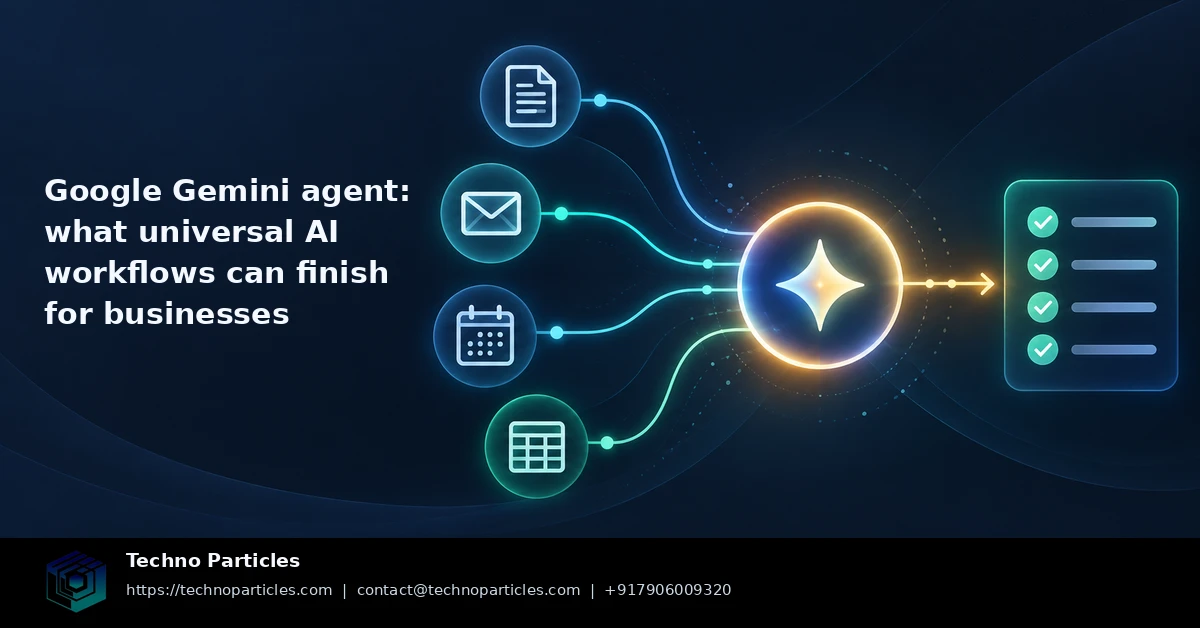
Google is presenting its Gemini agent as a shift from asking an AI for answers to assigning it complete, supervised work. In an October 8, 2026 Google Cloud announcement, the company described a unified work agent that can answer questions, create media, write and run code, schedule tasks, respond to events, use connected tools, and coordinate temporary or persistent sub-agents. The central question for businesses is not whether the agent can generate text, but how much operational work it can safely carry from request to result.
What makes Gemini Agent different?
Google says the system can work across Workspace, Microsoft 365, Slack, the web, mobile, desktop, and developer environments. Its proposed enterprise controls include model selection, cost controls, identity and permissions, sandboxing, persistent cloud execution, and governance. These features are designed to let an agent continue working after a user leaves the screen, while keeping access bounded by business rules.
The wider Gemini Enterprise platform announced in April adds Agent Designer, reusable Skills, long-running agents, Inbox monitoring, Data Insights, Deep Research, Projects, Canvas, partner agents, connectors, and support for bringing your own MCP servers. Together, these capabilities point toward repeatable workflows rather than isolated prompts.
Which business workflows could it handle?
- Finance: collect records, reconcile transactions, flag exceptions, and prepare a review package for approval.
- Sales: research prospects, enrich account information, draft outreach, update a CRM, and schedule follow-ups.
- Operations: monitor inboxes or incidents, summarize changes, route tasks, and escalate unusual events.
- Research and marketing: combine approved sources into reports, create campaign assets, and coordinate launch checklists.
Googleâs May announcement also described Gemini Spark as a 24/7 personal agent working across Workspace, custom connectors, and the open web. High-risk actions, such as sending emails, still require approval. Businesses planning these workflows should begin with clean data, carefully designed permissions, human checkpoints, and monitoring. Teams building connected systems can review Techno Particlesâ generative AI services as one implementation starting point.
What does a Gemini agent need before deployment?
The phrase âuniversal AI workflowsâ can sound broader than the practical reality. A Gemini agent can coordinate several steps, but each step depends on reliable access, clear instructions, and an approved business outcome. A finance workflow, for example, needs defined source systems, matching rules, exception categories, and a person responsible for approving unresolved discrepancies. Without those foundations, automation may simply move inaccurate information faster.
Start with bounded, repeatable processes
Businesses should begin with workflows that have a clear trigger and measurable result. An agent could watch a shared inbox for new supplier documents, extract relevant fields, compare them with records in an accounting system, and create a review task when something does not match. A sales agent might research a defined list of companies, prepare account briefs, and propose CRM updates without sending outreach until a manager approves the content.
This staged design also makes testing easier. Teams can first allow the agent to observe and summarize, then permit draft creation, and only later authorize limited updates in connected systems. High-impact actions such as financial transfers, customer-policy changes, mass messages, or production deployments should remain behind explicit approval gates.
Where implementation becomes difficult
Connectors do not automatically solve data quality or access management. Administrators must decide which identity the agent uses, what records it can read, which tools it can call, and how activity is logged. They also need fallback procedures for missing data, conflicting instructions, service outages, and unexpected outputs. Persistent cloud execution increases the importance of monitoring because a workflow may continue after its original requester has left.
For companies connecting AI to websites, CRM platforms, internal dashboards, or custom applications, an experienced application development team can help map permissions, APIs, review queues, and audit requirements before deployment.
Google Gemini Agent: What Universal AI Workflows Can Finish for Businesses - Techno Particles
How should teams govern Gemini agent workflows?
Governance should be designed alongside the workflow, not added after an agent is connected to business systems. Administrators need a written action policy that separates observation, drafting, recommendation, and execution. For example, an agent may be allowed to read approved sales records and prepare a follow-up, while sending the message requires a managerâs approval. The same pattern can protect customer data, financial records, and production systems.
Identity design is equally important. Each connector should expose only the records and actions required for a specific job. Temporary sub-agents may need narrow permissions and short lifetimes, while persistent agents require stronger ownership, logging, and review rules. Teams should also record which model, tool, data source, and instruction contributed to an important result. That audit trail helps investigate errors and improve the workflow.
Availability is still developing
Googleâs announcements describe a staged rollout rather than unrestricted access to every Gemini agent capability. The company said several Gemini Enterprise features would arrive over the following months, while Gemini Spark was rolling out soon and Workspace access was planned for business preview. The reviewed announcements did not confirm universal pricing or availability. Businesses should therefore validate eligibility, supported connectors, regional access, and commercial terms before designing a production process around a specific feature.
A practical pilot can measure completion rate, review time, exception frequency, data-access failures, and the percentage of tasks that require human intervention. Those measures reveal whether the agent is reducing operational effort or merely creating another queue for employees to supervise. A focused workflow assessment, such as Techno Particlesâ project consultation service, can help teams map an initial use case, its integrations, and its approval boundaries before committing to broader automation.
What should businesses expect next?
The most useful interpretation of Google Gemini agent is an expanding orchestration layer for supervised work. Its value will depend less on the promise of universal automation than on how reliably each business connects data, tools, permissions, and people.
Turning universal AI workflows into operating routines
For many businesses, the next step will be selecting one process that crosses several systems without requiring unrestricted autonomy. A product launch workflow could gather approved campaign information, check inventory data, draft website copy, prepare social-media variations, and create a review checklist. Each output can remain a draft until the responsible team confirms accuracy, brand alignment, and timing.
Customer-retention work offers another practical pattern. A Gemini agent could monitor approved support or account signals, identify customers who meet a defined risk condition, summarize relevant history, and suggest a response for an account manager. The workflow becomes more useful when its trigger, evidence, recommendation, and approval status are visible to the people who own the relationship.
Measure the work before expanding it
Teams should compare the agent-assisted process with the existing baseline. Useful measures include time to produce a first draft, time spent gathering information, correction frequency, unresolved exceptions, and the number of actions requiring escalation. Quality reviews should examine not only whether a task was completed, but whether the result used the right records and followed the organizationâs policies.
It is also important to test failure conditions deliberately. A pilot should include missing documents, contradictory customer data, expired credentials, unavailable connectors, ambiguous requests, and duplicate events. The agent should pause, explain the issue, and route the case to a named owner rather than silently guessing. These tests are especially important when workflows touch employee records, customer communications, financial information, or regulated data.
Businesses planning a connected rollout can pair workflow design with SEO and digital strategy expertise when agents will create or update public-facing content. That review can help preserve search intent, brand consistency, accessibility, and human editorial control while automation handles repetitive preparation.
Google Gemini agent therefore looks most promising as a configurable layer between business intent and coordinated execution. Its practical reach will be determined by data readiness, permissions, oversight, and the discipline used to expand from a tested pilot to a broader operating system.

How should teams prepare for Google Gemini agent workflows?
Businesses should begin with a contained process where the expected result, source data, and approval owner are easy to define. A sales-prospecting workflow, for example, could collect information from approved records, summarize account history, draft a personalized outreach plan, and place the result in a review queue. The agent can coordinate preparation while a salesperson remains responsible for accuracy, suitability, and the final communication.
Build the workflow around trusted inputs
Before connecting a Google Gemini agent to business systems, teams should identify which data sources are authoritative and which records require cleaning. Duplicate contacts, outdated product details, inconsistent naming, and incomplete permissions can make an automated result appear polished while remaining unreliable. Connector testing should confirm what the agent can read, what it can change, and how failures are reported.
Reusable Skills and templates can help standardize recurring work. A company might define a Skill for preparing a weekly operations brief, including required sources, formatting rules, escalation conditions, and an approval step. The same structure can support marketing reports, inventory checks, onboarding documents, or customer-service summaries without giving every workflow unrestricted access.
Use human review where consequences are high
Approval checkpoints are particularly important for external messages, financial decisions, employee records, customer eligibility, and changes to production systems. The agent should present its evidence, proposed action, and unresolved uncertainty before execution. Employees also need a clear way to reject, edit, retry, or escalate a task instead of accepting an opaque recommendation.
For organizations preparing the technical foundation, application development support can help connect internal systems, design role-based workflows, and create interfaces that make agent activity visible to the people responsible for oversight.
Start with a measurable pilot
A short pilot should track completion time, correction effort, exception types, and human approval rates. Those results can show whether the Google Gemini agent is genuinely reducing coordination work before the business expands its permissions or adds more systems.
The pilot should also define a clear stopping rule. If the agent repeatedly uses incomplete records, produces corrections that outweigh the time saved, or cannot explain why it selected a particular action, the workflow needs redesign before expansion. Automation should earn broader access through evidence, not through novelty.
What Google Gemini agent workflows could change next
The larger significance of the Google Gemini agent is its attempt to connect conversation, software tools, business data, and ongoing execution in one operating layer. Googleâs announcements describe workflows that can research, analyze, create, monitor events, and coordinate other agents. For a business, that could reduce the manual handoffs between a CRM, spreadsheet, inbox, project board, analytics platform, and content system.
However, âuniversalâ does not mean unlimited or automatically reliable. Access is being introduced in stages, and Google has not confirmed one universal price or unrestricted availability across every described capability. Businesses should evaluate the specific Gemini Enterprise features, connectors, identity controls, and approval options available to their organization before planning a full deployment.
The most practical adoption path is selective delegation. Let the agent gather evidence, prepare drafts, detect exceptions, and coordinate routine steps.

Leave a comment