

What if an AI agent could become more useful without changing its model weights? Google Research’s Harness² project explores that question with an open-source framework that recursively improves how agents plan, use tools, remember lessons, and coordinate with other agents. The work was described in the paper Recursive Agent Harnessing for an Open World, submitted to arXiv on October 9, 2026.
What Google Harness² changes
Harness² treats the surrounding “harness” as the improvement layer. Instead of retraining a foundation model, the system can refine prompts, guardrails, memory, tool instructions, subagents, skills, scripts, and plugins. This matters because many agent failures come from weak workflows or poor tool choices rather than from the model alone.
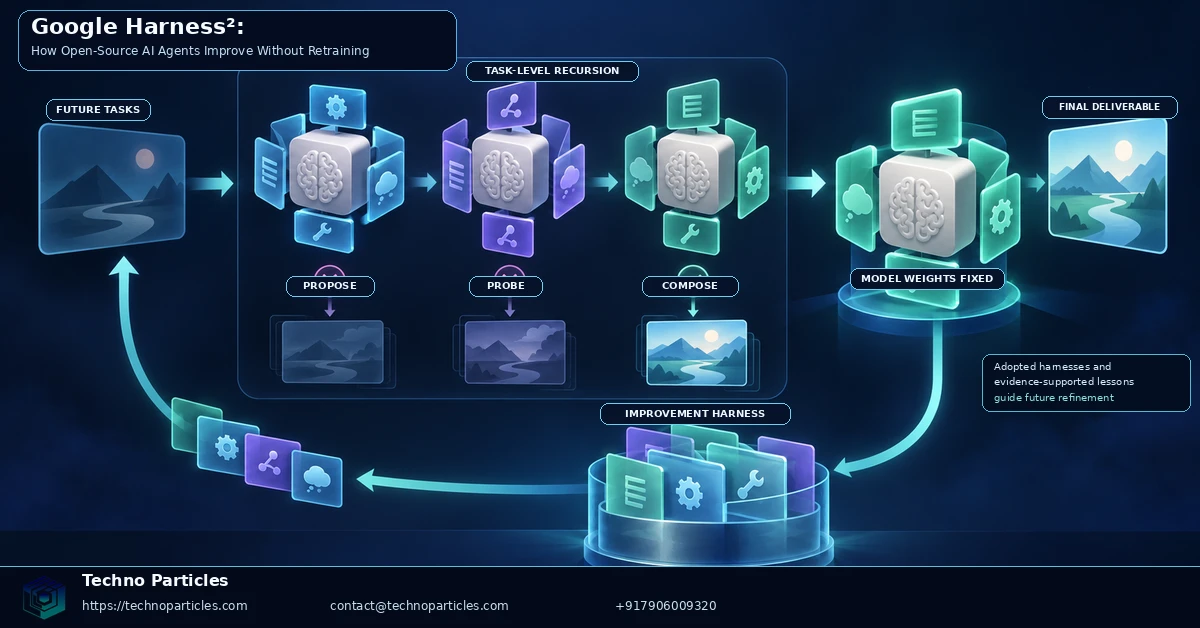
Its central Propose–Probe–Compose process generates candidate improvements, tests them through behavioral contrasts, and combines useful changes. The approach does not depend on ground-truth feedback for every task. A second recursion level can retain lessons from earlier work, allowing the agent system to reuse useful guidance on future tasks.
Why the setup is attracting attention
The Google Research repository describes Harness² as an Apache 2.0 framework, making it relevant to developers experimenting with custom automation, research assistants, and business workflows. Reported tests showed gains of up to 11.5 points on WorkBuddy-Bench, 4.5 points on JobBench, and 11.8 percentage points on LAB for selected GLM-5 and Gemini 3.5 Flash configurations. These figures come from the project’s own research reporting and should not be treated as independent validation.
For organizations building generative AI and automation solutions, the practical idea is significant: improvement may come from systematically refining the agent’s operating environment, not only from selecting a larger model. A credential-free local demo offers an accessible starting point, while full model-backed benchmarks require Linux, Python 3.12, Node.js 20+, uv, Google Cloud CLI, model access, and additional dependencies.
Google Harness² open-source setup: what developers need
The easiest way to understand Harness² is to separate its local demonstration from its full evaluation workflow. The repository offers a credential-free demo, so developers can inspect the framework’s recursive improvement pattern without immediately connecting a commercial model account. That makes it useful for learning how prompts, memory, tools, and agent roles are assembled around a fixed model.
Running the model-backed benchmarks requires a more specific environment. The project documentation lists Linux, Python 3.12, Node.js 20 or newer, and uv among the core requirements. Developers also need the Google Cloud CLI, configured access to the relevant models, and extra dependencies for the benchmark suites. In practice, teams should begin with the demo, then verify each dependency before attempting comparative runs.
A practical workflow for experimenting with Harness²
- Start with a narrow task. Choose a repeatable workflow such as document classification, research planning, or structured data extraction.
- Define the harness surface. Record the prompts, guardrails, memory rules, tool descriptions, skills, and subagent instructions that shape the agent’s behavior.
- Probe failure patterns. Compare different configurations using consistent inputs, paying attention to tool misuse, missing context, incomplete outputs, and unnecessary steps.
- Compose and retain useful changes. Keep improvements that generalize across tasks, while isolating changes that help only one prompt or dataset.
This approach is particularly relevant to teams building custom application development solutions, because an agent can be improved through its workflow layer without changing the underlying model. A CRM assistant, internal knowledge tool, or lead-routing system could use the same discipline to refine escalation rules and tool guidance over time.
Important limits before deployment
Harness² remains a research project, and the repository states that it is not an officially supported Google product. Its reported benchmark gains are promising but come from the project’s own evaluation. Businesses should therefore validate reliability, security, cost, and data-handling behavior on their own workflows before treating recursive harness improvement as production-ready.
Google Harness²: How Open-Source AI Agents Improve Without Retraining - Techno Particles
How recursive harness improvement works in practice
Harness² is best understood as an engineering loop around an existing model. A team first describes the task and the tools available to the agent. The framework can then propose changes to instructions, memory formats, safety rules, or specialist roles. Probing compares how those versions behave, while composition preserves the changes that appear useful across multiple trials. This makes the harness itself an object of testing rather than a static configuration file.
That distinction is important for Google Harness² open-source setup projects. Developers do not need to assume that every failure requires fine-tuning. If an agent chooses the wrong tool, forgets a constraint, or produces inconsistent structured output, the first investigation can focus on its operating instructions and workflow. Teams can also keep a record of which changes were tested, what failure they addressed, and whether the improvement survived different inputs.
Where businesses could apply the approach
A support agent might learn better escalation guidance, while a sales workflow could refine lead qualification, CRM updates, and follow-up sequencing. In an internal document system, recursive lessons could improve retrieval instructions and identify when a human review is necessary. These are practical extensions of the framework’s core idea, not claims that Harness² already provides production-ready business connectors.
Organizations developing AI project consultation and workflow solutions should treat each harness change as a controlled experiment. Start with a representative test set, measure task completion and error types, and review whether the agent’s new behavior creates security or compliance risks. Keep separate configurations for experimentation and production so an automatically generated improvement cannot silently alter a live process.
What the research does not establish
The published results do not prove that recursive harnessing will outperform retraining, fine-tuning, or careful manual prompt design in every domain. Benchmark outcomes may depend on the selected models, tasks, evaluation settings, and available tools. The project’s Apache 2.0 license supports experimentation, but licensing does not remove the need to inspect dependencies, protect credentials, and evaluate data governance before deployment.
Turning Harness² experiments into a repeatable setup
A useful implementation detail is version control. Store each harness configuration with its model name, tool definitions, memory format, guardrails, test inputs, and observed failures. This creates an audit trail for every change proposed by the recursive process. It also helps teams identify whether an improvement is broad or merely fits one example.
Harness²’s Propose–Probe–Compose cycle is valuable because it does not depend on a conventional answer key for every task. Behavioral contrasts can reveal that one agent configuration follows constraints more consistently, uses fewer unnecessary tools, or produces a more complete result. However, teams still need carefully designed evaluation criteria. Human review, structured checks, and domain-specific acceptance tests remain important when errors could affect customers, finances, privacy, or compliance.
What developers should monitor
- Consistency: Does the revised harness behave reliably across new inputs rather than only the examples used during probing?
- Tool safety: Can the agent request sensitive actions, expose credentials, or make irreversible changes without appropriate approval?
- Operational cost: Do additional probes, subagents, or tool calls increase latency and model usage enough to change the business case?
- Recovery behavior: Can the workflow explain uncertainty, retry safely, and hand an ambiguous task to a person?
These checks matter when Google Harness² open-source setup is considered for customer-facing products. A team building a generative AI solution can use a sandbox to test recursive changes, then promote only reviewed configurations to staging. Access controls, logging, rollback procedures, and data minimization should be designed alongside the agent loop, not added after deployment.
The broader lesson is that fixed model weights do not mean a fixed application. Prompt structure, memory, tools, and specialist roles can become an evolving engineering layer, provided every change is measured and governed.

A practical Google Harness² open-source setup path
For a first experiment, developers can begin with the repository’s credential-free local demo. This is a useful way to inspect the recursive workflow and understand how prompts, memory, tools, and agent roles are represented before connecting a model or business dataset. Keep the trial isolated from production credentials and real customer information while the team learns how proposed harness changes are generated and evaluated.
Model-backed testing requires a more deliberate environment. Google Research’s setup documentation lists Linux, Python 3.12, Node.js 20 or newer, uv, the Google Cloud CLI, configured model access, and additional benchmark dependencies. Teams should record the exact model, package versions, configuration files, and benchmark command used for every run. That information is essential when comparing results because a change in the environment can look like an improvement in the harness.
From experiment to application
The repository is released under the Apache 2.0 license, which supports reuse and modification, but the README also states that Harness² is not an officially supported Google product. That distinction matters for organizations assessing support expectations, security review, and long-term maintenance. An open-source framework can be valuable without carrying the same operational guarantees as a commercial platform.
A sensible path is to reproduce a small task locally, connect only non-sensitive tools, and define measurable checks before allowing recursive changes. For example, a document workflow might require valid citations, a CRM assistant might need approval before updates, and a coding agent might be restricted to a temporary workspace. Teams building custom application development solutions can then compare Harness² with manual prompt versioning, fine-tuning, or a conventional orchestration layer.
The reported benchmark gains are encouraging research signals, not a universal performance guarantee. Before adoption, test representative workloads for accuracy, latency, cost, privacy, and failure recovery. If the harness improves behavior only on the evaluation examples, the team should treat that as overfitting in the application layer and continue refining its test set.
What Google Harness² means for AI development
Google Harness² open-source setup points to a different way of improving AI agents. Instead of changing model weights, teams can refine the surrounding system: prompts, memory, tools, guardrails, specialist agents, and reusable skills. This makes experimentation more accessible for organizations that need to improve workflows without immediately collecting training data or funding a fine-tuning pipeline.
That flexibility still requires discipline. Recursive improvement can introduce unnecessary complexity, hidden assumptions, or changes that help one benchmark while weakening performance elsewhere. Every proposed update should therefore be recorded, reviewed, and tested against representative tasks. Teams should compare not only answer quality, but also tool usage, response time, model cost, privacy exposure, and recovery when an instruction is unclear.
Who should try Harness² first?
The framework is most suitable for developers and research teams comfortable with local environments, model configuration, and evaluation workflows. It may be useful for document processing, research assistants, coding workflows, internal knowledge systems, and other applications where agent behavior depends on multiple tools or steps. A small sandbox project is a better starting point than a customer-facing deployment.
Organizations should also remember that the repository is a research release rather than an officially supported Google product. Support, security, dependency maintenance, and compatibility remain the adopter’s responsibility.

Leave a comment