


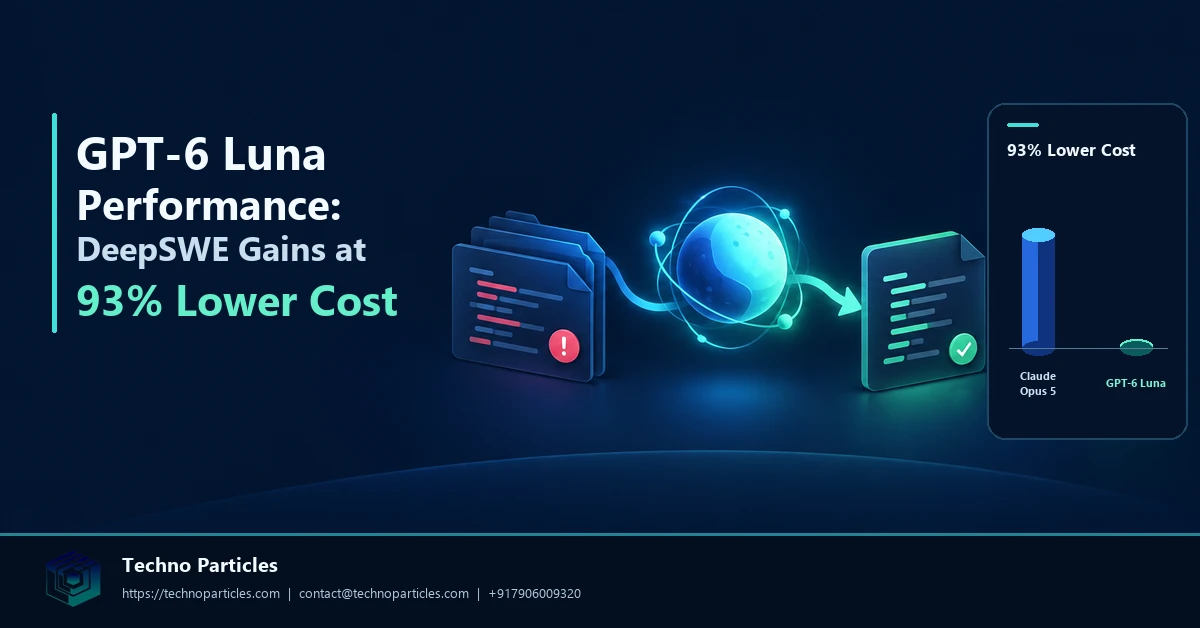
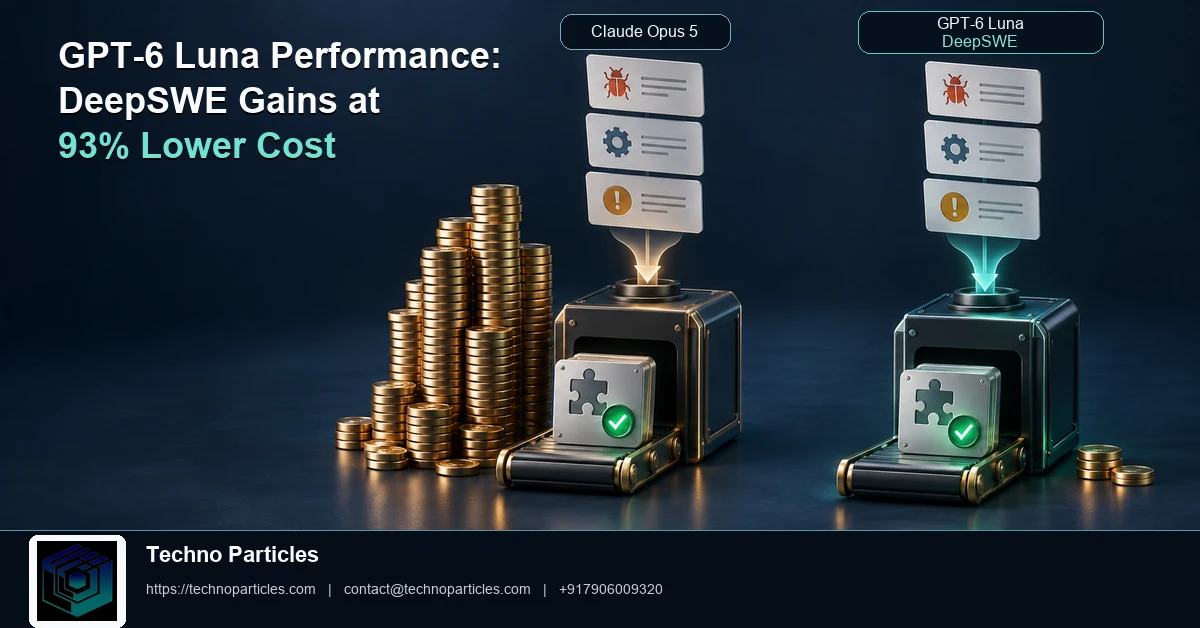
OpenAIâs September 22, 2026 announcement puts GPT-6 Luna in a striking position for software-engineering workloads: it scored 66.6% on DeepSWE v1.1 at maximum effort, matching the published scores of Claude Opus 5 and Fable 5 at medium effort. The bigger headline is cost. OpenAI reports that Luna completed the comparison at 93% lower per-task cost than Claude Opus 5 and 96% lower than Fable 5.
What GPT-6 Lunaâs DeepSWE performance actually measures
DeepSWE is not a short coding quiz. Maintained by Datacurve, the benchmark contains 113 original, long-horizon software-engineering tasks covering TypeScript, Go, Python, JavaScript, and Rust. Each task runs in an isolated environment and is checked through program-based verification. That design makes the result more relevant to coding agents that must inspect a repository, plan changes, edit multiple files, and test whether the implementation works.
However, the comparison needs careful reading. OpenAI says Luna was evaluated in its research environment or API, while the competing scores came from public reports. Effort settings, evaluation harnesses, tool access, and cost-accounting methods can all affect the outcome. A benchmark score therefore signals capability under defined conditions; it does not establish universal superiority or guarantee success in a production codebase.
Why the lower cost matters for development teams
GPT-6 Luna is documented at $0.10 per million input tokens and $0.50 per million output tokens, with a 1.05-million-token context window and a maximum output of 128,000 tokens. Its API page also lists function calling, structured outputs, code interpreter, hosted shell, and computer-use support. Together, those capabilities could make repeated repository analysis, test repair, migration planning, and review workflows more economical.
For teams exploring these patterns, application development services can provide a practical route from benchmark results to controlled, measurable engineering workflows.
How developers can test GPT-6 Luna without overtrusting the benchmark
The most useful response to GPT-6 Lunaâs DeepSWE result is a controlled pilot, not an immediate replacement decision. Start with a small set of real tasks drawn from your own repositories: dependency upgrades, failing-test repair, API changes, documentation updates, and isolated feature requests. Record the task description, repository state, tools available, human intervention, completion time, token usage, and whether the resulting tests pass.
This approach turns the headline about GPT-6 Luna performance into evidence that reflects your engineering environment. It also reveals where the model needs supervision. A coding agent may produce a plausible patch while missing backward compatibility, security implications, deployment constraints, or an edge case that the existing test suite does not cover.
A practical agent workflow
- Define boundaries: give the agent a limited branch, explicit acceptance criteria, and no production credentials.
- Require inspection first: ask it to summarize relevant files, dependencies, assumptions, and planned tests before editing.
- Separate implementation from review: use a second pass to identify risky changes, untested paths, and unnecessary modifications.
- Measure outcomes: compare successful task completion, review effort, runtime, token cost, and rollback frequency across models.
Lunaâs large context window may be useful when an issue spans documentation, application code, tests, and configuration. Its listed function-calling and hosted-shell capabilities could also support structured orchestration, such as retrieving issue details, running approved checks, and returning machine-readable status. Those possibilities still depend on the surrounding harness, permissions, prompts, and safeguards; the modelâs API feature list alone does not prove that a workflow will be reliable.
Businesses considering repository automation should also plan for data handling and auditability. Keep generated patches reviewable, log tool actions, protect secrets, and define a clear human approval step before merging. Teams that need help designing this kind of measured engineering workflow can explore project consultation services.
GPT-6 Luna Performance: DeepSWE Gains at 93% Lower Cost - Techno Particles
Where GPT-6 Lunaâs cost advantage may change coding-agent design
The reported GPT-6 Luna performance becomes more consequential when software teams treat model usage as an iterative process. A coding agent may need several attempts to understand an unfamiliar repository, reproduce a failure, propose a patch, run tests, and revise the implementation. Lower token pricing can make that loop easier to afford, especially for internal tools where every task still receives human review.
That advantage should be assessed against the complete operating cost, not token prices alone. Teams should include tool calls, hosted execution, storage, monitoring, retries, reviewer time, and the cost of failed changes. A cheaper model that requires extensive correction may not deliver a cheaper workflow. Conversely, a model that handles repository context and test feedback consistently could reduce the number of manual cycles even when its first answer is not perfect.
What to compare beyond a single score
- Task completion: record whether the requested behavior works, not merely whether code was generated.
- Patch quality: inspect maintainability, compatibility, error handling, and unnecessary file changes.
- Verification depth: run existing tests plus targeted checks for security, performance, and edge cases.
- Human effort: measure review time, clarification requests, and the frequency of manual rewrites.
- Operational safety: confirm that permissions, secrets, logs, and rollback procedures are controlled.
For a business building an internal dashboard, customer portal, or workflow system, this evaluation can begin with a sandboxed repository and a fixed task set. A team experienced in Generative AI implementation can help define the agentâs tools, approval gates, and measurement framework without assuming that benchmark parity removes the need for engineering judgment.
The most defensible interpretation of the DeepSWE result is therefore practical rather than absolute: GPT-6 Luna may make frequent software-engineering experimentation more economical under the tested conditions. Its value in production still depends on task selection, repository quality, test coverage, integration design, and disciplined oversight.
Turning GPT-6 Lunaâs benchmark result into an engineering decision
The next step is to translate the reported GPT-6 Luna performance into a repeatable cost and quality test. For each task, record input and output tokens separately, because the model page lists different prices for each: $0.10 per million input tokens and $0.50 per million output tokens. A long-running agent can also incur tool, execution, storage, and review costs that are not represented by the modelâs token price.
Build a comparison sheet around completed work rather than raw usage. Useful fields include whether the patch passed the required tests, how many retries were needed, how much human review it required, and whether the change introduced follow-up fixes. This makes it possible to compare a low-cost first attempt with a more expensive workflow that produces a cleaner result sooner.
Use Lunaâs tools with explicit controls
GPT-6 Lunaâs documented support for function calling, structured outputs, code interpreter, hosted shell, and computer use may help teams connect the model to a controlled development loop. For example, an orchestrator could provide a ticket, allow approved repository inspection, run selected tests, and return a structured result for human review. Each tool should have narrowly defined permissions, predictable inputs, and a visible audit trail.
The 1.05-million-token context window may also be relevant for tasks involving large codebases, test output, configuration files, and technical documentation. More context is not automatically better, however. Teams should still retrieve the most relevant files, remove sensitive data where possible, and ask the agent to identify which evidence supports each proposed change.
For companies building custom dashboards, portals, or internal workflow software, this kind of pilot can be paired with application development services to define repository boundaries, testing gates, and deployment controls. The goal is to learn where the model reliably reduces engineering effort before expanding its access or assigning it higher-risk work.
How to validate GPT-6 Luna performance in a real repository
A useful pilot should move from controlled tasks to representative engineering work only after the baseline is clear. Start with issues that have defined acceptance criteria, reproducible tests, and limited production risk. Compare GPT-6 Luna with the teamâs current workflow on the same tickets, using the same repository snapshot and equivalent tool permissions. This helps separate the modelâs contribution from differences in task difficulty or environment setup.
Set limits before expanding access
Agent permissions should increase gradually. A first phase might allow read-only repository access and test execution in an isolated environment. Later phases can permit changes to a dedicated branch, while deployment, database migrations, dependency upgrades, and production configuration remain subject to explicit approval. These boundaries are particularly important when hosted shell or computer-use capabilities are enabled.
Teams should also test failure behavior deliberately. Feed the agent incomplete requirements, failing tests, conflicting documentation, and tasks involving unfamiliar modules. Record whether it asks for clarification, reports uncertainty, or makes a confident but unsuitable change. Such observations can reveal weaknesses that a headline benchmark score cannot show.
Repository preparation matters as well. Clear contribution instructions, reliable automated tests, useful issue descriptions, and consistent formatting give a coding agent better evidence to work from. If the codebase lacks these foundations, improving its documentation and test coverage may produce a larger productivity gain than changing models.
Businesses planning a broader implementation can combine this pilot with website development services or application development support when the agent will contribute to customer-facing systems. The important design choice is to define which work is safe to automate, which work requires review, and which work should remain entirely human-led.
Keep benchmark claims in proportion
The DeepSWE comparison is a useful signal about cost-efficient long-horizon coding tasks, but it does not establish identical results across every language, repository, team, or deployment environment. OpenAI notes that evaluation environments and competitor reporting conditions differed, so teams should treat local measurements as the stronger basis for adoption decisions.
That distinction is central to interpreting the headline: GPT-6 Luna performance on DeepSWE is an encouraging efficiency signal, not a universal ranking of coding ability. DeepSWE covers 113 long-horizon software-engineering tasks across several languages, but a production repository may involve different dependencies, architecture decisions, security requirements, and business constraints. A model that performs well on benchmark tasks can still need careful guidance when requirements are ambiguous or the cost of an error is high.
What GPT-6 Luna performance means for teams
For developers and businesses, the reported 93% lower cost than Claude Opus 5 creates a practical reason to test Luna in iterative engineering workflows. Lower model pricing can make it more affordable to run multiple attempts, request targeted reviews, regenerate failed patches, or use an agent for routine maintenance. The benefit is greatest when teams measure completed, accepted work rather than treating token price as the entire automation budget.
Claude Opus 5 and Fable 5 remain relevant comparison points because the reported scores were achieved under different effort settings and evaluation conditions. Teams should therefore reproduce representative tasks locally before choosing a default model. A fair trial should track pass rates, retry frequency, review time, tool usage, escaped defects, and total cost per accepted change.
A measured path to adoption
Begin with isolated repositories, non-production branches, and tasks with clear acceptance criteria. Require automated tests and human approval before merging. Gradually expand the modelâs responsibilities only when the evidence shows consistent quality and safe failure behavior.

Leave a comment