

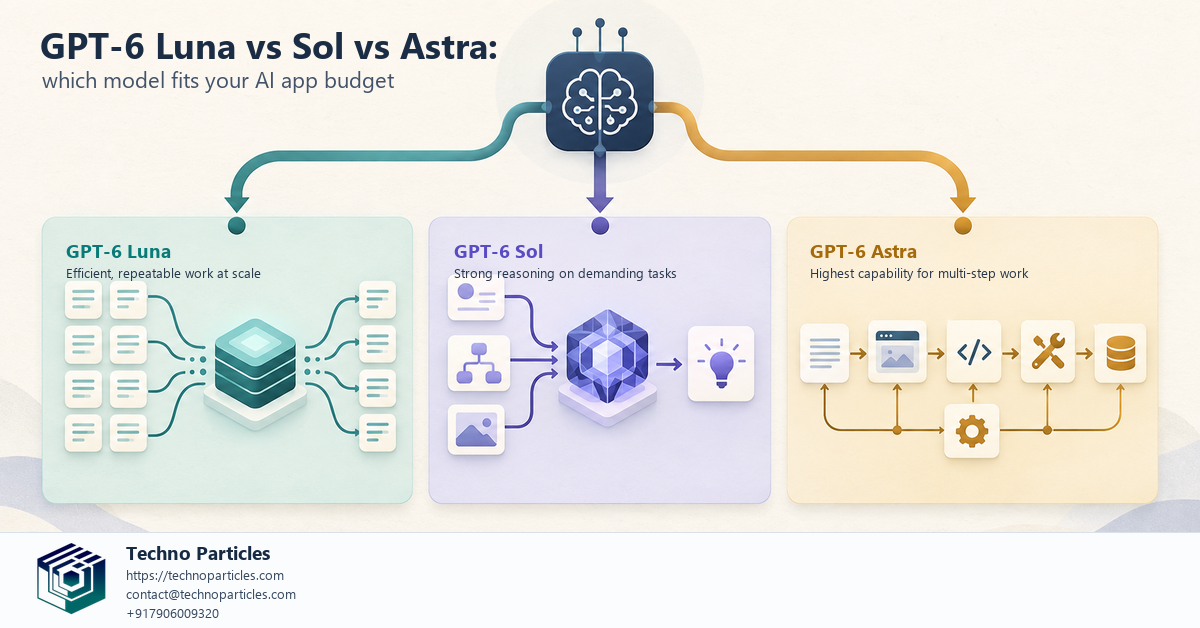
Choosing between GPT-6 Luna, Sol, and Astra is less about finding a single âbestâ model and more about matching intelligence, speed, reliability, and cost to each request. OpenAIâs current model catalog positions Astra as the most capable option for difficult end-to-end work, Sol as the practical balance for coding and agentic workflows, and Luna as the efficient choice for focused, high-volume tasks.
GPT-6 Luna vs Sol vs Astra: the core difference
As checked on 24 September 2026, all three models are documented with a 1.05-million-token context window and support up to 128,000 output tokens. That shared capacity makes them suitable for large documents, code repositories, research material, and multi-step application workflows. However, their reasoning options, rate limits, response behavior, and pricing differ, so context length alone should not determine your selection.
Official pricing shows a wide spread
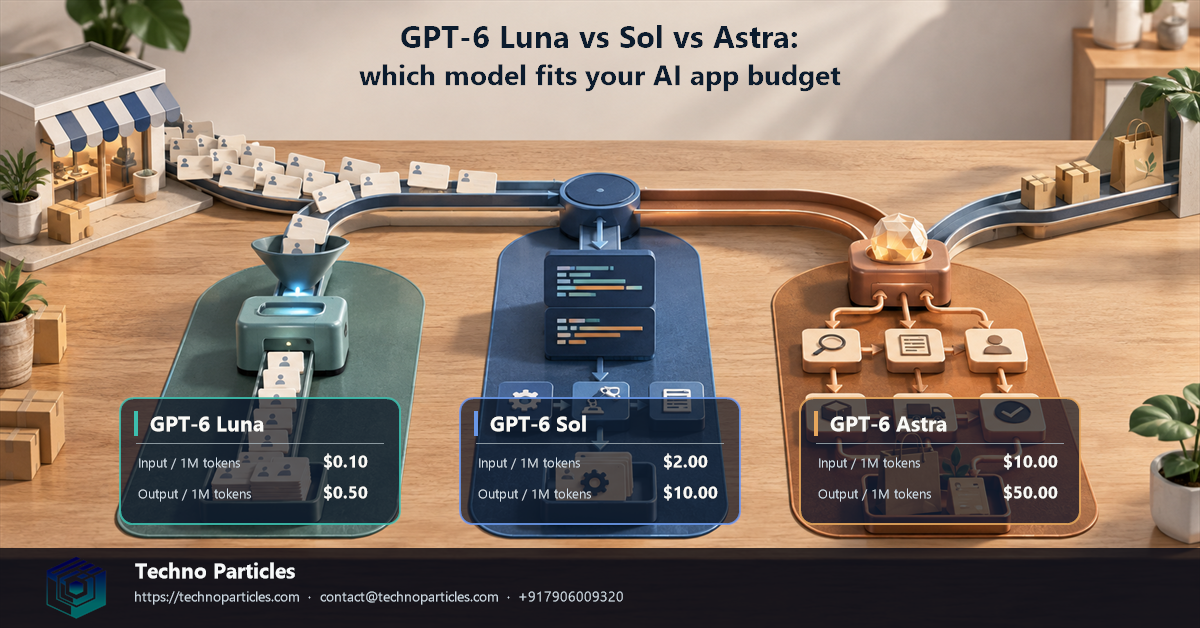
For standard short-context API usage, OpenAI lists Astra at $10 per million input tokens and $50 per million output tokens. Sol is priced at $2 input and $10 output, while Luna costs $0.10 input and $0.50 output per million tokens. Long-context rates are higher. These figures make Luna attractive for classification, extraction, rewriting, routing, and other predictable tasks, while Astraâs premium is easier to justify when a failed answer could create expensive review or rework.
The real application bill also includes retries, tool calls, latency-related infrastructure, monitoring, and human evaluation. A low-cost model can become expensive if it needs repeated correction; a powerful model can waste budget on routine prompts. Teams building Generative AI solutions should therefore measure cost per successful task, not merely cost per token.
Why model choice changes with the workflow
Astra is aimed at computer use, software engineering, research, and professional work, with performance claims in its announcement treated as company-reported. Sol may fit production agents that need meaningful reasoning without Astraâs price, while Luna can handle the high-volume first pass before harder cases are escalated.
Match GPT-6 Luna, Sol, or Astra to the job
GPT-6 Luna is the sensible starting point when the task is narrow, repetitive, and easy to validate. Examples include product categorisation, lead-field extraction, FAQ drafting, document tagging, translation checks, and first-pass content transformation. Its low listed price can support high request volumes, but teams should still test accuracy on representative data before sending outputs directly to customers.
GPT-6 Sol is better suited to workflows where the model must interpret instructions, write or review code, call tools, and recover from ordinary ambiguity. It can serve as the default model for an internal assistant, a customer-support workflow with escalation, or an agent that updates records after checking several sources. The extra cost over Luna may be worthwhile when fewer retries and more dependable tool decisions reduce operational friction.
GPT-6 Astra belongs at the top of a routing hierarchy when the request combines difficult reasoning, long evidence chains, computer use, software engineering, or professional research. That does not mean every complex prompt needs Astra. Instead, reserve it for cases where accuracy, planning depth, or recovery from unusual situations matters more than raw throughput. Teams developing custom application development solutions can place these model choices behind a single service layer, making future routing changes easier.
Build a budget-aware model routing plan
A practical design is to let Luna handle the first pass, send uncertain or high-value requests to Sol, and escalate only the hardest cases to Astra. Define escalation signals before launch: low confidence from a separate checker, failed validation, tool-call errors, conflicting source material, or a request involving irreversible business action. Keep a human approval step for sensitive decisions.
Measure each route using successful-task cost, response time, correction rate, tool reliability, and user satisfaction. Run the same evaluation set across all three models, then include retries and review time in the calculation. Because OpenAI can change pricing, aliases, rate limits, and availability, confirm the live documentation before committing your production budget.
GPT-6 Luna vs Sol vs Astra: Which Model Fits Your AI App Budget? - Techno Particles
How to test GPT-6 Luna, Sol, and Astra before launch
A model comparison becomes useful only when it reflects the requests your application will actually receive. Build an evaluation set from anonymised support tickets, product records, code tasks, documents, or other representative inputs. Include easy cases, ambiguous requests, long-context examples, tool-use steps, and situations where the correct response is to ask for clarification rather than guess.
Measure successful outcomes, not just token spend
For each GPT-6 Luna vs Sol vs Astra test, record input and output tokens, end-to-end latency, retry frequency, validation failures, tool-call accuracy, and human correction time. Then calculate the cost per successful result. This reveals whether Lunaâs low price remains economical after retries, or whether Sol or Astra reduces enough rework to justify a higher API bill.
Use separate checks for different workloads. A classification system may need precision and consistent labels, while a coding agent may need reliable tool selection, recoverable errors, and safe handling of incomplete requirements. For customer-facing features, add review for tone, factual grounding, privacy, and refusal behavior. These measurements are more useful than transferring benchmark results directly to your application, especially because the official performance claims for Astra come from OpenAI and may not predict every production scenario.
Keep the model behind a replaceable service layer
Applications should avoid scattering model names, pricing assumptions, and prompt-specific routing throughout the codebase. A central model service can assign Luna, Sol, or Astra according to task type, urgency, context size, confidence signals, and customer value. It can also log the selected model and fall back when a model reaches a rate limit or produces an invalid response.
For businesses building SEO-aware websites and web applications, this separation makes it easier to change aliases, compare updated rates, or introduce a new model without redesigning the user interface. Add configuration controls for spending limits, maximum retries, timeout behavior, and human approval of irreversible actions. Recheck OpenAIâs live documentation before deployment, because pricing, availability, rate limits, and model aliases can change.
Turn the comparison into a production decision
The best choice in a GPT-6 Luna vs Sol vs Astra comparison depends on the complete workflow, not only the advertised token rate. A model that produces a cheaper first answer may become more expensive if it needs repeated retries, extensive human correction, or additional verification steps. Conversely, Astraâs higher price may be justified for a high-value request where a failed answer could delay engineering work or affect a business decision.
Account for context, latency, and tool use
All three models are documented with a 1.05-million-token context window and up to 128,000 output tokens, but that does not make them interchangeable. Check the reasoning options, rate limits, and tool support available for the specific model and API endpoint you plan to use. Large context can also increase processing cost, so avoid sending an entire database, codebase, or document archive when a targeted retrieval step can provide the needed evidence.
Latency matters just as much as price in interactive products. Luna may be appropriate for fast, high-volume classification or extraction, while Sol can provide a stronger default for multi-step assistants and coding workflows. Astra is better reserved for difficult research, computer-use, software-engineering, or professional-work tasks where deeper reasoning and recovery from unusual conditions are valuable. These assignments should be validated through your own workload tests rather than assumed from a model description.
Design safeguards before increasing autonomy
Connect model outputs to structured schemas, validation rules, logging, and retry limits. Require confirmation before actions such as changing customer records, sending payments, publishing content, or modifying production code. A central project consultation service can help teams map these approval points and estimate the operational cost before implementation.
Finally, test fallback behavior. If Luna fails validation, route the request to Sol; if Sol encounters conflicting evidence or an unusually difficult task, escalate to Astra or a human reviewer.
Build a rollout plan for GPT-6 Luna, Sol, and Astra
Start with the least complex model that meets the taskâs quality requirements, then increase capability only when testing identifies a clear benefit. For example, an extraction workflow can begin with Luna, while requests involving multiple tools, conflicting instructions, or substantial code changes can be evaluated with Sol. Reserve Astra for cases where the additional reasoning capacity or professional-work features produce a measurable improvement.
Use staged traffic instead of changing every user at once. Run the selected model on a small percentage of requests, compare its results with the existing route, and review failures before expanding access. Keep a stable fallback available during the transition. This is particularly important for applications that manage customer information, inventory, employee records, or other data where an incorrect automated action may create operational or compliance problems.
Control costs after deployment
Set monthly budgets by feature, customer segment, or workflow rather than tracking only one organisation-wide total. Monitor token usage, average response size, retries, escalations, and the percentage of requests sent to Astra. A sudden increase in long prompts or repeated tool calls can raise costs even when the number of user requests remains unchanged.
Review prompts and retrieval policies regularly. Remove repeated instructions, limit irrelevant context, and summarise long histories when the task does not require every message. Store model and pricing settings in configuration so finance and engineering teams can update them without a full application release. Teams planning a new application development project should also define ownership for monitoring, incident response, and model-version changes before launch.
Recheck the decision as models change
GPT-6 Luna, Sol, and Astra should be compared again whenever OpenAI changes pricing, aliases, context rules, rate limits, or tool availability. Keep dated evaluation results and record the assumptions behind each routing decision. That evidence turns a one-time model selection into an operational process that can adapt as the API and the applicationâs workload evolve.
Make the decision measurable
A practical GPT-6 Luna vs Sol vs Astra decision should end with a scorecard, not a permanent model label. Track task success, factual accuracy, tool-call errors, response time, retry frequency, token consumption, and human-review effort. Compare those results by workflow, because the best model for document extraction may not be the best choice for coding, research, or customer support.
Before launch, create a representative evaluation set using real but protected examples. Include ordinary requests, incomplete instructions, long-context cases, conflicting information, and requests that should be rejected. Review both successful outputs and failure patterns. This makes it easier to decide whether Lunaâs efficiency, Solâs balance, or Astraâs advanced capabilities deliver the strongest business value for a particular feature.
Final verdict: choose by workflow, then verify continuously
Luna is the logical starting point for focused, high-volume tasks when its quality meets the requirement. Sol is a stronger general-purpose option for coding, agentic workflows, and applications that need more reasoning without the highest listed price. Astra fits difficult end-to-end work, including demanding research, software engineering, computer-use, and professional-work scenarios, but its premium cost makes selective routing important.


Leave a comment