
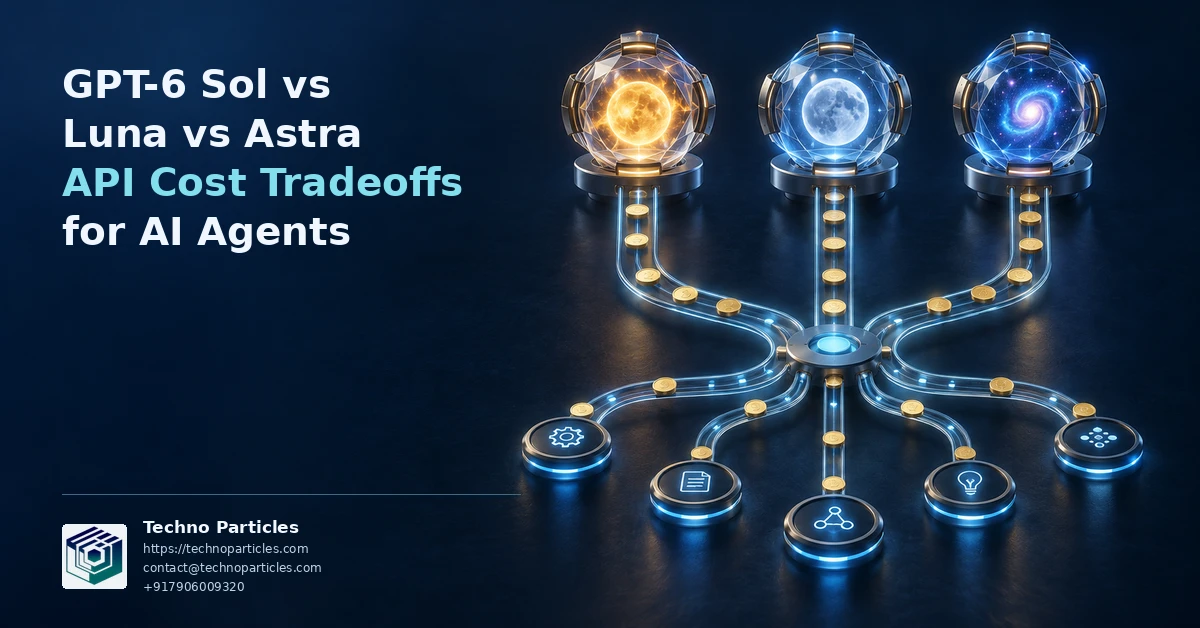
OpenAI’s GPT-6 family gives developers three distinct choices for agent systems: GPT-6 Astra for the hardest work, GPT-6 Sol for demanding coding and agentic workflows, and GPT-6 Luna for efficient, high-volume tasks. That makes the GPT-6 Sol vs Luna vs Astra API cost tradeoffs for AI agents more important than simply choosing the model with the highest capability.
According to OpenAI’s current API model catalog, the short-context prices are $10 per million input tokens and $50 per million output tokens for GPT-6 Astra, $2 and $10 for GPT-6 Sol, and $0.10 and $0.50 for GPT-6 Luna. All three list a 1.05-million-token context window and a maximum output of 128,000 tokens. The headline difference is therefore large: Astra costs five times more than Sol, while Sol costs twenty times more than Luna on both input and output.
What OpenAI’s three model tiers actually signal
OpenAI describes Astra as its state-of-the-art model for ambiguous problems, deep analysis, and ambitious deliverables. The API catalog positions it as the flagship for complex reasoning and coding. Sol is designed to balance intelligence and cost, with a specific focus on complex coding and agentic workflows. Luna is described as the efficient option for focused, repeatable, and high-volume work.
Those labels are useful starting points, not a guarantee that one model will win every benchmark or business workflow. An agent’s total cost also depends on how often it calls a model, how much context it resends, how long its answers are, whether tool calls trigger additional turns, and whether a failed action requires a retry. A cheaper token price can lose its advantage if the model needs substantially more attempts to complete the task.
A simple API cost comparison
Consider an agent that processes one million input tokens and generates 200,000 output tokens in short-context pricing. Astra would cost about $20 for that workload: $10 for input and $10 for output. Sol would cost about $4, while Luna would cost about $0.20. The calculation excludes separate tool charges, storage, retrieval, and application infrastructure, but it makes the tiering clear.
Output tokens deserve special attention. Agent loops can produce lengthy plans, tool summaries, code patches, and explanations. Because output is priced five times higher than input for each model, controlling verbosity can materially reduce spend. Structured outputs, concise tool results, and explicit response limits can help an application avoid paying for text that nobody uses.
For a small Indian business testing a lead-management agent, Luna may be economical for classification, duplicate detection, field extraction, routing, and routine follow-up drafts. A lead management system can reserve Sol for conversations requiring judgment and Astra for escalations involving complex customer histories or policy-sensitive decisions.
Where Luna, Sol, and Astra fit in an agent architecture
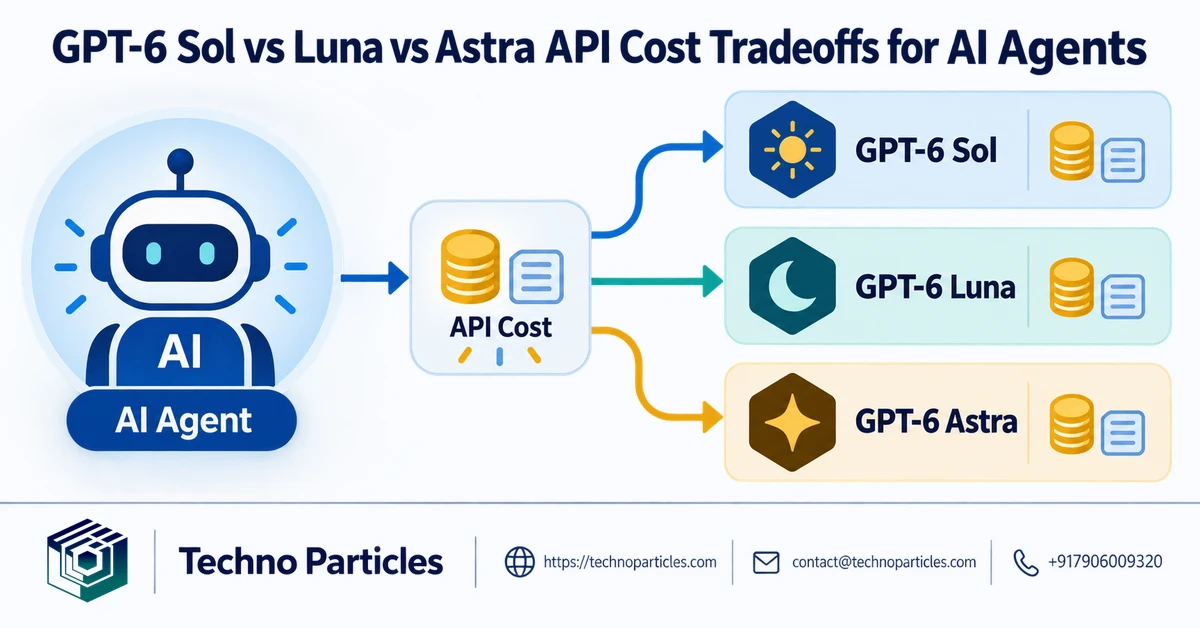
The strongest cost strategy is usually model routing rather than selecting one model for every turn. GPT-6 Luna can handle predictable work with clear schemas: classify an inbound request, extract invoice fields, summarize a support ticket, check whether a form is complete, or decide which workflow should run next. These tasks occur frequently, so Luna’s low price can make a meaningful difference at scale.
GPT-6 Sol is the practical middle layer. OpenAI lists it for complex coding and agentic workflows, and its API supports functions, web search, file search, and computer use. That combination makes Sol a reasonable default for agents that must interpret instructions, choose tools, recover from ordinary errors, and produce an answer that a human can review. It is also less expensive than Astra when the workflow does not need the flagship tier.
GPT-6 Astra belongs at the top of the escalation path. It is intended for ambiguous requirements, deep analysis, complex research, and multi-step professional work. In an application, that could mean resolving a disagreement between records, designing a migration plan, reviewing a risky code change, or making a decision where a weak answer creates a costly downstream error. The premium is easier to justify when the value of correctness is high.
Reasoning effort changes the economics
The model is only one pricing decision. The GPT-6 guidance also distinguishes reasoning effort. Sol and Luna support a “none” setting, while Astra does not; each model also offers higher reasoning levels. Higher reasoning may improve difficult results, but it can increase latency and token usage. A sensible design starts with the lowest setting that passes representative evaluations, then raises effort only for specific failure modes.
That approach is especially useful for custom generative AI solutions. A workflow can begin with Luna at low effort, send uncertain cases to Sol at medium effort, and escalate only unresolved cases to Astra. The application should record the reason for each escalation so the team can identify whether the routing rule, prompt, retrieval layer, or model needs improvement.
Caching, context length, and hidden cost drivers
OpenAI’s pricing page lists separate rates for cached input and cache writes. Reusing a stable system prompt, policy library, or tool description can therefore reduce the cost of repeated context, provided the application preserves the cacheable prefix correctly. Caching is not a substitute for trimming irrelevant history, however. An agent that sends every previous message, tool response, and document on every turn can still waste budget.
Long-context pricing is another factor. The catalog lists higher rates when a request uses long context, so a large context window should be treated as capacity rather than a target. Retrieval should return the smallest evidence set that supports the decision. For a custom application, developers should log input tokens, cached tokens, output tokens, model, reasoning setting, latency, tool calls, and retry count for every production task.
Building a reliable routing policy
Start with a task inventory, not a model preference. Mark each task as routine, judgment-heavy, or high-risk. Define an acceptance test for accuracy, tool completion, latency, and user experience. Then compare Luna, Sol, and Astra on the same prompts and data. The result may show that a cheap model handles most volume while a stronger model is needed only for a narrow percentage of cases.
What businesses should test before choosing a model
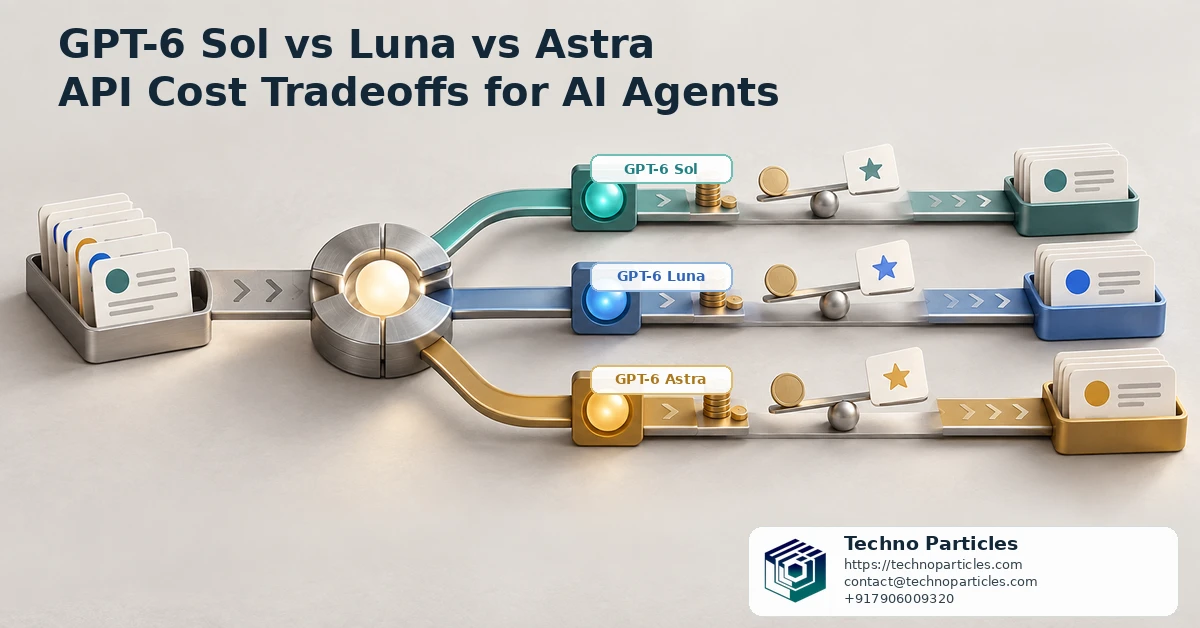
Cost estimates should use production-shaped traces rather than a single synthetic prompt. Capture the average input and output tokens per turn, the number of turns per completed job, the percentage of jobs that require escalation, and the cost of failed or repeated tool calls. Then calculate cost per successful task, not merely cost per API request. This is the metric that matters for a customer-support workflow, research assistant, internal operations agent, or software automation.
For example, an agent may appear cheaper on Luna but require additional clarification turns or human correction. Sol could become the better economic choice if it completes the same workflow more consistently. Astra may still be the right option for a small volume of high-value decisions when one incorrect action could delay a launch, misclassify a compliance issue, or damage a customer relationship.
Teams should also test safety and operational boundaries. OpenAI’s GPT-6 guidance notes that availability, tools, reasoning settings, and usage limits can differ by model and product version. The documentation also states that EU data residency for Astra, Sol, and Luna is available only with Standard processing, while regional processing can add a 10% uplift for eligible models released after March 5, 2026. Data residency and processing mode may therefore affect the final bill for organizations with location requirements.
A practical three-tier pattern for AI agents
- Luna for volume: Use it for extraction, triage, routine summaries, simple classification, and repetitive workflow steps with clear validation.
- Sol for judgment: Use it for tool selection, coding assistance, research synthesis, customer conversations, and ordinary exception handling.
- Astra for escalation: Use it for ambiguous, high-impact, or technically complex tasks where deeper reasoning is worth the premium.
This pattern can support a business management system that automates employee requests, reporting, and approvals while reserving stronger reasoning for unusual cases. It can also fit an e-commerce operation: Luna can normalize catalog data, Sol can investigate order issues, and Astra can review complicated disputes or propose process changes.
Implementation checklist for developers
Use the Responses API and set the model explicitly to gpt-6-luna, gpt-6-sol, or gpt-6-astra. Keep prompts modular, validate structured output, and define tool permissions outside the model. Add timeouts, retry limits, audit logs, and a human approval step before irreversible actions. Evaluate real examples continuously because model selection is an engineering decision, not a one-time pricing exercise.
Teams building a customer-facing product should also design the interface around uncertainty. Show when an agent is waiting for a tool, request confirmation before sending messages or changing records, and make escalation visible. A clear UI and UX process can reduce user confusion even when the underlying model remains the same.
The bottom line on GPT-6 Sol vs Luna vs Astra API cost tradeoffs for AI agents
The GPT-6 Sol vs Luna vs Astra API cost tradeoffs for AI agents are best understood as a quality-routing problem. Luna offers the lowest token prices for repeatable, high-volume work. Sol is the balanced choice for agents that need stronger judgment without flagship pricing. Astra is the premium layer for difficult, ambiguous, and high-consequence tasks.
Start with evaluations, measure cost per successful task, use caching and compact retrieval, and escalate selectively. Businesses planning an agent platform can review project consultation services to map workflows, metrics, and integration risks before committing to a model strategy. The winning architecture is unlikely to be “Astra everywhere” or “Luna everywhere.” It will be a measured system that sends each decision to the least expensive model capable of completing it reliably.
How to measure the real cost of an AI agent
Published token rates are only the starting point when comparing GPT-6 Sol, Luna, and Astra. The more useful figure is the cost of a successful completed task. An inexpensive request that fails, triggers several retries, or requires manual correction may cost more than a single premium call that finishes accurately. Track model spending alongside completion rate, tool-call count, latency, retry frequency, and human intervention.
Build an evaluation set before routing traffic
Create a representative test set from actual workflows rather than relying on simple prompt examples. Include routine requests, incomplete information, conflicting instructions, long documents, tool failures, and cases that require escalation. Run each model against the same inputs and record whether the final outcome meets your acceptance criteria. For an agent handling leads, for example, accuracy may include extracting the right fields, identifying urgency, updating the CRM correctly, and avoiding duplicate records.
- Measure reliability: Count successful end-to-end outcomes, not merely well-written responses.
- Measure efficiency: Record input tokens, output tokens, cached tokens, tool calls, and average response time.
- Measure risk: Track incorrect actions, unsupported claims, privacy violations, and unnecessary escalations.
- Measure user impact: Note abandonment, satisfaction, correction time, and the number of tasks requiring human review.


Leave a comment
Your email stays private. You can see your comment immediately on this browser. Others see it after approval.