

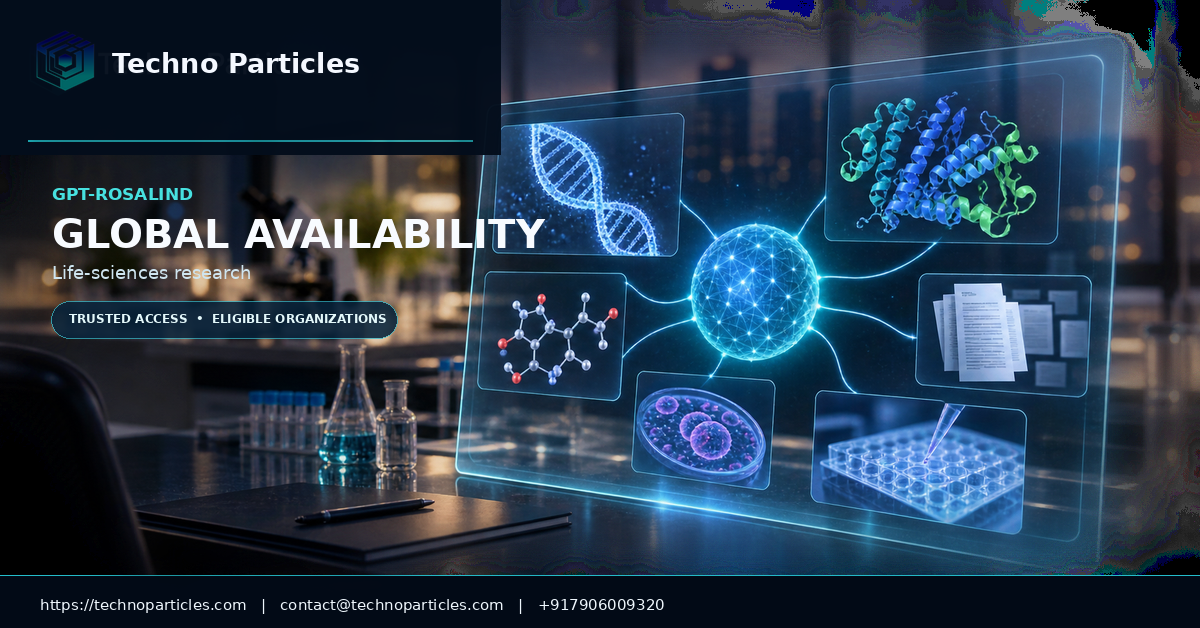
OpenAI has expanded GPT-Rosalind from a research preview into global availability for eligible organizations working in life sciences research. The September 11, 2026 update changes the modelâs position from a limited pilot into a more formal enterprise research offering, although it is still not an open public chatbot or an unrestricted commercial API.
GPT-Rosalind is OpenAIâs specialized model for biology, drug discovery, genomics, protein engineering, medicinal chemistry, translational medicine, and related scientific workflows. It is available through ChatGPT Enterprise, Codex, and the OpenAI API for approved internal research use. Access remains controlled through OpenAIâs trusted-access program, with eligibility, safety, compliance, and organizational-governance requirements.
What changed with GPT-Rosalind global availability?
When OpenAI introduced GPT-Rosalind on April 16, 2026, the company described it as a frontier reasoning model built for life sciences research. The first deployment began with qualified customers through a trusted-access structure, initially focused on organizations able to demonstrate legitimate scientific work and appropriate safeguards.
The latest announcement says GPT-Rosalind is now available globally to eligible organizations. This means geography is no longer the primary limitation for organizations that satisfy OpenAIâs approval requirements. It does not mean that every researcher, student, startup, or individual can select GPT-Rosalind immediately.
OpenAI says eligible organizations with Enterprise or Business agreements can request access. Approved users may find the model in the ChatGPT or Codex model picker, while approved organizations can request API access for internal research tools, workflows, and applications. The Help Center states that API access is not currently available for customer-facing products or external commercial applications.
What GPT-Rosalind is designed to do
The model is intended to help researchers move through complicated, multi-step work involving papers, biological databases, experimental results, and computational tools. OpenAI highlights evidence synthesis, target research, genomics and sequencing analysis, protein and sequence analysis, medicinal chemistry, wet-lab troubleshooting, and experiment planning.
In practice, GPT-Rosalind is best understood as a research collaborator that can help organize and execute parts of a workflow. A scientist might ask it to compare evidence around a target, interpret a sequence-analysis result, identify missing information, suggest follow-up questions, or coordinate a series of tool calls. The output still requires expert review, laboratory validation, and normal scientific governance.
OpenAIâs Rosalind Workbench presents a related workflow environment for life sciences. The company describes it as an orchestrated workspace that brings research questions, data, and scientific tools together. Guided sequencing analysis is one starting point. Researchers can provide sequencing files and sample details, review an analysis plan, inspect quality-control metrics, and examine saved outputs before deciding what to investigate next.
For organizations exploring how domain-specific AI could fit into existing systems, Techno Particlesâ Generative AI development services provide relevant context on AI content generation, agents, document automation, and business workflows.
GPT-Rosalind Global Availability for Life Sciences Research Explained - Techno Particles
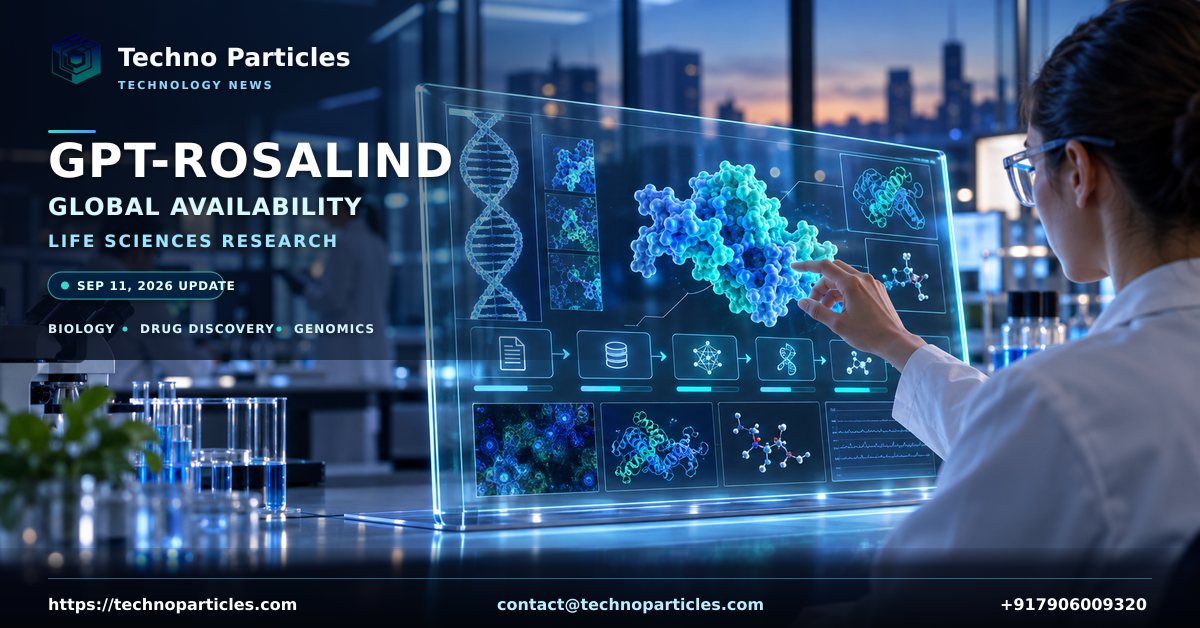
Who can access GPT-Rosalind?
GPT-Rosalind global availability is aimed at organizations rather than casual users. OpenAI says approved teams need a legitimate scientific purpose, clear public-benefit objectives, strong governance, misuse-prevention controls, and secure management of users and data. The companyâs access process is designed to make powerful biological reasoning available while reducing the risk that advanced capabilities are used irresponsibly.
That structure matters because life sciences research can involve sensitive biological information, unpublished findings, proprietary compounds, patient-related data, or procedures that require careful oversight. A model that can reason across scientific evidence and tools must be placed inside an accountable environment. Access approval is therefore only one part of deployment; organizations also need internal review procedures, permission management, auditability, and human sign-off.
Availability is global, but it is conditional. An organization in India, Europe, or another region may apply, yet approval is not automatic. The practical route is to use OpenAIâs access request process or contact the company through an eligible enterprise relationship. Individual researchers should expect that access may depend on their institutionâs workspace, role, and approved use case.
How the technical workflow differs from ordinary chat
One of the most important details is that GPT-Rosalind is not designed to require every large research dataset to be pasted into a conversation. OpenAIâs Help Center recommends pointing the system toward files in a local directory, database, or approved storage system. GPT-Rosalind can then help select focused analyses, run targeted steps, interpret outputs, and turn useful procedures into repeatable skills.
This approach has several advantages. Raw omics data can be too large and complicated for direct conversational context. Keeping the files in controlled storage can support better access policies and reduce unnecessary duplication. Tool-driven analysis also makes it easier to separate the original data, the computational method, the intermediate output, and the researcherâs final judgment.
In Codex, OpenAIâs Life Sciences Research Plugin adds an orchestration layer for scientific work. The launch announcement says it connects researchers to more than 50 public multi-omics databases, literature sources, and biology tools. Listed workflow areas include human genetics, functional genomics, protein structure, biochemistry, clinical evidence, and public-study discovery.
The plugin is not the same thing as GPT-Rosalind. OpenAI says the plugin package can be used more broadly with its mainline models, while eligible Enterprise users can combine it with GPT-Rosalind for deeper biological reasoning. That distinction is useful for teams that want to experiment with connected scientific tools before requesting access to the specialized model.
Performance claims and what they mean
OpenAI reports strong results on several evaluations. Its Rosalind page lists gains in performance per token on Genebench, Medchem Bench, Labworkbench, and LifeSci Bench. The launch announcement also says GPT-Rosalind outperformed GPT-5.4 on six of eleven LABBench2 tasks and achieved leading performance among models with published scores on BixBench.
OpenAI further describes a collaboration with Dyno Therapeutics involving RNA sequence-to-function prediction and generation using unpublished sequences. The company reports that best-of-ten submissions ranked above the 95th percentile of human experts on the prediction task and around the 84th percentile on sequence generation.
These are meaningful signals, but they remain company-reported evaluations and should not be treated as proof that the model can replace scientists. Benchmark tasks may not capture every laboratory condition, dataset bias, safety issue, or regulatory requirement. The strongest use case is assisted research in which experts verify sources, inspect methods, reproduce analysis, and decide whether an idea is biologically plausible.
Teams planning a custom internal interface may also review Techno Particlesâ application development services and project consultation support when mapping AI tools to existing research operations.
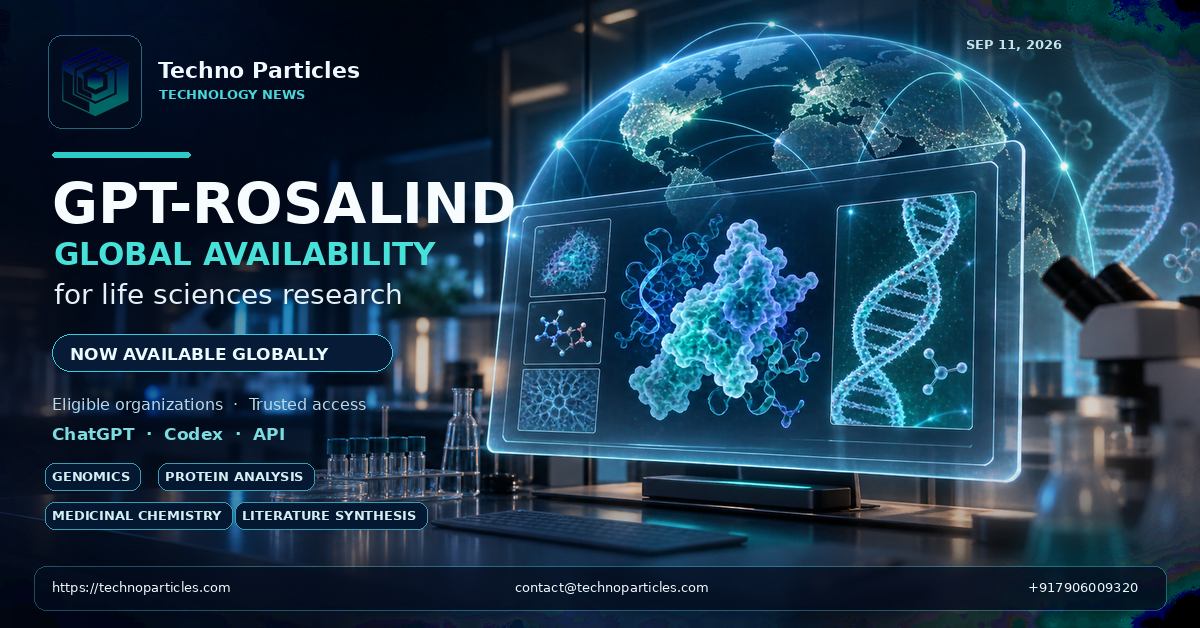
Pricing, availability limits, and deployment questions
OpenAI says published GPT-Rosalind pricing will take effect on October 5, 2026. As of the September 11 announcement, the public information emphasizes access qualification rather than a universal self-serve price list. Organizations should therefore confirm current commercial terms directly with OpenAI, especially if they need API access, enterprise seats, data controls, or a large-scale internal deployment.
The present restrictions are equally important. GPT-Rosalind is for approved research workflows, not customer-facing products or external commercial applications. An organization may be able to use the API for an internal research tool, but that does not automatically authorize a public application that gives biological recommendations to customers. Teams should confirm the permitted scope before building a production feature around the model.
Researchers should also treat model output as a starting point for investigation. GPT-Rosalind can summarize evidence, connect tools, and propose hypotheses, but it cannot establish experimental truth through language alone. Literature citations need checking. Sequence interpretations need domain review. Proposed protocols require laboratory and biosafety approval. Patient, clinical, and proprietary information needs suitable handling under the organizationâs policies and applicable regulations.
Why this matters for biotech and research teams
The larger significance of GPT-Rosalind global availability is the move toward specialized AI systems embedded in scientific workflows. General-purpose models can explain biology and help draft documents, but research teams often need something more operational: a system that can navigate databases, analyze structured and unstructured evidence, preserve intermediate results, and coordinate repeatable tasks.
For a small biotechnology company, that could reduce the time required to survey a target or organize early computational work. For a university laboratory, it could help standardize literature reviews and make analysis procedures easier to share. For a larger pharmaceutical organization, the value may come from governed access, reusable workflows, and integration with existing research infrastructure.
Indian life sciences companies and research institutions should view the announcement as an access and governance opportunity, not simply a new model launch. Before applying, teams can identify a narrow, measurable workflow, document the data involved, define expert-review checkpoints, and determine which outputs are safe to automate. A pilot focused on literature synthesis or public dataset analysis may be easier to govern than a workflow involving sensitive clinical data.
Organizations that need supporting digital infrastructure can explore Techno Particlesâ technology services, including custom systems, CMS, analytics, and automation. Its project portfolio also reflects experience across applications, AI workflows, e-commerce, and business software, although GPT-Rosalind access itself must be obtained from OpenAI.
The practical takeaway
GPT-Rosalind global availability means eligible life sciences organizations worldwide can now seek access to OpenAIâs specialized research model through approved enterprise channels. The model supports biology, drug discovery, genomics, protein analysis, medicinal chemistry, evidence synthesis, and tool-heavy research workflows across ChatGPT Enterprise, Codex, and the API.
It remains a controlled system, with access limits, governance requirements, and restrictions on customer-facing applications. Pricing is scheduled to take effect on October 5, 2026, while organizations should verify current terms during the application process.
For researchers, the most realistic expectation is not an autonomous scientist. It is a powerful assistant that can help turn fragmented evidence and data into clearer research decisions, provided experts remain responsible for validation. The organizations most likely to benefit will be those that combine GPT-Rosalind with secure data practices, transparent workflows, and disciplined scientific judgment.
Techno Particles can help businesses evaluate related AI and digital-workflow requirements through its consultation team, but the modelâs biological capabilities, eligibility, and access policies remain governed by OpenAI.
What global availability changes for research teams
The significance of GPT-Rosalind global availability is not limited to the number of countries or organizations that can request access. It may also broaden the range of research teams able to test advanced scientific assistance within their own institutional controls. Universities, biotechnology companies, pharmaceutical groups, and contract research organizations can evaluate the model against workflows that are often slowed by fragmented information, specialist terminology, and repetitive analysis.
That evaluation should begin with clearly defined tasks. A team might test whether GPT-Rosalind can organize public research papers, compare experimental methods, identify unanswered questions, or help researchers navigate large biological datasets. These trials should use representative examples and documented success criteria, such as accuracy, time saved, traceability of sources, and the amount of expert correction required. A fluent answer alone is not evidence that a scientific workflow is reliable.
Governance remains part of the product decision
Global access also makes governance more important.



Leave a comment