

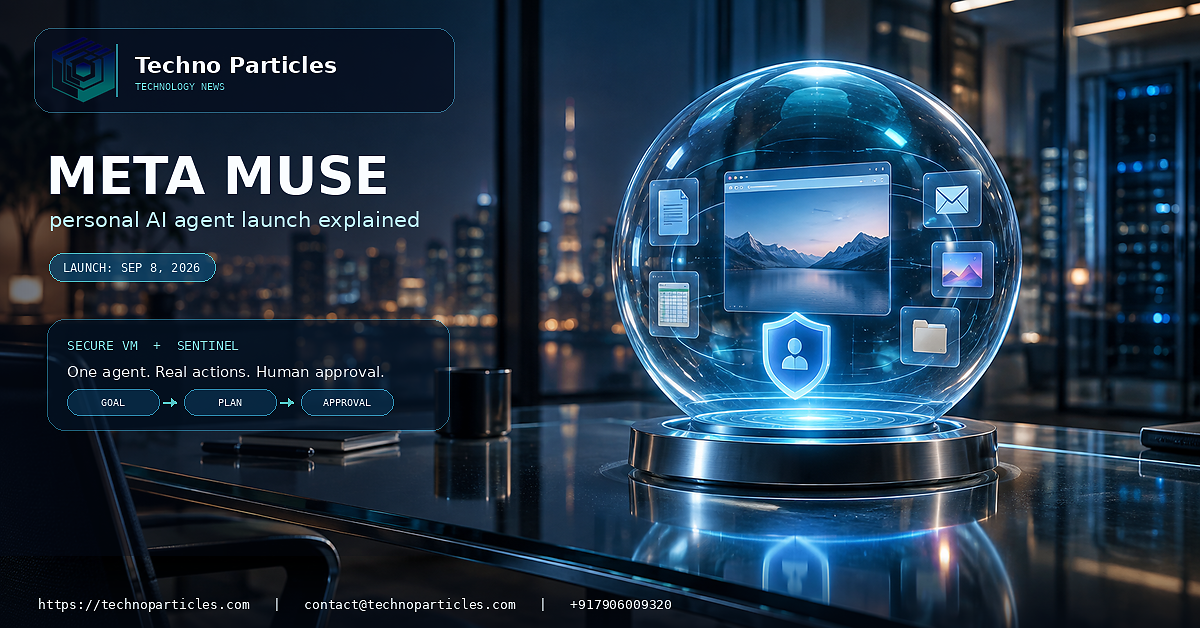
Meta Muse personal AI agent launch explained in simple terms: Meta has introduced a new kind of assistant that can do more than answer questions. Announced on September 8, 2026, Muse is designed to plan tasks, use connected services, browse the web, and continue working after a person closes the app.
Meta describes Muse as a personal AI agent built for everyday users, rather than a specialist tool for developers. The company says people can communicate with it through a standalone Muse app, WhatsApp, and the web at muse.ai. At launch, the service is rolling out in the United States on iOS and Android, with AI glasses support planned for the future.
What changed in the Meta Muse launch?
The important change is the move from conversation to action. A conventional chatbot may explain how to book travel or write an email. Muse is intended to open a browser, complete forms, coordinate several steps, and ask for approval when an action is sensitive. Meta gives examples including sending emails, booking travel, shopping, monitoring prices, and organizing reminders.
Muse can also work on broader goals. A user might ask it to create a long-term fitness plan, help establish a business, or manage a project with multiple deadlines. Meta says the agent can turn a goal into a personalized plan, coordinate time and resources, and make progress without requiring a new prompt for every step.
That background operation is one of the launchâs clearest distinctions. If a task requires research or waiting for a price change, Muse can keep working after the user leaves the app. It is expected to return when something changes or when human approval is required. This makes it closer to a digital operator than a question-and-answer assistant.
How Muse uses memory and context
Meta says Muse remembers details that matter to a person and can use them later. For example, it might turn a recipe saved on Instagram into a grocery list, suggest a dinner menu, or remember dietary restrictions before helping with invitations. These examples show why personal context is central to the product.
The benefit is convenience: users do not need to repeat preferences, schedules, or ongoing goals. The trade-off is that the agent becomes more deeply connected to personal data. Meta says users can inspect, edit, and download files stored in their Muse environment and can tell the agent to forget particular information.
For businesses, this direction could influence how customers handle routine digital work. A company might eventually use similar agents for lead research, document preparation, scheduling, or support workflows. Businesses considering such systems should first map permissions and approval points. Techno Particlesâ project consultation services can help organizations evaluate where agentic automation fits without handing an AI unnecessary control.
Why the launch matters
Meta Muse personal AI agent launch explained through its broader significance: Meta is competing in the shift toward agentic AI, where models are expected to plan and execute tasks instead of producing text alone. That shift could affect productivity software, e-commerce, travel booking, personal organization, and online marketing.
Still, Muse is a new product with a limited initial rollout. Metaâs announcement describes the architecture and intended capabilities, but it does not establish that every task will work reliably on every website or service. Users should treat the launch as an important step, not proof that fully autonomous digital work has arrived.
Meta Muse Personal AI Agent Launch Explained: What It Does - Techno Particles
Inside Muse Secure VM
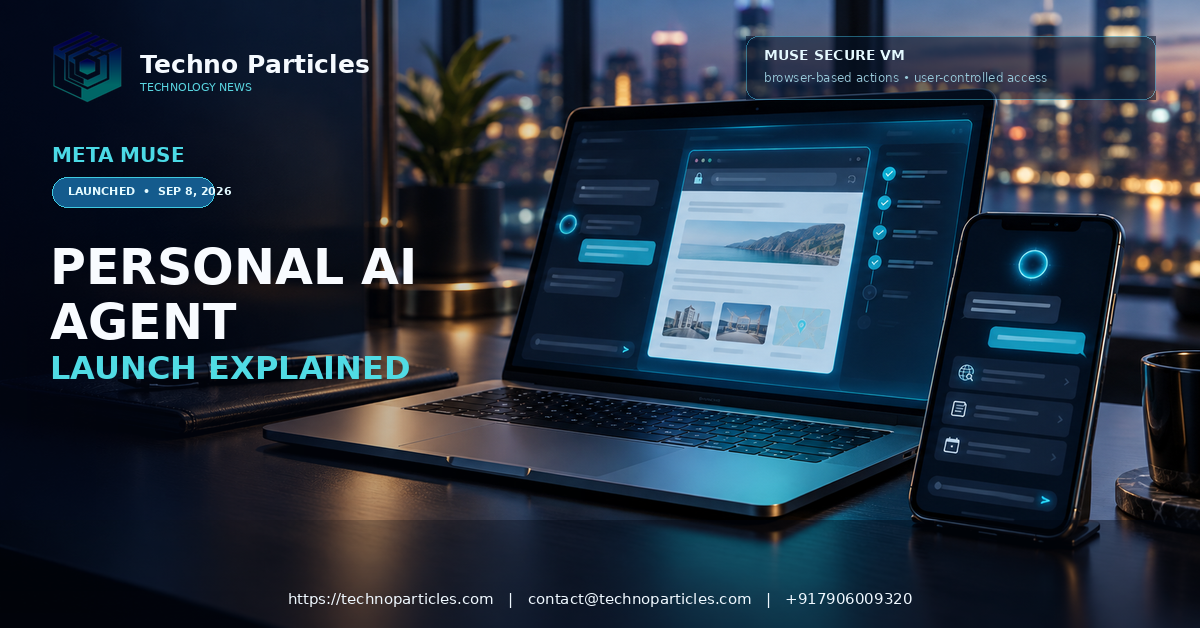
Meta built Muse around a dedicated cloud computer called Muse Secure VM. According to the companyâs technical explanation, each person receives an isolated virtual machine containing the agent, its workspace, a browser, connected-service data, and stored credentials. The design is meant to keep one userâs environment separate from other users and to give the agent enough computing resources to perform real work.
The architecture matters because an agent that can read private information and act online creates risks that ordinary chatbots do not face. A malicious instruction hidden in a webpage, document, image, or email could attempt to redirect the agent. Meta says Muse assumes the system may encounter attacks and uses several layers of protection to limit potential damage.
What is the Sentinel agent?
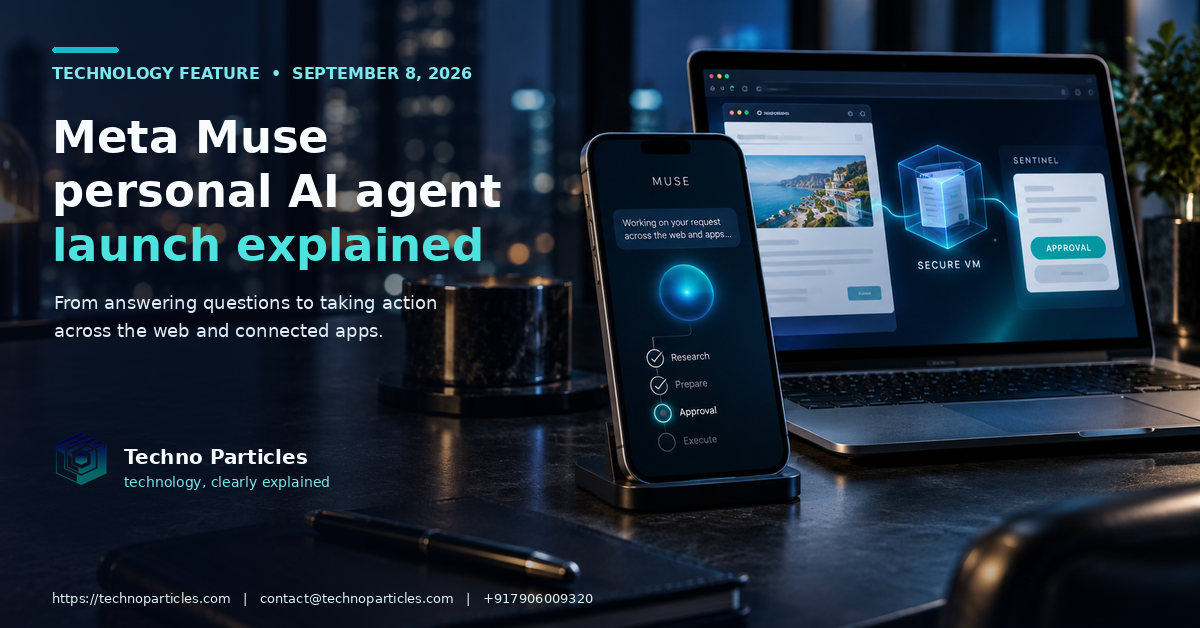
A separate component called Sentinel acts as the permission authority. Muse proposes actions, but Sentinel controls internet access and connector actions. Meta says Sentinel can request approval before activities such as sending an email or making a purchase. Permissions can be scoped by task, session, time period, or connector, depending on the action.
This separation is designed to prevent the main model from granting itself broader access. Muse is not supposed to see passwords or payment details directly. Credentials are stored outside its runtime environment, while tightly controlled services execute approved operations. Meta also says users can choose whether an email connection is read-only or allowed to send messages.
For online shopping, Meta has partnered with Stripe Link at launch. The company says Link can generate a one-time-use card so the merchant does not receive the userâs normal card details. Muse is expected to show the exact purchase information and request approval. Meta says Shop Pay support is planned, while 1Password support is also coming for existing logins.
Privacy promises and their boundaries
Meta says Muse conversations and virtual-machine data are not shared with its advertising systems. It also says users can opt out of having interactions used to train Metaâs AI models. However, the companyâs safety post makes an important qualification: the standard launch architecture does not cryptographically prevent Meta from accessing data when necessary to support, secure, or operate the service.
Meta plans to introduce Muse Confidential VM later in 2026. The proposed system would encrypt the full virtual machine with a key held only by the user, preventing Meta from accessing the contents. The company says trusted testers and external auditors are involved in the design, but this future feature should not be treated as available at launch.
Prompt injection also remains an open problem. Meta says Muse uses model training, classifiers, untrusted-content labels, browser controls, isolated execution, and human approvals. Its research team openly acknowledges that Muse can still make mistakes. That admission is significant: safety controls reduce risk, but they do not remove the need for supervision.
How developers and companies should interpret it
Museâs connector model points toward a future in which agents interact with APIs, command-line tools, browsers, and business software. Companies may need clearer permission systems, activity logs, reversible actions, and human review for high-impact changes. A CRM agent, for example, should not automatically edit every customer record simply because it can access the database.
Organizations building such workflows can start with low-risk tasks such as summarizing inquiries, preparing reports, or identifying schedule conflicts. More sensitive actions, including payments, account changes, hiring decisions, and customer communications, should remain approval-based. Techno Particlesâ application development expertise is relevant for businesses that need custom workflows around existing systems.
Companies should also prepare the surrounding digital infrastructure. Structured data, stable APIs, clear user roles, and accessible interfaces make automation more dependable. A well-planned CMS or CRM integration can give an agent controlled information to work with, while audit trails make it easier to investigate failures.
Availability, pricing, and practical limits
Meta says Muse is free for most everyday needs, with subscription plans for people who want to do more. The announcement does not provide a full pricing table, usage quotas, or a detailed comparison between free and paid plans. Those details should be checked in the product interface as availability develops.
The confirmed rollout is in the United States through iOS, Android, and muse.ai. Meta says AI glasses support is coming soon, but the company has not established a worldwide release schedule in the announcement. That means users in India and elsewhere should not assume immediate access. Availability may also vary by device, account, connected service, or staged rollout.
Technical capability does not guarantee universal compatibility. Websites can change their layouts, block automated browsing, require extra verification, or present information that is difficult for a model to interpret. A task that works on one retailer or travel site may fail on another. Users should review results, especially when money, deadlines, legal obligations, or personal reputation are involved.
How to use Meta Muse responsibly
People trying Muse should begin with tasks that are useful but easy to reverse. Asking it to organize a shopping list, summarize a calendar, research options, or prepare a draft is less risky than authorizing immediate purchases or outbound messages. Start with read access where possible, then add write permissions only after the agent behaves as expected.
Approval prompts should be treated as decision points, not routine pop-ups. Check the recipient, amount, destination, dates, and wording before allowing an action. Audit trails can help users understand what Muse attempted, what it changed, and where it may have relied on uncertain information.
Privacy settings deserve equal attention. Users should review connected apps, stored memories, training opt-out controls, and files inside the virtual machine. Sensitive documents should not be uploaded simply because the agent can process them. A personal agent is most useful when its access matches a clearly defined purpose.
What Meta Muse means for online businesses
For businesses, the launch may change how customers discover products and complete routine interactions. If agents increasingly compare prices, fill forms, schedule appointments, and purchase goods, websites will need fast performance, accurate product information, accessible forms, and dependable checkout flows. Search visibility will still matter, but businesses may also need content and interfaces that software agents can interpret correctly.
This makes technical quality part of an agentic-AI strategy. Responsive layouts, structured product data, clear navigation, secure authentication, and reliable APIs can improve both human and automated experiences. Techno Particlesâ website development services and UI/UX design services can support companies reviewing those foundations.
Marketing teams should also watch how attribution changes when an AI performs research or purchases. Brands may need stronger first-party data practices, transparent policies, and useful content that earns trust before an agent recommends an option. Search optimization remains valuable, particularly when pages answer specific questions clearly. Techno Particles provides SEO services for businesses building that discoverability.
The bottom line on the Meta Muse launch
Meta Muse personal AI agent launch explained in one sentence: Meta is introducing an assistant that can remember context, plan multi-step work, and take controlled actions across the web and connected apps. Its dedicated VM, Sentinel permission layer, credential isolation, and approval system show that Meta recognizes the security challenge of giving software real-world agency.
At the same time, the product is limited by its US rollout, evolving integrations, incomplete public pricing details, and the continuing risk of mistakes or prompt injection. The safest way to evaluate Muse is as a supervised digital operator. Let it handle repetitive research and preparation, but keep humans responsible for consequential decisions.



Leave a comment