

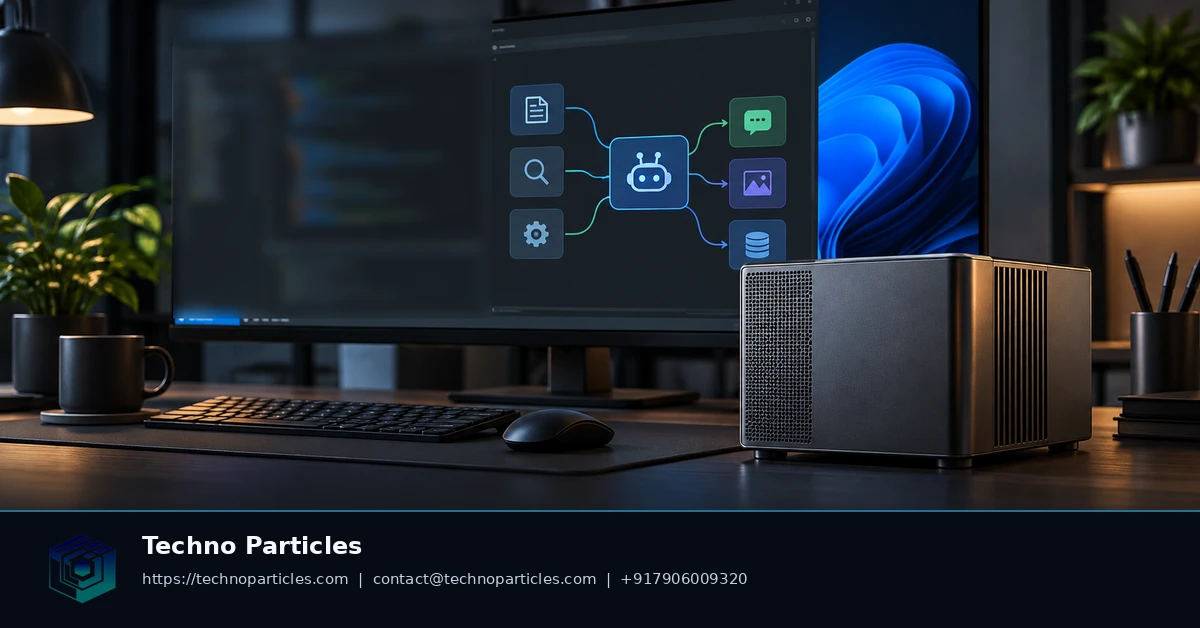
NVIDIA is bringing a new local-AI proposition to Windows developers with RTX Spark, a compact PC platform designed to run agents, models and demanding creative workloads close to the user. Announced with Microsoft on May 31, 2026, the platform combines an Arm-based 20-core Grace CPU with a Blackwell RTX GPU and up to 128GB of unified memory. NVIDIA says RTX Spark can deliver up to 1 petaflop of FP4 AI performance and handle models with as many as 120 billion parameters and up to 1 million tokens of context. These are NVIDIAâs specifications and capability claims, not independent benchmark results.
What RTX Spark means for Windows developers
The important change is not simply a faster desktop. RTX Spark is intended to provide a CUDA-compatible environment for experimenting with local coding agents, document workflows, model prototypes and privacy-sensitive business automation. Developers can keep data on a local machine for suitable tasks, while retaining the option to route selected workloads to cloud services when larger models or additional capacity are needed.
Microsoftâs Windows Experience coverage described platform-level work involving the scheduler, unified memory, Windows ML, TensorRT and Prism emulator optimizations. Together, those components are meant to make AI workloads feel more native on Windows, although actual results will depend on the specific device, software stack, thermal design and model.
Isolation and agent management are central
NVIDIAâs June 2 developer update introduced Microsoft eXecution Containers and NVIDIA OpenShell as building blocks for safer agent deployment. The tools are designed to support isolation, policy management, inference routing and personally identifiable information obfuscation. NVIDIA also reported 2x faster inference in selected llama.cpp workloads, plus further gains with vLLM; those figures come from NVIDIAâs own testing.
For businesses planning a local automation pilot, the practical starting point is a narrow workflow with clear data boundaries. Teams exploring Generative AI and agent automation services can evaluate which tasks need local execution before expanding to broader internal systems.
Where local Windows agents can help first
For developers, the strongest early use cases are controlled workflows rather than unrestricted autonomous software. An NVIDIA RTX Spark system could support a coding agent that searches a local repository, drafts tests and proposes changes without sending every file to a remote service. It can also provide a base for document classification, internal knowledge search, customer-support triage or back-office automation where privacy and predictable network access matter.
Start with a measurable pilot
A practical pilot should define the model, data sources, tools and approval boundaries before an agent is allowed to act. Teams can begin with read-only access, log every tool call and require human confirmation for emails, database updates, purchases or production deployments. That approach makes it easier to compare local inference with a cloud model on response quality, latency, operating cost and maintenance effort. Businesses planning this kind of workflow can also review AI project consultation services before connecting an agent to CRM, ERP or document systems.
- Keep sensitive files and credentials separated from the agent runtime.
- Use policy controls to restrict filesystem, network and application access.
- Provide a cloud fallback for models or tasks that exceed local capacity.
- Monitor memory use, heat, power consumption and response latency over time.
Availability still needs careful checking
NVIDIAâs October 7 event coverage positioned compact RTX Spark desktops for continuous local-agent workloads and identified partners including ASUS, Dell, HP, Lenovo, Microsoft Surface and MSI. However, availability, pricing, thermals, software compatibility and actual performance can vary by configuration. Buyers should verify the exact Windows build, driver support, memory capacity, model-serving tools and warranty terms for each system.
RTX Spark is also distinct from the Linux-oriented DGX Spark platform. That difference matters when selecting deployment instructions, container tooling and developer workflows. For Windows teams, the platformâs value will ultimately depend on whether local control and responsiveness justify the hardware investment for their specific models and automations.
NVIDIA RTX Spark Brings Local AI Agents to Windows - Techno Particles
Building NVIDIA RTX Spark local AI agents for Windows developers
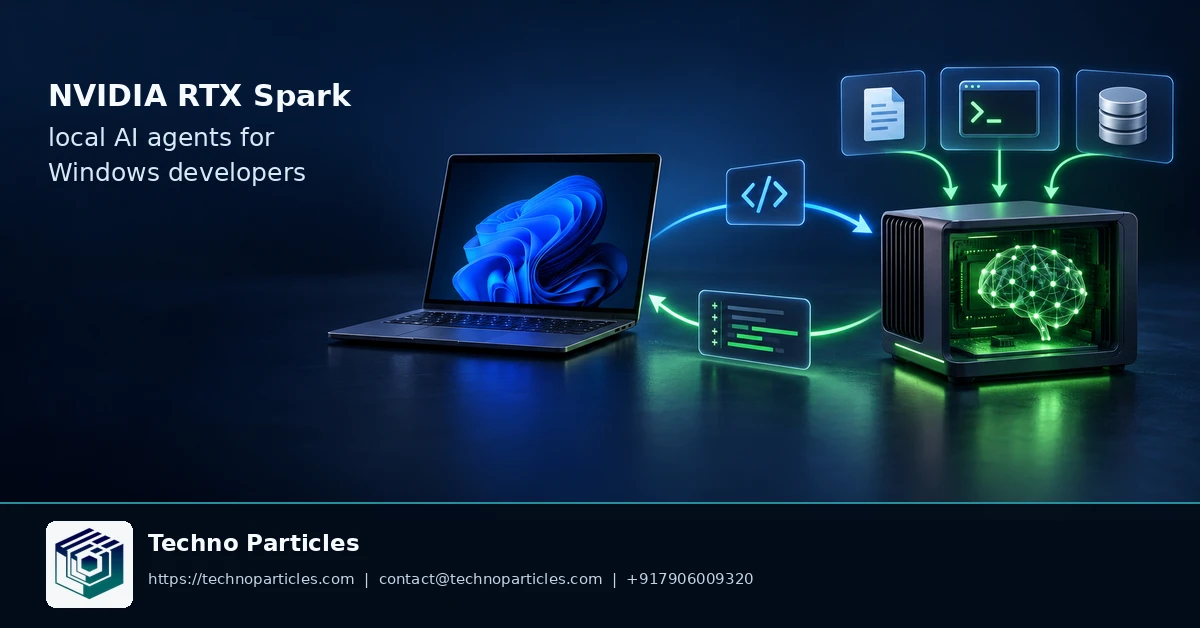
For Windows developers, the next step is turning the hardware platform into a controlled development environment. A useful architecture can keep source code, internal documents or structured business data on the local system while sending only approved prompts or summaries to a cloud model. This hybrid approach preserves flexibility when a local model cannot complete a complex task or when a team needs a larger context window than the installed configuration can comfortably serve.
Choose tools around the workflow
NVIDIA OpenShell and Microsoft eXecution Containers are relevant because an agent needs more than model access. Isolation can limit what an agent reads, changes or sends, while policy controls can define which tools are available. In practice, a coding agent might receive access to a selected repository and test command but no production credentials. A document agent could classify files in a designated folder and create draft records without being allowed to submit transactions.
NVIDIA reported that selected llama.cpp workloads ran twice as fast in its testing, with additional gains reported for vLLM. These results should be treated as vendor measurements rather than a guarantee for every model, quantization level or Windows configuration. Developers should benchmark their own prompts, batch sizes, context lengths and concurrent users before committing to a production design.
- Record first-token and complete-response latency.
- Measure memory headroom during long-context requests.
- Test recovery when a tool call fails or a model is unavailable.
- Review logs for sensitive data before enabling remote fallback.
Teams that plan to connect local agents with websites, mobile apps or internal dashboards may need an application layer for authentication, queues, audit trails and human approvals. A review of application development services can help map that layer before the agent is connected to business-critical systems.
What Windows developers should test before deployment
Developers evaluating NVIDIA RTX Spark local AI agents for Windows developers should treat the first setup as an engineering test, not a finished production platform. Begin by selecting one model and one workload, then document the required context length, tool permissions, response speed and acceptable error rate. This baseline makes it easier to determine whether local execution delivers a practical advantage over an application programming interface hosted in the cloud.
Build a controlled development loop
A reliable workflow can separate four layers: the model runtime, the agentâs tools, the business data it may access and the approval process around its actions. Keep these layers independently configurable so a model can be replaced without rewriting the entire application. Windows ML, TensorRT, llama.cpp or vLLM may suit different model formats and workloads, so compatibility should be checked against the exact GPU driver, Windows release and software package.
For coding or document automation, developers should create test cases that include incomplete instructions, malformed files and unavailable tools. They should also verify that the agent refuses requests outside its assigned scope. Local processing can reduce data movement, but it does not automatically make a workflow secure: credentials, cached prompts, logs and downloaded models still require access controls and retention policies.
- Use separate user accounts or containers for experimental agents.
- Store secrets outside prompts and source repositories.
- Require approval before external messages or irreversible changes.
- Keep an exportable audit trail for debugging and compliance reviews.
Teams extending a local agent into a customer-facing portal may need responsive interfaces, role-based access and usage monitoring around the model service. That is where SEO-aware website development services can support the surrounding product experience while the AI workload remains on the Windows system.
The platformâs longer-term value will become clearer as more models, containers and developer tools support its Windows-focused hardware path. Until then, measured pilots and configuration-specific testing remain essential.
Designing a dependable local-agent workflow
The most useful NVIDIA RTX Spark local AI agents for Windows developers will be built around clearly bounded jobs rather than unrestricted autonomy. A team might begin with repository search, test generation, document classification or internal knowledge retrieval. Each task should have a defined input, an approved tool list and a measurable result before additional actions are added.
Keep sensitive actions behind approval gates
Local inference can reduce the need to upload source code or business records, but the surrounding workflow still determines the risk. Agents may read cached files, access environment variables or write logs containing confidential information. Developers should therefore separate experimentation from production data, rotate credentials regularly and require human approval before sending messages, changing records or publishing content.
A practical pilot can use synthetic or redacted data first. Record the model version, runtime, driver configuration, prompt template and tool permissions for every test. This makes failures easier to reproduce when a Windows update, model conversion or container change affects behavior. It also helps teams compare local execution with a cloud fallback using the same evaluation set.
- Define which files and folders each agent can access.
- Limit network destinations instead of granting unrestricted browsing.
- Set timeouts and spending controls for cloud fallback.
- Review tool calls and outputs before expanding autonomy.
Plan the application layer early
Businesses connecting agents to customer portals, CRM records or internal dashboards will need authentication, permissions, monitoring and a clear escalation path. The model is only one component; queues, APIs and audit records often determine whether the system remains dependable under real workloads. Teams planning that surrounding product can explore Generative AI development services to shape an implementation around their data and approval requirements.
Because RTX Spark configurations, software support and partner availability can differ, developers should validate the exact system before standardizing on it. A measured pilot will reveal whether local responsiveness, privacy control and offline resilience justify the hardware and maintenance commitment for the intended workflow.
What NVIDIA RTX Spark local AI agents mean for Windows developers
NVIDIA RTX Spark local AI agents for Windows developers could make advanced automation easier to prototype without sending every prompt, file or codebase to a remote service. NVIDIAâs announced hardware and software stack is designed to combine CUDA-compatible acceleration, Windows ML, TensorRT and local model runtimes, while cloud services remain available when a task exceeds the systemâs capacity.
The strongest early use cases are practical and bounded: coding assistance across private repositories, document extraction, internal knowledge search, test generation and workflow orchestration. Developers can start with a small agent that reads approved files, calls a limited set of tools and produces an auditable result. They can then compare local latency, model quality, memory use and maintenance effort with a cloud-based implementation.
Local does not mean automatic
Running an agent on a Windows PC may improve privacy and reduce dependence on network connectivity, but it does not remove operational risk. Access permissions, model updates, prompt injection, corrupted documents and unsafe tool calls still require safeguards. A dependable deployment should use isolated environments, restricted folders, explicit network rules and human approval for actions such as sending email, changing records or publishing content.

Leave a comment