

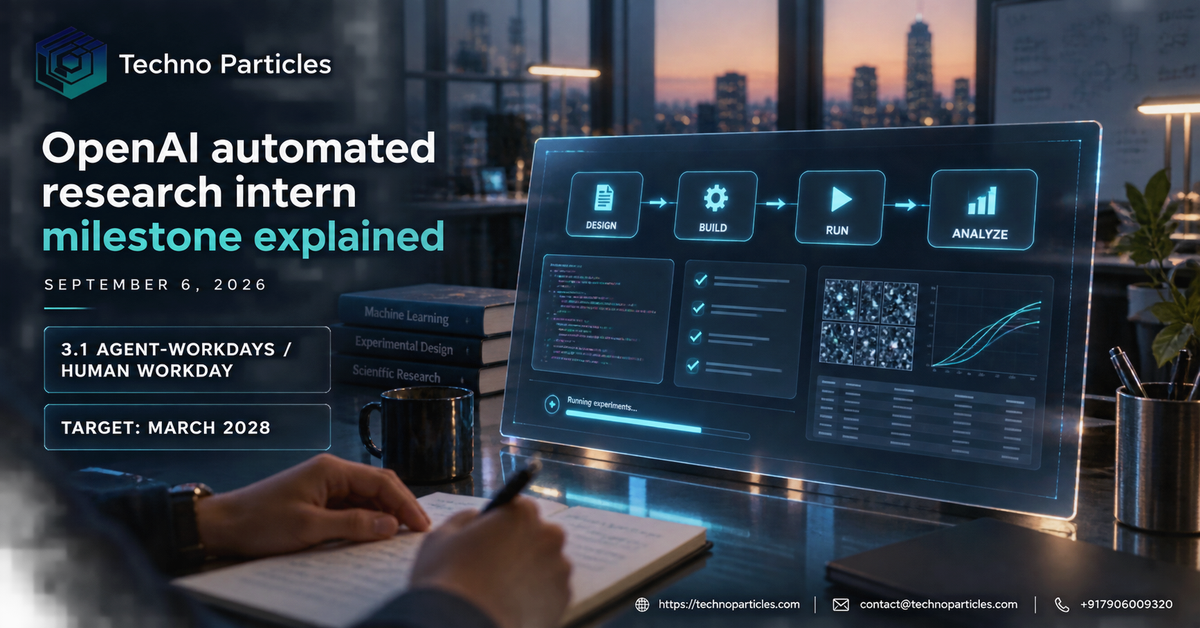
OpenAI says it has reached an internal milestone that once sounded like a distant forecast: an automated research intern. In a September 6, 2026 update, the company said its systems can now carry out well-defined research tasks under human direction, including assignments that could take a skilled researcher several days.
The announcement is important, but it needs careful interpretation. OpenAI has not introduced a public product called Research Intern, published a standalone benchmark proving that an AI can independently conduct science, or claimed that human researchers are no longer needed. The milestone describes an internal capability and workflow built around coding agents, research tools, human supervision, and repeated experiments.
OpenAI also said it is making progress toward a more ambitious goal: an automated AI researcher by March 2028. That future system would need to do much more than complete assigned tasks. It would need to help choose meaningful problems, design experiments, assess evidence, communicate results, and operate reliably over long periods.
What the automated research intern milestone means
OpenAI defines a research intern as a system that can complete a bounded assignment specified by a person. The task might involve writing code, running experiments, analyzing outputs, investigating a technical question, or preparing material for a researcher to review. The key phrase is âunder human direction.â People still set priorities, establish the problem, judge whether the result is useful, and decide what happens next.
This makes the milestone narrower than the phrase automated researcher may suggest. It is closer to adding a capable software collaborator to a laboratory or engineering team than to creating a completely independent scientist. An agent can take responsibility for a substantial piece of work without owning the entire research agenda.
The distinction matters because research contains several different kinds of difficulty. Running code or searching a large set of documents can be automated more readily than deciding which unanswered question deserves months of effort. Producing a plausible result is also easier than determining whether the result is correct, reproducible, original, and important.
Why OpenAI considers this a significant change
OpenAIâs update describes a shift in how its own researchers work. The company says researchers now use coding agents throughout the day, often in concurrent sessions. Agents are handling more complex tasks, succeeding more often, and helping teams write code and run experiments faster.
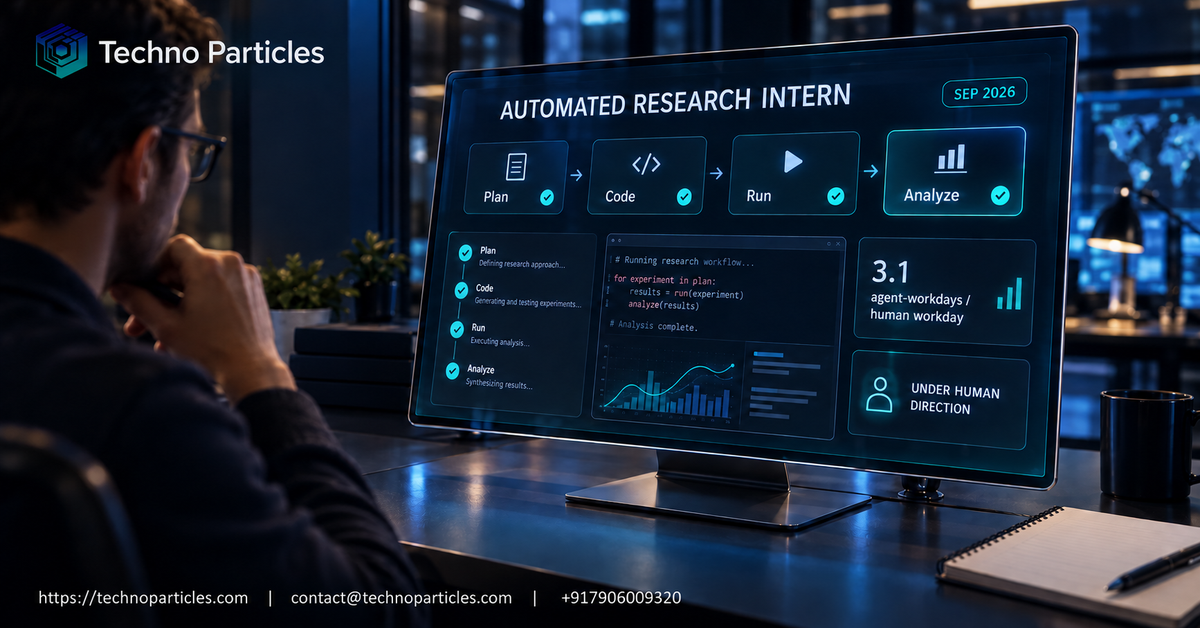
The company reported that, by mid-August 2026, its research organization was using the equivalent of 3.1 agent-workdays for every human researcher workday. This is an internal usage measure, not a claim that agents deliver 3.1 times the scientific output. Runtime can include failed attempts, repeated experiments, waiting periods, and work that still requires substantial human correction.
Even with that limitation, the figure shows how agentic systems are becoming part of an operating process rather than occasional chat assistants. For organizations building software, analytics, or AI products, the practical lesson is that productivity gains may come from orchestrating many supervised tasks instead of asking one model to solve an entire project in a single response.
Businesses exploring similar workflows can review generative AI development services and application development options when evaluating internal automation.
OpenAI Automated Research Intern Milestone Explained: What Changed - Techno Particles
How the system fits into the research lifecycle
OpenAIâs update uses a research lifecycle that can be understood as six connected stages: deciding what to study, designing an approach, building the required software, running experiments, analyzing results, and communicating findings. Agents appear to be increasingly useful across the execution-heavy stages, especially coding, experiment management, and analysis.
Human involvement remains especially important at the beginning and end. A person may need to decide whether a proposed problem is strategically valuable, whether the available evidence supports a conclusion, and whether a surprising result reflects a genuine discovery or a mistake in the setup. Those judgments are difficult to reduce to simple instructions.
This division of work explains why the intern label is useful. An intern can make meaningful progress on an assigned project while still working inside a structure created by more experienced researchers. The system may generate implementation ideas, compare approaches, inspect logs, or summarize experimental outcomes, but a human remains accountable for the research direction and final interpretation.
What the milestone does not prove
The announcement does not prove that OpenAI has solved hallucinations, evaluation, alignment, or autonomous scientific reasoning. It also does not establish that every task completed by an agent is reliable without review. OpenAI describes its own measurements and observations, but the update is not an independent audit or a public benchmark with standardized tasks and reproducible scores.
The 3.1 agent-workday figure should therefore be read as evidence of intensive internal adoption, not as a universal productivity guarantee. A company with strong infrastructure, specialized tools, private data, experienced researchers, and large computing resources may achieve results that smaller teams cannot reproduce immediately.
There are also practical limits. Agents can misunderstand an objective, use an unsuitable method, overfit to a test, misread noisy data, or produce code that appears correct while failing in unusual cases. Long-running workflows create more opportunities for small errors to compound. Human review is not merely a ceremonial final step; it is part of the control system.
Why the safety discussion is central
OpenAI frames automated research as a possible way to accelerate progress in deep learning and alignment. Faster research could help create better safeguards, but greater capability also creates new risks. If agents can write and test increasingly powerful systems, mistakes may scale faster than before. Access controls, monitoring, sandboxing, audit logs, and carefully defined permissions become essential.
The company has also acknowledged that rapid recursive self-improvement is not automatically an outcome that society should pursue. That position highlights a tension at the center of the announcement: the same tools that might improve safety research could also increase the speed at which frontier systems are developed.
For developers and business leaders, this means automation should be designed around accountability. Clear task boundaries, approval gates, data restrictions, reversible actions, and human escalation paths are more important than simply giving an agent broader access.
Teams planning these systems can combine SEO-aware website development with custom dashboards, secure backends, and project consultation to define where automation is genuinely useful.
How this differs from public research assistants
Public tools such as deep-research assistants can browse sources, synthesize information, and produce cited reports. The automated research intern described by OpenAI is broader in workflow terms. It is aimed at internal technical research and may interact with code, experiments, repositories, and specialized infrastructure.
That does not necessarily make it a better everyday research product. A public assistant is optimized for accessibility and user-facing reporting, while an internal agent can be configured around a laboratoryâs tools and permissions. The two categories overlap, but they solve different problems.
What the milestone means for developers and businesses
The OpenAI automated research intern milestone matters beyond frontier AI laboratories because it illustrates a likely direction for knowledge work. Instead of treating AI as a chatbot that answers one question at a time, organizations may use agents as supervised workers inside repeatable processes.
A product team could ask an agent to inspect support data, identify recurring defects, draft test cases, and prepare a report for an engineer. A marketing team might use a controlled workflow to compare campaign results, organize customer feedback, and suggest experiments. An operations group could connect documents, forms, and analytics so that routine investigations produce structured outputs for review.
These examples are not claims about a public OpenAI feature. They are reasonable applications of the broader agent pattern described in the companyâs announcement. Success depends on the quality of the data, the clarity of the task, the integration architecture, and the review process.
For Indian SMEs and growing companies, the practical starting point is usually narrower than an autonomous research lab. A secure lead pipeline, reporting dashboard, content workflow, or internal knowledge assistant can create measurable value without giving an AI unrestricted control over business systems. CMS solutions, employee management systems, and lead management systems can all benefit from carefully scoped automation.
What to watch next
The next meaningful evidence will be more detailed evaluation. Observers will want to know which tasks agents complete, how often humans intervene, how results are checked, how much compute is required, and whether the work generalizes beyond OpenAIâs internal environment. Public examples and reproducible tests would make the milestone easier to compare with other research agents.
OpenAIâs March 2028 target for an automated AI researcher is also a roadmap goal, not a guaranteed delivery date. Reaching it would require progress in long-horizon planning, memory, tool use, scientific judgment, evaluation, and safety. It would also require answers to governance questions about who controls such systems and how their outputs are verified.
OpenAI automated research intern milestone explained in one takeaway
The simplest explanation is this: OpenAI says its internal agents can now complete well-defined, multi-day research assignments under human supervision. That is a meaningful step in research automation, but it is not proof of a fully autonomous scientist, a public product launch, or the end of human expertise.
The milestone shows where advanced AI development is heading. People may increasingly define goals, review evidence, and manage risk while agents handle more of the coding, experimentation, analysis, and documentation between those decisions. For businesses, the opportunity is real, but it should be approached as workflow engineering rather than magic.
Organizations considering adoption should begin with tasks that are measurable, reversible, and easy to review. They should protect confidential data, record agent actions, test outputs against known results, and keep a human owner responsible for consequential decisions. Businesses that need help connecting AI with websites, applications, analytics, or digital workflows can explore Techno Particles services and its project portfolio.
OpenAIâs announcement is best understood as a capability milestone inside a supervised research system. Its importance will ultimately depend not on the label âintern,â but on whether these agents can produce reliable, reproducible, and valuable work while remaining understandable and controllable. That is the standard that will determine whether automated research becomes a durable advantage or simply another impressive demonstration.
What the milestone could change for research teams
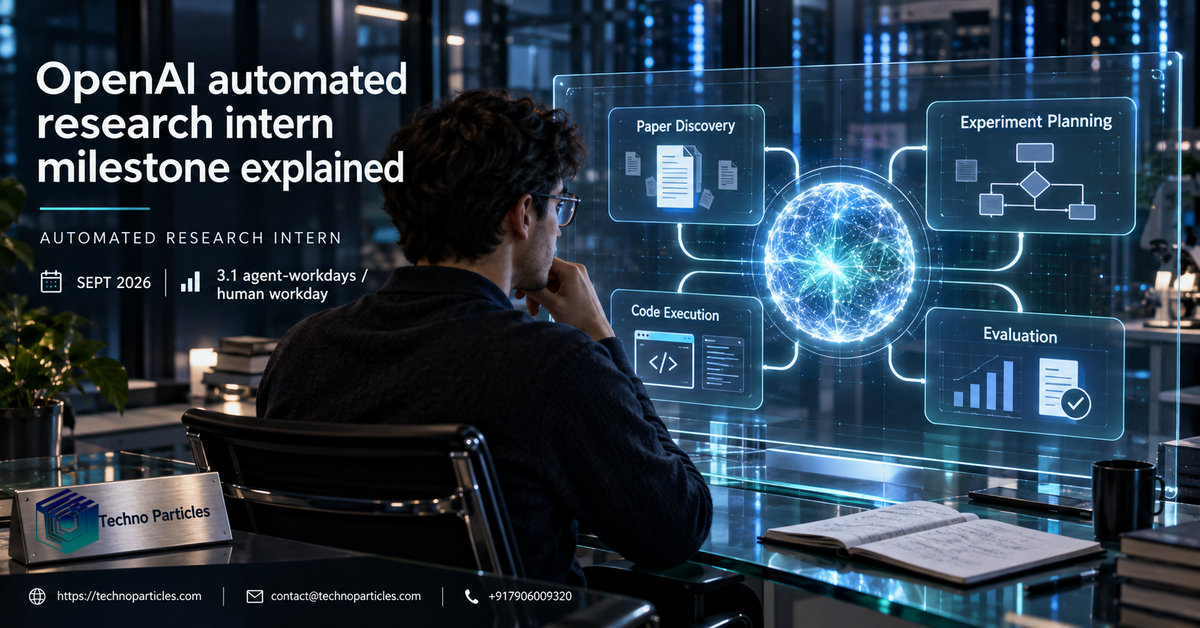
The practical importance of the automated research intern milestone lies in how it may redistribute work inside an engineering or science organization. A capable agent could take a broad assignment, divide it into smaller questions, search available documentation, write and run code, compare results, and prepare a report for review. Human researchers would still define the objective and judge the significance of the findings, but they might spend less time on repetitive investigation and more time on experimental design and interpretation.
This model could be especially useful when a project involves many small iterations. For example, an agent might test several implementation approaches, identify recurring errors, organize experiment logs, and highlight the results that deserve closer attention. The value would not come from one spectacular answer.

Leave a comment