

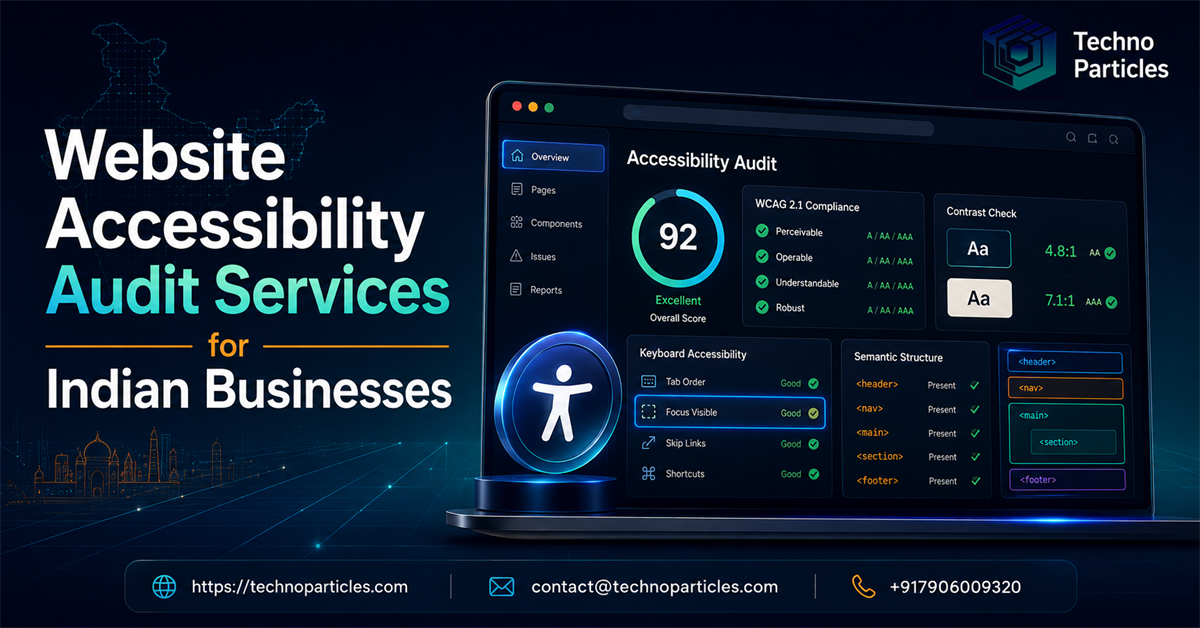
Digital access should not depend on a visitorâs ability, device, connection, or preferred way of navigating the web. Website accessibility audit services for Indian businesses help identify barriers that can prevent people from reading content, completing forms, purchasing products, or contacting a company. A thoughtful audit turns accessibility from a technical afterthought into a practical part of website quality.
For Indian organisations, accessibility matters across multilingual audiences, mobile-first users, older customers, people using assistive technology, and visitors browsing in challenging network conditions. An accessible website is generally easier for everyone to use, including people who rely on keyboard navigation, screen readers, captions, zoom, voice input, or high-contrast settings.
What a website accessibility audit examines
An accessibility audit is a structured review of a websiteâs content, design, code, and user journeys. Automated tools can detect certain issues, such as missing alternative text or poor colour contrast, but they cannot understand every interaction. A reliable audit combines automated scanning, manual testing, and human review.
Navigation and page structure
Auditors review heading order, landmark regions, menus, skip links, page titles, focus indicators, and the consistency of navigation. Visitors should be able to understand where they are and move through a page without relying on a mouse. Clear structure also helps search engines interpret content and helps users scan information quickly.
Content and visual presentation
The review covers image descriptions, link text, colour contrast, text resizing, readable typography, spacing, video captions, and instructions. Important meaning should never be communicated through colour alone. Content should remain understandable when users enlarge text, change browser settings, or apply a custom colour scheme.
Forms and interactive features
Forms are often where accessibility problems become business problems. An audit checks whether fields have clear labels, required states are announced, errors are explained in text, and users can correct mistakes without losing their entries. Buttons, accordions, modals, carousels, filters, and other controls should expose their purpose and state to assistive technology.
Techno Particles can support this work through responsive website development that considers structure, performance, and inclusive user journeys from the beginning. For an existing website, findings can be translated into an improvement roadmap rather than treated as an isolated compliance document.
Why accessibility deserves business attention
Accessibility expands the number of people who can use a website successfully. It can also improve clarity, mobile usability, content quality, and conversion paths for the wider audience. A customer struggling with a tiny tap target or unclear error message may not identify the issue as an accessibility problem; they may simply leave.
Accessible practices can strengthen trust. When visitors can find information, compare products, submit enquiries, and complete payments with fewer obstacles, the organisation communicates care and professionalism. Accessibility is especially relevant to education, healthcare, public-facing services, e-commerce, finance, travel, and professional services, where digital interactions may be essential rather than optional.
Accessibility should be approached as an ongoing quality discipline. New campaigns, plugins, product pages, PDFs, videos, and application features can introduce fresh barriers. Regular reviews and a clear ownership process help keep improvements active after the first audit is complete.
Website Accessibility Audit Services for Indian Businesses - Techno Particles
How an accessibility audit works
A useful audit begins with context. The reviewer needs to understand the websiteâs goals, audience, technology stack, content workflow, and most important user journeys. A product catalogue, an education portal, and a lead-generation website may have different risks even when they use similar templates.
1. Scope and discovery
The first stage defines the pages and interactions to be tested. This may include the homepage, navigation, search, category pages, service pages, contact forms, account areas, checkout, booking flows, downloadable documents, and responsive layouts. Prioritising high-value journeys makes the audit more actionable when a website is large.
2. Automated checks
Scanning tools can review many pages quickly for common technical patterns. They may flag missing alternative text, duplicate identifiers, insufficient contrast, form-label problems, invalid attributes, and some keyboard or landmark issues. Automated results are useful signals, but every result requires interpretation. A tool may report an image issue even when the image is decorative, or miss a poor experience that depends on timing and context.
3. Manual keyboard testing
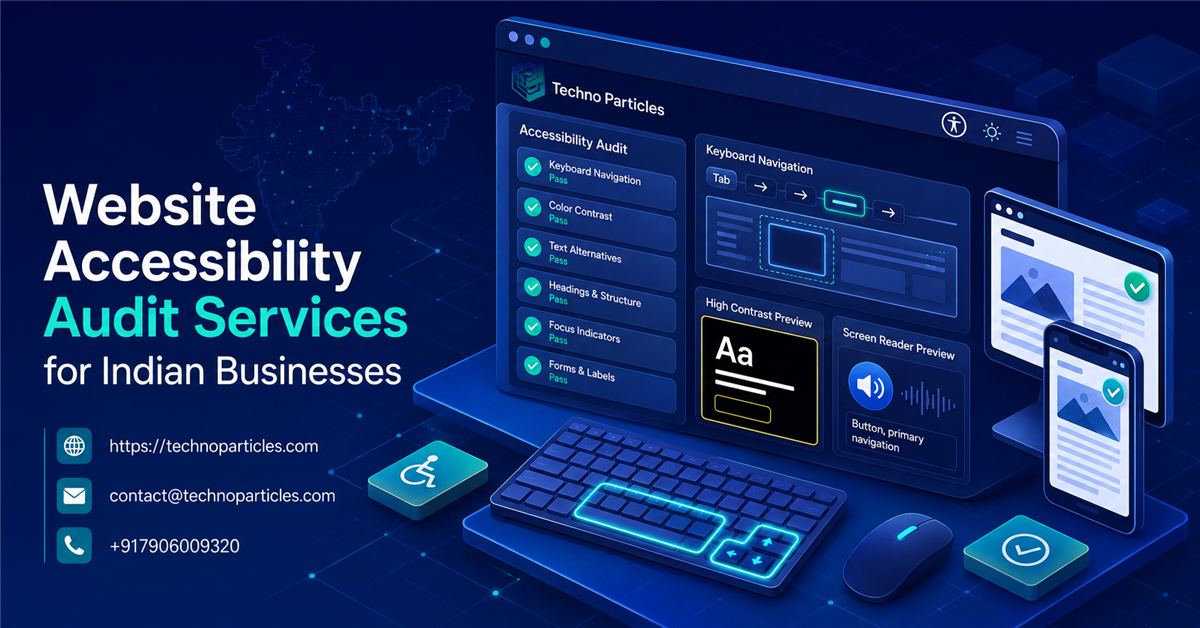
Manual testing checks whether users can operate the site with a keyboard or keyboard-like input. Reviewers move through menus, fields, dialogs, sliders, filters, and checkout controls using Tab, Shift+Tab, Enter, Space, and arrow keys. They look for lost focus, invisible focus states, trapped focus, unexpected scrolling, and controls that cannot be reached.
4. Screen reader and responsive testing
Testing with screen readers helps reveal whether headings, labels, instructions, status messages, and control states are announced in a meaningful order. Responsive checks examine zoom, small screens, orientation changes, text reflow, touch targets, and horizontal scrolling. These tests are important for Indian users who may access services primarily through smartphones.
5. Reporting and prioritisation
A good report explains each issue in plain language, identifies the affected page or component, describes the user impact, references the relevant accessibility principle, and recommends a practical fix. Findings should be prioritised by severity, frequency, business importance, and implementation effort. A clear distinction between critical blockers, significant barriers, and enhancements helps teams plan sensibly.
Common issues found on Indian business websites
Many accessibility barriers are connected to everyday website practices. Images may be uploaded without useful alternative text, while banners may contain text that disappears for users who cannot see the image. Developers may create visually attractive headings with generic containers instead of semantic heading elements. These choices affect both accessibility and content comprehension.
Other frequent issues include low contrast in brand colours, placeholder-only form labels, links such as âread moreâ without context, menus that work only on hover, and pop-ups that cannot be closed from a keyboard. Videos may lack captions, automatic sliders may move too quickly, and error messages may be displayed visually without being announced.
Third-party tools also deserve attention. Chat widgets, payment gateways, maps, booking systems, cookie notices, and social media embeds can create barriers beyond the core website code. The audit should record where an external component affects a key journey and whether a more accessible configuration or alternative is available.
When redesign or remediation involves complex flows, UI/UX design support can help connect technical corrections with clearer layouts, content hierarchy, and user research. For organisations managing frequent updates, a suitable CMS implementation can also include editorial guidance for accessible publishing.
Accessibility and search performance
Accessibility and SEO are not identical, but they often benefit from the same foundations: meaningful headings, descriptive links, text alternatives, logical content, fast performance, and mobile-friendly layouts. Improving these fundamentals can make a website easier for people and search engines to understand. It is important, however, not to claim that accessibility alone guarantees rankings.
Turning audit findings into an improvement plan
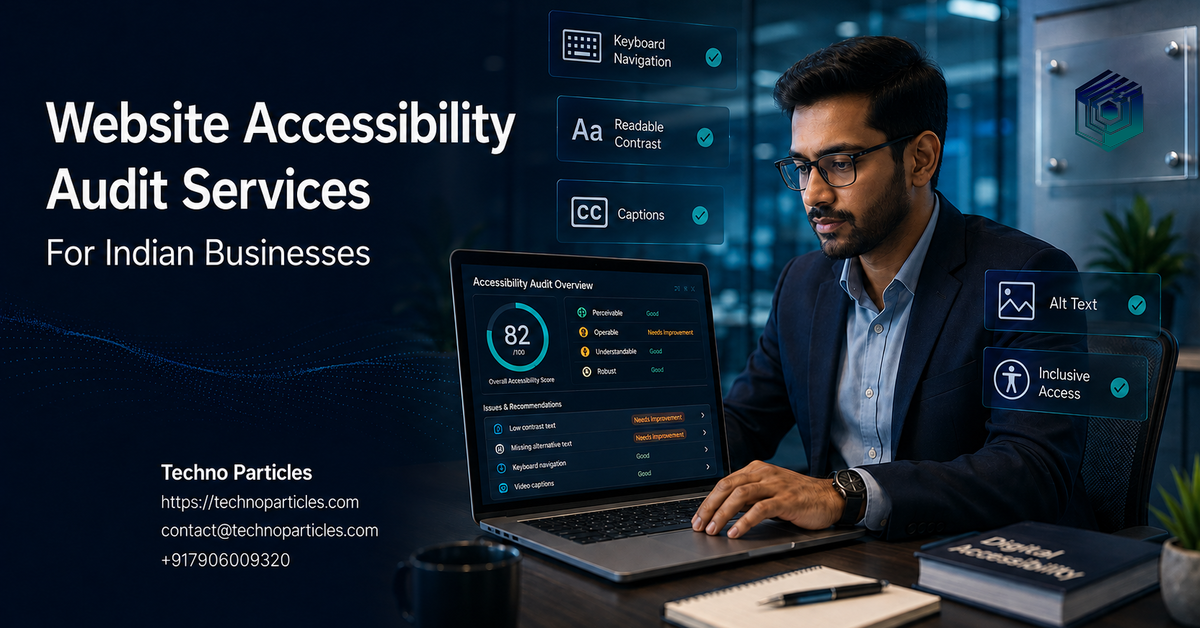
The value of website accessibility audit services for Indian businesses is measured by what happens after the report. Remediation should begin with the issues that block essential tasks, such as submitting a lead form, accessing a service description, signing in, making a payment, or completing a booking. These fixes can often deliver immediate improvements to both user experience and business continuity.
Build a prioritised backlog
Convert findings into development tasks with clear acceptance criteria. A task might require a visible focus indicator across all interactive elements, a correctly associated label for each input, or an accessible name and state for a custom menu. Assign owners, record affected templates, and track verification status so that improvements do not disappear into a general maintenance queue.
Improve the design system
Repeated components should be corrected at their source. Buttons, cards, forms, alerts, tables, navigation bars, and modal windows need reusable patterns with accessible states. A design system can document contrast requirements, typography, spacing, focus treatment, error messaging, and interaction behaviour. This reduces the risk of solving the same problem differently on every page.
Strengthen content operations
Editors and marketers need practical publishing rules. These may cover writing descriptive link text, adding useful image alternatives, captioning video, structuring headings, avoiding colour-only instructions, and checking documents before uploading them. Short training and review checklists can prevent recurring issues without making content production unnecessarily slow.
Retest and monitor
After remediation, the affected journeys should be tested again. Retesting confirms whether the issue is actually resolved and whether the fix introduced a new problem. Accessibility should also be included in quality assurance for future releases, redesigns, campaigns, and third-party integrations. A periodic audit is valuable when a website changes frequently or supports important customer transactions.
Choosing the right audit partner
Look for a partner that combines technical knowledge with practical communication. The provider should be able to review source code, content, responsive behaviour, forms, third-party integrations, and real user journeys. Ask whether the process includes manual testing, how findings are prioritised, and whether the team can help with remediation and verification.
The best engagement is collaborative. Designers, developers, content teams, marketing managers, and business owners should understand why a change matters and how it affects their work. A report full of unexplained tool output may look thorough but can be difficult to act on. Clear examples, reproducible steps, and implementation guidance create much more value.
Techno Particles supports businesses with website, application, SEO, digital marketing, and user-experience services. Its broader digital services team can help organisations connect accessibility improvements with performance, conversion, content, and maintainability. Businesses planning a larger digital change can also use project consultation to define priorities, risks, and a realistic delivery sequence.
Frequently asked questions
Is an automated scan enough?
No. Automated tools identify common detectable patterns, but they cannot fully judge wording, interaction logic, focus order, timing, or whether a control is understandable. Manual and assistive-technology testing are necessary for a more dependable assessment.
Should a small business invest in an audit?
Yes, particularly when the website generates leads, accepts payments, provides essential information, or serves a broad public audience. A focused review of critical journeys may be a practical starting point for a smaller site.
Does accessibility apply only to people with disabilities?
No. Captions help people in quiet or noisy environments, keyboard access helps users with temporary injuries, clear forms help everyone avoid mistakes, and readable layouts support visitors on small screens or slow connections.
Conclusion
Website accessibility audit services for Indian businesses provide a structured way to uncover digital barriers and turn them into measurable improvements. By combining automated checks, manual review, assistive-technology testing, clear prioritisation, and ongoing quality assurance, organisations can create websites that are more inclusive, usable, and trustworthy. Accessibility is not a single checkbox; it is a practical commitment to helping every visitor complete the task they came to do.
For organisations ready to review their digital experience, explore SEO and website improvement services or start a conversation with Techno Particles about your websiteâs accessibility goals.



Leave a comment