

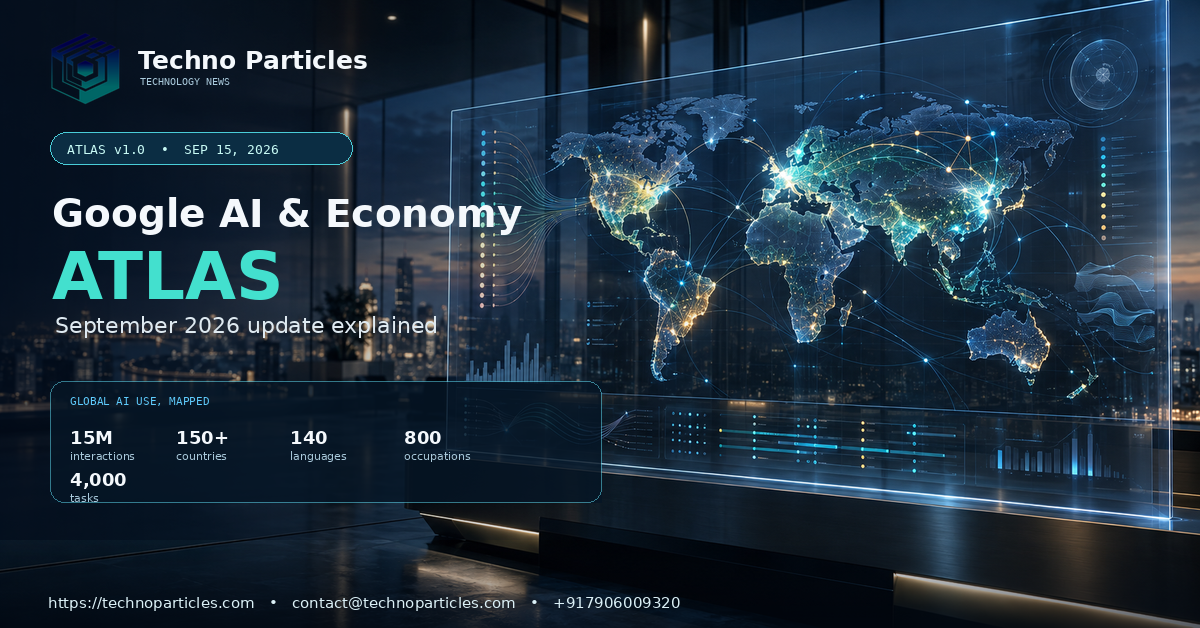
Googleâs AI Economy ATLAS September 2026 update adds a more practical view of how artificial intelligence is being used across jobs, countries, homes, laboratories, and creative industries. The company has launched new interactive data visualizations and published research with Google DeepMind and MIT FutureTech, giving users a way to explore millions of aggregated and de-identified AI activity points.
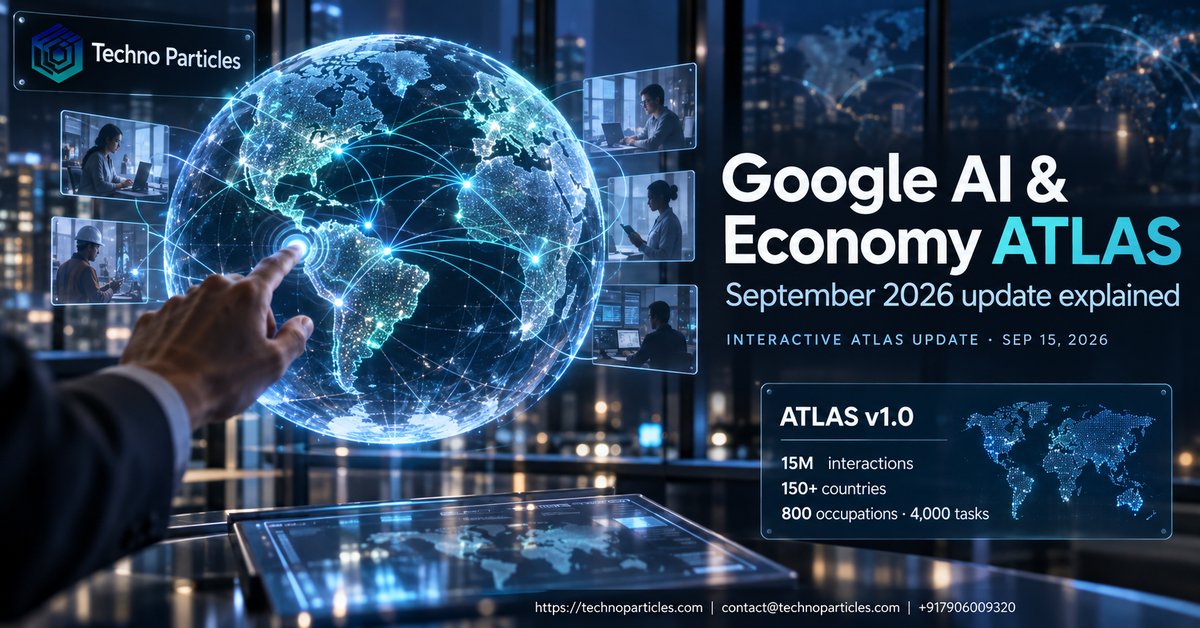
The update matters because public AI discussions often focus on future predictions, investment totals, or benchmark scores. ATLAS looks at observed usage instead. Google says its first dataset covers 15 million human-AI interactions from the Gemini App, AI Mode, and Gemini API. The data spans more than 150 countries, 140 languages, 800 occupations, and 4,000 tasks.
Google describes ATLAS as an ongoing Activity, Task, Landscape, and Adoption Study. It is not a complete census of all AI use. It mainly reflects activity connected with selected Google AI products, while important services such as Google Workspace, Gemini Enterprise, and some enterprise platforms are not fully represented. That distinction is essential when interpreting the results.
What changed in the September update?
The biggest change is access. Googleâs initial ATLAS report, published in July 2026, presented a high-level analysis of how people used AI at work and in daily life. The September update adds an open-access interactive experience. Users can examine adoption by country, occupation, task, and type of activity instead of relying only on headline findings.
The new visual approach makes ATLAS more useful for researchers, policymakers, business leaders, educators, and technology teams. A company can investigate whether AI activity in its industry is mainly related to information retrieval, writing, planning, troubleshooting, learning, design, or other forms of collaboration. The tool can also encourage better questions about where adoption is growing and where implementation remains limited.
Google also highlighted Indiaâs creative economy. In the companyâs analysis, arts, design, entertainment, sports, and media occupations account for 19% of work-related AI usage in India, described as 1.6 times the global average. This does not mean that every creative worker uses AI, nor that AI has replaced creative work. It indicates that these categories form a comparatively large share of observed AI activity.
The United States shows a different pattern. Computer and mathematical occupations account for 30% of work-related AI usage there, according to Google, which is twice the share seen in the rest of the world. The contrast suggests that adoption is shaped by local industries, digital infrastructure, education, income, and the kinds of work common in each economy.
ATLAS also identifies differences outside conventional office work. Google reports that real-time equipment diagnostics and troubleshooting represent 7% of work-related AI usage in Brazil and Germany, compared with 4% in Japan. Such examples are important because they show AI being used as a practical assistant for physical or technical work, not only as a writing tool.
For Indian businesses, the update offers a useful reminder that AI adoption is not limited to large software companies. Designers, marketing teams, educators, exporters, retailers, and service providers can all use AI for research, customer communication, content development, analysis, and workflow support. However, the data should guide questions rather than act as a ready-made implementation plan.
Businesses considering new AI projects can begin by reviewing their repetitive tasks, information bottlenecks, quality risks, and approval requirements. A carefully designed AI project consultation can then connect those needs with suitable automation, custom software, or human review.
Google AI Economy ATLAS September 2026 Update Explained - Techno Particles
What does ATLAS reveal about workplace AI?
The central message from Googleâs earlier ATLAS research remains visible in the September update: workplace AI use is broad, but often shallow. Google reported that AI activity appeared across 68% of occupations representing 90% of total United States employment. Yet in a typical job, AI was used for only about 21% of tasks in the dataset.
This finding challenges two simple assumptions. The first is that AI is relevant only to a small group of technical professionals. The second is that broad adoption automatically means that entire occupations are being automated. The ATLAS evidence points to a more incremental pattern. People frequently use AI for selected activities while continuing to perform the wider job themselves.
Google categorized most workplace interactions as collaborative or assistive. Common examples include ideation, strategy, information retrieval, learning, drafting, iteration, and troubleshooting. These activities can improve speed or reduce friction, but they still require judgment. A worker may ask an AI system to summarize information, suggest alternatives, or explain a technical problem before checking the result and making a final decision.
In the report, creative design and hypothesis testing were especially prominent categories. Google said these non-routine cognitive tasks represented 65% of work-related AI interactions, compared with 35% of tasks in the wider economy. The comparison suggests that people may be experimenting with AI most actively in areas where generating possibilities, evaluating options, and refining ideas are already part of the work.
That pattern has practical consequences for employers. Buying an AI subscription is unlikely to transform a business by itself. The more important work involves identifying a process, defining acceptable output, assigning responsibility, and connecting AI assistance to existing systems. A sales team might use AI to classify leads, but still need a reliable CRM, clear qualification rules, and human approval before outreach.
Similarly, an e-commerce company may use AI to produce product descriptions, but it still needs accurate specifications, brand guidance, search optimization, and review procedures. Businesses building these workflows can combine CMS development, SEO strategy, and automation rather than treating generative AI as a standalone feature.
What the science findings add
The September 2026 update also presents research from Google, Google DeepMind, and MIT FutureTech about how scientists use AI. The work analyzes 2,600 specialized AI models and survey responses from more than 600 scientists in the United States and United Kingdom. Google says nearly half of surveyed scientists use some form of AI every day.
The research distinguishes between large language models and specialized models. LLMs such as Gemini are used across many scientific fields and task categories. Specialized systems appear relatively more common in health and life sciences, as well as domain-specific prediction, generation, and simulation work. This suggests that the future of scientific AI is likely to involve several model types working together.
Scientists reported saving just under seven hours per week through AI, according to Googleâs summary. That time can support literature review, coding, documentation, analysis, and other research activities. However, time saved at one stage can create pressure elsewhere. Researchers may generate hypotheses faster than laboratories, clinical studies, or field experiments can test them.
Google therefore describes new bottlenecks in the research pipeline. Validation remains essential, and physical experimentation cannot always accelerate at the same rate as digital idea generation. The lesson applies beyond science: faster content, code, or analysis can increase the need for review, testing, compliance checks, and operational capacity.
For developers and product teams, the science findings support a balanced approach. AI can increase the number of ideas a team explores, but quality depends on selecting the right inputs, monitoring outputs, and preserving human accountability. Teams that document these stages are more likely to gain repeatable value from AI.
Limitations, access, and why the update matters
ATLAS is valuable because it is based on large-scale observed interactions, but it has clear limitations. It does not represent every AI system, every country equally, or every business workflow. Googleâs products have particular user groups and distribution patterns. The dataset also reflects what people do with selected tools, not necessarily the full economic value created by those activities.
The research is also observational. A high share of AI usage in an occupation does not prove that AI caused productivity growth, increased wages, reduced employment, or improved outcomes. It shows that people are using AI in certain ways. Measuring long-term effects will require additional studies, business data, worker surveys, and economic analysis.
Privacy is another important part of Googleâs description. The company says ATLAS uses aggregated and de-identified interactions. That reduces direct identification risk, but readers should still understand that the study is built from product usage data. Businesses deploying AI internally should set their own rules for confidential information, retention, access control, auditability, and vendor contracts.
Availability is straightforward for the public-facing experience: Google announced the interactive ATLAS site as an open-access resource in September 2026. It is primarily a research and exploration tool, not a commercial dashboard for managing a companyâs private AI usage. Google has not presented it as a replacement for internal analytics, governance, or workflow software.
How businesses can use the findings
For small and medium-sized businesses in India, the best takeaway is not to copy the adoption patterns of another country. It is to use ATLAS as a prompt for a structured audit. List the tasks employees repeat, the information they search for, the documents they create, and the decisions that frequently wait for approval.
Next, separate suitable AI assistance from high-risk automation. Drafting, summarization, translation, customer-question classification, and internal knowledge search may be useful starting points. Decisions involving money, employment, legal commitments, medical information, or sensitive customer data require stronger controls and, in many cases, human review.
The technical foundation matters as much as the model. A business may need a responsive website, secure application backend, customer database, analytics layer, or API integration before AI can deliver dependable results. Techno Particles works across website development, application development, and generative AI solutions, which are relevant when an AI feature must operate inside a broader digital product.
Design is equally important. If users cannot understand an AI suggestion, correct it, or see why an action occurred, adoption may suffer. Clear interfaces, useful error states, permissions, and accessible workflows can make the difference between an impressive demo and a dependable business tool. A focused UI/UX design process helps teams address those issues early.
Marketing and content teams should also interpret the numbers carefully. AI can support keyword research, content planning, campaign variations, and reporting, but search visibility still depends on relevance, accuracy, original insight, technical quality, and user trust. A combined digital marketing strategy can place AI assistance inside a wider plan instead of making automation the entire strategy.
Final takeaway
The Google AI Economy ATLAS September 2026 update shows that AI adoption is already widespread, but its economic impact is still developing. People are mostly using AI to assist with selected tasks, generate options, solve problems, and accelerate knowledge work. The research also shows that local industries influence adoption, with India standing out for creative-sector usage and the United States leading in technical work.
The most responsible conclusion is neither that AI will change everything immediately nor that current usage is insignificant. ATLAS provides an evidence-based snapshot of a moving system. Businesses should use it to identify practical opportunities, measure results, protect sensitive information, and redesign workflows around both machine assistance and human judgment.


Leave a comment